
The Smart Export Guarantee pays you for the renewable electricity you export to the grid, but only once you’ve signed up to a supplier’s SEG tariff. It won’t pay you for the electricity your own household uses. To get paid, you need three things in place: an eligible generation system with an MCS certificate, a meter that can record half-hourly export readings, and a signed contract with a licensed SEG supplier.
Before you do anything else, work through this:
- Confirm your installation has a valid MCS certificate or an accepted equivalent
- Check your meter actually supports half-hourly export readings, not just import
- Shortlist SEG licensees and compare their tariffs before you commit
Table of Contents
- How solar export guarantee payments and metering actually work
- Who qualifies: technologies, capacity limits, and metering rules
- What SEG tariffs look like and what you can realistically earn
- How to sign up to a SEG tariff and what to expect
- Is the solar export scheme actually worth it?
- Installer checklist: what we check before your first SEG application
- Solar export scheme: what actually gets you paid
- What the guidance leaves out
- Frequently asked questions
- Sources
How solar export guarantee payments and metering actually work
Payments come from your meter, not your inverter. SEG licensees pay you based on the electricity your meter records leaving your property, using a half-hourly-capable meter, according to Ofgem’s SEG guidance. There’s a difference between three separate figures that homeowners often confuse:
- Generation — the total electricity your panels produce
- Self-consumption — the portion you use immediately in your home
- Export — the surplus that flows back to the grid, which is the only figure SEG actually pays for
If your panels generate 10 kWh on a sunny afternoon and your house uses 6 kWh of it, only the remaining 4 kWh counts towards your SEG payment. Suppliers set their own tariff rates and structures. The only rule Ofgem enforces is that the rate must sit above 0p/kWh, so there’s no fixed national price to compare against, only whatever your chosen supplier offers.
Who qualifies: technologies, capacity limits, and metering rules
Eligibility isn’t limited to solar. The scheme covers several low-carbon generation technologies, provided you stay under set capacity thresholds. According to Ofgem, that means:
- Solar PV
- Wind
- Hydro
- Anaerobic digestion
- Micro-combined heat and power (micro-CHP)
Capacity limits: most technologies qualify up to stated capacity thresholds, with micro-CHP subject to a lower cap. Almost every domestic and small business solar installation sits far below these ceilings, so capacity rarely becomes the sticking point.
Certification does become the sticking point for some. You need MCS accreditation or an equivalent recognised scheme, plus a meter capable of half-hourly export readings. You can check an installer’s certification status directly through the MCS certificate search tool.
One thing catches people out repeatedly: SEG is never automatic. Having an eligible system doesn’t trigger payments. You have to actively apply to a supplier and get accepted onto a tariff before a single kWh earns you anything.
What SEG tariffs look like and what you can realistically earn
There’s no government-set export rate. Suppliers decide both the tariff structure and the price, and the only regulatory floor is that it must be greater than 0p/kWh. Ofgem deliberately built the scheme this way to let the market compete on tariff design rather than lock everyone into one number.
You’ll generally find two tariff types on offer:
- Fixed tariffs — a set rate for a fixed contract term, giving you certainty but no upside if wholesale prices rise
- Variable tariffs — rates that track wholesale electricity prices, which can pay more at peak times but carry more unpredictability
Before signing anything, check the contract length, whether the supplier backdates payments to your commissioning date, and whether you need to be their import customer too, Solar Export Guarantee: boost your property returns breaks down how these variables affect long-term returns. Export rates almost always sit below what you’d pay to import electricity, which is precisely why most households find greater value in using their own generation first.
Pro Tip: Don’t judge a tariff purely on its advertised pence-per-kWh export rate. A slightly lower export price bundled with a genuinely competitive import tariff often beats a headline SEG figure attached to an expensive import deal.
How to sign up to a SEG tariff and what to expect
Getting paid isn’t complicated, but skipping a step can cost you months of income. Follow this sequence:
- Check Ofgem’s list of SEG licensees and compare what each is offering before applying anywhere
- Gather your documents: MCS certificate number, commissioning date, and your meter’s make, model, and serial number
- Apply directly to your chosen supplier, who will verify your meter’s export-reading capability
- Wait for processing and meter verification, which typically takes a few weeks depending on the supplier
- Start receiving payments, usually on a quarterly or annual cycle depending on the tariff terms
Suppliers rarely backdate payments to your commissioning date, so applying the moment your installation goes live matters more than most homeowners realise. Your export supplier doesn’t have to be the same company that supplies your household electricity, so it’s worth checking smart meter compatibility before assuming you’re locked into one provider for both.
Is the solar export scheme actually worth it?
For most households, avoiding imported electricity saves more money than SEG export payments ever will. That’s not a knock against the scheme, it’s simply how the economics stack up: import prices are almost always higher than export rates, so every kWh you use yourself is worth more than the same kWh sold back to the grid.
SEG earns its keep in specific situations:
- Your household generates far more than it can use, even after covering peak demand
- You’ve found a genuinely strong export tariff through comparison shopping
- You’re running a small business with large roof space and modest daytime consumption
One rule matters more than any tariff comparison: you cannot claim SEG and Feed-in Tariff payments for the same installation. If you’re already on a legacy FIT contract, check what you’d lose before switching, because FIT rates were often set more generously than today’s SEG market offers.
Pro Tip: Before chasing a better export rate, ask whether a battery would let you use more of your own generation instead. Storing surplus power for evening use frequently beats exporting it, according to Energy Saving Trust’s SEG guidance.
Installer checklist: what we check before your first SEG application
Smart Home Technical sees the same avoidable mistakes on repeat: meters that can’t actually record exports, applications submitted weeks after commissioning, and batteries sized for the wrong job.
- Ask your installer to confirm your meter type, model, and serial number, and specifically whether it supports half-hourly export readings rather than just standard smart metering
- Apply to a supplier the same week your system is commissioned, not once the paperwork settles
- Size batteries to cover your typical evening demand rather than to minimise what you export, since that’s where the real financial benefit sits, as shown in real battery savings examples
- Have your MCS certificate number, commissioning date, and meter details ready before you contact any supplier
Homeowners rarely lose money on SEG itself. They lose money in the gap between commissioning and applying, and in meters that were never actually export-ready in the first place.
Solar export scheme: what actually gets you paid
Sign up to a SEG tariff the moment your MCS-certified system is commissioned, because suppliers rarely backdate payments to cover the delay.
| Point | Details |
|---|---|
| SEG pays exports only | You earn nothing for electricity you generate and use yourself, only for surplus sent to the grid. |
| No automatic enrolment | You must actively apply to a supplier’s SEG tariff; eligibility alone triggers nothing. |
| Meter capability is essential | Confirm your meter records half-hourly export readings before assuming you’re SEG-ready. |
| Apply promptly after commissioning | Suppliers rarely backdate payments, so delays in applying cost you real income. |
| Self-consumption often beats export income | Using your own generation, or storing it in a battery, typically saves more than SEG pays out. |
What the guidance leaves out
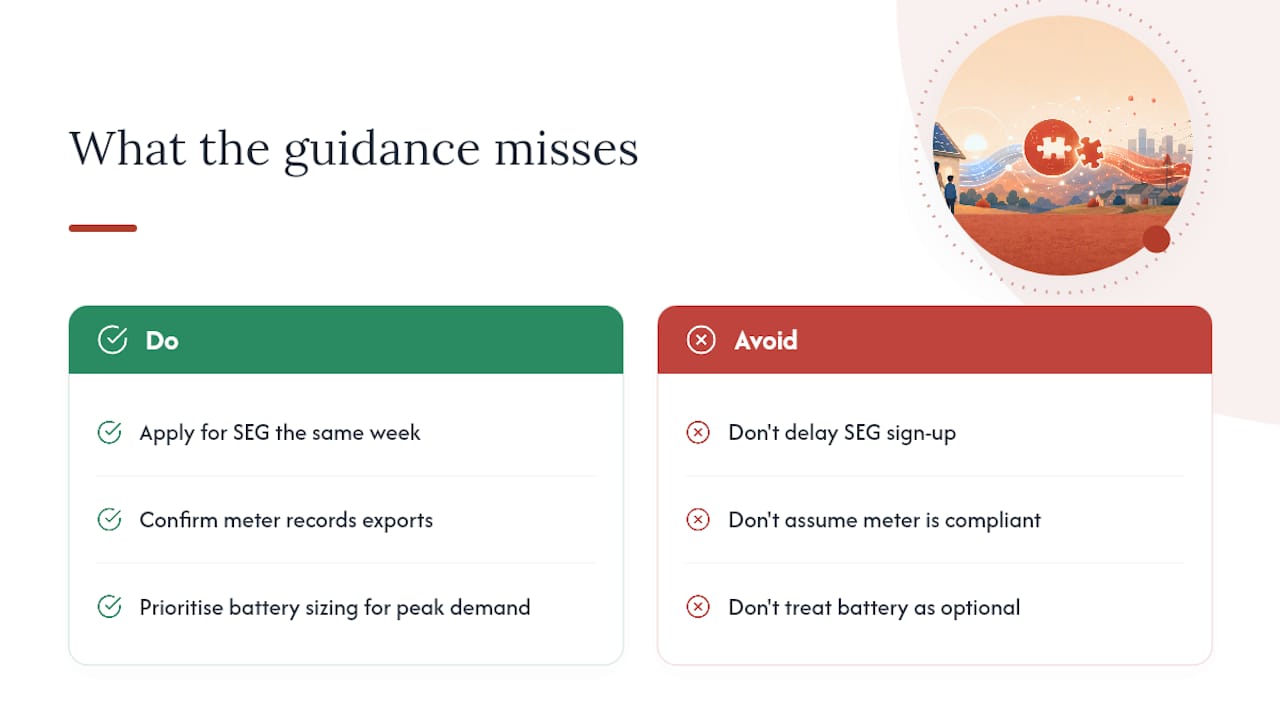
Government pages get the mechanics right but underplay two things that actually cost homeowners money: the gap between commissioning and applying, and meters that quietly fail to meet export-reading standards.
The conventional advice treats SEG sign-up as a formality you handle after the “real” work of installation is done. That’s backwards. The application should happen in the same week as commissioning, not after you’ve settled into the new system, because every week of delay is a week of unpaid exports that no supplier will reimburse retroactively.
The other blind spot is batteries. Most explainers mention storage in passing, as if it’s a nice-to-have. In practice, sizing a battery to cover your evening peak demand usually delivers more financial benefit than any export tariff you’ll find, because avoided import costs consistently outweigh export income. If you’re weighing up SEG against a combined solar battery system, start with the battery sizing conversation first. The export tariff matters, but it’s the smaller lever.
Frequently asked questions
Do I get paid for all the electricity my solar panels generate?
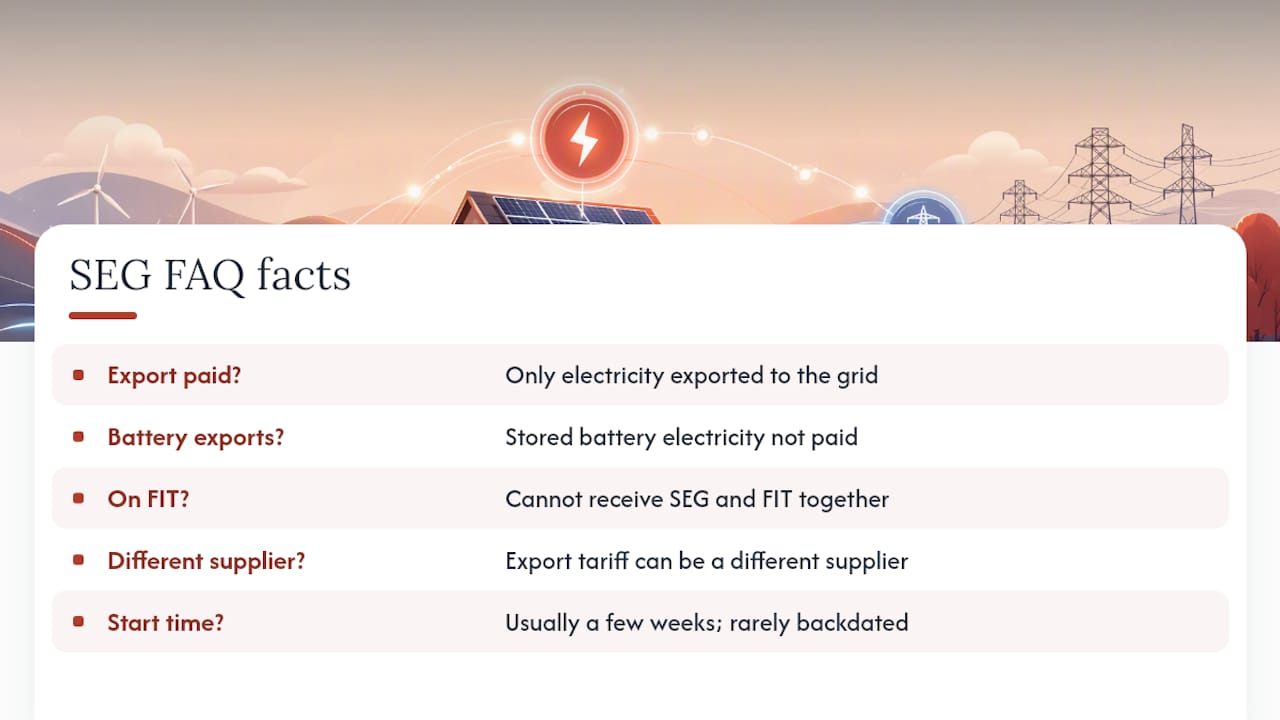
No. SEG only pays for electricity you export to the grid, not for what you generate and use yourself, and not for electricity stored in a battery for later use.
Can I get SEG payments if I’m still on the Feed-in Tariff?
No. You cannot claim SEG and FIT payments for the same installation, so check what you’d give up before switching schemes.
Does my SEG supplier have to be the same company that supplies my electricity?
No. You can choose a different supplier for your export tariff than the one supplying your household’s imported electricity, provided they offer a SEG-compliant tariff.
How long does it take to start receiving SEG payments?
It depends on the supplier’s processing and meter verification time, typically a few weeks, but payments rarely get backdated to your commissioning date, so applying early matters.
Is a battery a better investment than chasing a higher SEG tariff?
For most households, yes. Avoiding imported electricity through self-consumption or storage usually saves more than switching to a marginally better export rate.
Ready to get your system SEG-ready from day one? Smarthometechnical handles MCS-certified solar installations with correct meter specification built in from the start, so you’re not left chasing export readings after the fact.
Sources
Recommended
- How solar panel guarantee works: a homeowner’s guide – Smart Home Technical Ltd
- How smart meters work with solar panels in the UK – Smart Home Technical Ltd
- Solar net metering in Dorset: what homeowners need to know – Smart Home Technical Ltd
- How solar panel hail resistance works: 2026 guide – Smart Home Technical Ltd
