
Solar battery storage is defined as a system that captures surplus solar energy and releases it when grid electricity is most expensive, cutting household bills by hundreds of pounds each year. UK households can save up to £823 annually by combining rooftop solar panels with battery storage under smart tariffs, according to a May 2026 New Economics Foundation analysis. That figure varies by roof orientation: south-facing roofs achieve £823, east or west-facing roofs reach £728, and north-facing roofs still deliver £602. These examples of solar battery savings are not theoretical projections. They reflect real households using systems like the Tesla Powerwall alongside time-of-use tariffs from suppliers such as E.On to shift consumption away from peak pricing windows.
1. Examples of solar battery savings from UK households
The NEF’s 2026 analysis is the most detailed UK dataset available on this topic. It models a typical household under the current price cap and finds that solar plus battery storage can reduce nearly 44% of annual energy bills. That is not a marginal improvement. It represents a structural shift in how a home consumes electricity.
South-facing installations consistently outperform other orientations because they generate more solar output across the day, giving the battery more surplus energy to store. A household with a south-facing roof, a 4kWp solar array, and a 10kWh battery can realistically hit that £823 annual saving. East or west-facing roofs generate less midday output but still deliver strong morning or afternoon generation, landing savings around £728.
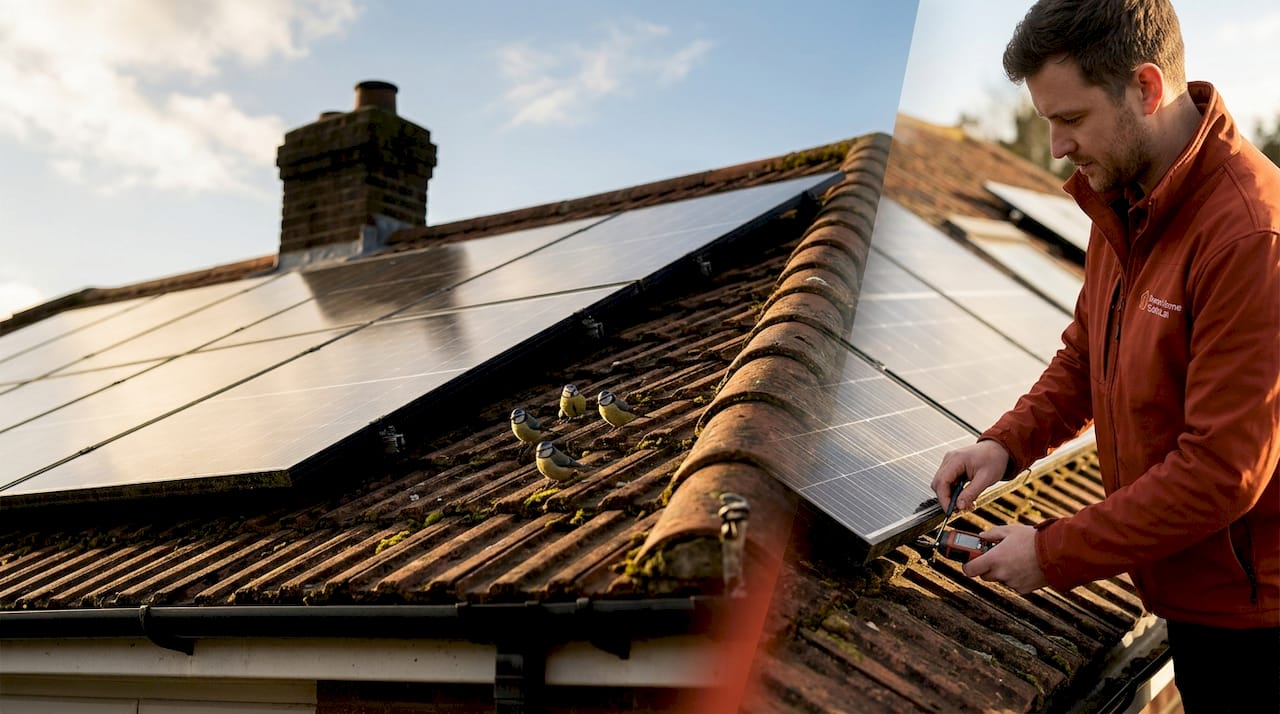
One homeowner in the US shared that their solar-plus-battery setup produced a $1,100 per year bill reduction, effectively reaching a near-zero electric bill. Their system combined solar output with a battery to optimise grid imports and export credits simultaneously. While US tariff structures differ from the UK, the underlying principle is identical: store what you generate, use it when rates are highest.
Pro Tip: When comparing your potential savings to published examples, check whether the figure includes export revenue, reduced grid imports, or both. Many headline numbers combine all three, and your actual split will depend on your tariff and usage pattern.
- South-facing roof with battery: up to £823 annual saving
- East or west-facing roof with battery: approximately £728 annual saving
- North-facing roof with battery: approximately £602 annual saving
- Solar-plus-battery with optimised tariff: near-zero electricity bills in some cases
2. How tariff structures shape your actual savings
Savings from solar batteries depend heavily on tariff structures and consumer energy usage patterns, particularly time-of-use arbitrage. This is the mechanism that turns a battery from a passive storage device into an active cost-saving tool. Without a compatible tariff, a battery simply stores solar surplus rather than exploiting price differences between cheap and expensive grid periods.
A Tesla Powerwall owner in the US demonstrated this clearly. Without any solar panels at all, they saved $8 per day purely by charging the battery during cheap off-peak hours and discharging it during expensive peak windows. Over a month, that compounds to roughly $240. The saving came entirely from rate arbitrage, not from generating any electricity.
In the UK, smart tariffs such as Octopus Energy’s Agile or Go tariff offer off-peak rates as low as 7p per kWh, while peak rates can exceed 35p per kWh. A 10kWh battery charged at 7p and discharged at 35p saves approximately £2.80 per full cycle. Run that cycle daily and the annual saving from tariff arbitrage alone reaches over £1,000 before solar generation is even factored in.
Effective time-of-use savings depend on the household’s load timing and tariff block sizes, not solely on battery capacity. A large battery paired with a household that uses most of its electricity at midday will not deliver the same returns as a well-matched system where evening demand aligns with peak pricing.
Pro Tip: Before committing to a battery, check whether your current or prospective tariff has a meaningful spread between off-peak and peak rates. A flat-rate tariff removes most of the financial case for battery storage.
3. Cost and payback period examples
One installer shared that a complete solar and battery system costing around $34,000 can pay itself off in approximately four to five years through energy savings. That is a strong return by any investment standard, though it assumes consistent savings and stable energy prices across the payback window.
In the UK, a typical 4kWp solar array with a 10kWh battery costs between £12,000 and £18,000 installed, depending on the brand, roof type, and installer. At £823 annual savings, the payback period sits between 14 and 22 years on savings alone. However, when you factor in export payments through the Smart Export Guarantee, avoided bill inflation, and potential battery cycling revenue through schemes like Virtual Power Plants, the payback shortens considerably.
Batteries can double the cost of a solar installation but may save thousands over a decade depending on incentives and export payments. This is the honest trade-off every homeowner must weigh. The battery adds upfront cost but unlocks savings that a solar-only system cannot access.
| System type | Approximate cost | Annual saving | Estimated payback |
|---|---|---|---|
| Solar only (4kWp) | £6,000 to £8,000 | £300 to £450 | 15 to 20 years |
| Solar plus 10kWh battery | £12,000 to £18,000 | £700 to £823 | 14 to 22 years |
| Battery only (smart tariff) | £4,000 to £6,000 | £500 to £1,000 | 4 to 10 years |
Pro Tip: Ask your installer to model payback using your actual consumption data, not industry averages. A household using 5,000kWh per year will see very different returns from one using 2,500kWh.
4. Solar-only vs solar-plus-battery: what the numbers show
Solar-only systems deliver genuine savings, particularly where export compensation is strong. Under the UK’s Smart Export Guarantee, homeowners receive between 4p and 15p per kWh exported, depending on the supplier. A well-sized solar array can export 40% to 50% of its generation, producing meaningful export revenue without any battery involved.
Adding a battery changes the economics by capturing that exported energy and using it at home instead. Since the retail price of electricity (what you pay to import) is always higher than the export rate, self-consumption is more valuable than export. A household that shifts from 40% self-consumption to 80% self-consumption by adding a battery effectively doubles the financial value of each unit generated.
In regions with strong export credits, solar-only may be nearly as cost-effective as solar-plus-battery, making batteries more valuable for energy resilience than pure bill savings. This is a nuance that many sales conversations skip. If your export rate is high and your peak usage is low, the battery’s financial case weakens.
Pros of adding battery storage:
- Increases self-consumption from roughly 40% to 80% or more
- Enables time-of-use tariff arbitrage for additional savings
- Provides backup power during grid outages
- Reduces dependence on grid price fluctuations
Cons of adding battery storage:
- Doubles the upfront cost of a solar installation
- Payback period extends unless smart tariffs are used
- Battery degradation reduces capacity over 10 to 15 years
- Savings are not guaranteed without correct configuration
5. Why system configuration determines real-world savings
Battery savings are only realised when the system is well configured to cycle during peak price windows. Misconfiguration or a mismatch between solar array size and battery capacity can leave the battery underused, cycling at the wrong times, or failing to capture peak-rate savings altogether. This is the most common reason homeowners report lower savings than expected.
A 10kWh battery paired with a 2kWp solar array in a high-consumption household will drain quickly and spend most of the day empty, unable to cover evening peak demand. The same battery paired with a 6kWp array in a moderate-consumption home will cycle fully every day and deliver maximum savings. The numbers in published examples assume optimal sizing. Your installer should model your specific load profile before recommending a system.
Charge and discharge schedules matter as much as hardware. Most modern inverters, including those used with the Tesla Powerwall and GivEnergy systems, allow time-based scheduling. Setting the battery to charge between midnight and 6am on a cheap tariff and discharge between 4pm and 9pm during peak pricing is the configuration that produces the headline savings figures you see in case studies.
6. Practical steps to maximise your solar battery savings
Getting the most from a solar battery system requires more than buying the right hardware. The examples that produce the strongest savings share a consistent set of practices.
- Match battery capacity to your evening demand. If your household uses 8kWh between 4pm and 11pm, a 10kWh battery covers that comfortably. A 5kWh battery will run out before the peak window closes.
- Choose a smart tariff before installation. Octopus Agile, Octopus Go, and E.On’s Next Drive tariff all offer significant off-peak discounts that a battery can exploit. Switching tariff after installation is possible but adds delay.
- Set charge and discharge schedules immediately. Many homeowners leave batteries on automatic mode, which does not always align with peak pricing windows. Manual scheduling or a smart energy management system produces better results.
- Monitor generation and consumption monthly. Apps from GivEnergy, SolarEdge, and Tesla all provide consumption data. Reviewing this data lets you adjust schedules as your usage patterns change across seasons.
- Use a reputable installer. Smarthometechnical specialises in solar panel installation and battery storage, and correct installation is the foundation of every saving figure cited in this article.
Pro Tip: Roof orientation affects generation by up to 27% between south-facing and north-facing installations. If you have a choice of roof pitch or orientation, prioritise south-facing for maximum output and savings.
Key takeaways
Solar battery savings are highest when system size, tariff structure, and charge scheduling are aligned to the household’s actual consumption pattern.
| Point | Details |
|---|---|
| UK savings range | NEF analysis shows £602 to £823 annual savings depending on roof orientation and tariff. |
| Tariff arbitrage is critical | A battery without a time-of-use tariff delivers far lower returns than published examples suggest. |
| Payback varies widely | Solar-plus-battery payback ranges from under five years to over 20, depending on system cost and savings achieved. |
| Configuration drives results | Mismatched system sizing or poor scheduling reduces real savings regardless of battery brand or capacity. |
| Solar-only is still viable | In high-export-rate environments, solar without a battery can deliver comparable bill savings at lower upfront cost. |
What I have learned from real solar battery installations
After years of installing solar and battery systems across UK homes, the pattern I see most often is this: homeowners who do their research on tariffs before installation consistently outperform those who focus only on hardware specifications. A Tesla Powerwall on a flat-rate tariff is a significantly less effective investment than a GivEnergy system on Octopus Agile. The battery is the same. The tariff makes the difference.
The £823 saving figure from the NEF is achievable, but it is not automatic. I have seen households with south-facing roofs and correctly sized systems hit that number within the first year. I have also seen households with identical hardware save less than £400 because their battery was cycling at the wrong times or their tariff had no meaningful peak-to-off-peak spread.
The other misconception I encounter regularly is that a battery pays for itself through solar generation alone. It does not. The battery’s financial value comes from rate arbitrage and increased self-consumption. Solar generation is the fuel. The battery is the mechanism that converts that fuel into maximum bill savings. Without both working together, neither performs at its best.
My honest advice: get a consumption analysis done before you buy. Any installer worth working with will model your specific usage profile against available tariffs and give you a realistic savings projection. If they quote you a headline figure without asking about your consumption, walk away.
— Simon
Get your solar battery savings calculated by Smarthometechnical

Smarthometechnical designs and installs solar panel and battery storage systems for UK homeowners and property managers who want real, quantified savings rather than estimates. Every installation starts with a consumption analysis so you know exactly what to expect before any work begins. The team handles everything from roof survey and system design through to commissioning and tariff guidance, ensuring your battery cycles at the right times from day one. To see completed projects and understand what a well-installed system looks like in practice, visit the Smarthometechnical solar installations page or get in touch for a tailored quotation.
FAQ
How much can a solar battery save per year in the UK?
UK households can save between £602 and £823 per year by combining solar panels with battery storage under a smart tariff, according to a 2026 NEF analysis. The exact figure depends on roof orientation, system size, and the tariff used.
Do solar batteries save money without solar panels?
Yes. A homeowner using a Tesla Powerwall without solar panels saved $8 per day purely through time-of-use tariff arbitrage, charging cheaply off-peak and discharging during expensive peak hours.
What is the payback period for a solar battery system?
Payback periods range from four to five years in optimised cases to 14 to 22 years for standard UK solar-plus-battery installations. The key variables are system cost, annual savings achieved, and whether smart tariffs are used.
Is solar-plus-battery better than solar only?
Solar-plus-battery increases self-consumption from roughly 40% to 80%, which is more financially valuable than exporting surplus at low export rates. However, in markets with strong export compensation, solar-only can be nearly as cost-effective for bill savings alone.
What reduces solar battery savings in practice?
Poor system sizing, incorrect charge scheduling, and flat-rate tariffs are the three most common causes of underperformance. Battery savings depend on the system cycling during high-value price windows, which requires both correct configuration and a compatible tariff.
