
Solar panels resist hail primarily through thermally tempered front glass, which is 4–5 times stronger than ordinary float glass, combined with reinforced aluminium frames and a layered construction designed to absorb and redirect impact energy. The international benchmark is IEC 61215, which requires panels to survive impacts from 25mm ice balls travelling at 23 m/s. Premium modules push well beyond that, engineered to handle much larger and faster hailstones than the baseline test.
Here is what that engineering actually involves:
- Thermal tempering: Glass is heated to around 620°C then rapidly cooled, creating a compressed outer layer that resists shattering on impact.
- Glass thickness: Most residential panels use relatively thick front glass; dual-glass architecture adds a second tempered sheet at the rear, removing the weaker polymer backsheet entirely.
- Frame design: A 6005-T6 aluminium alloy frame distributes load across the module rather than concentrating stress at the point of impact.
- Certification floor: IEC 61215 sets the minimum; Swiss VKF HW4 and enhanced Class SH tests cover hail up to 75mm for panels sold into higher-risk markets.
Table of Contents
- How hail actually damages solar panels
- What do certification standards actually test?
- How to inspect your panels after a hailstorm
- Practical ways to protect your panels from hail
- Should you invest in premium hail-resistant panels?
- Smarthometechnical installs panels built to last through British weather
- Key takeaways
How hail actually damages solar panels
The most common assumption after a hailstorm is that if the glass is intact, the panel is fine. That is often wrong. Microcracks in photovoltaic cells beneath undamaged glass are the leading cause of long-term power loss, and they are invisible to the naked eye.
Hail damage falls into two broad categories. Visible damage includes cracked or chipped glass, delamination at the panel edges, and dented frames. Hidden damage is subtler: microcracks propagate through silicon cells under repeated thermal cycling, gradually reducing output over months or years.
The kinetic energy of a hailstone scales with both size and velocity. A 45mm hailstone, roughly golf-ball sized, carries approximately ten times the impact energy of the 25mm baseline used in standard testing. Panel type also matters here:
- Monocrystalline panels use a single silicon crystal structure, which is efficient but can propagate cracks more readily once a microcrack initiates.
- Polycrystalline panels have a grain-boundary structure that sometimes limits crack propagation, though they are generally less efficient.
- Thin-film panels (cadmium telluride or amorphous silicon) are more flexible and tend to absorb impact differently, but their glass substrates are still vulnerable to direct strikes.
After a storm, look for yellowing or browning at cell edges, hairline fractures visible at an angle in low light, and any change in the panel’s surface texture.
What do certification standards actually test?
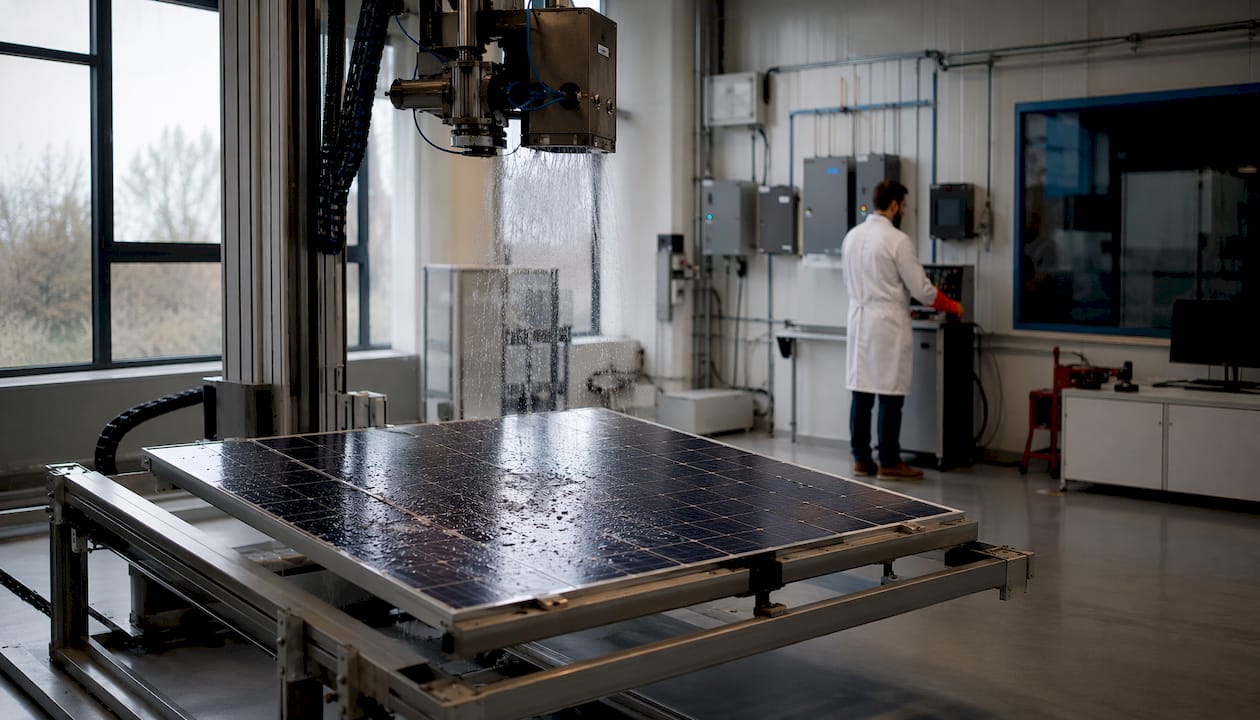
IEC 61215 is the global baseline. It specifies 25mm hailstones at 23 m/s, striking eleven defined locations on the module face. Pass that, and the panel earns its standard certification. Fail, and it cannot be sold as compliant.
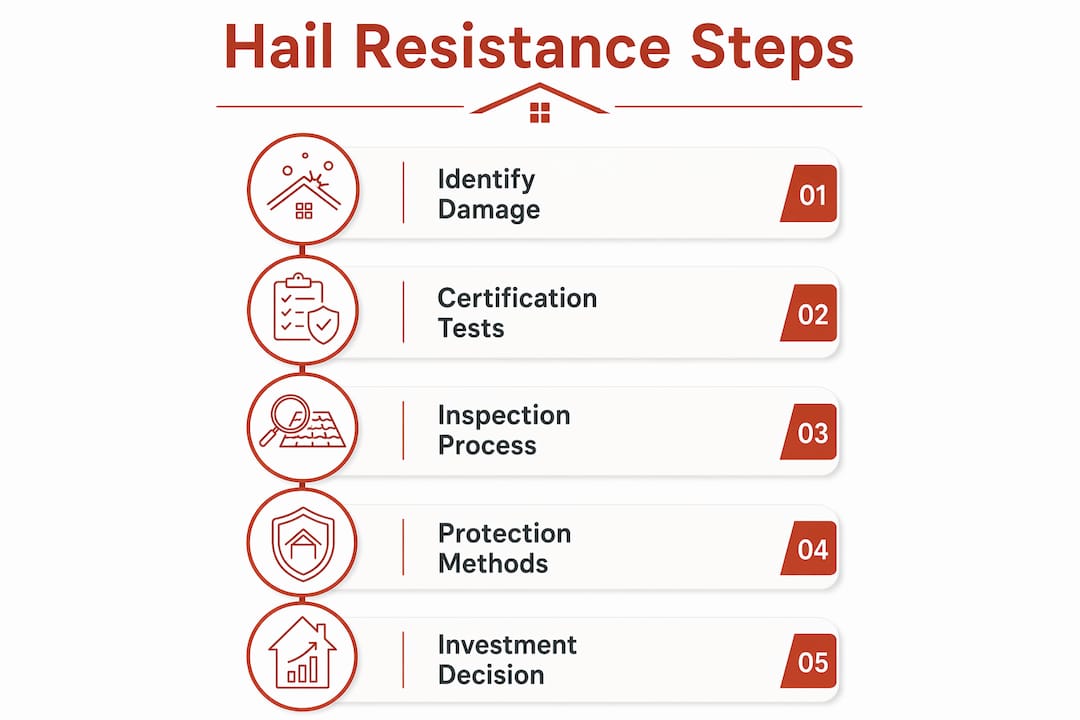
Beyond that floor, two tiers matter for homeowners in hail-prone areas:
| Standard | Hail size | Velocity | Notes |
|---|---|---|---|
| IEC 61215 (baseline) | 25mm | 23 m/s | Mandatory for market entry |
| IEC 61215 Class MH | — | — | Mid-level enhanced rating |
| IEC 61215 Class SH | 45mm+ | — | High-resilience designation |
| Swiss VKF HW4 | Up to 75mm | Varies | Strictest national standard |
Third-party verification from bodies such as TÜV Rheinland or RETC adds credibility to manufacturer claims. A certificate number on the datasheet means an independent lab ran the test, not just the factory. When comparing panels, ask specifically for the hail class, not just “IEC 61215 compliant,” since that phrase covers only the 25mm baseline.
Understanding how hail resistance standards interact with your panel warranty is equally worth checking before you buy.
How to inspect your panels after a hailstorm
Start from the ground with binoculars before going anywhere near the roof. Obvious glass fractures, surface chips, and frame deformation are visible at a distance. If the glass looks intact, that does not end the inspection.
- Check your inverter display immediately after the storm. Fault codes or a drop in output relative to a clear-sky day are the first electronic signal that something is wrong.
- Walk the roof perimeter if safe to do so, looking at panel edges and junction boxes for cracking or moisture ingress.
- Photograph any visible damage before touching anything, both for insurance purposes and for your installer’s assessment.
- Request electroluminescence imaging if you suspect hidden cell damage. This technique passes a small current through the panel and photographs the light emitted, revealing microcracks as dark patches that standard visual checks miss entirely.
- Compare your system’s output data from before and after the storm using your monitoring app or inverter portal.
Pro Tip: Set a monthly performance baseline in your inverter monitoring app before storm season. A sudden drop of more than 5% on a clear day is a reliable trigger for a professional inspection, even when the glass looks perfect.
If you find damage, contact a qualified installer rather than attempting repairs yourself. Cracked glass on a live panel carries real electrical risk.
Practical ways to protect your panels from hail
No panel is hail-proof, but several measures meaningfully reduce the risk of damage.
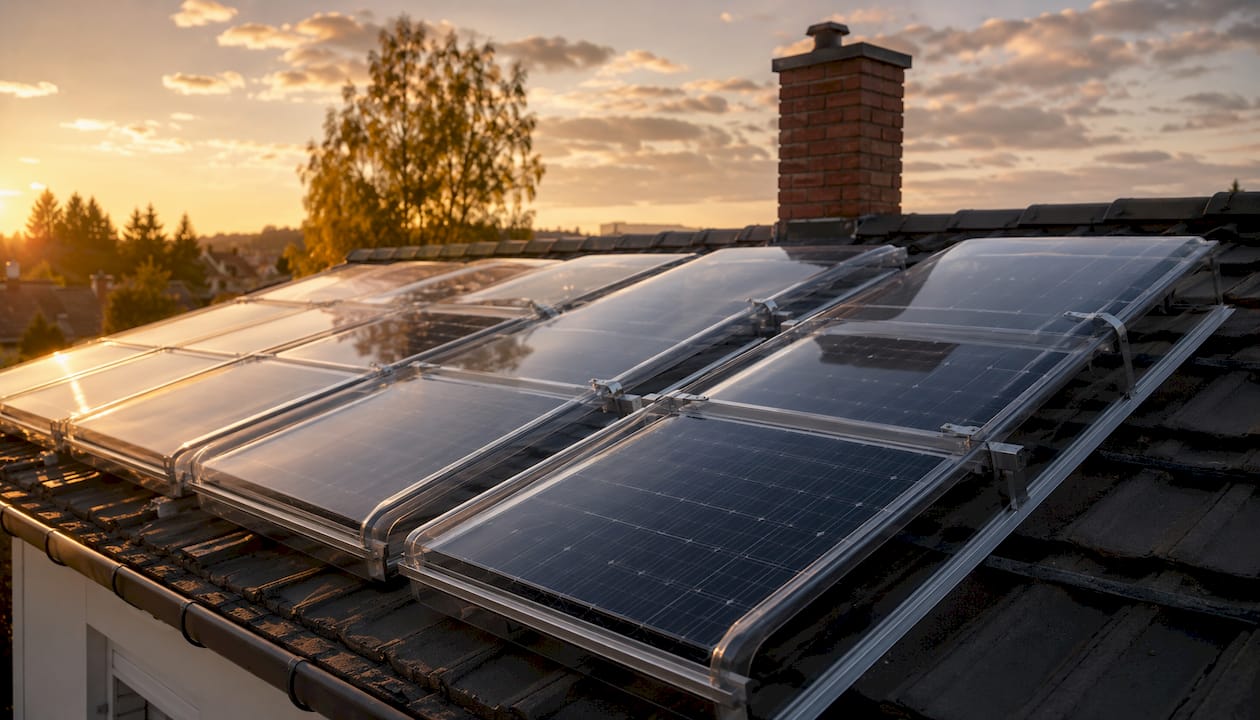
Temporary protective covers come in two main types: hard-shell polycarbonate shields that clip over individual panels, and soft fabric covers that wrap the array. Hard-shell covers offer better impact protection; fabric covers are quicker to deploy but provide less resistance to large hailstones. Both are practical for homeowners who receive advance storm warnings.
Panel tilt angle is one of the most underappreciated factors in hail resilience. A steeper pitch deflects hailstones rather than absorbing their full force perpendicular to the surface. Installers working in hail-prone areas often factor this into the mounting design from the outset, since retrofitting the angle later is costly.
Additional measures worth discussing with your installer:
- Specify modules with dual-glass construction rather than a polymer backsheet, particularly for exposed roof positions.
- Confirm that frame fixings and mounting rails are rated for the wind and impact loads typical of your location.
- Keep gutters and drainage clear so that hail accumulation does not add weight stress to the array.
- Review your home insurance policy to confirm solar panels are covered under buildings or contents, and check the excess against likely repair costs.
For panels that do sustain damage beyond repair, understanding your options for compliant panel disposal is a practical next step before replacement.
Should you invest in premium hail-resistant panels?
The answer depends almost entirely on where you live and how often severe hail reaches your area. Industry guidance points to nine or more severe hail days per year as the threshold where investing in enhanced hail-resistant modules becomes economically justified, given the mitigation of insured losses those panels deliver.
Severe hail, defined as hailstones exceeding 44mm in diameter, has caused significant damage to PV modules in affected areas, and the frequency of such events is forecast to increase. For most of the UK, large hail is relatively rare compared to the US Midwest or parts of Australia, but localised severe storms do occur, particularly across the Midlands and northern England.
Premium modules engineered beyond the IEC 61215 baseline include technologies such as LONGi’s Ice-Shield construction, which uses a reinforced rear structure and thicker front glass to handle hailstones up to 55mm diameter at speeds around 34 m/s. The upfront cost premium over a standard module is real, but so is the difference in resilience when a serious storm arrives.
Pro Tip: Before purchasing, ask your installer to pull historical hail data for your postcode using NOAA or a UK Met Office severe weather archive. A site-specific risk profile takes ten minutes and gives you a concrete basis for deciding whether the premium is worth paying.
Proactive design beats retrofitting every time. Choosing the right module before installation, rather than adding protection after the fact, is consistently the more cost-effective path. Your solar system planning stage is the right moment to raise hail resilience with your installer.
Smarthometechnical installs panels built to last through British weather
If you want solar panels specified for durability from day one, Smarthometechnical is the practical alternative to a generic installation. As electrical contractors specialising in renewable energy, the team selects modules and mounting systems matched to your roof’s exposure, local weather patterns, and long-term performance targets, not just the lowest upfront price.
Every solar installation Smarthometechnical carries out includes a full site assessment covering orientation, tilt, and local risk factors, so hail resilience is built into the design rather than bolted on as an afterthought. The team also handles battery storage and EV charger integration, making it straightforward to build a complete home energy system in one project.
Get in touch with Smarthometechnical today for a no-obligation quote and a site assessment tailored to your home.
Key takeaways
Solar panels resist hail damage through thermally tempered glass that is 4–5 times stronger than standard float glass, reinforced aluminium frames, and certification testing that ranges from 25mm baseline hailstones up to 75mm under the strictest national standards.
| Point | Details |
|---|---|
| Tempered glass is the core defence | Thermal tempering makes front glass 4–5 times stronger than float glass, resisting shattering on impact. |
| Microcracks are the hidden risk | Hail can damage cells beneath intact glass, causing gradual power loss that only electroluminescence imaging reveals. |
| Certification tiers vary widely | IEC 61215 baseline covers 25mm hail; Class SH covers 45mm hail, and Swiss VKF HW4 extends testing up to 75mm. |
| Tilt angle reduces impact force | Panels mounted at a steeper pitch deflect hailstones rather than absorbing their full perpendicular force. |
| Smarthometechnical designs for durability | Every installation includes a site assessment covering local risk factors, module selection, and mounting angle from the outset. |
Recommended
- How solar panel guarantee works: a homeowner’s guide – Smart Home Technical Ltd
- Solar panel efficiency explained for homeowners in 2026 – Smart Home Technical Ltd
- How solar planning works: a homeowner’s guide 2026 – Smart Home Technical Ltd
- Why solar panels lose efficiency: a UK homeowner’s guide – Smart Home Technical Ltd
