
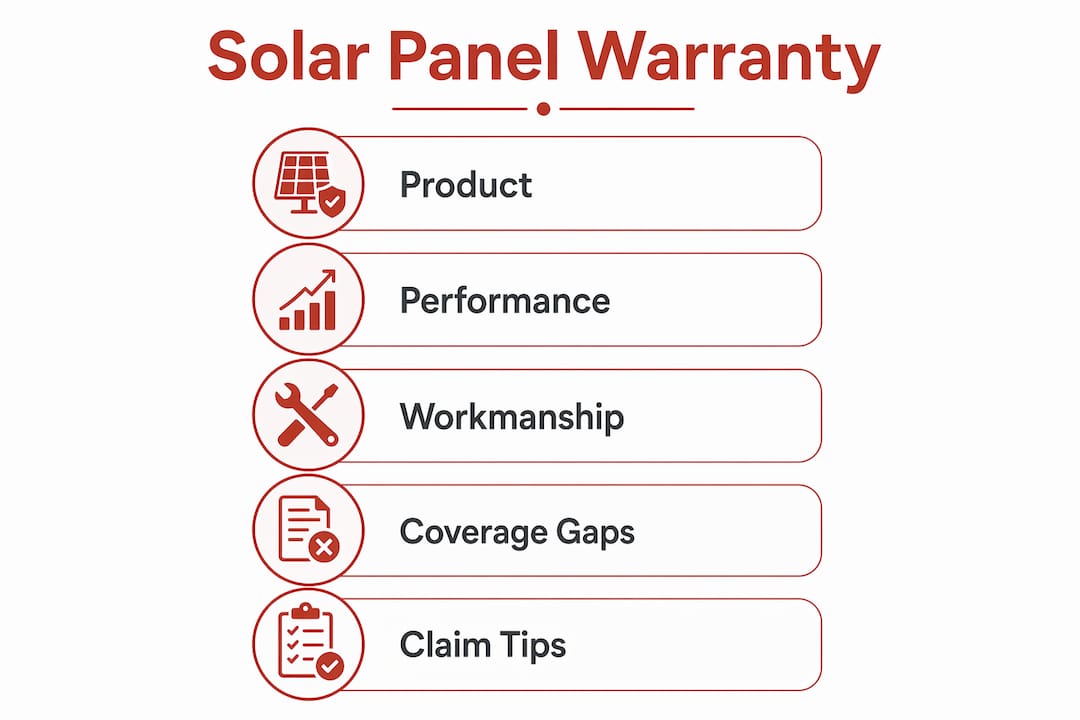
A solar panel guarantee is a composite of three distinct warranties: a product warranty covering manufacturing defects, a performance warranty assuring minimum power output over time, and a workmanship warranty protecting installation quality. Understanding how solar panel guarantee works is not optional for homeowners or property developers. It determines what you can claim, from whom, and for how long.
Standard solar panel warranties in 2026 include all three types, each with separate terms. Product warranties typically run 12–30 years. Performance warranties cover around 25 years. Workmanship warranties span 5–15 years. Each warranty comes from a different source and covers a different kind of failure. Knowing the difference before you sign a contract protects your investment from day one.
How does a solar panel guarantee work?
A solar panel guarantee works by splitting protection across three separate warranty categories, each addressing a different risk. The product warranty is issued by the panel manufacturer. The performance warranty is also manufacturer-issued. The workmanship warranty comes from your installer. None of these overlap, and none of them replace each other.

Product warranty
The product warranty covers physical manufacturing defects. These include cracked glass, defective solar cells, delamination, and junction box failures. If a panel fails because of how it was made, this warranty applies. Terms typically run 12–30 years depending on the manufacturer and panel technology.
Performance warranty
The performance warranty guarantees that your panels will still produce a minimum percentage of their rated power after a set number of years. Most manufacturers guarantee 80–87% output at year 25. This warranty does not promise a specific number of kilowatt hours. It sets a floor on degradation. If your panels fall below that floor due to cell degradation, you have a valid claim.
Workmanship warranty
The workmanship warranty covers faults caused by the installation itself. Poor mounting, incorrect wiring, and electrical faults that arise from how the system was fitted all fall under this category. Your installer issues this warranty, not the manufacturer. Terms typically run 5–15 years. This distinction matters because if your installer ceases trading, the warranty may disappear with them.
What do the different solar warranty types actually cover?
Each warranty type has specific coverage, specific exclusions, and a specific claims process. Understanding these differences prevents costly surprises.
Product warranty covers:
- Manufacturing defects such as cracked glass or delaminated cells
- Defective junction boxes or connectors
- Frame corrosion caused by material failure
- Premature cell failure unrelated to external damage
Performance warranty covers:
- Power output falling below the guaranteed threshold due to cell degradation
- Degradation rates exceeding the manufacturer’s stated annual decline
Workmanship warranty covers:
- Faulty mounting or racking that causes panel movement
- Incorrect electrical connections made during installation
- Water ingress caused by poor sealing at installation points
What none of these warranties cover is physical damage from storms, falling debris, or accidental impact. That falls under your home insurance policy. Homeowners insurance covers physical damage to solar panels but typically excludes mechanical breakdown and performance degradation. The two protection systems, warranties and insurance, serve different purposes and must both be in place.
Pro Tip: Request a written copy of all three warranty documents before installation begins. Verbal assurances from a salesperson carry no legal weight.
How do warranty terms vary by panel technology?
Panel technology directly affects the quality of the warranty you receive. N-type solar panels offer better warranty terms with superior power output retention compared to P-type panels. That difference is significant over a 25-year system life.
N-type panels typically guarantee 87.4–92% output at year 25–30. P-type panels generally guarantee 80–83% over the same period. The gap reflects a lower annual degradation rate in N-type cells. A panel that degrades more slowly stays above its performance warranty threshold for longer, which means fewer valid claims and more consistent energy generation.
Manufacturer policies also differ on whether labour costs are included in warranty claims. Most product warranties exclude labour costs for panel replacement, which can reach up to £450 per panel. Some manufacturers bundle labour coverage into their warranty programmes, particularly for certified installer networks. Choosing a panel brand that includes labour in its warranty terms reduces your out-of-pocket exposure significantly.
The table below summarises the key differences between warranty tiers by panel type.
| Warranty feature | N-type panels | P-type panels |
|---|---|---|
| Performance at year 25 | 87.4–92% | 80–83% |
| Typical product warranty | 25–30 years | 12–25 years |
| Labour often included | Yes, via certified programmes | Rarely |
| Annual degradation rate | Lower | Higher |
Choosing panels with well-rounded warranty terms and using a certified installer programme gives you the strongest combined protection. Certified programmes often unlock extended manufacturer support that standard retail purchases do not include.
Common pitfalls in solar panel guarantees
The most common mistake homeowners make is assuming their warranty covers more than it does. Several gaps appear repeatedly, and each one can cost you money.
Workmanship warranty depends on installer survival. Workmanship warranties depend heavily on the financial health of the installer company. If your installer goes out of business, your workmanship warranty may become worthless. This is not a rare scenario. Many smaller installation firms do not survive the full warranty period.
Performance claims require hard data. Performance warranty claims require detailed monitoring data proving that underperformance is caused by panel degradation, not shading, soiling, or inverter faults. Manufacturers reject claims where external factors could explain the output drop. Without a continuous monitoring system, you may not be able to prove your case.
Labour costs are usually excluded. Most product warranties cover the cost of the replacement panel but not the labour to remove and refit it. At up to £450 per panel, that exclusion adds up quickly on a multi-panel system.
Insurance gaps are common. Standard home insurance policies treat solar panels as part of the dwelling structure. Failure to update your coverage limits after installation means any payout after a loss is calculated on your pre-solar home value. You could be significantly underinsured.
Performance warranties are thresholds, not guarantees. A 25-year performance warranty sets a power output floor rather than guaranteeing specific energy production. Panels can remain within warranty specification yet still deliver less electricity than you expected, due to local weather, shading, or system configuration.
Pro Tip: Ask your installer whether their workmanship warranty is backed by a performance bond or insurance policy. If the company folds, a bond means you still have recourse.
How to manage and claim your solar panel warranties
Managing your warranties well starts on installation day, not when something goes wrong.
-
Collect all documentation at handover. Obtain the manufacturer’s product warranty certificate, the performance warranty terms, and the installer’s workmanship warranty in writing. Store digital copies in a secure location.
-
Install a monitoring system immediately. Performance warranty claims require clean, continuous output data. A monitoring system records daily generation figures and flags underperformance automatically. Without this data, a manufacturer can reject your claim on the grounds that you cannot prove panel degradation caused the shortfall.
-
Check whether labour is included in your product warranty. If it is not, negotiate with your installer before signing the contract. Some installers will include labour coverage for an additional fee or as part of a service agreement.
-
Negotiate workmanship warranty length. The standard 5-year workmanship warranty is short relative to a 25-year system life. Push for 10 years minimum, or ask whether the installer holds a performance bond that protects you if the business closes.
-
Update your home insurance immediately after installation. Contact your insurer and declare the added value of the solar system. Request confirmation that mechanical breakdown and performance degradation are covered, or ask about endorsements that add this protection.
-
Keep a maintenance log. Regular cleaning and annual inspections keep panels performing well and demonstrate to a manufacturer that you have maintained the system correctly. Neglect can void warranty terms.
Pro Tip: Set a calendar reminder every year to check your monitoring data against your performance warranty threshold. Catching a degradation issue early gives you time to build a strong claim before the warranty expires.
Continuous monitoring is the single most practical step you can take to protect your warranty rights over the full system life.
Key takeaways
A solar panel guarantee works through three separate warranties covering defects, performance, and installation quality, each requiring different evidence and claims processes to enforce.
| Point | Details |
|---|---|
| Three distinct warranties | Product, performance, and workmanship warranties each cover different risks and come from different parties. |
| Performance warranty is a floor | The guarantee sets a minimum output threshold, not a specific energy yield, so panels can be in spec yet underperform. |
| Workmanship risk is real | If your installer closes, the workmanship warranty may be void. Ask about performance bonds before signing. |
| Labour costs are usually excluded | Panel replacement labour can reach £450 per panel. Confirm whether your warranty includes it. |
| Insurance must be updated | Failing to update your home insurance after installation risks a payout based on pre-solar property value. |
Why performance warranties are misunderstood more than any other
The most persistent misconception I encounter is that a 25-year performance warranty means your panels will generate a predictable amount of electricity for 25 years. It does not. It means your panels will not degrade faster than a stated rate. Those are very different things.
A panel sitting at 81% output at year 25 is technically within warranty on most P-type products. Yet that same panel might be generating far less electricity than you budgeted for, because your original estimate assumed better local irradiance or fewer shading events than actually occurred. The warranty is not wrong. Your expectation was.
Workmanship warranties are the other area where I see homeowners get caught out. They are often the shortest warranty in the package, yet they cover the failures most likely to occur in years 2–8, when installation faults typically surface. Choosing a certified installer who offers a 10-year workmanship warranty backed by a bond is worth paying a premium for. The manufacturer warranty means nothing if the system was poorly installed.
The insurance piece is where I see the most avoidable financial exposure. Homeowners add £8,000–£15,000 of equipment to their roof and do not tell their insurer. When a storm causes damage, they discover their payout reflects the pre-solar home value. Update your policy the week the system is commissioned, not six months later.
— Simon
Solar installation with warranty clarity from Smarthometechnical
Choosing the right installer is as important as choosing the right panels. Smarthometechnical specialises in solar panel installation across southern England, working with panel technologies that carry strong product and performance warranty terms. Every installation includes a written workmanship warranty, and the team advises homeowners on insurance updates and monitoring setup from day one.

Whether you are a homeowner fitting panels for the first time or a property developer specifying systems across multiple sites, Smarthometechnical provides the documentation, certified installation, and post-installation support that makes your warranties enforceable. Contact Smarthometechnical to discuss your installation and get warranty terms that actually protect you.
FAQ
What is the difference between a product and performance warranty?
A product warranty covers manufacturing defects such as cracked cells or faulty junction boxes. A performance warranty guarantees that panels will still produce a minimum percentage of their rated power, typically 80–87%, at year 25.
Can a solar panel warranty be voided?
Yes. Physical damage from storms or accidents, neglected maintenance, and modifications made by uncertified installers can all void warranty terms. Always use a certified installer and keep a maintenance log.
Does home insurance cover solar panel failures?
Standard home insurance covers physical damage to panels but typically excludes mechanical breakdown and performance degradation. You need to update your coverage limits and check for relevant endorsements after installation.
How long does a solar panel workmanship warranty last?
Workmanship warranties typically run 5–15 years and are issued by the installer, not the manufacturer. If the installer ceases trading, the warranty may no longer be enforceable without a performance bond.
Do N-type panels have better warranties than P-type?
N-type panels generally carry stronger warranty terms, guaranteeing 87.4–92% output at year 25–30 compared to 80–83% for P-type panels, reflecting their lower annual degradation rate.
Recommended
- Why solar panel brands differ: a homeowner’s guide – Smart Home Technical Ltd
- Solar panel installation explained for southern England – Smart Home Technical Ltd
- Extending solar panel lifespan in Devon: 2026 guide – Smart Home Technical Ltd
- The role of solar in 2026 homes: a complete guide – Smart Home Technical Ltd
