
A second-generation smart meter is the single most important piece of kit between your solar panels and any export payment you will ever receive. It records, in near real time, exactly how much electricity your home draws from the grid and how much surplus your panels push back onto it. Without that accurate export record, your energy supplier has no basis to pay you under the Smart Export Guarantee, and estimated readings simply will not cut it for modern tariffs.
Here is what a smart meter actually does in a solar home:
- Records electricity imported from the grid on one register and electricity exported to the grid on a separate register.
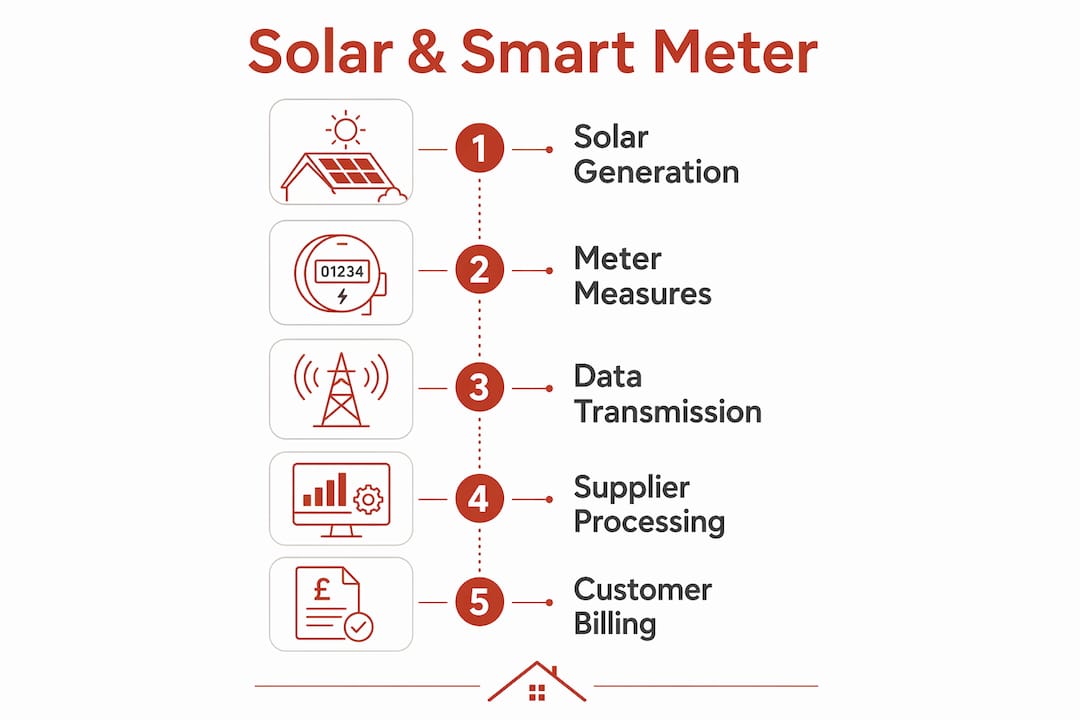
- Transmits half-hourly readings automatically to your supplier, removing the need for manual meter reads.
- Enables time-of-use tariffs by capturing usage at precise intervals throughout the day.
- Provides a digital in-home display showing current consumption and export figures.
- Qualifies your home for Smart Export Guarantee payments by verifying actual export volumes.
The financial case is straightforward. Accurate export data means accurate payments. Inaccurate or missing data means you leave money on the table, or worse, receive nothing at all.
First-generation vs second-generation smart meters: what actually differs
The distinction between the two generations is not just technical trivia. It has a direct bearing on whether your solar setup can access modern tariffs and export payments.
First-generation smart meters (SMETS1) were rolled out from around 2011. They measure consumption reasonably well, but many cannot accurately record exported electricity, and they often lose their “smart” functionality if you switch energy supplier. That last point caused real frustration for thousands of homeowners.
Second-generation meters (SMETS2) addressed both problems. They operate on a national communications network, so they retain full functionality regardless of which supplier you are with. Critically for solar owners, SMETS2 meters support accurate export measurement and the granular half-hourly data that modern tariffs and SEG payments require. Most new solar installations now use SMETS2 as standard.
A quick comparison of the two:
- Export measurement: SMETS1 often unreliable or absent; SMETS2 accurate and half-hourly.
- Supplier switching: SMETS1 can revert to “dumb” mode; SMETS2 retains smart functions.
- Tariff compatibility: SMETS1 limited; SMETS2 supports time-of-use and export tariffs.
- SEG eligibility: SMETS1 generally insufficient; SMETS2 meets supplier requirements.
- Data granularity: SMETS1 typically daily; SMETS2 half-hourly or more frequent.
If you have a SMETS1 meter and are planning to add solar, ask your supplier about an upgrade before commissioning your panels. Getting this sorted early avoids delays to your first export payment.
How does a smart meter track solar generation and export?
The meter sits downstream of your solar inverter, at the point where your home’s wiring meets the grid connection. It uses shunt resistors and voltage sensors to detect the direction and volume of current flowing in both directions. When your panels generate more than your home consumes, current flows outward; the meter logs that on its export register. When your home needs more than the panels produce, current flows inward and the import register ticks up.
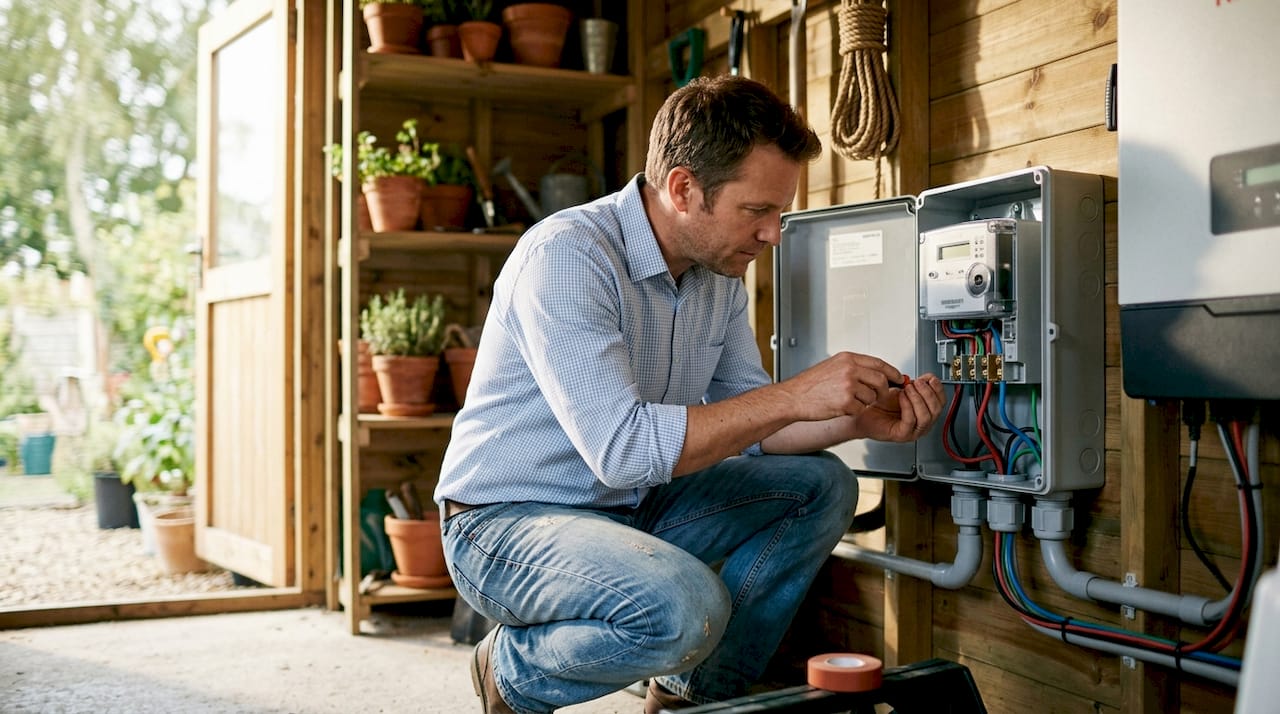
That raw electrical signal gets converted into a digital reading, then transmitted wirelessly to your supplier, typically via a secure radio frequency network. No meter reader, no estimate, no dispute about what actually happened on a sunny Tuesday in June.
Pro Tip: Coordinate your smart meter installation with your solar commissioning date. Your solar system may need to remain switched off until the meter is correctly configured to record exports. Confirm with your installer that the meter is live and logging before you turn the panels on, otherwise those early export units go unrecorded.
The in-home display that comes with most smart meters shows current usage and export in near real time. Practically speaking, you can watch the figure drop when a cloud passes and rise again when the sun returns. Historical data, usually accessible through your supplier’s app or online account, lets you compare generation across days, weeks, and months.
Reading the display is straightforward:
- A positive import figure means you are drawing from the grid.
- A zero or negative figure (depending on the display model) means you are exporting.
- The cumulative export total, shown in kWh, is what your supplier uses to calculate SEG payments.
Time-of-use tariffs and how solar changes the maths
Time-of-use tariffs charge different rates depending on when you use electricity. Peak periods, typically early morning and evening, carry the highest unit rates. Off-peak periods, often overnight, are significantly cheaper. A smart meter makes these tariffs possible because it captures usage at half-hourly intervals throughout the day.

For a solar homeowner, the interaction is genuinely interesting. Your panels generate most strongly between roughly 10am and 3pm, which overlaps with shoulder or off-peak periods on many tariffs. That means you are naturally reducing your grid consumption during cheaper hours anyway. The real gain comes from shifting high-demand appliances, like dishwashers and washing machines, into those same midday windows so you run them on free solar electricity rather than grid power at any rate.
Where it gets more nuanced is in the evening. Once generation drops off, you shift back to grid import during peak hours. Homeowners on time-of-use tariffs who also have battery storage can charge the battery during the solar peak and discharge it during the evening peak, effectively sidestepping the highest rates altogether. The smart meter records all of this accurately, so your bill reflects actual behaviour rather than a flat daily average.
The financial incentive is real: running more consumption during periods of strong solar generation, and less during peak grid-import hours, can meaningfully reduce annual electricity costs.
Earning payments through the Smart Export Guarantee
The Smart Export Guarantee is the UK government scheme that requires licensed electricity suppliers with more than 150,000 customers to offer export tariffs to eligible small-scale generators. For most solar homeowners, it is the primary route to being paid for surplus electricity.
SEG payments are calculated per kilowatt-hour of electricity exported to the grid. The rate varies by supplier and tariff, but the principle is consistent: your smart meter records every half-hour export reading, the supplier totals those readings across your billing period, and you receive a credit or payment accordingly. No smart meter capable of half-hourly export readings means no SEG payment. It is that direct.
Here is a simplified illustration of how export volumes translate into payments:
| Monthly export (kWh) | Example rate (p/kWh) | Monthly payment |
|---|---|---|
| — | — | £7.— |
| 150 | — | £22.— |
| — | — | — |
| — | — | — |
Rates are illustrative. Actual SEG rates vary by supplier and tariff.
To link your smart meter to an SEG tariff, the typical steps are:
- Confirm your meter is a SMETS2 (or a SMETS1 that your supplier accepts for export measurement).
- Apply to an SEG-licensed supplier, providing your meter serial number and installation details.
- Your supplier verifies export capability and activates the tariff on your account.
- Half-hourly export data flows automatically from your meter to the supplier.
- Payments appear on your bill or as a bank transfer, depending on the supplier’s process.
Some suppliers require a copy of your Microgeneration Certification Scheme (MCS) certificate as proof that your solar installation meets the required standard. Have that document ready before you apply.
What are the real benefits of smart meters with solar panels?
The benefits stack up quickly once you see the full picture of how smart meters and solar panels work together.
- Accurate billing: No more estimated readings. You pay for exactly what you import and receive payment for exactly what you export.
- Export income: Half-hourly export data is the gateway to SEG payments. Without it, surplus electricity simply disappears into the grid unrewarded.
- Consumption visibility: The in-home display and supplier app give you a clear view of when you use most energy, making it easier to shift habits and reduce costs.
- Tariff access: SMETS2 meters unlock time-of-use tariffs that flat-rate meters cannot support, opening up cheaper overnight rates and peak-avoidance strategies.
- Grid contribution: Smart meters support two-way communication with the grid, which helps network operators manage supply and demand more efficiently as more homes add solar.
- Future compatibility: As the grid evolves toward greater flexibility and demand response, homes with SMETS2 meters are already equipped to participate.
For a broader look at how solar fits into 2026 homes, the metering infrastructure is increasingly central to the whole proposition.
Common misconceptions about smart meters and solar panels
The most persistent myth is that a smart meter somehow limits how much electricity your solar panels can generate. It does not. Smart meters are passive measurement devices; they sit downstream of the inverter and record what flows past them. They have no control over the solar system’s output whatsoever.
A related misunderstanding is that smart meters cause higher electricity bills after solar installation. What actually happens is that the meter provides accurate data for the first time, replacing estimated readings that may have been too low. The bill looks higher because it is now correct, not because the meter is adding cost. Homeowners who see accurate usage data for the first time often realise their pre-solar estimates were simply wrong.
A third misconception is that you can receive SEG payments without a smart meter. A small number of legacy arrangements used deemed export estimates, but modern export tariffs universally require verified half-hourly readings. If your meter cannot provide those, no licensed supplier is obliged to pay you.
Pro Tip: Before your solar installation date, ask your installer to confirm in writing that your smart meter is configured to record exports, not just imports. A meter that is set up for import-only measurement will not log your export data, and you will have no record to claim against.
How battery storage changes what your smart meter records
Adding a battery to a solar setup changes the energy flows that the smart meter sees, though it does not change the meter’s fundamental job. Without a battery, surplus solar generation exports to the grid the moment it is produced. With a battery, that surplus charges the battery first, and export only happens once the battery is full.
The smart meter still records every unit that crosses the grid boundary in either direction. What changes is the volume. A well-sized battery can absorb most of the midday surplus, meaning less export but also far less evening import. Your combined solar battery system effectively uses the smart meter’s data to show you exactly how much grid interaction remains after storage does its work.
Some battery systems can also be set to export stored energy at specific times, for example during peak-rate periods when export rates are higher on certain tariffs. The smart meter captures this accurately, and the SEG payment reflects it. For homeowners with both solar and storage, the meter becomes the single source of truth for understanding system performance.
Potential issues with smart meters in solar installations
Smart meters are generally reliable, but a few specific problems crop up in solar homes worth knowing about; for practical examples of energy-saving home technology in Bremen, see Beispiele für energiesparende Haustechnik in Bremen.
Signal and connectivity issues affect some rural properties. Smart meters rely on wireless communication to transmit data to suppliers. In areas with poor mobile or radio coverage, readings may not transmit reliably, which can delay billing and SEG payments. If you live in a rural area, check coverage before installation; some suppliers offer alternative communication options.
SMETS1 compatibility gaps remain a practical issue. If you have an older first-generation meter and your supplier cannot upgrade it remotely, you may need a physical meter swap before your solar system can be properly registered for export payments. This can add weeks to the commissioning timeline.
Incorrect configuration is probably the most common problem. A meter installed or reconfigured without the export register being activated will record imports correctly but log zero exports. Everything looks fine on the display, but your SEG account shows nothing. Always verify with your supplier that both registers are active after installation.
Inverter compatibility is occasionally flagged in older or non-standard solar setups. Most modern inverters work without issue, but if your system uses a less common inverter type, confirm with your installer that the meter and inverter communicate correctly.
How to register your smart meter for Smart Export Guarantee payments
Registration is simpler than many homeowners expect, but the sequence matters. Getting the steps out of order is the most common cause of delayed payments.
First, your solar installation must hold a valid MCS certificate. This is the industry standard that confirms your panels were installed by an accredited contractor and meet the required technical specification. Without it, no SEG-licensed supplier will accept your application.
Second, confirm that your smart meter is a SMETS2 (or a supplier-accepted SMETS1) and that the export register is active. Your supplier can verify this remotely in most cases.
Third, contact an SEG-licensed supplier, which does not have to be your current electricity supplier, and submit an application. You will typically need your meter serial number, your MCS certificate number, and the installed capacity of your solar system in kilowatts.
Once approved, the supplier activates the export tariff on your account. Half-hourly export readings flow automatically from that point, and payments begin accumulating from the activation date. There is no backdating for the period before activation, so applying promptly after commissioning protects your income.
For a full walkthrough of the solar installation process including metering requirements, Smarthometechnical covers the end-to-end setup for UK homeowners.
If you are planning a solar installation or want to make sure your existing system is correctly metered for export payments, Smarthometechnical can help. As specialist electrical contractors covering solar panel installation, battery storage, and EV charger installation across southern England, the team handles everything from initial survey to smart meter coordination and MCS certification.
Get in touch with Smarthometechnical to discuss your solar and metering requirements.
Key takeaways
A second-generation smart meter is the foundation of any solar home that wants accurate billing, export payments, and access to modern time-of-use tariffs in the UK.
| Point | Details |
|---|---|
| SMETS2 meters are essential | Only second-generation meters reliably support half-hourly export measurement and SEG eligibility. |
| Separate registers track flows | Smart meters use distinct import and export registers to record grid consumption and solar surplus accurately. |
| SEG payments require verified data | Half-hourly export readings from a smart meter are required by suppliers before any SEG payment is made. |
| Meters do not limit generation | Smart meters are passive devices; they record energy flows but have no control over solar output. |
| Register before switching on | Confirm export register activation with your supplier before turning your solar system on to avoid losing early export data. |
Recommended
- Why solar panels lose efficiency: a UK homeowner’s guide – Smart Home Technical Ltd
- How solar planning works: a homeowner’s guide 2026 – Smart Home Technical Ltd
- The role of solar optimisers: a homeowner’s guide – Smart Home Technical Ltd
- Examples of solar water heating for UK homeowners – Smart Home Technical Ltd
