
Solar panel recycling is the process of recovering valuable materials from end-of-life photovoltaic systems under UK WEEE regulations, which classify solar panels as Category 14 waste and make landfill disposal illegal. This solar panel recycling Devon guide covers everything Devon homeowners and businesses need to know: legal obligations, local recycling routes, material recovery rates, and who pays for what. The UK WEEE framework mandates that up to 95% of materials can be recovered from a standard panel, including glass, aluminium, silicon, and copper. Getting this right protects you from fines, protects the environment, and supports a circular economy for renewable energy.
How can Devon homeowners and businesses recycle solar panels legally?
Recycling photovoltaic panels in Devon follows a clear process, but you need to use the right channels at every step. Cutting corners by using an unlicensed collector is a legal offence under UK environmental law, not just bad practice.
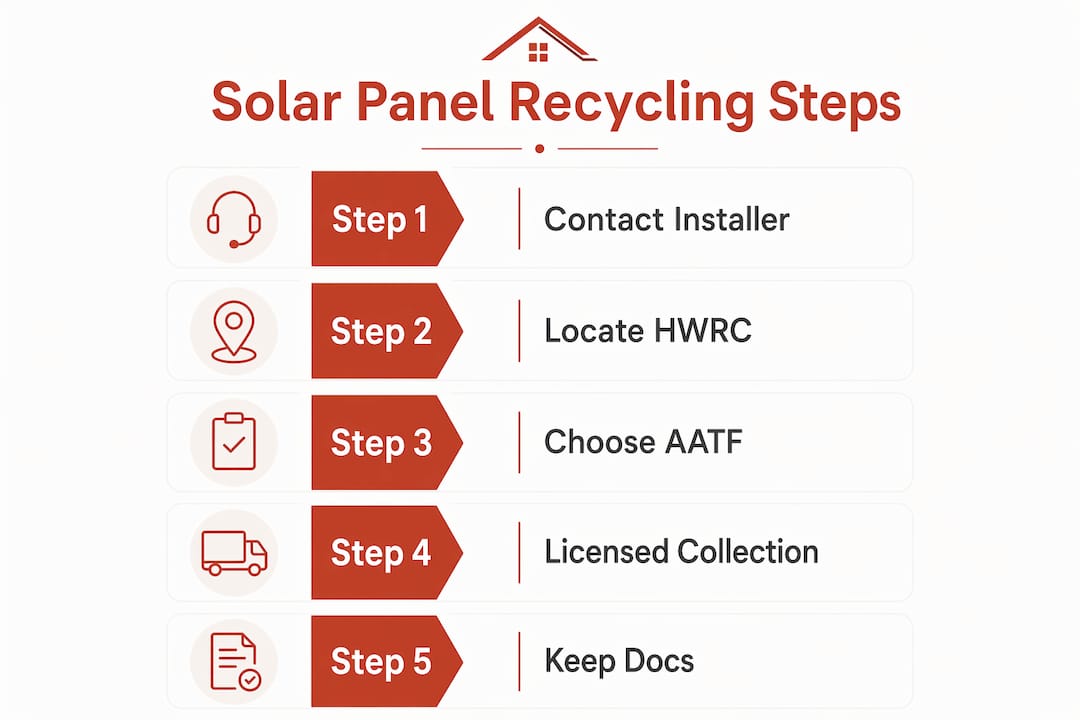
Step 1: Contact your original installer or manufacturer
Your first call should be to whoever installed your panels. Many manufacturers and installers operate take-back schemes funded by producer responsibility obligations. These schemes often arrange collection at no charge to you for the panels themselves.
Step 2: Locate a Devon Household Waste Recycling Centre accepting WEEE
Devon County Council operates a network of Household Waste Recycling Centres (HWRCs). Not every site accepts large WEEE items such as solar panels, so ring ahead to confirm capacity and any size restrictions before loading a van.
Step 3: Choose an Approved Authorised Treatment Facility
Only an Approved Authorised Treatment Facility (AATF) can legally process solar panels for recycling in the UK. These facilities recover materials at high purity rather than shredding panels into low-grade waste. Ask your collector or drop-off point to confirm AATF status before handing over your panels.
Step 4: Arrange licensed collection if needed
If you cannot transport panels yourself, hire a licensed waste carrier. You can verify carrier registration on the Environment Agency’s public register. The carrier must issue you a Waste Transfer Note at the point of collection.
Step 5: Keep your documentation
Retain your Waste Transfer Note. Businesses must keep this for a minimum of two years. Homeowners are not legally required to retain documentation, but keeping a copy is good practice if questions arise later.
Pro Tip: If your panels are still generating power, check whether a local community energy scheme or second-hand solar market will take them. Reuse is always preferable to recycling, and functional panels can have years of life left.
Key practical points for Devon solar panel disposal:
- Packaging: wrap panels in bubble wrap or cardboard to prevent breakage during transport, as broken glass creates a hazardous waste category.
- Drop-off versus collection: drop-off at an HWRC is usually free; collection from your property by a licensed carrier may carry a small logistics fee.
- Roof removal is a separate cost from recycling. See the cost section below for detail.
What materials are recovered during solar panel recycling?
A standard crystalline silicon solar panel is roughly 75% glass by weight. That single fact explains why glass recovery is the priority in any recycling process.
Material breakdown and recovery rates
| Material | Approximate share by weight | Recovery rate |
|---|---|---|
| Glass | ~75% | ~95% |
| Aluminium frame | ~10% | ~100% |
| Silicon cells | ~5% | 85–95% |
| Copper wiring | ~1% | 90%+ |
| Silver and other metals | <1% | Variable |
These recovery rates are achievable only at advanced processing facilities. Basic shredding operations recover far less and produce lower-grade outputs that cannot re-enter solar panel manufacturing.
How the recycling process works
Advanced facilities use a three-stage approach. First, mechanical disassembly removes the aluminium frame and junction box. Second, thermal processing burns off the encapsulant polymer that holds the glass and silicon cells together. Third, chemical treatment separates silicon from the remaining cell materials, recovering it at sufficient purity for reuse.
Advanced recycling processes enable recovered silicon and glass to re-enter solar panel manufacturing, creating a genuine circular economy rather than downcycling into lower-value products. This distinction matters because Devon businesses and homeowners who choose an AATF are directly supporting that circular loop.
Pro Tip: Ask your chosen recycler whether they use thermal processing or basic shredding. The answer tells you immediately whether recovered materials will re-enter high-value manufacturing or end up in road fill.
Recovering these materials also avoids the environmental cost of mining virgin silicon and bauxite. Aluminium smelting from raw ore uses roughly 14 times more energy than recycling aluminium. Choosing proper solar panel disposal in Devon is not just a legal obligation. It is a measurable environmental decision.
What are the costs of solar panel recycling in Devon?
The recycling process itself is typically free for residential customers. The costs that catch homeowners off guard are the ones that come before the panel reaches a recycling facility.
Recycling costs for residential customers are generally covered by producer take-back schemes. Commercial fees range from £5 to £25 per panel depending on volume and logistics. That cost structure reflects the Extended Producer Responsibility model, where manufacturers fund end-of-life processing through compliance schemes.
The costs that fall on you as the owner are:
- Roof removal and labour: Removing panels from a pitched roof requires scaffolding, safety equipment, and electrical disconnection. Roof removal costs typically run from £200 to £500 or more depending on array size and roof access. Electrical disconnection by a qualified electrician adds a further £100 to £200.
- Transport to a recycling point: If you arrange your own transport, factor in vehicle hire or fuel costs for larger arrays.
- Licensed carrier fees: If a licensed carrier collects from your property, expect a logistics charge on top of any per-panel recycling fee.
- Commercial array scale: A business with a 50-panel rooftop array faces a very different cost profile from a domestic 12-panel installation. At £25 per panel for commercial processing, a 50-panel array costs £1,250 in recycling fees alone, before removal.
Producers fund recycling costs but owners bear the physical removal and logistics costs. This is the distinction most Devon homeowners miss when they assume recycling is entirely free. Budget for removal separately from recycling, and get quotes from at least two qualified contractors before committing.
What are the legal requirements for solar panel recycling in Devon?
UK law is unambiguous. Solar panels are WEEE and must be handled accordingly. This applies to every installation, regardless of size.
All solar panels, including large commercial arrays, fall under household WEEE classifications. That means the same compliance rules apply whether you have 6 panels on a bungalow or 200 panels on a farm building.
For Devon businesses, the legal checklist is:
- Use only a licensed waste carrier registered with the Environment Agency.
- Obtain a Waste Transfer Note from the carrier at the point of collection.
- Obtain a WEEE Evidence Note from the AATF that processes your panels.
- Keep both documents for a minimum of two years.
- Never hand panels to a scrap dealer or unlicensed collector.
Using an unlicensed collector to dispose of solar panels violates your Duty of Care under UK environmental law. The Environment Agency can issue fines and enforcement notices. The liability sits with the business that generated the waste, not the collector. Ignorance of the carrier’s licence status is not a legal defence.
Using unlicensed collectors is the most common compliance failure in solar panel disposal. Scrap dealers may offer to take panels for free or even pay a small sum, which makes them attractive. The risk of an enforcement notice and the reputational damage to a Devon business far outweighs any short-term saving.
Homeowners have a lighter compliance burden but are still subject to Duty of Care. Handing panels to a collector who cannot produce a licence and issue a Waste Transfer Note puts you in breach of that duty.
Key takeaways
Responsible solar panel disposal in Devon requires licensed carriers, AATF processing, and clear separation of recycling costs from removal costs.
| Point | Details |
|---|---|
| Recycling is legally mandatory | Landfill disposal of solar panels is illegal under UK WEEE regulations. |
| Use an AATF for processing | Only Approved Authorised Treatment Facilities recover materials at high purity for circular reuse. |
| Removal costs fall on the owner | Roof removal and electrical disconnection are not covered by producer take-back schemes. |
| Businesses need two documents | Waste Transfer Notes and WEEE Evidence Notes must both be retained for two years. |
| Material recovery is high | Glass, aluminium, and silicon are recovered at 85–100%, making proper recycling genuinely worthwhile. |
What I have learned from years of solar installations in Devon
The question I get asked most often is not “how do I recycle my panels?” It is “why does it cost so much to get them off the roof?” That confusion comes from a gap in how the industry communicates the Extended Producer Responsibility model. Producers fund the recycling. Nobody funds the scaffolding.
My honest observation is that homeowners who planned their installation well, and chose an installer who discussed end-of-life management upfront, face far fewer surprises at disposal time. If you are planning a solar installation now, ask your installer directly: “What is your take-back process when these panels reach end of life?” A good installer has an answer.
The other thing I see regularly is panels that still work being sent for recycling because the owner assumed they were finished. A panel producing 70–80% of its original output is not waste. It is an asset. Community energy projects, agricultural buildings, and off-grid applications all have appetite for second-hand panels. Check that route before you book a recycler.
Looking further ahead, UK solar panel waste is projected to reach 2 million tonnes by 2050. Devon’s recycling infrastructure will need to scale considerably to handle that volume. The homeowners and businesses who build good disposal habits now, using licensed carriers and AATFs, are the ones who will find the process straightforward as that infrastructure develops. Those who rely on informal routes will face increasing enforcement as the regulatory environment tightens.
The lifespan of a solar panel in Devon is typically 25 to 30 years. That means panels installed during the early UK solar boom are approaching end of life right now. This is not a future problem. It is a present one.
— Simon
How Smarthometechnical supports Devon solar customers
Smarthometechnical provides professional solar panel installations across Devon, with end-of-life management built into the conversation from day one. Whether you are installing a new system or managing panels that are approaching the end of their working life, the team can advise on compliant disposal routes, licensed carriers, and take-back options specific to your location.

Smarthometechnical works with Devon homeowners and businesses to make sure solar investment is managed responsibly at every stage, from first installation through to final recycling. Contact the team for a quote or to discuss your current system’s end-of-life options. Getting the right advice early avoids the compliance headaches and unexpected costs that catch too many owners off guard.
FAQ
Are solar panels classed as WEEE in the UK?
Yes. Solar panels are classified as WEEE Category 14 under UK regulations, making landfill disposal illegal and requiring processing at a licensed facility.
Is solar panel recycling free for Devon homeowners?
The recycling process itself is typically free via producer take-back schemes. Homeowners usually pay separately for roof removal and electrical disconnection, which can cost £300 to £700 or more.
What documents do Devon businesses need for solar panel disposal?
Businesses must obtain a Waste Transfer Note from their licensed carrier and a WEEE Evidence Note from the Approved Authorised Treatment Facility. Both must be kept for at least two years.
Can I use a scrap dealer to dispose of solar panels in Devon?
No. Using an unlicensed collector breaches your Duty of Care under UK environmental law and can result in fines from the Environment Agency. Only licensed waste carriers and AATFs are legally compliant.
How do I find a licensed solar panel recycler in Devon?
Check the Environment Agency’s public register of licensed waste carriers, then confirm that your chosen facility holds AATF status. Your original installer may also offer or recommend a take-back scheme.
Recommended
- Why solar panels are recyclable: 2026 guide – Smart Home Technical Ltd
- Extending solar panel lifespan in Devon: 2026 guide – Smart Home Technical Ltd
- Solar panel leasing vs buying Devon: 2026 guide – Smart Home Technical Ltd
- Solar panel installation explained for southern England – Smart Home Technical Ltd
