
A full house rewire in 2026 typically costs between £2,500 and £16,000 depending on property size, with most three-bedroom homes landing between £4,500 and £8,000. Before you get quotes, book an Electrical Installation Condition Report (EICR). It’s the cheapest way to find out whether you need a full rewire, a partial fix, or nothing urgent at all.
Here’s the shape of the market by property size:
- 1-bed flat: £2,000 to £4,000
- 2-bed terrace: £3,500 to £6,000
- 3-bed semi: £4,500 to £8,000
- 4-bed detached: £6,500 to £11,000
- 5-bed house: £9,000 to £16,000
A typical 3-bed rewire in 2026 averages around £5,500, taking roughly 5 to 7 days on site. Add 15 to 30% if you’re in London or the South East, where labour rates run higher than the rest of the country.
Key Takeaways
Rewiring a UK house in 2026 costs most homeowners between £2,500 and £16,000, with an EICR the correct first step before any quote is compared.
| Point | Details |
|---|---|
| Typical 3-bed cost | Budget £4,500 to £8,000, with the market average sitting near £5,500. |
| Get an EICR first | An EICR costs £150 to £280 and often turns a “full rewire” scare into a targeted fix. |
| Expect 5 to 7 days | Standard 3-bed rewires run 5 to 7 days across first fix and second fix phases. |
| Budget beyond the wiring | Add £500 to £1,200 for a consumer unit and several hundred pounds for making good. |
| Work with Smarthometechnical | Smarthometechnical surveys, runs the EICR, and quotes rewires with EV and solar-ready consumer units built in from the start. |
Table of Contents
- How much does a house rewire cost by property size in the UK?
- What affects the cost of rewiring a house?
- Why does an EICR matter before you get a rewire quote?
- How long does a house rewire take and how disruptive is it?
- Should you get a partial rewire or a full rewire?
- What extra costs should you budget for beyond the rewire itself?
- How can you cut the cost of your rewire without cutting corners?
- How do you choose a qualified electrician for a rewire?
- How does Smarthometechnical approach a rewire project?
- Is EICR-first the smartest way to plan a rewire?
- Ready to get your rewire surveyed and quoted properly?
- Sources
How much does a house rewire cost by property size in the UK?
Price scales with floor area, but it’s not a straight line. A 1-bed flat can cost proportionally more per room than a 4-bed house, because fixed costs (consumer unit, testing, the electrician’s first day setting up) don’t shrink much with a smaller footprint.
Here’s what you’re likely to pay, and what’s usually bundled into the price:
- 1-bed flat: £2,000 to £4,000, roughly 2 to 3 days on site. Includes a new consumer unit, rewired sockets and lighting, and standard testing.
- 2-bed terrace: £3,500 to £6,000, around 4 days. Slightly more cable runs, especially if there’s a loft or cellar to route through.
- 3-bed semi: £4,500 to £8,000, typically 5 to 7 days. This is the benchmark most quotes get compared against.
- 4-bed detached: £6,500 to £11,000, around 7 to 9 days. More circuits, often a bigger consumer unit, sometimes outbuildings.
- 5-bed house: £9,000 to £16,000, 8 to 12 days or more depending on layout and whether there are multiple floors or an extension involved.
Whether you’re living in the house during the work changes the maths too. Occupied properties run 15 to 25% more expensive than empty ones, because electricians have to work around furniture, keep rooms usable overnight, and can’t just rip up every floor at once.
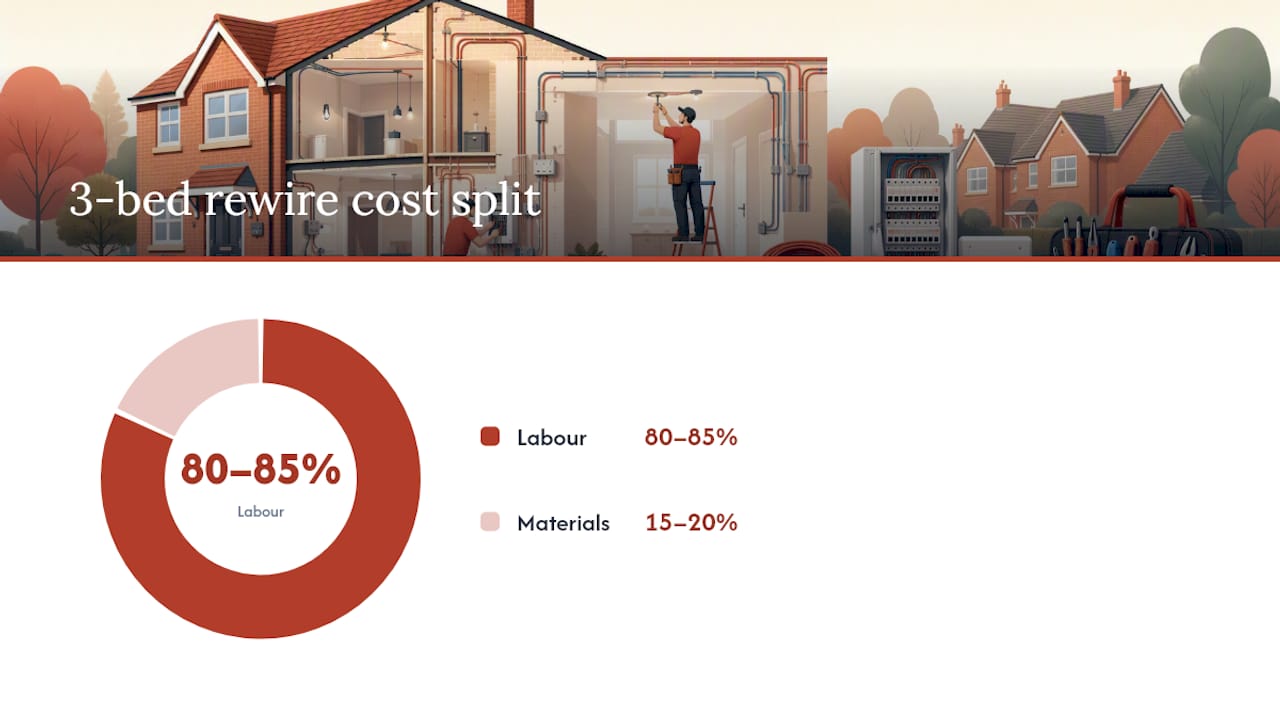
Take a typical 3-bed semi as a worked example. A quote of £6,000 might break down as roughly £4,800 to £5,100 in labour and £900 to £1,200 in materials, cable, back boxes, a new consumer unit, sockets and switches. That split reflects a wider pattern across the trade: labour usually accounts for 80 to 85% of the total bill, with materials making up the rest. It’s why two electricians quoting for identical cable and identical sockets can still land £1,000 apart. The difference is time on the job, not the parts list.
What affects the cost of rewiring a house?
Quotes for what looks like the same job can vary by thousands of pounds, and it’s rarely because someone’s trying to overcharge you. Four things drive most of the difference.
- Access. Solid walls need chasing out, which is slow and messy. Suspended timber floors are quick to lift and relay; concrete floors sometimes mean surface-mounted trunking instead, which changes both the price and the finish.
- Hidden hazards. Older properties sometimes still have rubber-insulated or VIR cabling behind the plaster, which looks fine until you touch it. Asbestos in older lath and plaster walls, or long-buried junction boxes wired to no discoverable standard, can add days to a job once discovered.
- Specification. A basic dual-RCD consumer unit costs less than a full RCBO board, but RCBO units isolate faults circuit by circuit rather than tripping the whole house. If you’re planning an EV charger or a heat pump, that difference matters more than it sounds.
- Regional labour rates. An identical job costs more in Guildford than in Grimsby. London and the South East premium isn’t padding, it’s the going day rate for a qualified electrician in that postcode.
Pro Tip: Ask any electrician quoting your job whether they’ve found VIR cabling or old junction boxes in similar-aged houses on your street. Local knowledge often flags problems before they’ve even opened a wall.
Why does an EICR matter before you get a rewire quote?

Get an EICR before you get a single rewire quote. It typically costs between £150 and £280 for a standard home, and it tells you precisely what’s wrong rather than leaving you to guess from a cold-caller’s warning about “dangerous old wiring.”
The report grades faults by severity:
- C1 means danger present, needing immediate attention.
- C2 means potentially dangerous, needing action soon but not necessarily a full rewire.
- C3 means improvement recommended, but not urgent.
Plenty of “you need a full rewire” panic calls resolve, after an EICR, into a handful of C2 fixes costing a few hundred pounds. That said, if the report or the inspection turns up visible rubber-insulated or VIR cable, that’s usually a genuine sign the whole system needs replacing rather than patching. Once work is complete, you should receive an Electrical Installation Certificate and, for notifiable work, Part P sign-off from your local authority via a registered electrician. Keep both. They matter when you sell the house.
How long does a house rewire take and how disruptive is it?
Timelines depend on size, but the pattern is consistent everywhere. Small flats take 3 to 5 days. A standard 3-bed house takes 5 to 7 days. Larger detached homes can run 8 to 12 days or more.
- First fix comes first: chasing walls, lifting floorboards, running new cable to every room. This is the noisy, dusty phase, and it’s when most of the mess happens.
- Second fix follows: fitting sockets, switches, light fittings and the consumer unit. Quieter, quicker, and far less disruptive to daily life.
- Staying in the house during works is manageable if you plan around it. Ask your electrician which rooms go offline each day, seal off dust with plastic sheeting, and line up your plasterer to start as soon as second fix finishes rather than leaving exposed chases for weeks.
Should you get a partial rewire or a full rewire?
A partial rewire replaces specific circuits, a kitchen, a bathroom, or just the consumer unit, rather than every cable in the house. It’s cheaper upfront, typically £1,500 to £5,000, and it can be the right call in some situations.
- Sensible when: your EICR flags isolated C2 faults, you’re renovating one room and want to future-proof just that space, or the rest of the house has modern, tested wiring in good condition.
- A false economy when: most of the property’s cabling is over 30 years old, you’ve found VIR or rubber insulation anywhere, or you’re likely to need further electrical work within five years anyway.
Paying for a partial job now, then a full rewire in three years once more faults surface, almost always costs more than doing it properly once. If your EICR shows scattered problems across multiple circuits rather than one contained area, that’s usually the signal to go full rather than partial.
What extra costs should you budget for beyond the rewire itself?
The cable and labour quote is rarely the whole bill. Four extras catch people out most often.
- Consumer unit upgrades: a standard dual-RCD board costs roughly £500 to £800, while a full RCBO board runs £800 to £1,200. RCBO is worth the premium if you’re planning an EV charger or solar battery storage, since it isolates faults per circuit instead of tripping everything.
- Surge protection: increasingly bundled into new consumer units, and worth specifying if the house has sensitive electronics or a heat pump.
- Making good: plastering and redecorating after first fix typically adds several hundred pounds per room, depending on how much wall was chased out.
- Room-specific extras: kitchens often need extra circuits for appliances, bathrooms need properly zoned wiring for safety, and if an EV charger or solar-ready consumer unit is on your radar, it’s far cheaper to provision for it during the rewire than to retrofit later.
How can you cut the cost of your rewire without cutting corners?
There’s real room to save money on a rewire, but most of the savings come from timing and preparation, not from skimping on materials.
- Get the EICR first. It stops you overpaying for a full rewire when a partial fix would do, and it stops you underpaying for a partial fix when the whole system is actually shot.
- Combine the rewire with renovation work. If you’re already stripping a kitchen or extending, doing the electrics at the same time saves on making good twice.
- Time it around an empty house where you can. Empty properties cost 15 to 25% less to rewire than occupied ones, since electricians can work faster without living constraints.
- Keep accessory choices simple. Standard white sockets and switches cost less than specialist finishes, and you can always upgrade the faceplates later without touching the wiring behind them.
- Avoid scope creep once work starts. Deciding to add three extra sockets on day three costs more than specifying them in the original quote.
Pro Tip: Ask for an itemised quote broken down by labour, materials, consumer unit, and making good. It makes comparing electricians honest, and it flags exactly where your money’s going if you need to trim the budget.
How do you choose a qualified electrician for a rewire?
Rewiring is notifiable work under Part P of the Building Regulations, so the person doing it needs to be properly registered, not just competent with a set of pliers.
- Check they’re registered with NICEIC or NAPIT, the two main UK certification bodies for domestic electrical work.
- Confirm they carry public liability insurance and can name it, not just claim it.
- Ask whether the job will be notified to your local authority under Part P, and who’s responsible for that paperwork.
Before signing anything, get these answers in writing:
- What’s the exact scope of works, room by room?
- What’s the realistic timescale, including first fix and second fix?
- Who handles making good, and is that priced separately?
- What certification will you receive on completion, and when?
Red flags worth walking away from: a quote with no consumer unit spec listed, an electrician who can’t show you a recent EICR they’ve completed, or anyone pushing you to sign before you’ve had a second quote.
How does Smarthometechnical approach a rewire project?
Smarthometechnical runs every rewire through the same sequence: a physical survey, an EICR where one hasn’t already been done, an itemised written quote, then certified completion with the paperwork you need for insurance or resale.
- Survey and EICR first, so the scope reflects the actual state of your wiring rather than an assumption.
- Consumer unit options explained upfront, including whether an RCBO board makes sense given your plans for EV charging or solar-ready wiring.
- Case examples available, including whole-home energy system integrations and past junction box repair work in Dorset, for homeowners who want to see finished jobs before committing.
Pro Tip: If solar or an EV charger is even a five-year possibility, mention it at survey stage. Wiring the right capacity in now costs far less than retrofitting a bigger consumer unit later.
Is EICR-first the smartest way to plan a rewire?
The conventional advice on rewiring is oddly binary: either your house is “fine” or it “needs a full rewire,” with nothing in between offered as a serious option. That’s not how electrical faults actually distribute across a property, and it’s not how the EICR grading system works either. Most houses have a mix, some genuinely dangerous circuits, some tired but functional ones, and treating every job as all-or-nothing pushes people towards either overpaying for unnecessary work or underinvesting in a system that’s genuinely failing.
What the research behind this guide actually supports is narrower and more useful: get the EICR, read the C1/C2/C3 grading properly, and let that decide the scope rather than a gut feeling or a scare tactic from a doorstep caller. The other place homeowners consistently underinvest is the consumer unit. Spending an extra few hundred pounds on RCBO now, especially with EV charging or solar batteries on the horizon, is far cheaper than a second visit in three years to upgrade a board that was already being replaced anyway.
— Simon
Ready to get your rewire surveyed and quoted properly?
Skip the guesswork of comparing unqualified quotes against each other. Smarthometechnical surveys the property, runs the EICR if you haven’t already got one, and hands you an itemised quote covering the rewire, consumer unit specification, and certification, all before any cable gets touched. For homeowners in Dorset, Hampshire and Devon planning a rewire alongside solar panels, battery storage or an EV charger, that means one electrician managing the whole electrical picture instead of three separate contractors passing the buck.

If you’re planning ahead for solar or battery storage as part of the same project, take a look at solar installation services to see how a rewire and a solar-ready consumer unit can be scoped together. Get in touch to book a survey and receive a written quote for your property.
Sources
- House Rewire Cost UK 2026 – EstimateAI
- House Rewire Cost UK: 2026 Price Guide | FixQuotes
- House Rewiring Cost UK 2026: £3,500–£12,000 (Full vs Partial)
- How Much Does It Cost To Rewire A House in 2026? – MyBuilder
Recommended
- Examples of whole home energy systems for UK homeowners – Smart Home Technical Ltd
- How solar reduces your household bills: a homeowner’s guide – Smart Home Technical Ltd
- Why solar panel size matters for UK homes in 2026 – Smart Home Technical Ltd
- What is a solar fuse box upgrade for homeowners? – Smart Home Technical Ltd
