
Rooftop solar cuts your electricity bill by letting you use free solar generation inside your home rather than buying power from the grid. Every kilowatt-hour (kWh) your panels produce and you consume on-site is a kWh you no longer pay your supplier for. Add the Smart Export Guarantee (SEG) for surplus electricity you send back to the grid, plus a battery to capture what you’d otherwise waste, and the role of solar in reducing bills becomes genuinely significant over a system’s 25–30 year life.
The three mechanisms that drive savings:
- Self-consumption — using solar electricity as it is generated, replacing bought electricity at retail price
- Export payments (SEG) — selling surplus generation back to the grid under the Smart Export Guarantee
- Storage and time-of-use optimisation — a battery captures midday surplus for use in the evening, increasing self-consumption further
Immediate benefits for homeowners:
- Lower monthly electricity bills from day one of generation
- A second income stream from exported electricity
- Protection against future energy price rises
- Potential uplift in property value
Table of Contents
- How solar actually saves you money
- Typical costs, payback, and a worked UK example
- How batteries and EVs change the financial case
- What actually determines how much you save?
- Practical ways to get more from your solar system
- Monitoring, maintenance, and how long your system will last
- Is solar worth it for your UK home?
- Key takeaways
- An installer’s perspective on what actually matters
- Smarthometechnical: professional solar installation for UK homeowners
- Further reading and useful UK sources
How solar actually saves you money
Self-consumption is the engine of solar savings. When your panels generate electricity and you use it immediately, you avoid paying retail price for that unit. The Energy Saving Trust is clear that this is the principal driver of financial benefit, because the retail rate you avoid is almost always higher than the export rate you’d receive for sending the same unit to the grid.
Every kWh consumed on-site is worth the full retail price of electricity, which is typically several times higher than SEG export rates. Export rates under the SEG are set by individual licensed suppliers and tend to be considerably lower than retail prices. That gap is why shifting your consumption to match generation, rather than exporting everything, is the single most effective thing you can do to maximise savings.
The Smart Export Guarantee (SEG) explained: The SEG is a UK government scheme that requires licensed electricity suppliers with 150,000 or more customers to offer a tariff paying homeowners for every unit of renewable electricity they export to the grid. Rates vary by supplier and are not fixed by the government, so shopping around for the best SEG tariff can make a meaningful difference to your annual returns. Because SEG export rates are generally lower than what you pay to import electricity, self-consumption always takes priority in the financial calculation.
Avoided import is the third way to think about it. Every kWh your solar system generates and you use means one fewer kWh on your bill. Over a year, a typical domestic-sized system in the UK generates several thousand kWh, and if you self-consume around half of that, you avoid buying a substantial portion from the grid. The rest goes to the grid under SEG. Both streams contribute to your savings, but the self-consumption portion is worth roughly twice as much per unit.
A smart meter is worth having alongside your solar installation. It gives your supplier accurate half-hourly readings, which are needed to access the best SEG tariffs and to track exactly how much you export versus import.
Typical costs, payback, and a worked UK example
Yes, solar typically pays back for UK homeowners, though the timeline depends heavily on your self-consumption rate, your tariff, and your system size. The US Department of Energy’s recommended method applies equally well here: divide your net upfront cost by your annual financial benefit (bill savings plus export income) to estimate payback years.
Assumptions used in the worked example below:
- System size: 4.5 kWp (the typical domestic size cited by the Energy Saving Trust)
- Installed cost: £7,600 (Energy Saving Trust baseline figure)
- Annual generation: 3,900 kWh (mid-range for a south-facing UK roof)
- Self-consumption rate: 50% (1,950 kWh used on-site)
- Retail electricity price avoided: 24p per kWh
- SEG export rate: 8p per kWh (on 1,950 kWh exported)
Worked calculation:
- Self-consumption saving: 1,950 kWh × 24p = £468
- SEG export income: 1,950 kWh × 8p = £156
- Total annual benefit: £624
- Payback period: £7,600 ÷ £624 = approximately 12 years
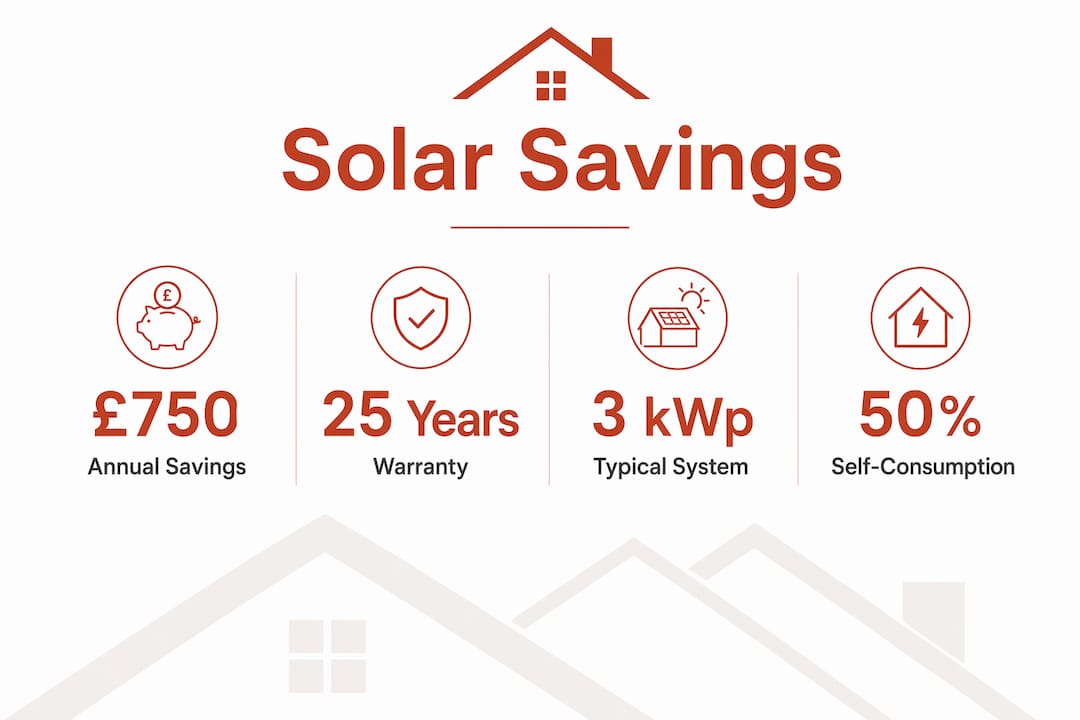
The Energy Saving Trust cites a household example reporting around £750 a year in savings, which reflects a higher self-consumption rate or a more favourable tariff. Payback in that scenario would be closer to 10 years, leaving 15–20 years of largely cost-free generation.
Typical system sizes and ballpark savings:
| System size | Approximate installed cost | Estimated annual saving (50% self-consumption) |
|---|---|---|
| 3 kWp | £3,000–£6,000 | — |
| 4.5 kWp | £7,600 | ~£750 |
Sensitivity notes: Increasing self-consumption significantly improves annual savings and reduces payback time, while lower self-consumption extends payback. Higher SEG rates also improve annual export income, affecting total savings.
One important caution: if you finance the installation with a loan, the repayments reduce your net benefit. A peer-reviewed study of 500,000 US solar adopters found that while median bill savings were substantial, off-bill loan repayments significantly reduced net financial benefit. The same logic applies in the UK. Buying outright or using a low-interest green finance product gives you the cleanest payback picture.
How batteries and EVs change the financial case
A battery does not generate electricity, but it multiplies the value of what your panels produce. Without storage, any solar generation that exceeds your home’s immediate demand goes to the grid at the lower SEG rate. A battery captures that surplus and releases it in the evening when your panels are no longer generating, replacing grid electricity at the full retail rate instead.
Three specific ways a battery improves your position:
- Higher self-consumption: A well-sized battery can push self-consumption from around 50% to 70–80%, materially increasing the value of each unit generated.
- Time-of-use tariff arbitrage: On tariffs like Octopus Go or similar time-of-use products, you can charge your battery from cheap overnight grid electricity and discharge it during peak-price periods, saving money even when the sun is not shining.
- Peak demand reduction: Discharging the battery during high-tariff periods reduces the amount of expensive grid electricity you consume.
Australian government guidance confirms that batteries increase savings by storing excess generation for later use, but notes that combined solar-plus-battery payback periods can be considerably longer than solar-only systems. In the UK, a battery typically adds £3,000–£6,000 to the upfront cost. The financial case is strongest when you have a time-of-use tariff, a large solar system that regularly generates more than you can use in real time, or an EV to charge.
Speaking of EVs: charging your car from daytime solar rather than overnight grid electricity is one of the most effective ways to increase self-consumption. A typical EV needs 10–15 kWh for a 50-mile top-up. If your panels can supply that directly, you avoid buying those units at retail price. You can read more about EV and solar pairing and how to set up smart charging to match your generation profile.

Pro Tip: A battery is most financially attractive when your household uses most electricity in the morning and evening, your solar system is 4 kWp or larger, and you are on or can switch to a time-of-use tariff. If you already self-consume 70% or more without storage, the additional gain from a battery may not justify the upfront cost at current prices.
Real-world solar battery savings examples show the difference a well-matched battery makes in practice.
What actually determines how much you save?
The size of your bill reduction depends on your site and your household, not just the system specification. Two homes with identical 4.5 kWp systems can see very different outcomes.
Roof orientation and pitch matter more than most homeowners expect. A south-facing roof at 30–40° pitch captures the most annual irradiance in the UK. East or west-facing roofs generate roughly 15–20% less annually. North-facing panels are rarely viable. The Energy Saving Trust confirms that south-facing, unshaded roofs in southern regions produce the most generation and therefore the largest bill savings.
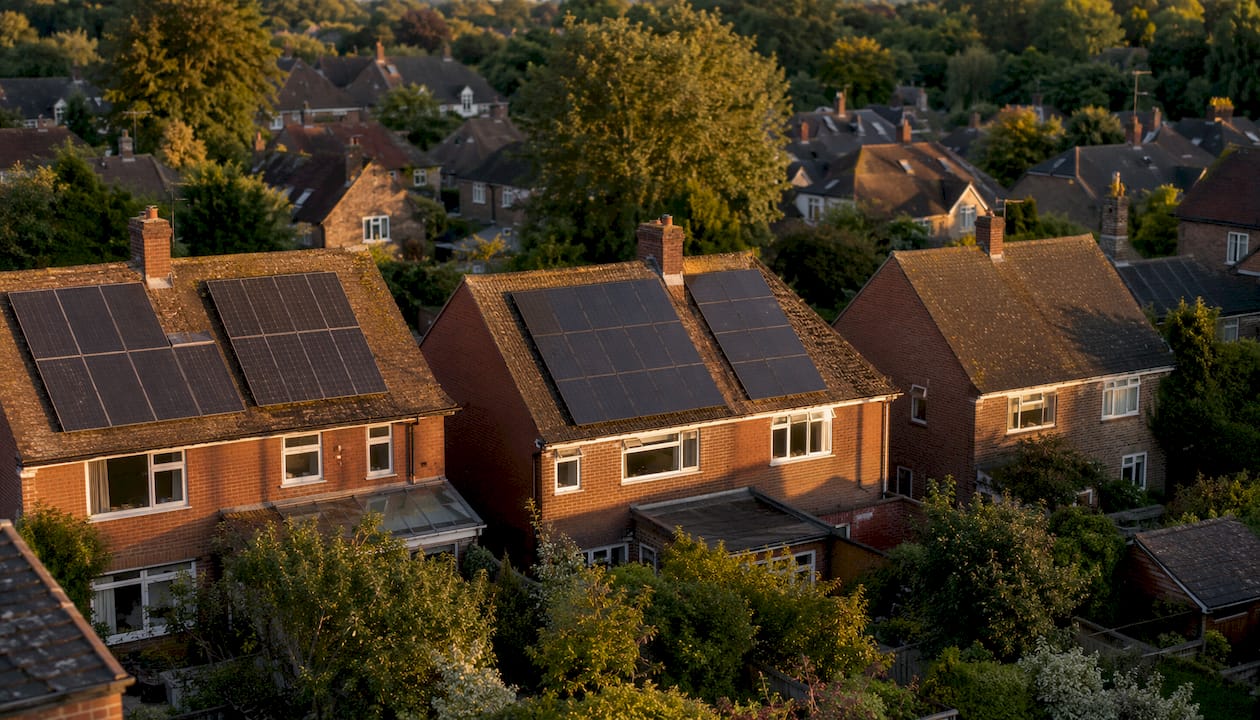
Shading is the silent killer of solar performance. A single chimney stack or nearby tree casting shade on even one panel can reduce output across a string significantly, depending on your inverter type. Solar panel shading is worth assessing carefully before you commit to a layout. Solar optimisers or microinverters can mitigate shading losses at module level.
Regional irradiance varies across the UK. Southern England receives meaningfully more peak sun hours than Scotland or Northern Ireland. A 4.5 kWp system in Hampshire will generate more annually than the same system in Aberdeen, all else being equal.
Household consumption patterns are arguably the most controllable variable. A household that runs the dishwasher, washing machine, and tumble dryer during daylight hours will self-consume far more than one that runs everything after 6pm. Daytime consumption is the lever most homeowners can pull without spending anything.
Tariff type also shapes the outcome. A flat-rate tariff means every kWh avoided is worth the same. A time-of-use tariff creates opportunities to save more by shifting consumption to cheap periods and using solar or battery power during expensive ones.
Inverter performance affects how efficiently generation is converted to usable AC electricity. A well-specified, properly maintained inverter running at high efficiency preserves more of your panels’ output. Solar optimisers can also help where partial shading or mixed roof orientations would otherwise reduce whole-string performance.
Practical ways to get more from your solar system
Modest changes to when you use energy can materially increase self-consumption without any additional capital cost. The Energy Saving Trust highlights scheduling high-energy appliances for mid-day as one of the most effective and cost-free steps a homeowner can take.
- Run the washing machine and dishwasher between 10am and 3pm. These are typically your two highest-draw appliances after heating. Shifting them to peak generation hours can add several hundred kWh of self-consumption annually.
- Use appliance timers or smart plugs. A £15 smart plug on your washing machine or immersion heater lets you schedule it to run when generation is highest, without changing your routine.
- Charge your EV during the day. If you work from home or can plug in during daylight hours, this is the single biggest self-consumption opportunity for EV owners.
- Add a battery. Once you have exhausted free behavioural changes, a battery is the next step for capturing surplus generation that would otherwise go to the grid.
- Consider a solar diverter for your hot water. Devices like the Eddi divert surplus solar generation to your immersion heater rather than exporting it at the lower SEG rate. Hot water is effectively free on sunny days.
- Upgrade to efficient appliances when replacing. An A-rated heat pump tumble dryer uses roughly half the electricity of a conventional model, meaning your solar generation goes further.
- Explore heat pump integration. A heat pump running during the day on solar electricity is a powerful combination for reducing both electricity and heating costs.
Pro Tip: Most modern inverters and battery systems come with a smartphone app that shows real-time generation and consumption. Spend five minutes each morning checking the forecast and deciding which appliances to run. It sounds trivial, but households that actively monitor their system consistently achieve higher self-consumption than those that fit and forget.
The distinction between cost-free changes (steps 1–3) and hardware investments (steps 4–7) is worth keeping clear. Start with behaviour and timers. They cost almost nothing and can shift payback by a year or two on their own.
Monitoring, maintenance, and how long your system will last
Regular monitoring preserves your savings and catches faults before they cost you months of lost generation. A solar installation is not a fit-and-forget purchase. The Energy Saving Trust recommends periodic performance checks as standard practice for any domestic system.
Routine checks to carry out:
- Daily or weekly: Check your inverter display or app for generation figures. A sudden drop in output on a clear day is the clearest sign something is wrong.
- Monthly: Compare generation against the same month last year (or against your installer’s estimated annual generation profile). A consistent underperformance of 10% or more warrants investigation.
- Annually: Inspect panels for dirt, bird droppings, or debris. Clean with water and a soft brush if needed. Check for new shading from tree growth or new structures nearby.
- Every 5–10 years: Have an electrician check the inverter, wiring, and mounting. Inverters typically carry 5–12 year warranties and may need replacing within the system’s life.
How long will the system last?
Solar panels are typically warranted for 25 years and often perform well beyond that, with manufacturers guaranteeing output at around 80–85% of rated capacity at year 25. Inverters have shorter lifespans, usually 10–15 years, so budget for one replacement over the system’s life. That cost is worth factoring into your long-term savings calculation.
How often should I check performance? A quick daily glance at your inverter app takes 30 seconds and is the most reliable way to catch faults early. A more thorough monthly comparison against expected generation takes about five minutes and is sufficient for most homeowners.
Is solar worth it for your UK home?
For most UK homeowners with a suitable roof, solar is worth the investment. A typical 4.5 kWp system costs around £7,600, saves about £750 a year, and pays back in roughly 10 years, leaving 15 or more years of largely free generation. The case strengthens further if you have an EV, can add a battery, or are on a time-of-use tariff.
Quick decision checklist:
- ✅ Roof faces south, south-east, or south-west with minimal shading
- ✅ You use electricity during the day (working from home, daytime appliance use, EV charging)
- ✅ You can fund the installation outright or via low-cost green finance
- ✅ Your current electricity bill is £1,000 or more per year
- ✅ You want protection against future energy price rises
- ⚠️ North-facing roof or significant shading: get a shading assessment before committing
- ⚠️ Financing with a high-interest loan: model the net savings carefully before proceeding
Next steps:
- Book a site survey with a qualified MCS-certified installer who will assess your roof, shading, and consumption profile
- Ask your installer for a projected annual generation figure and an estimated self-consumption percentage based on your usage
- Compare SEG tariffs from multiple licensed suppliers before choosing one
- Request details of monitoring options and warranty terms for both panels and inverter
- If a battery interests you, ask for a separate payback calculation that includes the battery cost
Financing options to consider: Many installers offer 0% or low-interest green finance. Some energy suppliers offer solar loans. The Warm Homes Plan, currently being developed by the UK government, may introduce further support for low-income households. Always model the net annual saving after repayments, not just the gross bill saving.
Key takeaways
Self-consumption is the single biggest driver of solar savings: every kWh you use on-site avoids retail-price electricity, which is worth roughly twice the typical SEG export rate.
| Point | Details |
|---|---|
| Self-consumption drives savings | Using solar electricity on-site avoids retail-price imports, worth more than the SEG export rate. |
| SEG export rates are lower | Export payments complement savings but are typically 4–15p/kWh versus 24–25p/kWh retail. |
| Typical payback: 10–12 years | A 4.5 kWp system at £7,600 installed saves roughly £750 a year on current UK figures. |
| Batteries raise value, add cost | Storage can push self-consumption to 70–80% but extends payback; strongest case with an EV or time-of-use tariff. |
| Smarthometechnical can help | Smarthometechnical provides site surveys, tailored savings models, battery and EV charger pairing across the UK. |
An installer’s perspective on what actually matters
Most homeowners who contact us have already read the headline payback figures and are broadly convinced solar makes sense. What they have not done is think carefully about self-consumption. That single variable, more than roof orientation or system size, determines whether a system pays back in 9 years or 15.
The most common mistake we see is installing a system sized for maximum generation without considering when the household actually uses electricity. A large system on a house where everyone is out from 8am to 6pm will export the majority of its generation at the lower SEG rate. A smaller system on a household with daytime occupancy, an EV, or a battery will outperform it financially, even though it generates less in total. Get your consumption profile right before you size the system.
A few questions worth asking at quote stage: What self-consumption percentage are you assuming in this savings estimate? What generation figure are you using, and is it based on actual irradiance data for my postcode? What monitoring system comes with the installation, and can I see real-time data? What happens if the inverter fails outside warranty? These are not awkward questions. A good installer will answer all of them without hesitation.
The benefits of solar self-consumption are real and well-documented, but they require a system designed around your household, not a generic template. That is the difference between a system that pays back as projected and one that quietly underperforms for years.
Smarthometechnical: professional solar installation for UK homeowners
Cutting your bills with solar is straightforward in principle. Getting the numbers right for your specific home, roof, and consumption pattern is where a professional installer earns their fee.
Smarthometechnical specialises in solar panel installation, battery storage, and EV charger pairing for UK homeowners. Every installation starts with a thorough site survey that covers roof orientation, shading analysis, and your actual consumption profile, so the savings estimate you receive is built on your data, not industry averages. The team advises on SEG tariff options, designs systems to maximise self-consumption, and sets up monitoring so you can track performance from day one.
When requesting a quote, ask for: your projected annual generation figure, the assumed self-consumption percentage, expected annual savings broken down by self-consumption and export, monitoring options included, and full warranty terms for panels and inverter.
To book a site survey or get a tailored savings estimate, visit the solar installations page and get in touch with the Smarthometechnical team.
Further reading and useful UK sources
- Energy Saving Trust — Solar panels: The most comprehensive free UK resource covering costs, savings, SEG, and worked examples. Start here.
- Ofgem — Smart Export Guarantee: The regulator’s official SEG guidance, including a list of licensed SEG suppliers and their current tariffs.
- MCS — Find a certified installer: MCS certification is the UK industry standard for solar installers. Use this directory to verify any installer you consider.
- US Department of Energy — Will I save money with solar?: Clear payback calculation methodology that applies the same arithmetic used in the worked example above.
- Smarthometechnical — The role of solar in 2026 homes: A broader guide to integrating solar with modern home technology, including heat pumps and smart controls.
- Smarthometechnical — Solar battery savings examples: Real UK case studies showing measured savings from combined solar and battery systems.
- Smarthometechnical — How smart meters work with solar: Explains how smart metering supports SEG access and accurate export tracking.
This article is general information for homeowners considering solar. Costs, tariffs, and savings figures vary by site, tariff, and household. Confirm current SEG rates with licensed suppliers and seek a site-specific assessment from an MCS-certified installer before making any financial decision.
Recommended
- Why switch to solar energy: a 2026 homeowner’s guide – Smart Home Technical Ltd
- Benefits of solar self-consumption for homeowners – Smart Home Technical Ltd
- Why solar suits rural homes: the complete 2026 guide – Smart Home Technical Ltd
- The role of solar optimisers: a homeowner’s guide – Smart Home Technical Ltd
