
A whole home energy system integrates heat pumps, solar panels, battery storage, EV chargers, and smart management software into a single coordinated setup. Rather than running each device independently, the system treats your home as one energy unit, shifting loads automatically, responding to live tariff prices, and maximising the electricity you generate yourself. A Home Energy Management System (HEMS) can reduce total energy use by 15–25% annually for an average UK household, with bill savings typically ranging from £150 to £300 per year through smart heating controls and load shifting alone.
Common examples of whole home energy systems in UK homes include:
- Solar-only starter system: rooftop panels feeding household loads, with surplus exported to the grid
- Solar plus battery: panels paired with a home battery to store daytime generation for evening use, increasing solar self-consumption from 30–50% to 70–80%
- Heat pump plus HEMS: an air source heat pump orchestrated by management software to run during cheap off-peak periods
- Full integrated system: solar, battery, heat pump, and EV charger all coordinated by a central hub responding to Octopus Agile or similar dynamic tariffs
- Aira Home Energy System: heat pump, solar panels, Power Store battery, and Power Hub inverter managed by Aira Intelligence as a single-vendor package
- Rendesco Flow: a whole-home heating solution combining heat pump technology with monitoring and automated tariff optimisation
- Open-platform HEMS: a software orchestration layer (such as Home Assistant with energy integrations) coordinating third-party hardware without a proprietary kit
Pro Tip: Don’t try to buy everything at once. Start with a smart meter and one generation or storage asset, then add the orchestration software layer once you understand your consumption patterns. That sequencing consistently delivers better returns than buying a full system upfront without a baseline.
Table of Contents
- What makes up a whole home energy management system?
- From basic monitoring to full whole-home orchestration: which level suits you?
- DIY or professional installation: what UK homeowners need to know
- How Smarthometechnical approaches whole home energy integration
- Does your home actually suit a whole home energy system?
- UK grants, incentives, and regulations you need to know about
- Smarthometechnical installs complete home energy systems across southern England
- Key takeaways
What makes up a whole home energy management system?
Every integrated home energy system is built from a combination of physical hardware and software that connects it all. Understanding what each component does helps you decide which to prioritise.
Core hardware components:
- Smart meter: provides half-hourly consumption data and forms the data backbone for any HEMS. The DESNZ rollout had widespread UK smart meter deployment by early 2026.
- Solar panels: generate electricity from sunlight, even on overcast days, reducing grid imports
- Battery storage: stores surplus solar generation or cheap off-peak grid electricity for use during peak hours; learn more about combined solar battery systems and how they work together
- Heat pump: typically 3–4 times more efficient than a traditional boiler, and the primary flexible load in most UK whole-home setups
- EV charger: a major controllable load; smart chargers can shift charging to off-peak windows automatically
- Smart thermostat: controls heating schedules and responds to external signals such as grid carbon intensity
- Smart plugs: add basic monitoring and scheduling to individual appliances
- Central hub or controller: the orchestration layer that connects all devices and executes automated decisions
The software layer is where the real intelligence sits. A HEMS reads live tariff prices, grid carbon intensity, weather forecasts, and your consumption history, then decides in real time when to charge the battery, run the dishwasher, or heat the hot water cylinder. On Octopus Agile, for example, EV charging at 9p/kWh off-peak versus 30p/kWh at peak represents a saving that compounds significantly across a year. Smart meters provide the raw data, but they do not act on it. The HEMS software is what turns that data into control actions.
| Component | Primary function | Typical UK cost | Typical annual saving |
|---|---|---|---|
| Smart meter | Consumption monitoring and tariff data | Free (supplier-installed) | Behaviour-change savings only |
| Wireless plug-and-play HEMS kit | Basic monitoring and scheduling | £150–£300 | — |
| Wired hybrid HEMS system | Full multi-device orchestration | — | — |
| Solar panels (4kW) | On-site generation | — | — |
| Battery storage | Store and shift energy | — | — |
| Air source heat pump | Efficient space and water heating | — | Varies by tariff and use |
| Smart EV charger | Scheduled low-cost vehicle charging | — | — |

Cost and saving ranges sourced from Axiom Eco Homes. Individual results depend on tariff, insulation, and usage patterns.
From basic monitoring to full whole-home orchestration: which level suits you?
Not every homeowner needs a fully automated system from day one. Whole home energy setups exist on a spectrum, and knowing where you sit helps you invest wisely.
| Level | What it includes | What you can do | Typical user benefit |
|---|---|---|---|
| Basic monitoring | Smart meter, in-home display, single-appliance monitors | View consumption data; spot high-usage appliances | Awareness and manual behaviour change |
| Intermediate control | Smart plugs, programmable thermostat, basic scheduling | Schedule appliances; set heating timers | Modest bill reduction; minimal automation |
| Advanced orchestration | Central HEMS hub, solar, battery, heat pump, EV charger, dynamic tariff integration | Automated load shifting; real-time tariff and carbon response; predictive scheduling | 15–25% energy reduction; maximised self-consumption; lowest possible running costs |
At the basic level, you are essentially reading a dashboard. A smart meter paired with an in-home display tells you what you are spending, but nothing acts on that information automatically. Many households stay here for years without realising how much further the technology can go.
Intermediate control adds scheduling. A smart thermostat like a Hive or Tado unit lets you programme heating around your routine, and smart plugs can cut standby loads on devices you forget to switch off. The savings are real but modest, and the system still relies on you to make decisions.
Advanced orchestration is where the examples of whole home energy systems described in this article operate. A central controller reads the Octopus Agile half-hourly price feed, checks the battery state of charge, looks at the weather forecast for solar yield, and decides autonomously whether to charge the battery from the grid now or wait for solar generation in three hours. The role of smart home energy management at this level is less about convenience and more about financial and carbon optimisation running continuously in the background.
DIY or professional installation: what UK homeowners need to know
The right installation path depends on what you are adding and how complex your existing setup is.
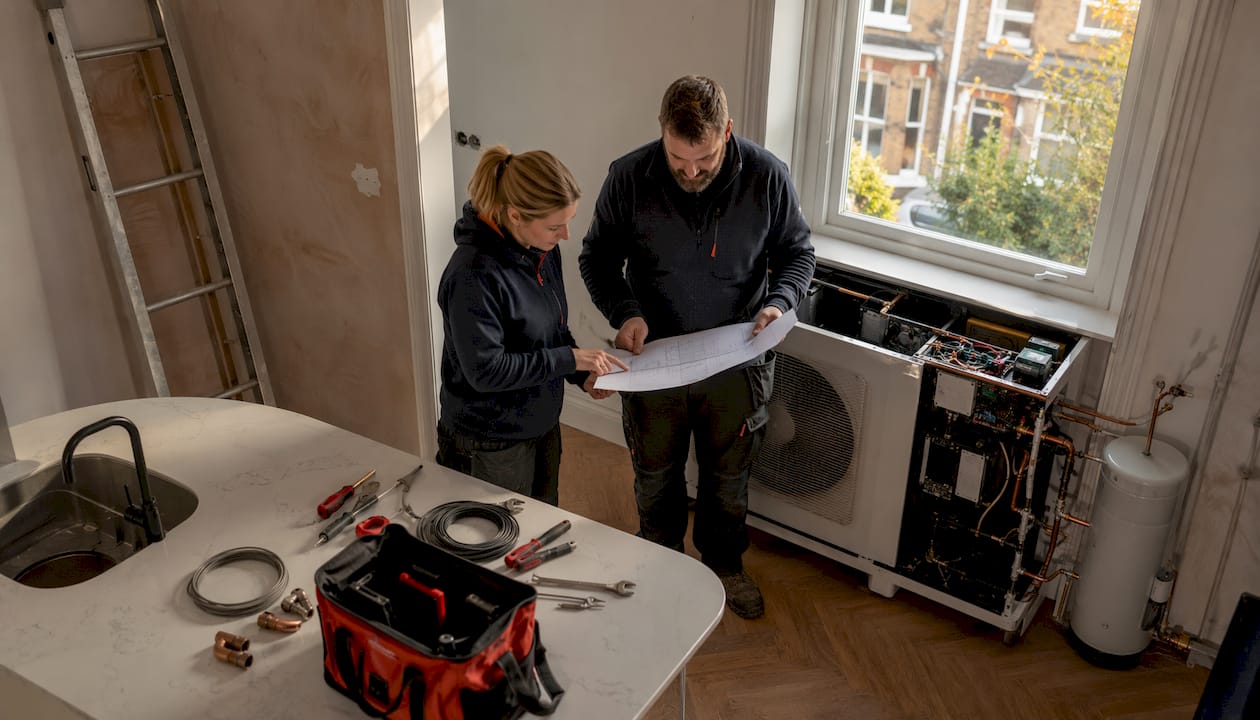
Wireless and plug-and-play components — smart plugs, in-home displays, and some basic HEMS controllers — can be self-installed without any electrical qualifications. The risk is low, and the setup is usually guided by a smartphone app.
Wired and hybrid systems are a different matter. Solar panels, battery storage, heat pumps, and EV chargers all require installation by a qualified electrician. For solar and batteries, MCS (Microgeneration Certification Scheme) certification is required to access the Smart Export Guarantee (SEG) payments. Heat pump installers must hold MCS accreditation to qualify for the Boiler Upgrade Scheme grant. EV charger installers should be OZEV-authorised. Choosing a contractor registered with TrustMark adds a further layer of consumer protection and is a condition of several government grant schemes.
Key installation planning steps:
- Audit your current energy use before specifying any system; a smart meter reading history of at least three months gives a reliable baseline
- Check your property’s grid connection capacity, particularly if you plan to add solar, a battery, and an EV charger simultaneously
- Confirm roof orientation and shading for solar; south-facing at 30–40° pitch is optimal, but east-west split arrays can work well for self-consumption
- Verify that your consumer unit has sufficient capacity and is compatible with the inverter and battery system you are specifying
- Ask your installer whether the components they supply are Smart-Ready certified, as this will matter for future regulatory compliance
- Plan cable routes for wired components before any walls are plastered or floors are laid in a renovation context
- Request a system design document showing how each component communicates with the others before signing a contract
Common challenges and how to handle them:
Incompatibility between inverters and battery systems is the most frequent headache in DIY setups. Not all batteries communicate with all inverters, and proprietary ecosystems can lock you into one brand’s hardware. If you are building a system incrementally, choose components that use open protocols such as Modbus or SunSpec from the outset. Connectivity dropouts in the HEMS controller are usually a Wi-Fi signal issue rather than a hardware fault; a dedicated 2.4GHz network for IoT devices resolves most cases. For professional installations, always confirm that the installer will commission the system fully and test automated functions before signing off.
How Smarthometechnical approaches whole home energy integration
The most effective whole home energy systems are built in phases, not purchased as a single transaction. Start with the smart meter as your data foundation, then add a generation or storage asset, and finally layer in the HEMS software that orchestrates everything. Skipping the orchestration layer is the single most common reason homeowners with solar and a battery still pay more than they should.
Purchasing Smart-Ready certified devices from the outset matters more than most homeowners realise. The UK’s Smart Secure Electricity Systems (SSES) regulations mandate smart functionality and cyber security standards for electric heating appliances, EV chargers, and battery systems. Buying non-compliant hardware now means replacing it sooner than you expect.
Dynamic tariff integration is where the financial case for a whole home system becomes compelling. A system coordinating solar, battery, heat pump, and EV charger against Octopus Agile’s half-hourly pricing can shift the majority of your controllable loads to the cheapest windows of the day, automatically and without any manual input. The how smart meters work with solar panels piece on the Smarthometechnical site explains the data flow in practical terms.
Pro Tip: Avoid adding devices from multiple vendors without first confirming they share a common integration layer. A fragmented setup where each device has its own app but nothing talks to anything else is the most expensive outcome: you pay for smart hardware and get dumb operation.
Systems designed and installed under a single service roof consistently outperform fragmented multi-vendor setups on automation reliability and return on investment. When one contractor is responsible for solar, battery, and EV charger installation and commissioning, the integration is tested as a whole rather than assembled piecemeal.
A typical integrated system with solar, battery, and HEMS software achieves solar self-consumption of 70–80% compared to 30–50% for solar alone, and total energy cost reductions of 15–25% annually for an average UK household.
Does your home actually suit a whole home energy system?
Compatibility is not just about whether the technology works. It is about whether your home’s physical and infrastructure characteristics allow it to work well.
Property type and construction:
Victorian and Edwardian terraces with solid walls present the most constraints. Poor insulation means a heat pump has to work harder, reducing its efficiency and the financial case for integration. Cavity wall and loft insulation should be addressed before specifying a heat pump as part of a whole home system. Modern builds from the 2000s onwards are generally well-suited, with adequate roof space, cavity walls, and consumer units that can accommodate additional circuits.
Flats and leasehold properties face a different set of barriers. Roof access for solar panels requires freeholder consent, and shared electrical infrastructure can limit what is possible without building-wide upgrades. Ground source heat pumps are rarely viable in urban flats for the same reason.
Rural homes often have the strongest case for integrated systems. Off-grid or partially off-grid properties with oil or LPG heating stand to gain most from switching to a heat pump and solar combination, and solar suits rural homes particularly well given the typically larger roof areas and fewer shading obstructions.
Grid connection and DNO constraints:
Properties in areas with constrained grid infrastructure may face limits on the size of solar array or battery system they can export from. Your Distribution Network Operator (DNO) must be notified for any generation system above 3.68kW single-phase or 11kW three-phase. Some rural areas require a G99 application rather than the simpler G98 notification, which adds lead time to installation. An experienced installer will handle this, but it is worth knowing before you set a timeline.
Existing heating infrastructure:
Homes with underfloor heating or large radiators are better suited to heat pump integration than those with small, high-temperature radiators sized for a gas boiler. A heat pump running at lower flow temperatures is more efficient and integrates better with a HEMS that schedules heating around tariff windows. If your radiators need upgrading, factor that cost into the whole system budget.
UK grants, incentives, and regulations you need to know about
The financial and regulatory context for whole home energy systems in the UK is more favourable in 2026 than it has been at any previous point, but the rules are specific and the deadlines matter.
Boiler Upgrade Scheme (BUS): provides a £7,500 grant towards the cost of an air source heat pump or a ground source heat pump. The grant is paid directly to your MCS-accredited installer and deducted from your invoice. There is no income threshold; the scheme is open to all owner-occupiers in England and Wales.
Smart Export Guarantee (SEG): requires licensed electricity suppliers with more than 150,000 customers to offer export tariff payments for surplus solar electricity sent to the grid. Rates vary by supplier; some dynamic SEG tariffs now pay more during peak demand periods, which integrates well with a HEMS that can decide when to export versus when to store.
VAT at 0%: solar panels, battery storage, heat pumps, and associated installation costs currently attract 0% VAT in the UK. This applies to the full installation cost, not just the hardware, and represents a meaningful saving on a whole system.
ECO4 and Great British Insulation Scheme: for lower-income households or those in properties with poor EPC ratings, these schemes fund insulation measures that are a prerequisite for efficient heat pump operation. Addressing fabric performance before adding a heat pump is both technically and financially sound.
Regulatory compliance:
The SSES programme’s government response confirms that hydronic heat pumps, storage heaters, heat batteries, standalone direct electric hot water cylinders, and hot water heat pumps must have smart functionality. EV chargers already fall under the EV Smart Charging Regulations 2021. Any component you purchase for a whole home system should carry Smart-Ready certification to remain compliant.
Home Energy Model (HEM) from 2027:
The UK government is replacing the Standard Assessment Procedure (SAP) with the Home Energy Model from H2 2027. HEM uses half-hourly dynamic simulation rather than monthly averages, which means it will fully credit battery storage, solar self-consumption, and smart tariff responsiveness in EPC ratings for the first time. Under the current SAP framework, a battery receives no EPC credit at all. Under HEM, it improves two of the four rating metrics simultaneously. Homeowners who install solar and battery storage now benefit from real-world savings in the interim and from an EPC uplift the moment HEM takes effect.
Smarthometechnical installs complete home energy systems across southern England
If you have read this far, you already know that the difference between a good whole home energy system and a mediocre one comes down to integration quality and installation expertise. A solar array that does not communicate with your battery, or a heat pump that runs on a fixed timer rather than a live tariff feed, leaves most of the financial benefit on the table.
Smarthometechnical is an MCS-accredited electrical contractor specialising in solar panel installation, battery storage, and EV charger installation across southern England. The team designs and installs systems where every component is specified to work together from day one, not bolted together from whatever was available. Whether you are starting with solar panels and want to add a battery later, or you are ready to install a full solar, battery, and EV charger setup in one project, Smarthometechnical handles the design, installation, and commissioning as a single coordinated job. You can also explore real solar battery savings from completed installations to see what integrated systems actually deliver in practice. Get in touch with Smarthometechnical for a no-obligation survey and system design.
Key takeaways
A whole home energy system that integrates solar, battery storage, a heat pump, and smart HEMS software can reduce total energy costs by 15–25% annually for a typical UK household, with solar self-consumption rising from 30–50% to 70–80% when battery storage is added.
| Point | Details |
|---|---|
| HEMS energy savings | A HEMS reduces total energy use by 15–25% annually for an average UK household through load shifting and tariff optimisation. |
| Solar self-consumption uplift | Adding battery storage raises solar self-consumption from moderate levels to substantially higher levels, significantly reducing grid imports. |
| Phased investment approach | Start with a smart meter, then add solar or battery, then layer in HEMS software for the best return on investment. |
| Smart-Ready compliance | Buy Smart-Ready certified devices now to comply with UK SSES regulations and avoid premature hardware replacement. |
| Smarthometechnical | MCS-accredited installer of solar panels, battery storage, and EV chargers across southern England, designing integrated systems from the outset. |
