
A solar fuse box upgrade replaces or reconfigures your household consumer unit and adds proper AC and DC overcurrent protection so inverters, PV strings and batteries can connect safely. It’s the electrical groundwork that has to happen before or during a solar installation, not an optional extra.
Most upgrades include:
- A new consumer unit with RCBOs, RCDs or AFDDs replacing an outdated fuse board
- A dedicated circuit for the inverter
- DC isolation or fused protection for the PV strings, often via a combiner box
- Full testing, labelling and a signed Electrical Installation Certificate
Any electrician doing this properly will work to standards checked by bodies like NICEIC, and for solar-specific work, under MCS. If your board is more than 20 years old or still uses rewireable fuses, read on, because you’re almost certainly looking at this job.
Key Takeaways
A solar fuse box upgrade replaces the consumer unit and adds DC-rated protection so PV, inverters and batteries can operate safely and pass certification.
| Point | Details |
|---|---|
| Core scope | Expect a new consumer unit with RCBOs, a dedicated inverter circuit, and DC isolation or a combiner box for the PV strings. |
| Main trigger signs | Ceramic fuses, missing RCDs, a fully populated board or adding a battery/EV charger all point to an upgrade being needed. |
| Two separate processes | Consumer unit work sits with your electrician; a main-fuse capacity change goes through your network operator separately. |
| Paperwork to insist on | Get a signed EIC, Part P notification where applicable, and an MCS certificate if solar was supplied under that scheme. |
| Where to get it done | Smarthometechnical surveys the board, handles DNO liaison where needed, and certifies the completed upgrade in one visit. |
Table of Contents
- What does a solar fuse box upgrade actually involve?
- When will your home actually need this upgrade?
- How much does a solar fuse box upgrade cost?
- What’s the process and timeline from survey to certificate?
- Who should carry out the work, and what should you receive?
- How do you prepare for a quote, and what should you ask?
- Is the upgrade worth the cost and disruption?
- DNO fuse upgrade or consumer unit upgrade: which do you need?
- Can your existing fuse box handle solar and battery systems?
- What happens if the upgrade is skipped or done badly?
- How Smarthometechnical handles your consumer unit upgrade
- Frequently asked questions
- Sources
What does a solar fuse box upgrade actually involve?
The core of the job is the consumer unit itself. Old boards with ceramic fuses or a single RCD covering everything get swapped for a modern metal enclosure with individual RCBOs on every circuit, or MCBs paired with RCD protection, plus spare ways left free for future circuits.
On the solar side, the inverter gets its own dedicated AC breaker rather than sharing a circuit. The DC side needs separate treatment entirely: a DC isolator and, where multiple strings feed into one point, a combiner box with individually fused strings. PV fuses have to be DC-rated and sized for temperature-corrected open-circuit voltage, using gPV class fuses to the IEC 60269-6 standard rather than standard AC fuses, which simply aren’t rated for the job. Surge protection devices are increasingly standard too, given how exposed roof-mounted arrays are to lightning-induced transients.
Once the physical work is done, the electrician runs continuity and insulation resistance tests, then issues an EIC. Depending on where you live, Part P notification to building control may be required, and if the solar system itself is being certified under MCS, that paperwork sits alongside the electrical certificate rather than replacing it.
- Old consumer unit removed and new board fitted
- Dedicated circuits added for inverter and any battery
- DC protection and combiner installed where needed
- Testing, labelling and certification completed
Pro Tip: Ask your installer to leave two or three spare ways in the new board, even if you’re not adding a battery or EV charger yet. It’s far cheaper to plan for expansion now than to pay for another board swap in three years.
When will your home actually need this upgrade?
A handful of signs make the answer fairly obvious before an electrician even arrives. If your consumer unit still uses ceramic, rewireable fuses, or you can’t see an RCD anywhere on the board, you’re working with wiring practice from decades ago. A full board with zero spare ways is another giveaway; there’s simply nowhere to add the inverter circuit without swapping the whole unit.
Common triggers include:
- Ceramic or rewireable fuses instead of RCBOs/MCBs
- No visible RCD protection, or only partial coverage
- A fully populated board with no spare ways
- A main switch rated too low for the added load
- Adding a battery system or EV charger alongside solar
Beyond visual checks, the installer’s own site survey often surfaces triggers you wouldn’t spot yourself: the inverter manufacturer requiring a dedicated circuit, battery charging demanding its own protected way, or conditions attached by the network operator after a connection application. A switchboard assessment before adding load typically checks board age, spare capacity, main switch rating and RCD coverage in one pass.
How much does a solar fuse box upgrade cost?
Pricing varies with scope, but the pattern is fairly predictable. A straightforward consumer unit replacement with PV-ready circuits sits at the lower end; adding battery circuits, surge protection, extra conduit work or a combiner box pushes it higher. A job that also requires a DNO main-fuse upgrade adds a separate cost and process entirely.
What actually drives the number:
- How many new circuit ways are needed (inverter, battery, EV charger)
- Whether the main fuse or supply capacity needs upgrading via the network operator
- Surge protection devices and DC combiner hardware
- Conduit, trunking or cable runs if the board is relocated
- Any additional re-wiring uncovered during the survey
Homeowners normally pay for the consumer unit work itself as part of the installer’s quote. Main-fuse upgrades on the network side are a different matter. UK Power Networks handles these as a separate application, and depending on the network operator’s policy, that cost may be billed independently of your electrician’s invoice. Always ask your installer explicitly whether a DNO application is included in the quote or sits outside it, because it’s one of the most commonly missed line items.
What’s the process and timeline from survey to certificate?
The sequence is fairly consistent across most jobs, even though the timeline stretches or shrinks depending on network operator involvement.
- A site survey scopes the existing board, spare ways, and cable routes, and the resulting quote should state clearly what it assumes about the current installation.
- If the main fuse or supply capacity needs changing, a DNO application goes in before installation day; timing depends entirely on the network operator’s queue.
- On installation day, the consumer unit is swapped, new circuits added, the inverter connected, and everything tested before the EIC and any Part P notification are issued.
Without DNO involvement, most consumer unit upgrades complete in a single day. Add a main-fuse application and you’re looking at weeks rather than days, since that part of the process sits with the network operator, not your electrician.
Many quotes carry a quiet caveat: “assuming existing board is adequate.” That single line is where scope creep and unexpected costs usually start, because it means the survey hasn’t actually confirmed the board can take the new load.
Push for a quote based on an actual site inspection, not an assumption.
Who should carry out the work, and what should you receive?
This isn’t a job for a general handyman or a DIY weekend. The person doing it needs to be a registered, competent electrician under a scheme such as NICEIC or NAPIT, working to Part P where your local authority requires notification. If the solar or battery system itself is being installed under MCS, that scheme has its own compatibility checks for the electrical connection too.
At completion, you should walk away with:
- A signed Electrical Installation Certificate for the consumer unit and new circuits
- Part P completion or notification paperwork, where applicable
- Test results and a labelling schedule for the new board
- An MCS certificate, if solar or battery equipment was supplied under that scheme
These documents aren’t just filing cabinet clutter. Insurers, future buyers and even the network operator may ask to see them, particularly if a claim or a house sale hinges on proving the electrical work was done to standard.
How do you prepare for a quote, and what should you ask?
Turning up to a site visit prepared saves time and tightens the quote. Take photos of your existing consumer unit and meter position beforehand if you can, and dig out any wiring diagrams or previous test certificates you have.
- Photograph the existing board, meter cupboard and roof access points
- Note the board’s age and any labels already fitted
- List what you want to add now (solar) and later (battery, EV charger)
- Gather any previous EIC or test certificates for the property
Once the installer is on site, a short list of questions cuts through vague quoting fast:
- Will you test the existing board before quoting, or assume it’s adequate?
- Is a DNO application included in this price, or billed separately?
- Will you leave spare ways for a battery or EV charger later?
- Exactly which certificates will I receive at completion?
- Is the workmanship covered by a warranty?
Treat “assuming board is adequate” as a red flag rather than reassurance. A proper site survey removes that assumption entirely.
Is the upgrade worth the cost and disruption?
The safety case is straightforward: modern RCBO protection and correctly rated DC fusing cut the risk of arc faults and fire in ways an old fuse board simply can’t. Beyond safety, a new board with spare ways future-proofs the property for a battery or EV charger without another disruptive swap later, and clear labelling makes fault diagnosis faster for anyone who works on the system after you.
Benefits:
- Modern overcurrent and earth-fault protection throughout the board
- Spare capacity for future battery or EV charger additions
- Clear labelling that speeds up fault-finding
- Stronger paperwork trail for buyers and insurers
Trade-offs:
- Upfront cost on top of the solar installation itself
- A day or more without power to parts of the house during the swap
- Possible weeks of waiting if a DNO main-fuse change is involved
Keep your EIC and Part P paperwork somewhere safe. It’s the evidence an insurer or a buyer’s surveyor will ask for, and without it, you’re relying on someone’s word that the work was done properly.
How Smarthometechnical approaches a fuse box upgrade
Every survey checks board age, spare ways, main switch rating, and whether RCDs or AFDDs are already fitted. Where a combiner is needed, we fit gPV-rated DC fuses and torque every connection to specification, because under-torqued lugs cause more service callbacks than faulty parts. You get a full test certificate and labelling schedule at completion, backed by a standard workmanship warranty.
- Board and spare-way assessment on every visit
- DC fusing sized and torqued to manufacturer spec
- Full certification and labelled documentation handed over
Pro Tip: Ask to see the combiner box labelling before the installer leaves site. Voltage, current and string IDs should be marked clearly, not scribbled on with a marker pen.
DNO fuse upgrade or consumer unit upgrade: which do you need?
These are two separate jobs, and confusing them is one of the most common mistakes homeowners make when budgeting for solar. A consumer unit upgrade deals with everything inside your property: the board, the circuits, the RCBOs, the PV and battery protection. That’s your electrician’s job, done under Part P and certified with an EIC.
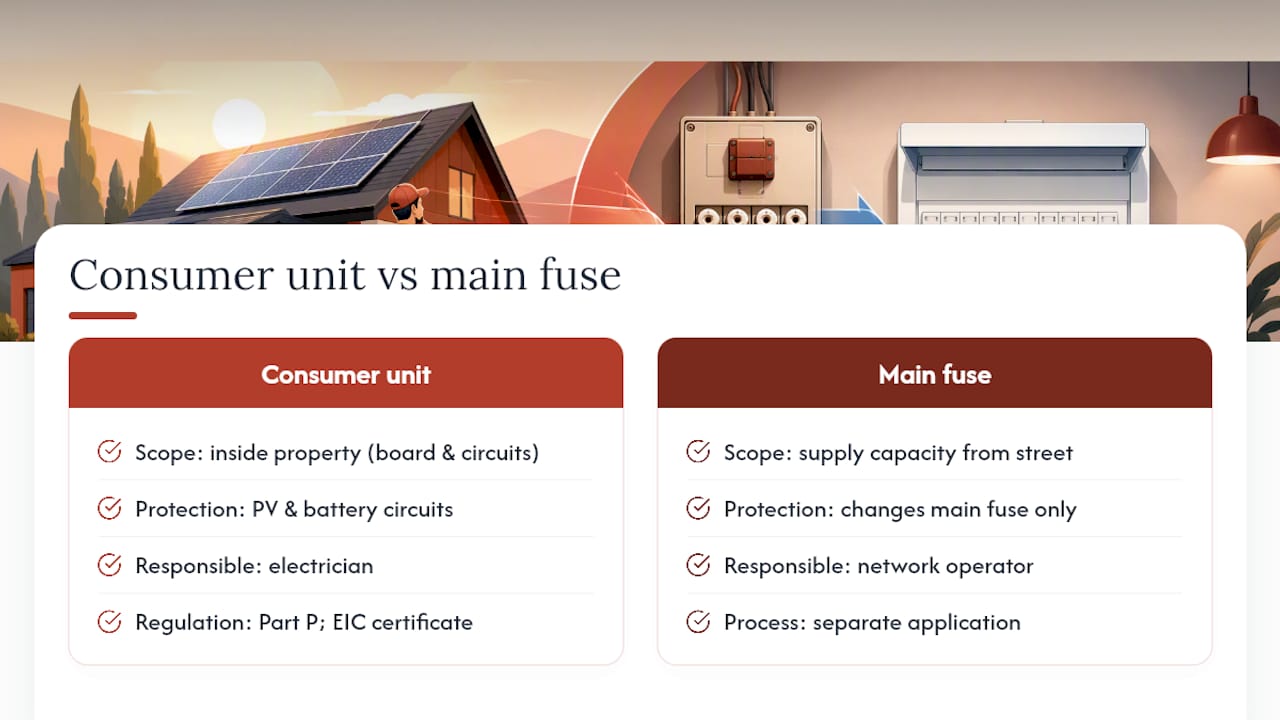
A main-fuse upgrade is different. It changes the capacity of the supply coming into your property from the street, and that’s controlled entirely by your regional network operator, not your electrician. UK Power Networks and other network operators handle this through a separate application process, and only they can physically alter or upgrade the main fuse.
You need a consumer unit upgrade in almost every solar installation, because old boards rarely have the spare capacity or protection standard for PV and battery circuits. You need a main-fuse upgrade only when your total demand, particularly with battery charging or an EV charger added on top of solar, would exceed what your existing supply can safely deliver.
The practical takeaway: your electrician can usually tell within the first few minutes of a survey whether your main fuse is likely to be a limiting factor. If it is, that application needs to go in early, because network operator timelines run to weeks, not days, and can hold up an otherwise-ready solar installation.
Can your existing fuse box handle solar and battery systems?
A few visual checks tell you a surprising amount before an electrician even arrives. Look at the board itself: ceramic, rewireable fuses are an immediate sign of an outdated installation. Modern MCBs or RCBOs, by contrast, suggest a board that’s at least reasonably current.
Count the ways. A fully populated board with every slot filled has no room for an inverter circuit without a swap. Check for a visible RCD, or ideally RCDs on individual circuits rather than one shared device covering the whole house. Look at the main switch rating too, usually printed on the switch itself, since that number matters once you start adding a battery or EV charger on top of solar generation.
None of this replaces a professional assessment, but it tells you what to expect from one. A proper site survey goes further: it measures actual spare capacity, checks whether the main switch and tails can handle the added load, and confirms whether DC protection can be integrated cleanly or needs a separate combiner enclosure.
If you’re planning both solar and a battery, or solar alongside an EV charger, get the assessment done before committing to equipment. Sizing the battery or charger around a board that can’t support it is a common and expensive planning mistake, and it’s far cheaper to catch at survey stage than after installation.
What happens if the upgrade is skipped or done badly?
Skipping the upgrade entirely, or bolting solar onto an inadequate board, creates risks that go well beyond an annoying trip switch. Standard AC fuses aren’t rated for DC fault currents, and using them anyway on the PV side can let a fault persist rather than clear safely, which is exactly the scenario DC-rated gPV fuses exist to prevent.
Incorrect fuse sizing is a specific, well-documented failure point. String fuses need sizing for the temperature-corrected open-circuit voltage of the array, and combiner main ratings are calculated from the sum of string short-circuit currents, multiplied by a safety factor and rounded up to the nearest standard rating. Get that wrong and you either have a fuse that nuisance-trips constantly or, worse, one that doesn’t clear a genuine fault at all.
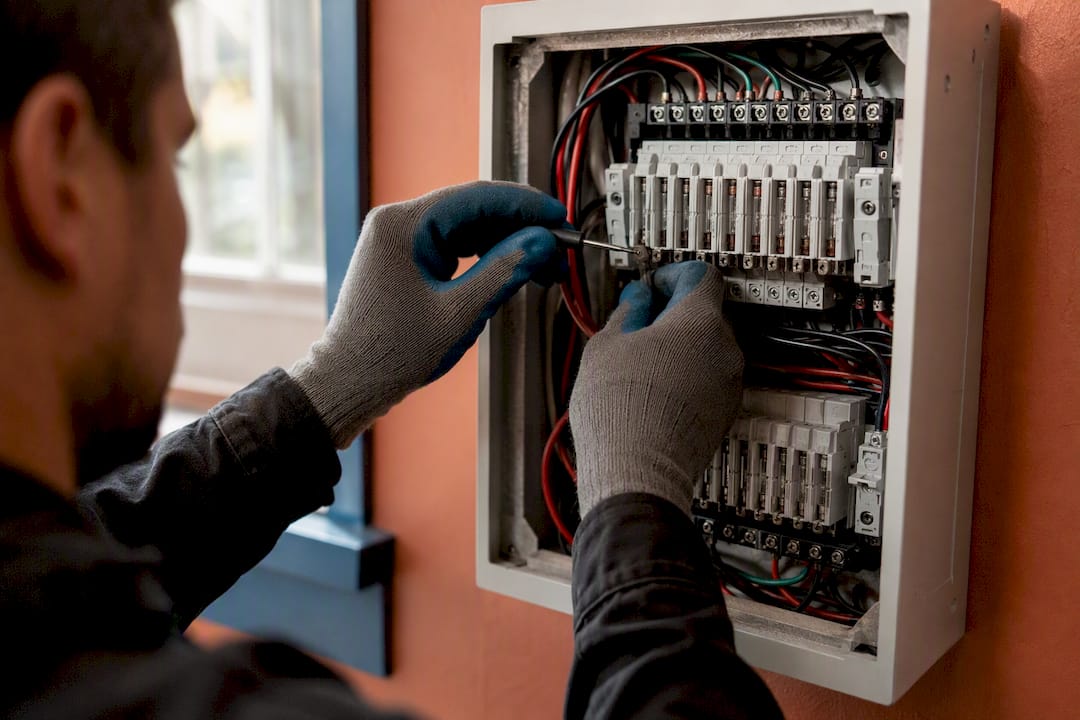
Poor workmanship causes just as many problems as poor design. Under-torqued lug connections in a combiner box are a leading cause of service callbacks, generating heat at the connection point that can eventually lead to arcing or fire. Missing or unclear labelling compounds every other issue, because anyone troubleshooting the system later, including the fire service in an emergency, has no way to isolate strings quickly.
Running a battery or EV charger off a board that was never assessed for the added load risks nuisance tripping at best and sustained overheating at worst. None of these are hypothetical; they’re the recurring patterns behind failed inspections and post-installation callbacks across the industry.
Why we recommend doing this alongside your solar installation
Scheduling the consumer unit upgrade with your solar install, rather than after, avoids a second disruption and a second call-out fee. It’s also simply safer to certify the whole system in one pass.
How Smarthometechnical handles your consumer unit upgrade
If you’ve read this far, you already know the drill: old board, no spare ways, or a battery and EV charger on the wish list means an upgrade is coming one way or another. Smarthometechnical runs the whole thing as one service rather than a patchwork of separate call-outs. That means one site survey covering the board assessment and the solar design together, one point of contact if a DNO application is needed for a main-fuse change, and one certified handover at the end rather than paperwork trickling in over weeks.

We handle the DNO liaison directly where a main-fuse upgrade is needed, fit the consumer unit and DC protection to spec, and hand over the full labelling schedule and test certification when the job’s done. For the site survey, we’ll need access to your current consumer unit, meter position and roof access details.
If you’re weighing up solar, a battery, or an EV charger, and you’re not sure whether your current board is up to the job, the fastest way to find out is a proper survey rather than a guess. Get in touch through our solar installations page to book a site visit and get a quote based on what your board actually needs, not an assumption about what it might handle.
Frequently asked questions
What is a solar fuse box upgrade in simple terms?
It’s the replacement or reconfiguration of your consumer unit, plus DC protection for the panels, so your electrical system can safely handle solar generation, inverters and batteries.
Do I always need a new consumer unit for solar panels?
Not always, but most older boards lack the spare ways, RCD coverage or fuse type needed for a compliant PV connection, so an upgrade is common rather than optional.
Who pays for a DNO main-fuse upgrade?
That’s a separate process from your electrician’s work, handled by your regional network operator, and billing arrangements vary, so always ask your installer whether it’s included in the quote.
What certificates should I receive after the work?
An Electrical Installation Certificate at minimum, plus Part P notification paperwork where required and an MCS certificate if the solar or battery system was installed under that scheme.
Can I add a battery later without upgrading the board again?
Only if the original upgrade left spare ways and sufficient main switch capacity for it, which is why it’s worth asking your installer to plan ahead even if you’re not adding a battery immediately.
Sources
- Fuse upgrade
- Solar Fuse Sizing: String and Combiner Protection 2026 | SurgePV
- How to wire a solar combiner box (step-by-step) | Sun Supply PV
Recommended
- Solar panel junction box repair dorset: 2026 guide – Smart Home Technical Ltd
- Solar cell junction box: how it works and what to check – Smart Home Technical Ltd
- Solar in Hampshire retrofits: a homeowner’s guide – Smart Home Technical Ltd
- The role of solar optimisers: a homeowner’s guide – Smart Home Technical Ltd
