
Solar energy can realistically cut an oil boiler’s fuel consumption by a moderate proportion in typical domestic and commercial settings, and by more when electrification is part of the plan. The role of solar in reducing oil boiler use falls along two main routes: photovoltaic (PV) panels powering an electrified heat source such as an air-source heat pump, and solar thermal collectors preheating water before it reaches the burner. A third, less common option is photovoltaic-thermal (PVT) collectors, which produce both electricity and heat from the same panel.
The primary mechanisms at a glance:
- PV + heat pump: Solar electricity offsets the running cost of a heat pump, which replaces the oil boiler entirely. This is the highest-impact route for long-term oil displacement.
- Solar thermal preheat: Flat-plate or evacuated-tube collectors warm incoming water before the boiler fires, reducing burner run time and fuel burn directly.
- PVT collectors: Hybrid panels that produce both heat and electricity; useful when roof space is limited and there is demand for both outputs.
- Immersion diverters and thermal stores: Controls that route surplus PV generation into a hot-water cylinder, cutting the boiler’s domestic hot-water load without a full electrification step.
Real-world numbers give a useful frame. An industrial modelling study calculated an average solar fraction of about 37.86% and annual heavy fuel oil savings of roughly 1,055.9 tonnes for the plant modelled. At the domestic end, a household case study reported approximately 80% reduction in heating CO₂ after replacing an oil boiler with an air-source heat pump and adding rooftop PV. Those two examples sit at opposite ends of the scale, but they bracket the realistic territory well.
Key takeaways
Solar energy can reduce oil boiler fuel use by a moderate proportion in typical settings, and by significantly more when PV is paired with a heat pump and the oil boiler is retired entirely.
| Point | Details |
|---|---|
| PV works best with electrification | PV alone does not reduce oil use; pair it with a heat pump or diverter to displace oil directly. |
| Solar fraction varies by season | Annual averages around 37% mask winter lows below 22%; always check the monthly breakdown. |
| Staged installs improve cashflow | Install PV and a diverter first; add a heat pump when the boiler reaches end of life for a 6–10 year payback. |
| Monitoring is not optional | Generation and consumption metering are the only way to verify actual oil displacement after installation. |
| Smarthometechnical covers the full process | Site surveys, MCS-accredited PV and solar thermal installs, diverters, batteries, and heat-pump electrical integration. |
Table of Contents
- How does solar actually reduce oil consumption?
- What is solar fraction and what reduction can you realistically expect?
- Which solar system suits which type of oil displacement?
- Siting, sizing, storage and controls that maximise oil displacement
- Costs, payback and the financial case for reducing oil use
- What do modelling studies and real projects actually show?
- A practical checklist for homeowners and facility managers
- When solar cannot fully replace an oil boiler
- An installer’s perspective: where solar helps most and what surprises homeowners
- Smarthometechnical can help you cut your oil boiler use with solar
- Sources
How does solar actually reduce oil consumption?
The connection between a rooftop solar array and a lower oil bill is not automatic. PV panels generate electricity, not heat, so on their own they do not touch the oil boiler at all unless something routes that electricity into the heating system. Understanding the functional pathways is what separates a well-designed installation from one that disappoints.
PV powering electrified heating
The most effective route for oil displacement is replacing the boiler with a heat pump and then using PV to cover a meaningful share of the heat pump’s electricity demand. A heat pump running on solar-generated electricity produces zero on-site combustion and zero oil consumption during those hours. The economic logic is straightforward: PV offsets the new electricity demand that the heat pump creates, so the combined system reduces both fuel cost and carbon output. The timing mismatch between peak solar generation (summer midday) and peak heating demand (winter evenings) is the principal constraint, and it is why storage matters.
Solar thermal preheating
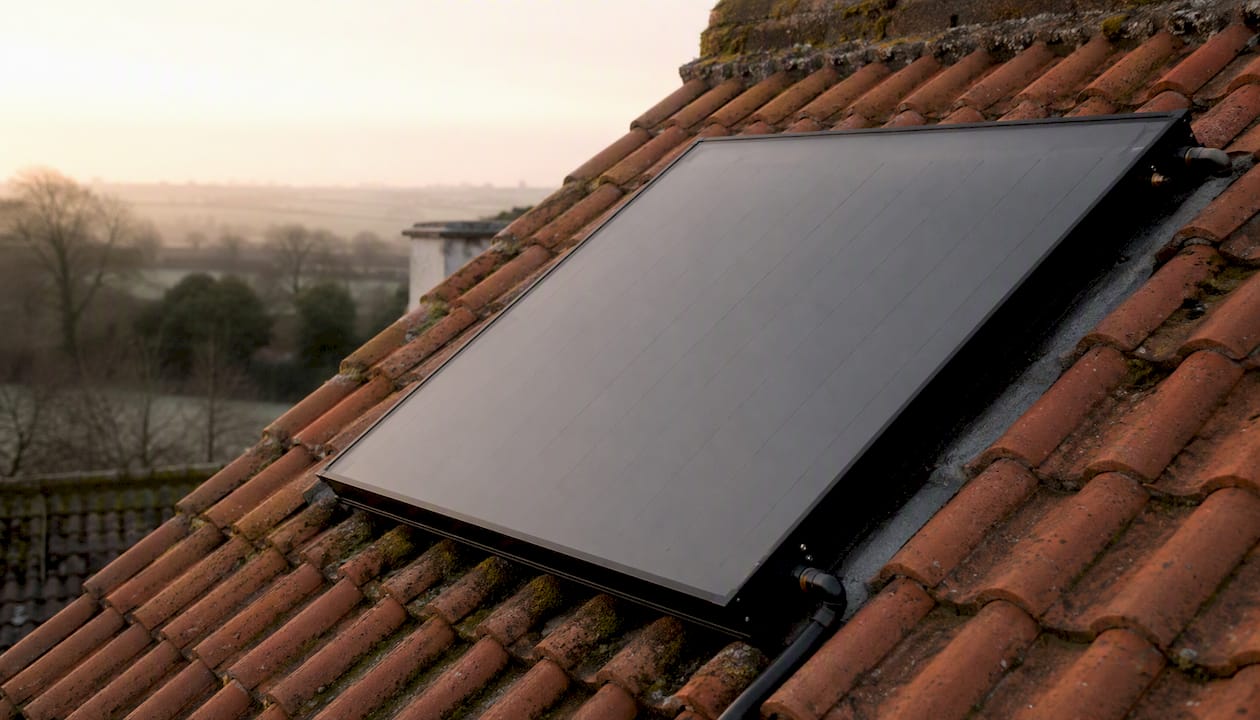
Solar thermal collectors work differently. They capture heat directly from sunlight and transfer it to a fluid that circulates through a heat exchanger in a hot-water cylinder. The boiler then only needs to top up the temperature rather than heat cold mains water from scratch, which shortens burner run time and cuts fuel use proportionally. For domestic hot water, this is often the most cost-effective entry point, particularly for households that are not yet ready to replace their boiler.
PVT and hybrid collectors
PVT panels combine a PV cell with a thermal absorber behind it. They are more expensive per unit than either technology alone, but they make sense when roof space is genuinely scarce and there is simultaneous demand for both electricity and hot water. The thermal layer also keeps the PV cells cooler, which marginally improves electrical output.
Controls and diversion strategies
A solar diverter (sometimes called an immersion controller) detects surplus PV generation and redirects it to an immersion heater in the hot-water cylinder rather than exporting it to the grid for a low feed-in payment. The cost is modest, typically £200–£300 fitted, and the impact on oil use is real: every kilowatt-hour of solar-heated water is a kilowatt-hour the boiler does not need to produce. Thermal stores extend this logic by holding a larger volume of pre-heated water, smoothing out the mismatch between when the sun shines and when hot water is needed. Smart relays and time-of-use controls add another layer, prioritising hot water before EV charging or battery charging based on the household’s demand profile.
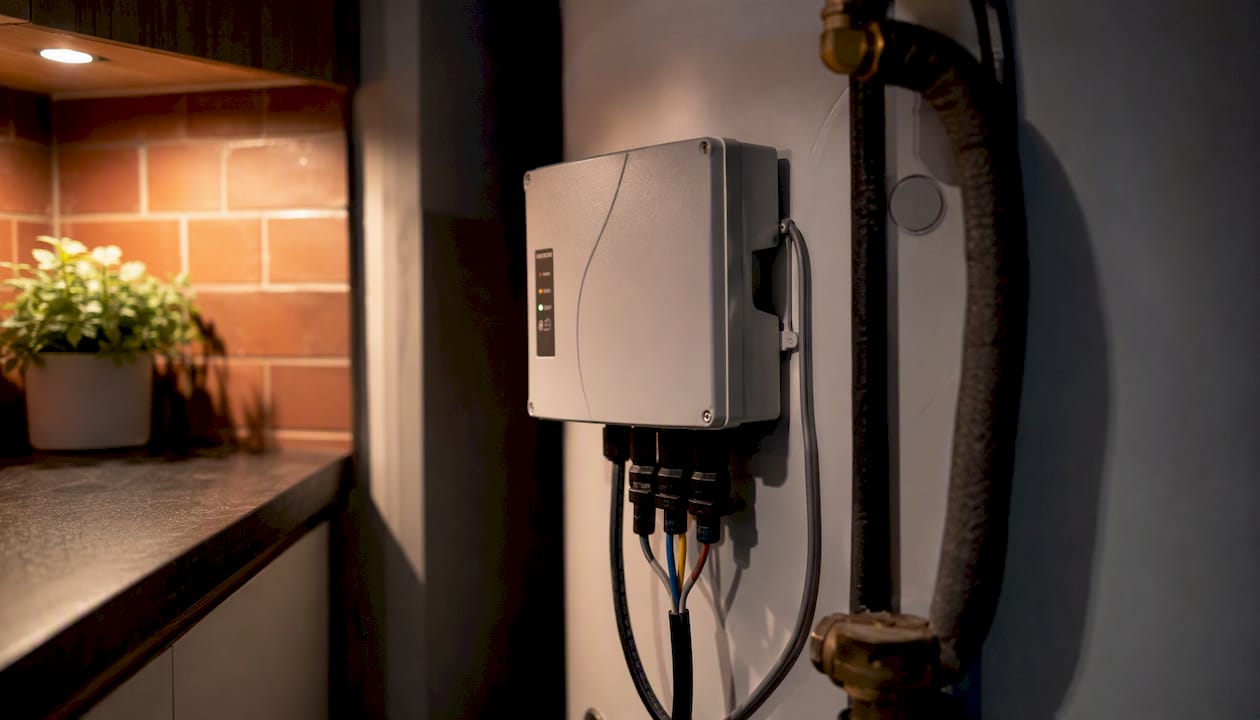
Pro Tip: Set your diverter to prioritise the hot-water cylinder before the battery. Hot water is a direct oil-displacement measure; the battery’s marginal gain for heating is lower unless you also have a heat pump running on stored electricity.
What is solar fraction and what reduction can you realistically expect?
Solar fraction is the proportion of a building’s total annual heat or hot-water demand that solar energy supplies. It is the single most useful number for comparing proposals and understanding how much oil you will actually save.
Realistic ranges vary considerably by system type, building, and location:
| Scenario | Typical solar fraction | Context |
|---|---|---|
| Domestic hot water only (solar thermal) | 10% of total heating load | Small flat-plate system, UK climate |
| Domestic hot water + PV diverter | 20–35% of total heating load | Moderate array, good orientation |
| Industrial solar thermal (PTC) | ~37.86% annual average | Modelled parabolic trough system |
| Hybrid industrial (solar-assisted oil) | ~26.99% of annual boiler energy | Refinery-scale modelling |
| PV + heat pump (full electrification) | Up to ~80% CO₂ reduction | Household case study with ASHP |
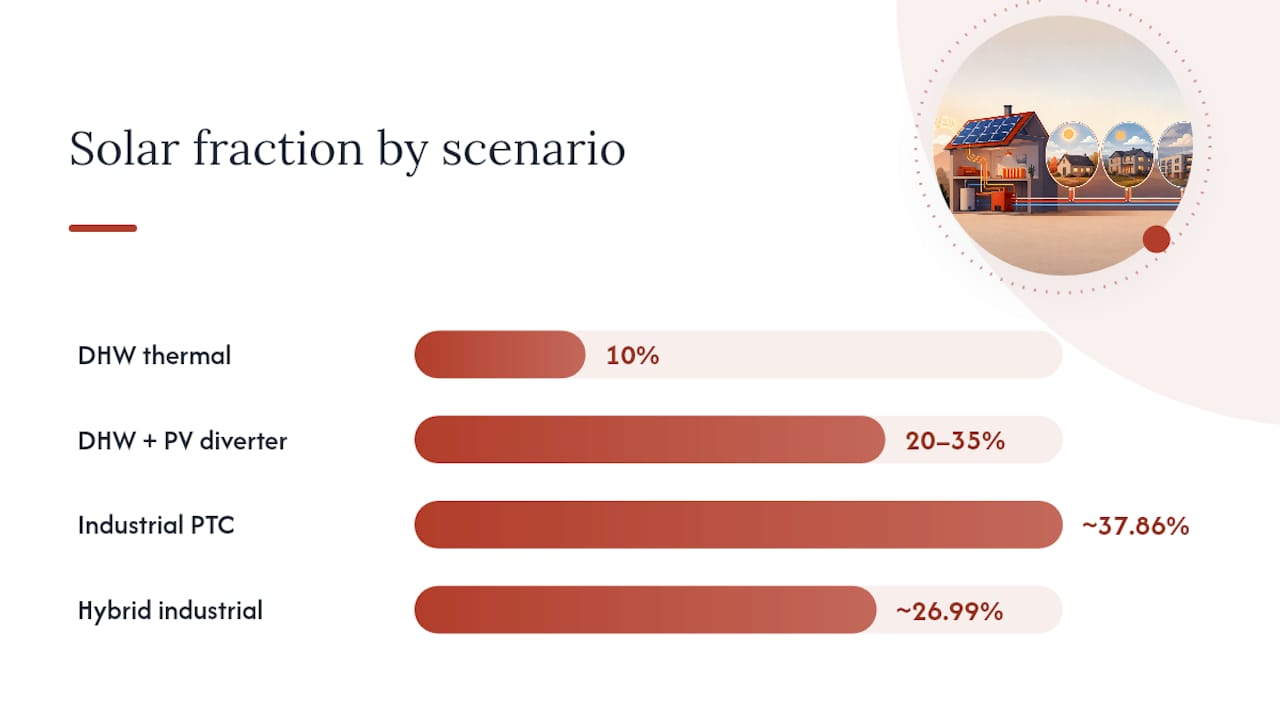
The industrial figures come from academic modelling studies. The parabolic trough study found monthly solar fractions ranging from roughly 21.8% to 64.6% depending on the season, which illustrates how much seasonality matters. A single annual average can hide the fact that solar is doing very little in December and a great deal in June.
The main factors that control your solar fraction are:
- Collector or array area: More roof area generally means a higher fraction, up to the point where summer generation far exceeds demand.
- Orientation and shading: South-facing, unshaded roofs in the UK produce significantly more than east- or west-facing ones. Even partial shading from a chimney stack can cut output noticeably. See Smarthometechnical’s guide on solar panel shading effects for detail.
- Demand profile: A building with high year-round hot-water demand (a care home, a small hotel, a family home with teenagers) will achieve a higher solar fraction from thermal collectors than one with low summer demand.
- Storage: Without a thermal store or battery, surplus solar generation is wasted. Storage raises the fraction by capturing generation that would otherwise be exported.
- Geographic insolation: Southern England receives more solar irradiance than Scotland; the difference is meaningful but not as large as many homeowners assume.
When an installer quotes you a solar fraction, ask for the monthly breakdown, not just the annual average. Also check what assumptions underpin it: the modelling tool used (TRNSYS is the industry standard for hourly simulation), the assumed demand profile, and whether storage is included. Accurate solar-fraction forecasts require hourly simulation because daily averages hide critical mismatches between solar generation peaks and heating demand spikes.
Which solar system suits which type of oil displacement?
The right system depends on what you are trying to displace and how far you want to go with electrification.
PV + heat pump is the route for homeowners who want to eliminate oil use over time. The heat pump replaces the boiler; the PV array offsets the heat pump’s electricity consumption. This combination produced the ~80% CO₂ reduction in the Russell and Kate case study, where an 11.2 kW air-source heat pump paired with a 3.65 kW PV system generating approximately 4,500 kWh per year.
Solar thermal (flat plate or evacuated tubes) suits properties where the boiler is not yet at end of life and the priority is reducing fuel burn for domestic hot water. Flat-plate collectors are cheaper and simpler; evacuated tubes perform better in cold or overcast conditions and are worth considering in northern regions. Solar water heating examples for UK homeowners show how these systems integrate with existing cylinders and controls.
PVT collectors make sense when roof space is the binding constraint and there is genuine simultaneous demand for electricity and hot water. They cost more to install and maintain than a straightforward PV array, so the case for them weakens if roof space is not actually scarce.
Hybrid or staged approaches are often the most practical path. Install PV first while the boiler still has years of life; add a diverter to use surplus generation for hot water; then replace the boiler with a heat pump when it reaches end of life. This spreads capital cost, generates immediate electricity savings, and positions the property for full electrification without a forced, expensive transition.
A quick mapping of systems to use cases:
- Domestic hot water only: Solar thermal flat plate or evacuated tubes; add a diverter if PV is already installed.
- Space heating reduction without full electrification: Solar thermal with a large thermal store; PV diverter as a supplement.
- Full oil elimination: PV + air-source or ground-source heat pump; battery optional but beneficial.
- Industrial or commercial process heat: Parabolic trough collectors (PTC) or large-scale flat-plate arrays; specialist design required.
- Limited roof space, mixed demand: PVT collectors.
Siting, sizing, storage and controls that maximise oil displacement
Getting the array size right is not complicated, but it does require a clear picture of post-electrification demand. If you are planning a heat pump, the installer should provide an estimated annual electricity consumption for the heat pump based on your property’s heat loss calculation. Size the PV array to cover a meaningful share of that figure, not just your current electricity bill.
A rough starting point for a domestic property: a 4–6 kWp array will generate approximately 3,500–5,500 kWh per year in southern England. A typical air-source heat pump for a medium-sized house might consume 3,000–5,000 kWh per year for heating and hot water. The overlap is not perfect because of seasonal mismatch, but it gives a useful order of magnitude.
Battery storage versus thermal stores
- Thermal stores are generally the better choice for oil displacement specifically. They hold pre-heated water that the boiler (or heat pump) does not need to produce, and they are cheaper per kilowatt-hour of storage than batteries. A well-sized thermal store of 200–300 litres can absorb several hours of surplus PV generation.
- Batteries are more flexible: they store electricity that can power the heat pump, lighting, appliances, and an EV charger. If you have a heat pump, a battery extends the hours during which the heat pump runs on solar electricity rather than grid electricity.
- Diverters without storage are the lowest-cost entry point. They do not store energy but they ensure surplus PV is used for hot water rather than exported at a low rate.
Control priorities
- Route surplus PV to the hot-water cylinder first via a diverter.
- Set the heat pump to run preferentially during solar generation hours where the tariff and controls allow.
- Use time-of-use tariffs (such as Octopus Energy’s Agile or Go tariff) to charge a battery overnight at low rates and run the heat pump on cheap grid electricity when solar is not available.
- Install generation and consumption metering from day one. Without metering, you cannot verify how much oil has actually been displaced.
Shading deserves more attention than it typically gets. Panel-level optimisers or microinverters mitigate this significantly.
The marginal cost of extra panels is low; the marginal gain in oil saved is real.*
Costs, payback and the financial case for reducing oil use
The financial case for solar as an oil-displacement measure is strongest when oil prices are high and when the installation is sequenced to avoid unnecessary capital expenditure.
Key cost drivers to understand:
- PV array (4–6 kWp): Typically £5,000–£8,000 installed in the UK, depending on roof complexity, panel type and inverter choice.
- Solar thermal system: Typically £3,000–£5,000 for a domestic flat-plate or evacuated-tube installation.
- Air-source heat pump: Typically £8,000–£15,000 installed, before any grant support.
- Battery storage (5–10 kWh): Typically £4,000–£8,000 installed.
- Diverter: £200–£300 fitted; the lowest-cost oil-displacement measure available.
Oil price exposure is a significant factor. Oil-heated homes are directly exposed to global commodity price swings; solar and a heat pump convert most of your heating cost to electricity, which is more stable and increasingly supplied by renewables. Solar paired with electrification acts as a long-term hedge against oil price volatility, reducing the risk of a sharp winter fuel bill.
Payback windows depend heavily on sequencing. Practical guidance recommends installing PV first, generating immediate electricity savings and using a diverter to cut hot-water oil use, then adding a heat pump when the boiler reaches end of life. This staged approach commonly produces a combined payback of 6–10 years depending on system sizes, local insolation, and any grant support received. Doing everything at once is more disruptive and ties up more capital before the oil boiler is actually retired.
For grant and incentive information, check the current status of the Boiler Upgrade Scheme and any local authority schemes at the time of your project. Subsidy amounts and eligibility rules change, so verify directly with the scheme administrator rather than relying on figures quoted in guides. The solar planning process also affects cost: most domestic PV installations fall under permitted development, but solar thermal and heat pumps may require additional checks.
Pro Tip: If cashflow is the constraint, start with PV and a diverter. The diverter costs under £300 and immediately reduces the oil the boiler burns for hot water. That saving starts from day one and improves the business case for the heat pump you will add later.
For commercial property owners, the benefits of solar at facility scale extend beyond fuel savings to include reduced carbon reporting obligations and potential improvements to EPC ratings, both of which affect asset value and leasability.
What do modelling studies and real projects actually show?
Academic modelling and homeowner case studies give the most credible numbers for what solar can realistically achieve when integrated with oil-fired systems.
Industrial parabolic trough study
The most detailed published modelling of solar integrated directly with an oil boiler found an average solar fraction of ~37.86% and annual heavy fuel oil savings of approximately 1,055.9 tonnes, with a projected five-year payback at industrial scale. The system modelled used parabolic trough collectors (PTC), which concentrate solar radiation onto a receiver tube. This is not a domestic technology, but the solar-fraction figure is useful as a ceiling for what well-designed solar thermal integration can achieve when the load profile is favourable.
Hybrid industrial modelling
A separate study of a solar-assisted hybrid oil heating system at refinery scale found solar contribution reaching approximately 26.99% of annual boiler energy under optimal conditions. The baseline assumptions included a specific climate, a defined load profile, and optimal collector sizing. Changing any of those inputs shifts the figure materially, which is why published solar-fraction numbers should always be read alongside their assumptions.
Russell and Kate: a domestic case study
The key assumptions here: a well-insulated property, a correctly sized heat pump, and a distribution system (radiators or underfloor heating) capable of operating at the lower flow temperatures a heat pump requires.
Monitoring is what turns these case studies into verifiable claims rather than estimates. Generation metering, consumption metering, and a heat meter on the heat pump together give you the data to confirm actual oil displacement rather than relying on modelled projections.
A practical checklist for homeowners and facility managers
Moving from interest to a funded, feasible project takes a structured approach. Work through these steps before committing to any installer.
- Assess your roof: Check condition, orientation, and available unshaded area. South-facing roofs with a pitch of 30–40 degrees are optimal; east- or west-facing roofs still work but produce less. A solar-ready home assessment covers this in detail.
- Audit your current oil use: Obtain your last two years of oil delivery records. This gives the baseline against which solar displacement will be measured.
- Check insulation and heat distribution: If you plan to add a heat pump, your insulation level and radiator sizing matter. Heat pumps run at lower flow temperatures than oil boilers; undersized radiators will reduce comfort and efficiency.
- Get at least two installer proposals: Each should include an estimated solar fraction with monthly breakdown, the modelling tool used, assumed demand profile, and proposed controls.
- Verify MCS certification: Any installer claiming eligibility for grant schemes must hold Microgeneration Certification Scheme (MCS) accreditation. Ask for their MCS number and check it on the MCS register.
- Sequence the investment: If the boiler has more than three years of life remaining, install PV and a diverter first. Plan the heat pump for when the boiler reaches end of life.
- Confirm monitoring: Specify generation metering, consumption metering, and a heat meter as part of the installation scope. Without these, you cannot verify displacement.
- Check planning requirements: Most domestic PV falls under permitted development, but confirm with your local authority if the property is listed or in a conservation area.
When solar cannot fully replace an oil boiler
Solar has real limits, and understanding them prevents expensive disappointment.
The fundamental constraints are:
- Winter solar shortfall: In the UK, solar generation in December and January is a fraction of summer output. A system that covers 60% of hot-water demand in July may cover 10–15% in January. The boiler remains essential for winter heating.
- Peak hot-water events: A large family, a guest house, or a care facility with simultaneous high demand will exceed what any reasonably sized solar thermal system can supply alone.
- Roof and land limitations: Properties with small, heavily shaded, or north-facing roofs cannot install enough collector area to achieve meaningful solar fractions.
- Building fabric constraints: Poorly insulated properties with high heat loss require more heating energy overall, which reduces the solar fraction for any given system size.
Typical hybrid operation looks like this: solar thermal or PV-diverter handles domestic hot water for most of the year; the oil boiler tops up when solar cannot meet demand; in winter, the boiler carries most of the heating load. When a heat pump is added, it becomes the primary heat source year-round, with the oil boiler retained as a backup only during the coldest periods or decommissioned entirely.
Ask for the monthly breakdown and the modelling assumptions. A forecast built on daily averages rather than hourly simulation will overstate performance, particularly in winter. Hourly simulation tools such as TRNSYS are the standard for credible modelling; if an installer cannot explain their methodology, that is a signal to ask harder questions.
Note: Solar fraction forecasts above 40% for domestic hot water alone, without a heat pump, are achievable only in summer months or in climates with high year-round insolation. For UK properties, treat annual figures above 35% for hot-water-only systems with scepticism unless the monthly profile supports them.
An installer’s perspective: where solar helps most and what surprises homeowners
The biggest gains from solar integration with oil heating come not from the solar system itself but from what it enables. A well-sized PV array with a diverter will cut a household’s hot-water oil use noticeably, but the step change happens when the oil boiler is replaced with a heat pump. That is when the solar fraction jumps from “useful supplement” to “primary energy source for heating.”
The most common surprise in retrofit projects is the distribution system. Heat pumps run at flow temperatures of 35–50°C rather than the 70–80°C an oil boiler produces. Radiators sized for an oil boiler are often too small to deliver adequate heat at those lower temperatures, which means either adding radiators, fitting larger ones, or accepting reduced comfort. This is not a reason to avoid the transition; it is a reason to budget for it and plan it properly. The Energy Saving Trust case study notes this as a standard consideration in heat-pump retrofits.
The second surprise is monitoring. Homeowners who install solar and a heat pump without generation and consumption metering often cannot tell how much oil they have actually displaced. They know their bills have changed, but they cannot separate the contribution of the solar array from the heat pump’s efficiency or a mild winter. Metering costs relatively little at installation and pays for itself in the clarity it provides, both for your own satisfaction and for any future grant or performance claim.
Smarthometechnical can help you cut your oil boiler use with solar
Oil-heated homes are among the best candidates for solar integration, and the path from oil dependency to a lower-cost, lower-carbon heating system is well-established. Smarthometechnical offers the full range of services needed to make that transition: site surveys, PV installation, solar thermal systems, battery storage, immersion diverters, and the electrical work required to integrate a heat pump with your existing system.

A Smarthometechnical site survey covers roof condition and orientation, shading analysis, current oil consumption, insulation level, and an estimated solar fraction based on your specific property. MCS-accredited installation means your system qualifies for relevant grant schemes, and post-install monitoring is included so you can see exactly how much oil your solar system is displacing. Whether you are starting with PV and a diverter or planning a full PV-plus-heat-pump transition, the process starts with a conversation about your property and your goals. Request a solar installation survey to get a site-specific feasibility assessment and a clear picture of what solar can realistically do for your heating costs.
Sources
The following sources were used in this article and are worth consulting for deeper technical or policy detail:
- Russell and Kate’s renewable energy story – Energy Saving Trust
- Design and evaluation of solar parabolic trough collector system integrated with conventional oil boiler
- Solar-assisted hybrid oil heating system for heavy refinery …
- Heating Oil vs Solar + Heat Pump Costs
