
Dorset households are not paid under US-style net metering. The UK uses the Smart Export Guarantee (SEG), a supplier-paid scheme where you receive a tariff in pence for every kilowatt-hour of surplus solar electricity you export to the grid. The practical difference matters: net metering credits your bill at a one-for-one rate against what you import, whereas the SEG pays a separate cash tariff that is almost always lower than your import rate. Understanding that distinction is the first step to getting the most from a solar system in Dorset.
The quick picture for Dorset homeowners and business owners:
- The UK has no net metering scheme. The Smart Export Guarantee replaced the Feed-in Tariff in January 2020.
- SEG tariffs are currently reported to range from approximately 5 to 15 pence per kWh depending on your supplier and chosen tariff.
- You must have an MCS-certified installation and an export-capable smart meter to qualify.
- Dorset has above-average solar yield, a local group-buy scheme, and grant support through the Warm Homes Local Grant.
- If you are unsure whether your system or meter qualifies, contact a local MCS-registered installer before assuming you are already being paid.
Table of Contents
- How solar net metering in Dorset actually works: SEG vs US net metering
- What you must have to qualify for SEG payments
- How SEG payments are calculated and how to increase your export income
- Local Dorset support: grants, group-buy schemes and council initiatives
- Should you export to the grid or store it in a battery?
- Step-by-step: how to get your Dorset solar exports paid under SEG
- Typical costs, timeline and payback for Dorset homes
- What to ask a Dorset installer before you sign anything
- Maintaining your solar system to protect export income
- Dorset case examples from Smarthometechnical
- Key takeaways
- A Dorset installer’s perspective
- Smarthometechnical: solar installation and SEG support in Dorset
- Useful sources and where to check for updates
How solar net metering in Dorset actually works: SEG vs US net metering
The phrase “net metering” comes from the United States, where utilities credit solar households at the full retail electricity rate for every unit they push back to the grid. Your meter literally runs backwards. That arrangement does not exist in the UK.
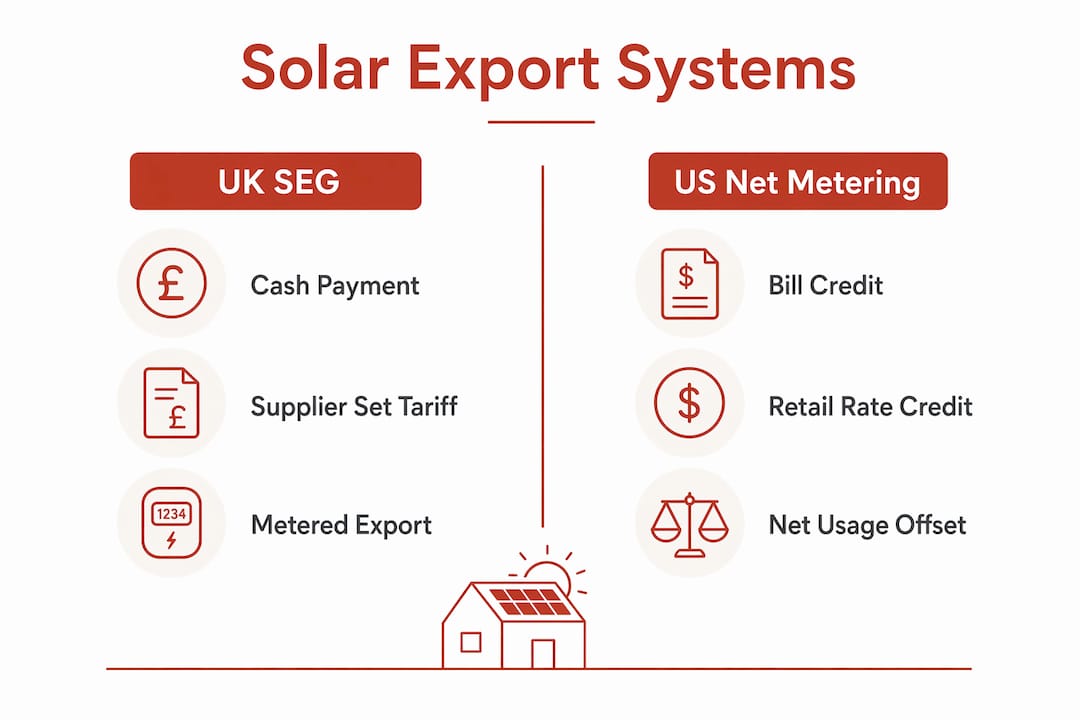
What this means in practice: you are paid a separate tariff for exports rather than having your import bill reduced unit-for-unit. A household importing electricity at 24p per kWh and exporting at 8p per kWh is still a net buyer of electricity at a significant cost difference—SEG export tariffs typically fall in the 5–15p per kWh range. That gap is precisely why battery storage and self-consumption strategies matter so much in the UK context.
Ofgem’s framework also means the SEG tariff is a genuine cash payment, not a bill credit, which creates a cleaner audit trail but also means you need to actively register with a supplier to receive it. It does not happen automatically when panels go on your roof.
What you must have to qualify for SEG payments
Eligibility is straightforward but non-negotiable. Miss any of these and you will not receive export payments.
- MCS certification: Your installation must be carried out by an MCS-registered installer and the system must be registered on the MCS database. This applies to most domestic solar PV systems up to 50 kWp. Without MCS paperwork, no SEG-obligated supplier will accept your application.
- Export-capable smart meter: You need a second-generation (SMETS2) smart meter configured to record export, or a dedicated export meter. First-generation meters often cannot report export data to your supplier remotely, which creates billing problems.
- System size: Domestic solar PV systems up to 50 kWp are eligible. Most home installations are 3–6 kWp, well within the limit.
- Supplier registration: You must actively apply to your chosen supplier’s SEG tariff. Your installer does not do this for you, though a good one will walk you through the process.
- DNO notification: Depending on system size, your installer must notify the local Distribution Network Operator (DNO) under G98 (systems up to 3.68 kW per phase) or G99 (larger systems). This is the installer’s responsibility, but worth confirming it has been done.
Understanding how a smart meter works with solar is worth doing before your installation date, because a meter swap can add several weeks to the timeline if it is not arranged in advance.
Pro Tip: Ask your installer to confirm MCS registration on the national database before they leave site. You can verify it yourself at mcscertified.com using the certificate number they provide.
How SEG payments are calculated and how to increase your export income
SEG tariffs are set by individual suppliers, not by government. The current market range commonly runs from about 5p to 15p per kWh. Octopus Energy, for example, offers competitive export tariffs and is worth comparing when you register.
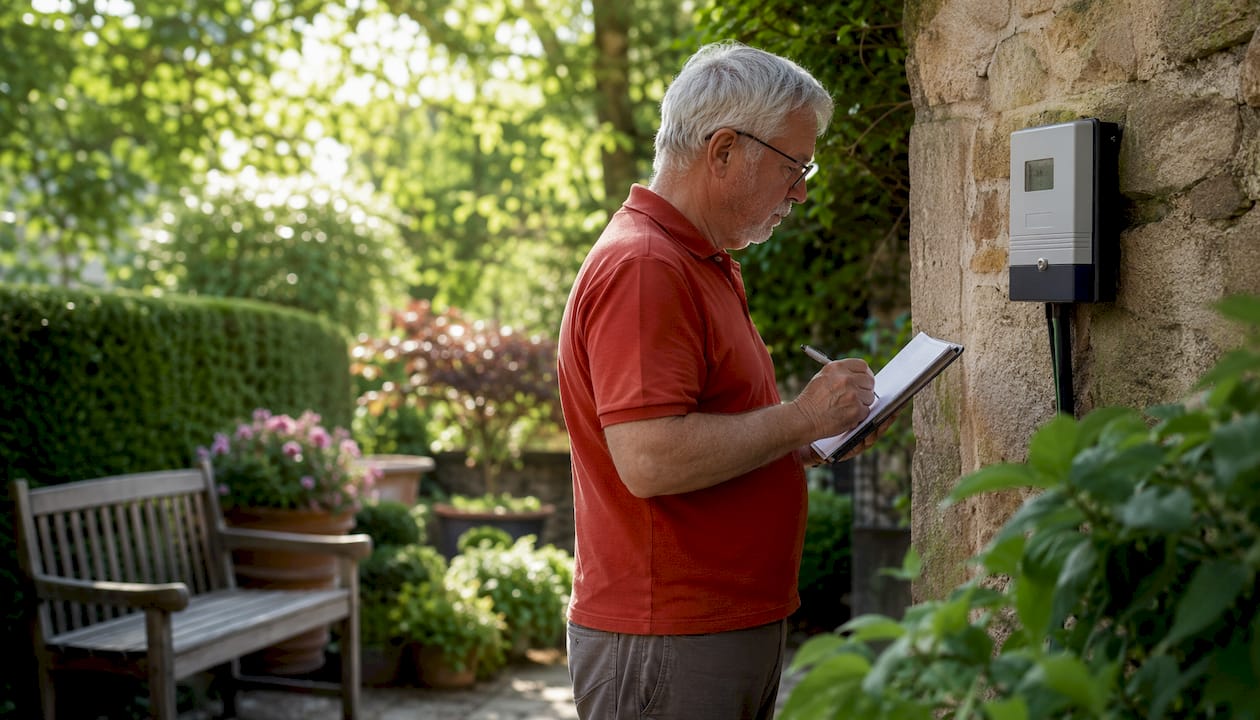
Metered export vs deemed export
Most SEG tariffs now require a metered export reading from a SMETS2 smart meter. A small number of older or simpler arrangements use a deemed export factor, typically assuming you export 50% of generation. Metered export is almost always more accurate and usually more favourable for households that self-consume heavily during the day.
Worked example for a Dorset home
Wareham’s solar yield is cited as relatively high for England, providing a good benchmark for much of the county. A 4 kWp system in that area can therefore generate around 4,200 kWh annually. If a household self-consumes a typical majority share of that, the remainder is exported. At a moderate SEG tariff, that produces a modest export income, on top of bill savings from the electricity used directly.
| 4 kWp, no battery | ~4,200 kWh | a typical majority share | the remainder is exported | a moderate SEG tariff | a modest export income
|
| 4 kWp + battery | ~4,200 kWh | self-consumes heavily during the day | the remainder is exported | a moderate SEG tariff | a modest export income
|
Adding a battery reduces export income but increases self-consumption savings, which are worth more per unit because you avoid paying import rates.
Switching SEG tariff or supplier
You are not locked in to your current supplier for SEG. You can switch energy supplier and register with a new SEG provider independently. Export agreements are separate from your import contract, so switching one does not automatically change the other. Check your SEG agreement for any notice period before switching.
- Compare tariffs at least annually, as rates change.
- Payments typically appear as a credit on your energy bill or as a separate bank transfer, depending on the supplier.
- Keep your own export meter readings as a cross-check against supplier statements.
Local Dorset support: grants, group-buy schemes and council initiatives
Dorset residents have access to several programmes that reduce upfront costs and provide impartial advice.

Switch Together Solar (Dorset Council): Dorset Council runs a group-buy solar scheme using a reverse auction model through independent experts iChoosr. Registered homeowners provide roof details, accredited installers bid competitively, and the most competitive pricing is recommended. You can add battery storage to the package. Installations under the current round were planned for completion by the end of June 2026. There is no obligation to proceed after registration. To participate, you must own your home or have landlord permission. Small and medium-sized enterprises and commonhold associations can also register.
Warm Homes Local Grant: Dorset Council and BCP Council have launched the Warm Homes Local Grant, funded by the Department for Energy Security and Net Zero. It covers insulation, heating upgrades, and renewable energy technologies for qualifying households. Eligibility requires an EPC rating of D to G and either an income below £36,000, a qualifying benefit, or residence in a qualifying postcode area. Owner-occupiers who qualify will not be expected to contribute towards eligible works.
Healthy Homes Dorset: This service provides impartial energy advice and can signpost tenants, landlords, and owner-occupiers to grant funding and support programmes. It is a useful first call if you are unsure which scheme applies to your situation.
- Check grant eligibility before committing to a full commercial installation, as funded measures can significantly reduce net cost.
- Local schemes have deadlines and funding caps, so early enquiry is advisable.
- Dorset Council’s planning guidance is broadly supportive of residential solar, which reduces planning risk for most standard roof installations.
Should you export to the grid or store it in a battery?
This is the most common question Dorset homeowners ask once they understand the SEG. The honest answer is that it depends on your consumption pattern, your EV situation, and the cost of the battery.
| Factor | Export via SEG | Battery storage |
|---|---|---|
| Payment rate | 5p–15p per kWh exported | Saves 20p–30p+ per kWh avoided import |
| Export measurement | Metered (SMETS2) or deemed | No export; self-consumption tracked internally |
| Eligibility / certification | MCS + export smart meter required | MCS for battery; no separate SEG registration needed |
| Setup time | Meter swap + supplier registration (4–8 weeks typical) | Installed at same time as panels or retrofitted |
| Financial outcome | Steady export income; lower if self-consumption rises | Higher savings per kWh; better with EV or evening demand |
Dorset Council’s own guidance recommends combining battery storage and EV charging with solar from the outset to maximise grid independence and long-term returns. That recommendation holds up financially when you consider that every unit stored and used at home avoids an import cost that is typically two to three times the SEG export rate.
Decision flow:
- High daytime electricity use (home workers, heat pumps): self-consumption is already high; battery adds less marginal value.
- Low daytime use but high evening demand or an EV to charge: a battery captures surplus generation and displaces expensive evening imports.
- High SEG tariff available and no EV: exporting may produce better short-term returns than a battery with a long payback.
- Planning to add an EV within two years: fit the battery now; the combined system pays back faster.
Pro Tip: Pairing a solar system with an EV charger and a battery means your car charges on surplus solar rather than grid electricity. On a solar and EV pairing setup, the savings on fuel costs alone can cut payback time by two or more years.
Step-by-step: how to get your Dorset solar exports paid under SEG
- Book a site survey. A qualified installer assesses roof orientation, shading, structural suitability, and your consumption profile. This shapes system size and battery recommendations.
- Confirm MCS certification. Agree in writing that the installer is MCS-registered and that the completed system will be registered on the MCS database. Ask for the certificate number before final payment.
- Arrange your smart meter. Contact your energy supplier to request a SMETS2 smart meter with export functionality before installation day. Meter swaps can take four to eight weeks, so start early.
- Installation and commissioning. The installer fits panels, inverter, cabling, and any battery. They carry out G98 or G99 DNO notification as required. Commissioning tests confirm the system is generating and exporting correctly.
- Receive MCS certificate and Electrical Installation Certificate. Both documents are needed for SEG registration and for any future property sale.
- Register for SEG with your chosen supplier. Compare tariffs, then apply online or by phone. You will need your MCS certificate number, meter serial number, and installation details.
- Verify your first export payment. Check that the kWh figure on your bill or payment statement matches your own monitoring data. Discrepancies are usually meter configuration issues, which your installer can resolve.
Typical timeline from survey to first SEG payment: six to twelve weeks, with meter swap and supplier processing accounting for most of the delay.
Typical costs, timeline and payback for Dorset homes
Dorset’s solar yield is genuinely above average for England. Wareham data puts yield at approximately 1,050 kWh per kWp per year, which is a useful benchmark for much of the county.
Residential solar installations currently attract 0% VAT, which meaningfully reduces the upfront cost compared with a few years ago.
| System | Approx. installed cost | Annual generation | Bill savings + SEG | Simple payback |
|---|---|---|---|---|
| 4 kWp panels only | typical installed cost range | expected annual generation | approximate annual savings including SEG | typical payback period |
| 4 kWp system with battery storage | higher installed cost range including battery | expected annual generation | approximate annual savings including SEG and battery benefits | typical payback period |
These figures are indicative. Actual savings depend on your tariff, self-consumption rate, and whether you qualify for grant support. A household on the Warm Homes Local Grant could see the net cost reduced substantially, shortening payback accordingly.
Key cost factors to discuss with your installer:
- Roof type and access (flat roofs or complex pitches add labour cost).
- Scaffolding requirements.
- Whether a battery is fitted at the same time as panels (cheaper than retrofitting later).
- Inverter specification: a hybrid inverter fitted now makes battery addition straightforward later.
What to ask a Dorset installer before you sign anything
Choosing the right installer protects your investment and your SEG eligibility. These are the questions worth asking at every meeting.
Credentials to request:
- MCS registration number (verify at mcscertified.com).
- NICEIC or NAPIT electrical registration.
- Public liability insurance certificate (minimum £2 million cover is standard).
- Inverter manufacturer warranty details (typically 5–12 years; some extend to 20 years with registration).
- Panel performance warranty (usually 25 years for power output).
Red flags:
- Pressure to sign a contract before a site survey has been completed.
- Vague or verbal-only promises about MCS registration.
- No written quote itemising panels, inverter, mounting, cabling, and labour separately.
- Unwillingness to provide references from recent local installations.
- No mention of DNO notification or G98/G99 paperwork.
Contract points to lock in:
- Written confirmation that the system will be MCS-registered.
- Commissioning date and what happens if it slips.
- Aftercare and servicing terms, including who handles inverter warranty claims.
- Confirmation of 0% VAT treatment for residential installation.
For retrofit considerations and what to check on an existing roof before installation, the solar retrofits homeowner’s guide covers the key structural and electrical checks in detail.
Maintaining your solar system to protect export income
A solar system requires relatively little maintenance, but skipping annual checks can quietly erode generation and create SEG billing discrepancies.
Annual checks:
- Inverter health: Review the inverter display or app for fault codes, efficiency figures, and any drop in output versus the previous year.
- Panel visual inspection: Look for cracked cells, bird fouling, moss, or debris accumulation, particularly on lower rows. Shading from new growth or nearby structures is a common cause of unexplained output drops.
- Cabling and junction boxes: Check for signs of discolouration, water ingress, or loose connections at the roof penetration points. A junction box issue left unaddressed can cause arc faults.
- Export meter readings: Record your own readings monthly and compare against supplier statements quarterly. A consistent discrepancy suggests a meter configuration error.
- Performance monitoring review: Most modern inverters provide app-based monitoring. Compare monthly kWh output against the same month in the previous year, adjusting for weather.
Between professional services, homeowners can safely clean panels with a soft brush and clean water (no detergents), check the inverter display for fault indicators, and confirm the monitoring app is still syncing data. A professional annual service should include a full electrical safety check and a written performance report.
Dorset case examples from Smarthometechnical
Smarthometechnical has completed solar installations across Dorset, covering a range of property types from coastal homes to rural farmhouses. A few patterns emerge consistently from local work.
A 4 kWp system on a south-facing roof in the Wareham area, paired with a 5 kWh battery, typically achieves self-consumption above 75% during summer months. The battery absorbs afternoon surplus and covers early evening demand, reducing the volume exported but significantly cutting import costs. SEG registration was completed within six weeks of commissioning in recent installs, with the main delay being the smart meter swap arranged through the homeowner’s supplier.
Pro Tip: Dorset’s coastal and rural properties often have aerial or satellite dish positions that create unexpected shading in winter when the sun is low. A good installer will model shading across all seasons, not just summer. See our guide on solar panel aerial interference for what to look for.
Key takeaways
The UK uses the Smart Export Guarantee, not net metering: Dorset homeowners must have MCS certification, an export-capable smart meter, and an active SEG registration with a supplier to receive export payments.
| Point | Details |
|---|---|
| SEG, not net metering | The UK pays a supplier tariff of about 5–15 pence per kWh for exports; there is no one-for-one bill credit. |
| MCS certification is mandatory | No MCS certificate means no SEG eligibility; always verify registration on the MCS database. |
| Dorset yield advantage | At ~1,050 kWh/kWp, a 4 kWp Dorset system can generate around 4,200 kWh/year, improving payback. |
| Battery vs export trade-off | Batteries save more per kWh than SEG pays; the right choice depends on your evening demand and EV use. |
| Smarthometechnical | Offers full solar installation, MCS registration, battery and EV charger pairing, and aftercare across Dorset. |
A Dorset installer’s perspective
Most of the Dorset homeowners who contact us have already spent time searching for “net metering” and come away confused. That confusion is understandable. The term is everywhere online, most of it written for a US audience, and it creates a false expectation that exported solar electricity will simply cancel out your import bill. It does not work that way here, and that gap between expectation and reality is where a lot of frustration starts.
What I find more interesting is the flip side of that story. Because the SEG pays a lower rate than you pay for imports, the real financial case for solar in Dorset is not about export income at all. It is about self-consumption. Every unit you generate and use yourself is worth the full import rate you avoid paying. That is where the payback actually comes from. Export income is a bonus, not the engine.
The households that get the best results are the ones who think about this from the start: right-size the system for their consumption, add a battery if they have evening demand or an EV, and treat the SEG as a useful top-up rather than the primary return. Dorset’s yield figures support that approach well. The county gets enough sun that even a modest 3–4 kWp system makes a genuine dent in annual bills, and the group-buy and grant options available locally mean the upfront cost is more manageable than many people assume.
The one thing I would push back on is the idea that you should wait for a better scheme or a bigger grant before acting. Tariffs, VAT treatment, and local grant windows all change. The system you install today starts paying back from day one.
Smarthometechnical: solar installation and SEG support in Dorset
Getting paid for your solar exports starts with the right installation, and that means MCS certification, the correct metering, and a system sized for your actual consumption rather than a generic template.
Smarthometechnical handles the full process for Dorset homeowners and businesses: site survey, system design, MCS-certified installation, smart meter coordination, battery and EV charger pairing, and ongoing aftercare. There are no hidden extras and no pressure to sign before you have seen a written proposal. The team covers Dorset, Hampshire, and Devon.
If you are ready to understand what a solar system would actually generate and earn at your property, the practical next step is a no-obligation site survey. Book yours or get a quote directly at Smarthometechnical solar installations.
Useful sources and where to check for updates
SEG tariffs change, and local grant schemes have deadlines and funding caps. Check these sources before making any financial decision, and revisit them annually.
- Smart Export Guarantee — GOV.UK: The official scheme rules, supplier obligations, and eligibility criteria. The primary source for any SEG question.
- Switch Together Solar — Dorset Council: Current round details, registration, and battery add-on options for the group-buy scheme.
- Warm Homes Local Grant — Dorset Warm Homes: Eligibility checker and application route for the Warm Homes Local Grant covering Dorset and BCP Council areas.
- Grants and funding for individuals — Dorset Council: Healthy Homes Dorset impartial advice and signposting to current funding streams.
- MCS Certified: Verify any installer’s MCS registration and check your own system’s certificate status.
- Ofgem: Regulator for the SEG; publishes supplier compliance data and consumer guidance.
- Smarthometechnical solar installations: Local contact for Dorset site surveys, MCS-certified installations, and SEG setup support.
SEG tariffs are reviewed by suppliers at their discretion, so comparing rates every twelve months is worthwhile. Local grant windows, particularly the Warm Homes Local Grant, operate on annual funding cycles and can close without much notice. Checking eligibility early costs nothing and could save thousands.
This article provides general information about solar export payments and local schemes in Dorset. It is not financial or legal advice. Confirm current tariffs, grant eligibility, and scheme rules directly with the relevant supplier, Ofgem, or Dorset Council before making any investment decision.
Recommended
- Solar panel aerial interference Dorset: what you need to know – Smart Home Technical Ltd
- How smart meters work with solar panels in the UK – Smart Home Technical Ltd
- Solar in Hampshire retrofits: a homeowner’s guide – Smart Home Technical Ltd
- Solar system annual service Dorset: homeowner’s guide – Smart Home Technical Ltd
