
Pairing an EV charger with solar panels is defined as using your home’s solar generation to supply electricity directly to your electric vehicle, cutting the cost of charging to a fraction of grid rates. For Hampshire homeowners, this combination delivers two clear wins: lower energy bills and a smaller carbon footprint. Solar-EV integration can reduce the cost per mile from as much as 20p on public chargers to as little as 1–2p using solar surplus. The key enabling technologies are CT clamps, solar-diverting smart chargers, and smart overnight tariffs.
What does EV charger solar panel pairing in Hampshire actually involve?
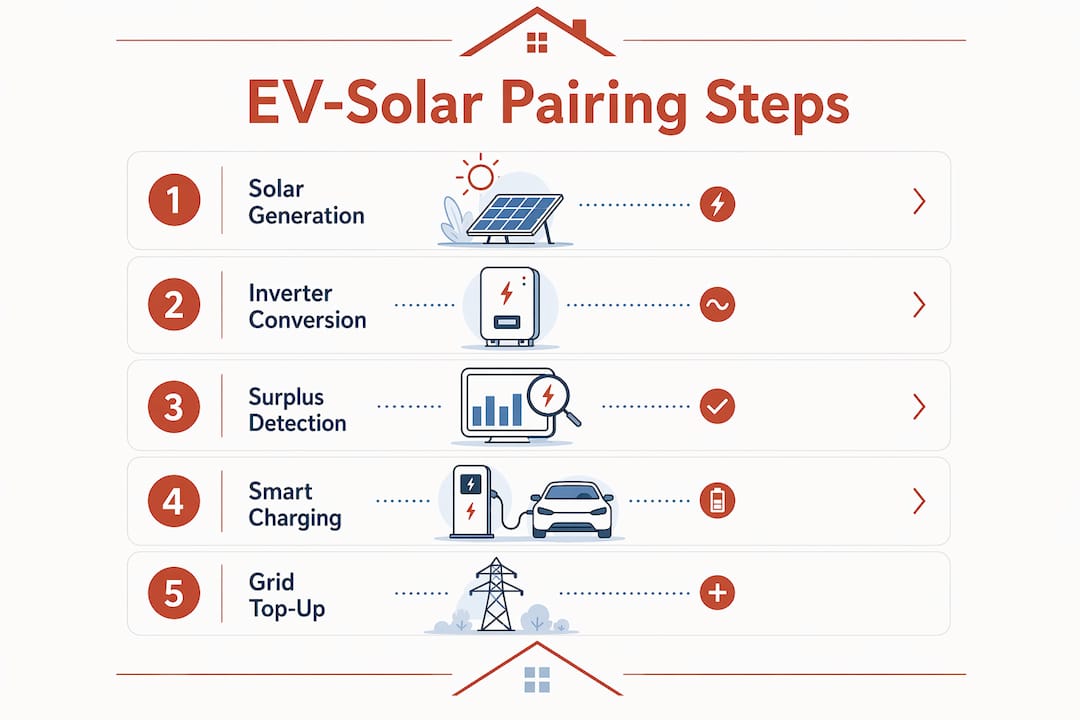
Solar-EV integration works by measuring your home’s live solar output and directing any surplus energy to your car rather than exporting it to the grid. Without this coordination, your EV charger simply draws from the grid regardless of how much sun your panels are generating. The result is a wasted opportunity every sunny afternoon.
Hampshire sits in southern England, which means 4–5 peak sun hours per day on average, varying between summer highs and winter lows. That seasonal variation matters when you are sizing a system and setting realistic expectations. A well-designed setup accounts for both the best and worst months.
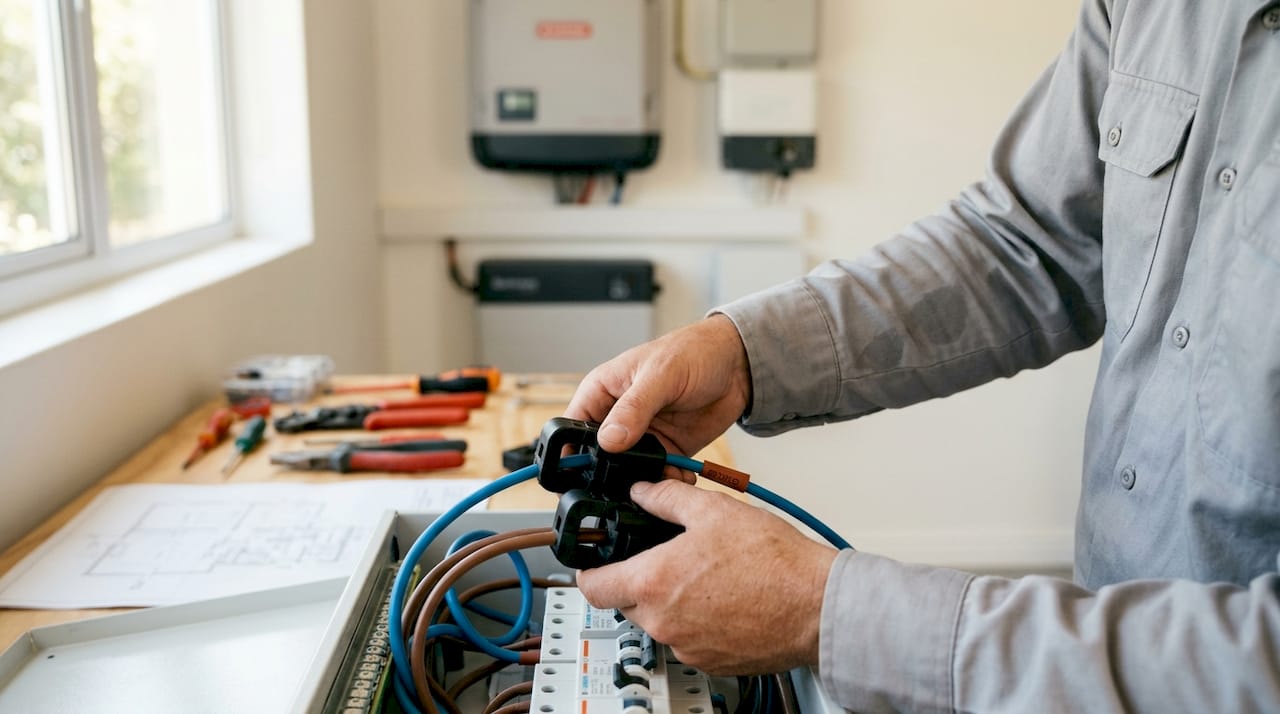
Three components make the pairing work. First, your solar panels generate DC electricity, which your inverter converts to AC for household use. Second, a CT clamp fitted at your main meter reads the real-time balance between generation and consumption. Third, a solar-diverting smart charger reads that CT clamp data and ramps its charging power up or down to match available surplus.
Is your existing solar system ready to add an EV charger?
Before adding an EV charger, assess your current solar array carefully. The size of your array determines how much surplus is realistically available for car charging on a typical day.
Key checks to carry out before installation:
- Array size and output. A 3.5 kW solar array can support roughly 14 kWh per day of charging demand, which suits most daily commutes in Hampshire.
- Inverter compatibility. Confirm whether your inverter supports smart energy management or communicates with third-party chargers. Older string inverters may need upgrading.
- CT clamp presence. Without CT clamps at your main incoming supply cable, your charger cannot distinguish solar power from grid power. Many existing installations lack them.
- Consumer unit capacity. Check that your consumer unit has a spare way for the EV charger circuit and that the overall load capacity is sufficient.
Pro Tip: Ask your installer to check your inverter’s data export capability. If it can push live generation data to a home energy management system, you gain far more control over how solar surplus is allocated.
Hampshire homes with systems installed before 2020 often lack CT clamps entirely. Retrofitting them is straightforward, but it must be planned before the EV charger goes in, not after.
How do you choose the right EV charger for solar pairing?
The charger you choose determines how well your system uses solar surplus. Not all smart chargers are equal when it comes to PV diversion.
Solar-diverting chargers
Chargers with built-in PV diversion, such as the Zappi, dynamically adjust charging power based on the solar surplus reading from CT clamps. The Zappi includes its own CT clamps and works with any solar system, making it one of the most practical choices for Hampshire retrofits. Other chargers rely on third-party energy management platforms to achieve similar results.
Charger power levels
A 7.4 kW single-phase charger is the standard for most Hampshire homes. It draws more power than a typical solar array produces alone, so the charger will blend solar and grid power during partial-sun periods. A 3.6 kW charger charges more slowly but matches solar output more closely on bright days, reducing grid top-ups.
| Charger type | Solar matching | Typical charge speed |
|---|---|---|
| 3.6 kW single-phase | High on sunny days | Slower overnight top-up |
| 7.4 kW single-phase | Moderate, blends solar and grid | Standard for most homes |
| 22 kW three-phase | Low solar match, grid-heavy | Fast, requires three-phase supply |
Smart tariffs as a complement
Smart tariffs like Octopus Intelligent Go fill the gap when solar generation is low. They allow your charger to top up overnight at off-peak rates, so your car is always ready regardless of the previous day’s weather. Combining a solar-diverting charger with a smart overnight tariff is the most reliable year-round strategy for Hampshire homeowners.
Pro Tip: Set your charger’s minimum state of charge to 20% and let the solar divert mode handle the rest during the day. The smart tariff then tops up to your target overnight. You rarely need to think about it again.
What does the installation process look like?
A well-planned installation avoids costly rework. Combining solar and EV charger installation in one project reduces overall costs, saves time on permits, and avoids redundant panel upgrades.
- System design. Size the EV load first, then confirm the solar array and any battery storage can support it. Decide early whether you want a DC-coupled or AC-coupled system, as this affects cost and future flexibility.
- Consumer unit assessment. Confirm the consumer unit can accommodate the EV charger circuit. Electrical panels sized with 20% headroom for EV load allow for future expansion without costly retrofits.
- Permissions and notifications. Notify your Distribution Network Operator (DNO) if your combined solar and EV system exceeds the threshold for your area. Your installer handles this, but confirm it is on their checklist.
- CT clamp installation. Fit CT clamps at the main incoming supply cable before the EV charger is commissioned. Correct CT clamp placement is the single most common oversight in solar-EV installations.
- Circuit installation. Run a dedicated circuit from the consumer unit to the charger location. The circuit must be sized for the continuous load of the charger.
- Charger installation and configuration. Mount and wire the charger, then configure its solar divert mode and link it to your CT clamp or energy management system.
- Commissioning and testing. Test the system on a sunny day to confirm the charger ramps up as solar surplus increases. Verify the smart tariff schedule activates correctly overnight.
Proper coordination between your solar installer and EV charger installer is not optional. Each party must confirm CT clamp positioning, metering setup, and control system configuration before sign-off. A single miscommunication here can mean months of charging from the grid instead of your roof.
Most solar installations require a licensed electrician and active coordination between the solar and EV charger teams. Smarthometechnical manages both sides of this process, which removes the coordination risk entirely.
How do you get the most from your solar and EV charging setup?
Once your system is live, a few practices make a significant difference to how much free solar energy your car actually uses.
- Schedule charging during peak solar hours. Set your charger’s solar divert mode to activate between 10:00 AM and 3:00 PM, when Hampshire solar generation is typically highest.
- Monitor CT clamp data. Most solar-diverting chargers provide an app showing real-time surplus. Reviewing this weekly helps you spot CT clamp drift or inverter issues early.
- Add battery storage. A home battery captures midday surplus that your car cannot absorb and releases it for evening charging. The hybrid solar battery approach is particularly effective in Hampshire, where cloud cover can interrupt midday generation.
- Use a ‘set-and-forget’ strategy. Solar divert mode paired with a smart overnight tariff gives you year-round savings without daily manual adjustments. You set the rules once and the system handles the rest.
- Avoid common mistakes. The most frequent errors are incorrect CT clamp placement, failing to enable solar divert mode after installation, and using a charger that lacks PV diversion capability entirely.
Pro Tip: Check your solar battery savings data after the first full month. If your solar self-consumption rate is below 60%, your CT clamps may be misplaced or your divert settings need adjusting.
Solar-aware charging saves money even in winter. Smart tariff overnight charging alone saves roughly £40 annually, and that figure rises substantially when combined with a solar and battery system.
Key takeaways
Pairing a solar-diverting smart charger with CT clamps and a smart overnight tariff is the most effective way for Hampshire homeowners to cut EV charging costs and maximise solar self-consumption year-round.
| Point | Details |
|---|---|
| CT clamps are non-negotiable | Without CT clamps at the main meter, your charger cannot use solar surplus and defaults to grid power. |
| Charger choice determines solar use | Solar-diverting chargers like the Zappi actively match charging power to available solar surplus. |
| Smart tariffs fill the gaps | Octopus Intelligent Go and similar tariffs cover low-sun periods with affordable off-peak grid charging. |
| Combined installation saves money | Planning solar and EV charger installation together reduces costs and avoids redundant upgrades. |
| Battery storage extends savings | Adding a home battery captures midday surplus for evening and overnight EV charging. |
What I have learned from Hampshire solar-EV installations
After working on solar and EV charger installations across Hampshire, the pattern I see most often is this: homeowners invest in a good solar array and a quality charger, then lose most of the benefit because the CT clamps were never fitted correctly. It sounds like a small detail. It is not. The CT clamp is the brain of the whole system. Without it reading accurately, you are just charging from the grid with extra steps.
The second thing I have noticed is that people underestimate how well the ‘set-and-forget’ approach works in practice. Hampshire weather is variable, but a solar-diverting charger combined with a smart overnight tariff handles that variability automatically. You do not need to watch the sky and manually switch modes. The system does it.
My honest recommendation is to plan the solar array and EV charger as a single project from day one. The cost saving from avoiding a second round of electrical work and DNO notifications is real. And the system performs better when both sides are designed together rather than bolted on separately. If you are retrofitting a charger onto an existing solar system, the first question to ask your installer is not “which charger?” It is “where are my CT clamps going?”
— Simon
Solar and EV charging solutions from Smarthometechnical
Hampshire homeowners who want a properly integrated solar and EV charging system need one team managing both sides of the installation. Smarthometechnical specialises in combined solar panel installations and EV charger setups, handling system design, CT clamp installation, DNO notifications, and commissioning under one roof.

Every installation is designed around your specific roof, your daily mileage, and your existing electrical setup. Smarthometechnical also provides post-installation support, so if your solar divert settings need adjusting or your smart tariff schedule needs updating, you have a team to call. For homeowners considering EV charger installation alongside a new or existing solar system, getting in touch early means the system is designed correctly from the start, not corrected after the fact.
FAQ
What is solar-aware EV charging?
Solar-aware EV charging uses CT clamps at your main meter to detect solar surplus and automatically directs that surplus to your EV charger, reducing grid power draw and cutting charging costs.
Do I need a special charger to use solar energy for my EV?
Yes. A standard charger draws from the grid regardless of solar output. A solar-diverting charger, such as the Zappi, reads CT clamp data and adjusts its power to match available solar surplus.
How much can I save by pairing solar panels with an EV charger in Hampshire?
Charging costs can fall from around 12–20p per mile on public chargers to as little as 1–2p per mile using solar surplus, with additional savings from smart overnight tariffs during low-sun periods.
Can I add an EV charger to my existing solar system?
Yes, but your installer must fit CT clamps at the main incoming supply cable and confirm your inverter and consumer unit are compatible before the charger is commissioned.
Does solar EV charging work in winter in Hampshire?
Solar generation is lower in winter, but combining a solar-diverting charger with a smart tariff like Octopus Intelligent Go ensures your car charges affordably overnight when solar output is insufficient.
Recommended
- Hybrid solar battery system hampshire: 2026 guide – Smart Home Technical Ltd
- Solar system fault finding Hampshire: 2026 guide – Smart Home Technical Ltd
- Hampshire new build solar options: 2026 guide – Smart Home Technical Ltd
- Solar in Hampshire retrofits: a homeowner’s guide – Smart Home Technical Ltd
