
A solar system annual service in Dorset is a comprehensive on-site inspection and maintenance visit that checks every critical component of your installation to maintain safety, performance, and warranty compliance. Most homeowners assume their monitoring app tells the full story. It does not. Physical problems like damaged cable clips or water ingress are completely invisible to remote monitoring and only caught during an on-site visit. For Dorset homeowners specifically, the county’s coastal salt air and bird fouling create conditions that accelerate wear far faster than inland UK locations. Smarthometechnical, as a specialist renewable energy contractor, sees this difference regularly across local installations.
What does a solar system annual service include in Dorset?
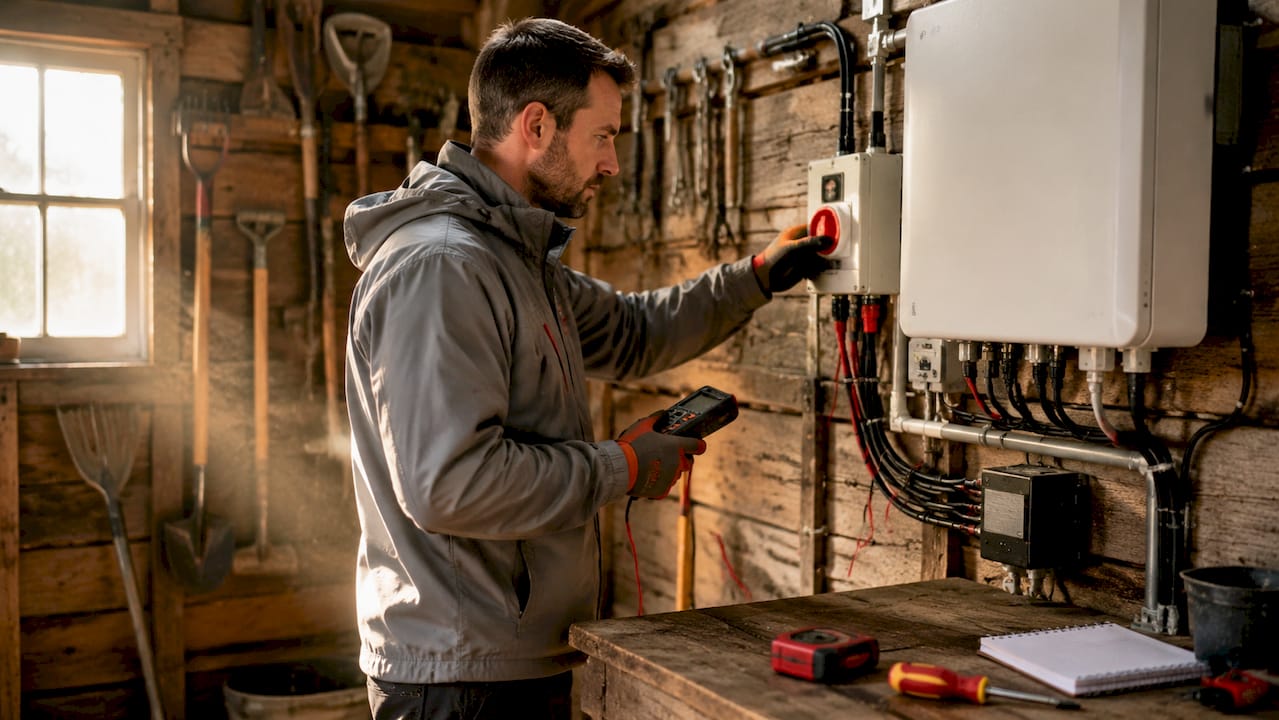
A professional annual solar service covers every component your monitoring system cannot see. Engineers physically check panels, cabling, isolators, inverter, battery, and earthing during a single on-site visit, then produce a written report with recommendations. That report is what separates a genuine service from a quick visual check.
The inspection covers the following areas:
- Panel condition: Cracks, delamination, soiling, and physical damage from weather or debris
- Cabling and connectors: Checking for UV degradation, loose MC4 connectors, and signs of arcing
- DC and AC isolators: Confirming correct operation and testing for wear or heat damage
- Inverter: Verifying fault codes, performance data, and ventilation clearance
- Battery storage: Assessing state of health and connection integrity where a battery is installed
- Earthing and earth-bond continuity: Confirming the system is correctly earthed to prevent shock risk
- Water ingress points: Roof penetrations, junction boxes, and inverter enclosures checked for moisture
- Consumer unit connection: Verifying the AC connection at the consumer unit is secure and correctly labelled
Electrical safety checks including DC and AC isolator testing and earth-bond continuity are particularly important because faults in these components can cause fires or system shutdowns with no warning. Dorset’s coastal climate means salt deposits can work into connector housings over time, making these checks more urgent than they would be for an inland property.
Pro Tip: Ask your engineer to confirm they will test DC isolator operation under load, not just visually inspect it. Isolators that appear fine can fail under operating conditions.
How to prepare for your annual solar service
Getting ready before the engineer arrives saves time and helps you get more from the visit. Here is what to do:
- Gather your documentation. Warranty certificates for your MCS, inverter, panels, and batteries should be accessible, including expiry dates. If you cannot find paper copies, check your original installer’s email correspondence.
- Download your monitoring data. Export or screenshot the last 12 months of generation data from your inverter app, whether that is SolarEdge, Solis, GivEnergy, or another platform. This gives the engineer a baseline to compare against.
- Note any symptoms you have observed. Reduced output on sunny days, error codes, unusual sounds from the inverter, or tripped breakers are all worth mentioning. Write them down so nothing is forgotten.
- Clear access to the inverter and consumer unit. Engineers need unobstructed access to both. Move any storage boxes, shelving, or furniture that blocks the inverter location.
- Check your roof access situation. If your panels are on a difficult pitch or require specialist access equipment, let the contractor know in advance so they arrive prepared.
Annual service timing is best in spring ahead of the high-generation summer months, so any issues are resolved before your system is working hardest. For Dorset homeowners near the coast, a spring service also addresses any salt and grime build-up from winter storms before it compounds further.
Pro Tip: A professional annual visit requires only a one-off booking with no ongoing commitment, so there is no reason to delay if your system has not been serviced in over 12 months.
Step-by-step breakdown of the annual service process
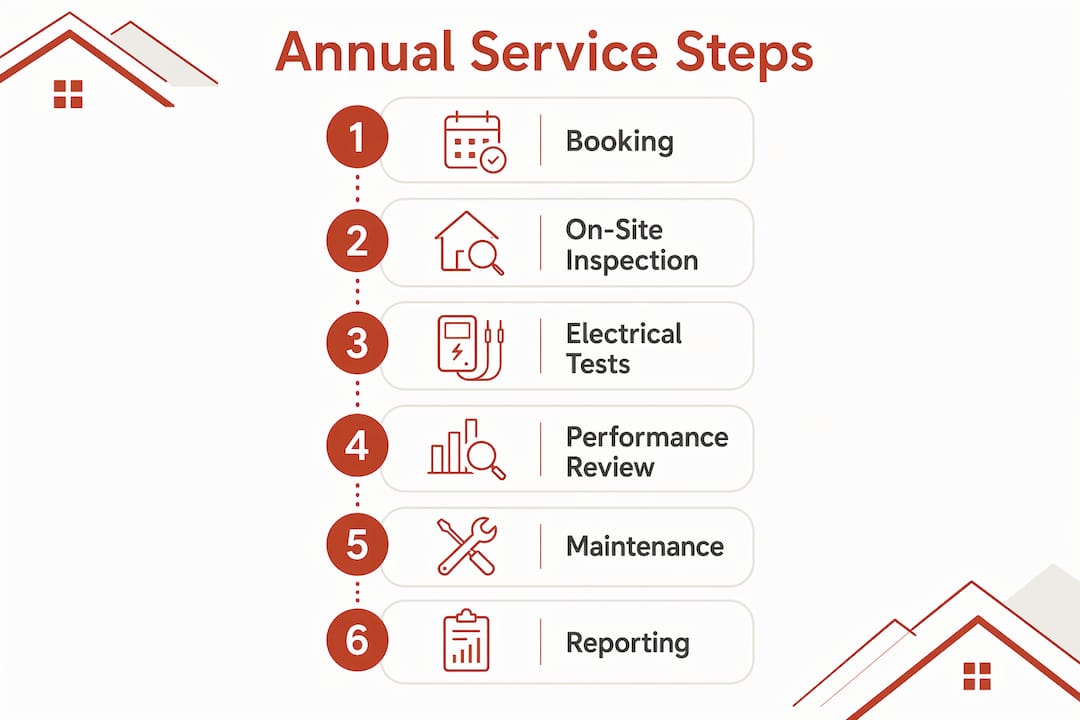
Understanding the sequence of the visit helps you know what to expect and why each stage matters.
- Performance data review. The engineer reviews your generation history against your original MCS design estimate. A significant shortfall flags a potential fault before the physical inspection begins.
- Visual roof and panel inspection. Panels are inspected from roof level for physical damage, soiling, shading from new growth, and mounting integrity. In Dorset coastal areas, salt air accelerates corrosion at frame edges and mounting brackets, so this stage takes longer than it would inland.
- Electrical component testing. DC isolators, AC isolators, and earth-bond continuity are tested with appropriate instruments. This is not a visual check. It requires a qualified electrician with the correct test equipment.
- Inverter and battery assessment. The inverter is checked for fault logs, firmware status, and correct operation. Where a battery is installed, state of health is assessed. Battery state of health that falls below 80% within warranty warrants a formal assessment and potential warranty claim.
- Cleaning if required. Typical UK soiling loss is 1 to 3% annually, meaning cleaning is often unnecessary for inland systems. Dorset coastal properties are the exception. Salt and bird fouling can reduce output noticeably, and the engineer will clean panels where the build-up justifies it.
- Written report and debrief. The visit concludes with a written maintenance report covering findings, any remedial work required, and a recommended timeline for next steps.
| Service stage | What it confirms |
|---|---|
| Performance data review | Generation is meeting MCS design estimates |
| Physical panel inspection | No physical damage, soiling, or mounting failures |
| Electrical safety testing | Isolators, earthing, and connections are safe and functional |
| Inverter and battery check | No fault codes, firmware is current, battery SoH is acceptable |
| Written report | Documented record for warranty and insurance purposes |
Common issues found during annual solar inspections
Dorset solar installations share a set of recurring problems that a professional service catches before they become expensive faults.
- Corroded MC4 connectors. Salt air works into connector housings over several years, causing resistance that reduces output and creates heat. This is one of the most common findings on coastal properties and is undetectable without physical inspection.
- DC isolator wear. DC isolators are exposed to UV and temperature cycling. Worn isolators can fail to disconnect the system safely, creating a serious risk during maintenance or emergency situations.
- Water ingress at roof penetrations. Poorly sealed cable entry points allow moisture into junction boxes and inverter enclosures. Left unaddressed, this causes corrosion and can trigger inverter faults.
- Damaged cable clips and conduit. UV exposure degrades plastic cable management components over time. Loose cables can chafe against roof surfaces, eventually damaging insulation.
- Bird fouling and nesting. Pigeons nesting under panels are a growing problem across Dorset. Fouling reduces output, and nesting material creates a fire risk near cabling.
“The problems that cause the most expensive repairs are almost never the ones homeowners notice themselves. They are the slow, invisible faults that build up between services.”
Homeowners sometimes notice symptoms linked to these issues: a drop in generation on otherwise sunny days, an inverter that resets overnight, or a tripped breaker with no obvious cause. These are signals worth investigating rather than ignoring. Timely attention to a corroded connector costs a fraction of replacing an inverter that has been running in a degraded state for two years.
Key takeaways
A professional solar system annual service in Dorset is the only reliable way to catch physical faults, maintain warranty compliance, and protect long-term system performance in a coastal environment.
| Point | Details |
|---|---|
| Physical inspection is irreplaceable | Remote monitoring cannot detect corroded connectors, water ingress, or isolator wear. |
| Dorset’s coastal climate increases risk | Salt air and bird fouling accelerate component degradation faster than inland UK locations. |
| Spring is the optimal service window | Servicing before summer maximises performance during peak generation months. |
| Documentation speeds up the visit | Having MCS certificates, warranty documents, and monitoring data ready saves time and supports claims. |
| Battery health needs professional assessment | State of health below 80% within warranty requires formal evaluation, not just monitoring data. |
What I have learned from servicing Dorset solar systems
I have been working on solar installations across Dorset for years, and the pattern I see most consistently is this: the homeowners who skip annual servicing are not being reckless. They are trusting their monitoring app, which shows green, and assuming everything is fine. The problem is that the app only tells you what the inverter is reporting. It has no idea what is happening at the connectors on your roof, inside your isolator housing, or at the cable entry point where water has been slowly pooling for 18 months.
The coastal factor in Dorset is genuinely significant. I have inspected systems in Weymouth and Swanage that looked perfect on monitoring data but had MC4 connectors with visible corrosion and isolators that were borderline unsafe. The same systems in Wiltshire or Somerset would likely have been fine for another two or three years without intervention. Location changes the risk profile entirely.
My honest recommendation is to treat the annual service the same way you treat a boiler service. You would not skip that because the heating is working. The value is in catching what you cannot see before it becomes what you cannot afford to ignore. Choose a contractor who provides a written report. If they cannot give you documentation of what was tested and what was found, the visit has limited value for warranty purposes or future fault diagnosis.
— Simon
How Smarthometechnical can help Dorset homeowners
Smarthometechnical provides professional solar system annual services across Dorset, carried out by qualified electrical contractors who specialise in renewable energy. Every visit includes a physical on-site inspection, electrical safety testing, and a written report you can keep for warranty and insurance purposes.
Whether your system was installed recently or has been running for several years without a formal check, the team at Smarthometechnical can assess its condition and advise on any remedial work needed. The company also handles solar panel installation and battery storage, so if your service reveals a component that needs upgrading, you are dealing with one contractor who knows the full picture. You can also explore EV charger installation and home energy management as part of a broader clean energy setup. Contact Smarthometechnical via the website to book your annual service or discuss your system’s needs.
FAQ
What is included in a solar system annual service?
A professional annual service covers a physical inspection of panels, cabling, isolators, inverter, battery, and earthing, followed by a written report. Engineers check components that remote monitoring cannot verify, including water ingress points and electrical safety.
How often should I service my solar panels in Dorset?
Once per year is the standard recommendation, with spring being the preferred timing ahead of peak summer generation. Dorset’s coastal environment means annual servicing is more important here than in many other UK regions.
Can I service my solar panels myself?
Homeowners can safely carry out ground-level visual checks and monitor output data, but electrical testing of isolators, earth-bond continuity, and inverter components requires a qualified electrician. DIY checks do not satisfy warranty or insurance requirements.
How do I know if my solar system needs a service urgently?
Reduced output on sunny days, inverter error codes, tripped breakers, or visible damage to panels or cabling are all signs that warrant an inspection sooner rather than waiting for the annual cycle.
Does an annual service protect my warranty?
Yes. Keeping records of professional annual inspections supports warranty claims for panels, inverters, and batteries. Warranty certificates and installation documentation should be available at the time of service to streamline any claims process.
