
Solar can work on many Dorset period properties. The honest answer is yes, with caveats — and those caveats matter enough that your first call should be to a heritage-aware installer who will survey the roof before quoting a price. Smarthometechnical offers exactly that kind of site visit across Dorset, and it is the sensible starting point for any period-home owner considering solar energy solutions in Dorset.
The three things that most often complicate the picture:
- Listed-building status — Grade I and Grade II* listings almost always require listed-building consent before any panels go up; Grade II is more flexible but still needs careful handling.
- Roof condition and type — thatched roofs cannot carry PV directly; aged slate or clay-tile roofs may need structural assessment before any mounting frames are fixed.
- Shading and orientation — many period homes sit in mature gardens or tight village plots where tree canopy or neighbouring buildings cut output significantly.
None of these is a deal-breaker on its own. They are simply the starting checklist for any competent installer working on older homes in Dorset.
Table of Contents
- Does Dorset get enough sun to make solar worth it?
- Can your period property actually take solar panels?
- Which system size suits a Dorset period home?
- What does installation cost, and are there local grants?
- How to choose a heritage-aware installer: questions to ask
- What to expect: timeline and disruption
- Aftercare: servicing, warranties and long-term planning
- What Athelhampton Zero teaches smaller period-home owners
- Key takeaways
- Why the conservation-aware approach matters more than the panels themselves
- Smarthometechnical: heritage-aware solar for Dorset period homes
- Useful sources and where to check current guidance
Does Dorset get enough sun to make solar worth it?
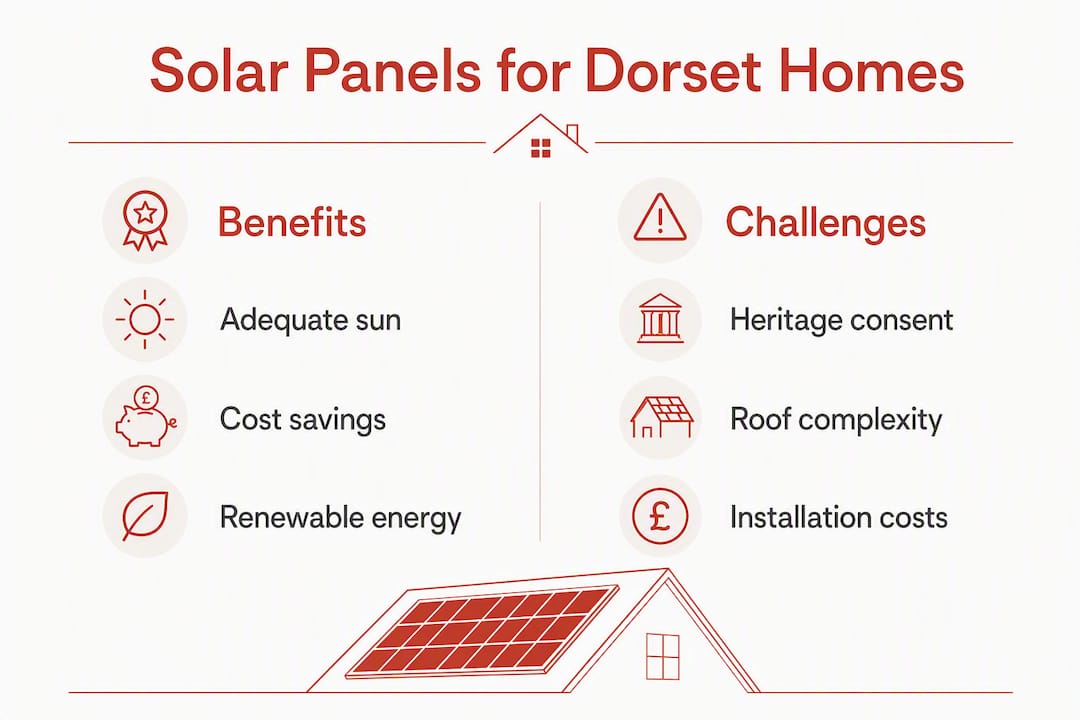
Dorset sits in one of the better-performing solar zones in England. The county’s southerly latitude, relatively low average cloud cover compared with northern England, and the moderating effect of the coast all contribute to a solar resource that is stronger than the UK average. The European Commission’s PVGIS tool lets you enter any Dorset postcode and get a site-specific irradiation estimate, which is worth doing before you commit to anything.
A worked example for a typical Dorset period home
A south-facing 4 kWp system on a Dorset roof typically generates around 3,400–3,600 kWh per year under average local conditions. A household using roughly 3,500 kWh annually might self-consume perhaps half of that generation directly, with the rest exported to the grid or stored in a battery. At current electricity prices, direct self-consumption of around 1,700 kWh per year could represent a saving in the region of £500–£600 annually, before any export payments.
Factors that make Dorset particularly favourable for solar panel installations that survive salt spray and corrosion:
- Higher-than-average annual sunshine hours for England
- Coastal weather patterns that clear cloud cover more quickly than inland areas
- Lower heating demand in mild coastal zones, meaning solar can contribute proportionally more to overall energy costs
- Good roof pitches on many traditional Dorset properties (30–45 degrees), which align well with optimal panel angles
A 3 kWp system on a smaller period cottage would generate proportionally less, around 2,500–2,700 kWh per year, but can still make a meaningful dent in electricity bills, particularly when paired with a battery.
Can your period property actually take solar panels?
Many period homes can accept photovoltaic (PV) panels with the right approach. The key word is appropriate — appropriate to the building’s fabric, its heritage status, and its roof geometry. Getting this wrong is expensive to undo.
When do you need planning or listed-building consent?
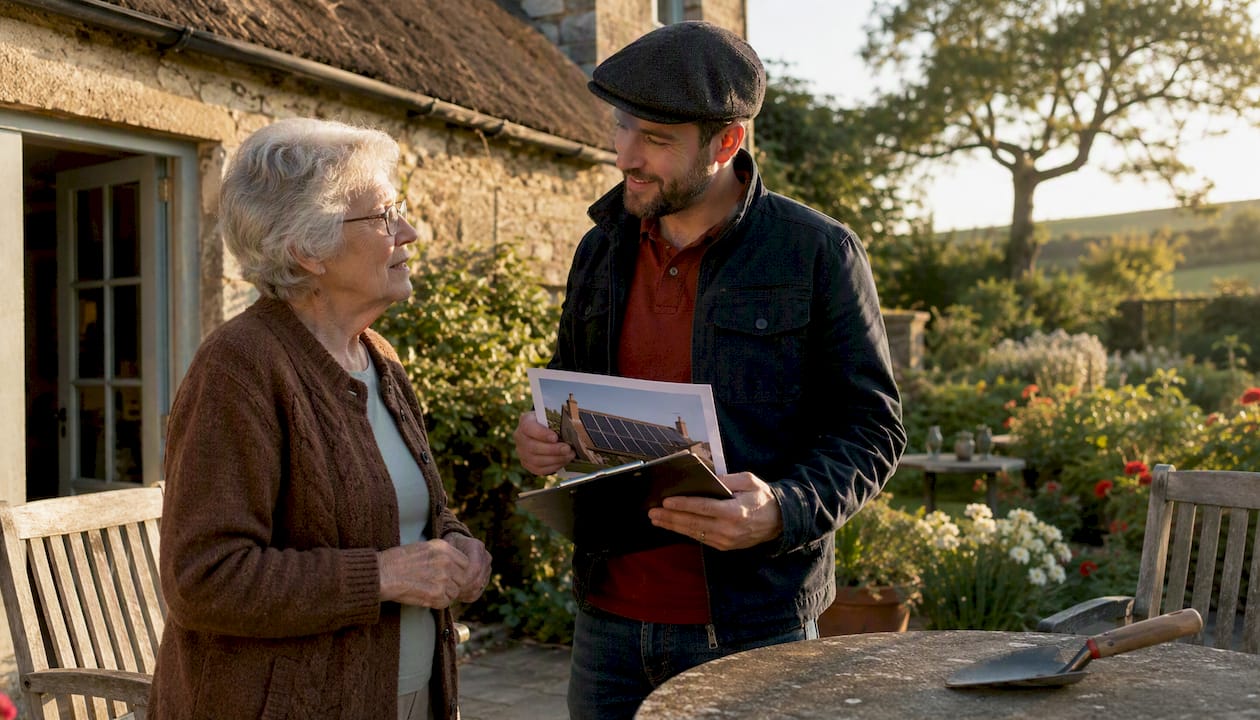
For most unlisted homes in conservation areas, solar panels on a rear roof slope are permitted development, meaning no planning application is required. The moment a property is listed, that changes. Listed-building consent is required for any works that affect the character of a listed building, and panels on a principal elevation almost certainly do qualify. Grade I and Grade II* properties face the highest bar; Grade II listings are assessed case by case, and rear or hidden roof slopes often gain approval.
Contacting the local conservation officer early is not optional — it is the move that separates projects that complete on time from those that stall for months. A good installer will produce visual mock-ups and, where required, a Heritage Impact Assessment before the application goes in. Practical planning engagement at this stage often shortens approval timelines and avoids costly rework.
Mounting options for different period roof types
| Roof type | Typical mounting approach | Key considerations |
|---|---|---|
| Clay or plain tile | Flush-mounted, low-profile hooks | Tile replacement on removal; check for fragile originals |
| Natural slate | Specialist slate hooks; minimal tile lifting | Irreplaceable slates need careful handling |
| Stone slate (Purbeck) | Bespoke brackets; structural check essential | Heavy material; load calculations required |
| Thatch | No direct roof mounting | Ground-mount or outbuilding array only |
| Lead-valley roofs | Panels sited away from valleys | Valley integrity must not be compromised |
Thatched roofs are a firm no for direct panel mounting. Fire risk and the inability to fix frames into thatch safely mean the only viable route is a ground-mounted array in the garden or panels on a detached outbuilding. For properties with mixed roof types, installers often site panels on a secondary, less-visible slope to satisfy conservation requirements while still capturing useful generation.
Older homes also present internal challenges: limited loft access for cable runs, lime-mortar walls that cannot be chased in the same way as modern builds, and electrical consumer units that may need upgrading before a solar inverter can be connected. Aerial equipment on period roofs can also affect panel siting — Smarthometechnical’s guide to aerial interference on Dorset roofs covers practical mitigation options.
Pro Tip: Ask any installer quoting for your property whether they will carry out a structural timber check before drilling. On period homes, a dye test or probe survey of roof timbers can reveal hidden decay that would make mounting unsafe. Any installer who skips this step on an older roof is cutting corners.
Smarthometechnical works with MCS (Microgeneration Certification Scheme) certification, which is the baseline quality standard for any domestic solar installation in the UK. Battery storage options compatible with period-home installations include GivEnergy systems (which pair well with a range of inverters and offer flexible capacity) and the Tesla Powerwall, which is widely recognised by homeowners and works as a standalone AC-coupled unit that can be retrofitted without replacing an existing inverter.
Which system size suits a Dorset period home?
Period homes rarely offer the clean, unobstructed roof area of a modern build. Chimneys, dormers, valleys, and heritage constraints all reduce usable space. That shapes which system sizes are realistic.
Typical system sizes and what they deliver
| System size | Est. annual generation (Dorset) | Approx. annual saving (self-consumption) | Typical installed cost range |
|---|---|---|---|
| 2 kWp | 1,700 kWh | £500–£600 | £3,000–£5,000 |
| 3 kWp | 2,500–2,700 kWh | — | £5,000–£7,000 |
| 4 kWp | 3,400–3,600 kWh | — | £7,000–£9,000 |
| 4–6 kWp (outbuilding/ground) | 4,200–5,400 kWh | £600–£900 | £8,000–£12,000 |
Cost ranges are indicative for Dorset period-home installs and include scaffolding. Heritage-specific work (bespoke mounting, planning liaison) pushes costs toward the upper end.
A 2–3 kWp system suits a cottage or smaller terraced period home where roof space is genuinely limited. A 4 kWp array is achievable on many larger Dorset farmhouses or Georgian townhouses with a good south-facing rear slope. Where the main roof is constrained by listing or thatch, an outbuilding or ground-mounted array in the 4–6 kWp range can deliver more generation without touching the historic fabric at all.
Battery storage: does it make sense?
Adding a battery changes the economics considerably. Without storage, surplus generation during the day is exported at a relatively low rate. A battery captures that surplus and makes it available in the evening, when grid electricity is most expensive. For a Dorset period home with a 4 kWp array, a 10 kWh battery (roughly the capacity of a GivEnergy 10.2 kWh unit or a single Tesla Powerwall 3) can increase self-consumption from around 40–50% to 70–80% of total generation.

The Tesla Powerwall is a common choice partly because homeowners recognise the name, but GivEnergy offers comparable capacity with strong installer support and flexible integration options. Understanding how combined solar battery systems work is worth doing before your site survey, so you can ask the right questions about inverter compatibility.
Pairing solar with an EV charger is increasingly popular. A smart charger can prioritise surplus solar generation for vehicle charging, which effectively extends the value of every kWh the panels produce. Smarthometechnical installs EV chargers alongside solar systems, and the combination makes particular sense for Dorset homeowners who drive regularly and currently charge from the grid overnight.
What does installation cost, and are there local grants?
Heritage-aware solar panel installations in Dorset cost more than a standard modern-home install. The additional costs are predictable: specialist scaffolding on irregular rooflines, bespoke mounting hardware, planning application fees, and sometimes a structural engineer’s report. Budget an additional £500–£2,000 on top of standard system costs for a period property, depending on complexity.
Key cost drivers specific to older Dorset homes:
- Multi-stage scaffolding on steeply pitched or multi-gabled roofs
- Bespoke tile hooks or slate fixings to avoid damaging original materials
- Listed-building consent application (typically £206 for a householder application in England, though fees are set by the local planning authority)
- Heritage Impact Assessment if required by the conservation officer
- Consumer unit or wiring upgrades to accommodate the inverter
Local grants and incentives
Dorset Council’s Switch Together Solar scheme is the most relevant local incentive. It is a group-buying programme that aggregates demand across Dorset households to negotiate collective procurement discounts and provides local support through the process. Participation can reduce the headline cost of a system compared with approaching installers individually.
At national level, the Warm Homes Local Grant and the Home Upgrade Grant both offer funding for energy efficiency measures including solar, though eligibility depends on household income, property EPC rating, and whether the property is off the gas grid. Grant schemes change frequently — check the current eligibility criteria directly on the GOV.UK pages before assuming you qualify.
Finance options worth exploring:
- Green loans from high-street banks and specialist lenders, often at lower rates than personal loans
- Hire purchase arrangements through installers, spreading the cost over 3–7 years
- Green mortgages or further advances from mortgage lenders for energy-efficiency improvements
Pro Tip: Grant eligibility for period homes can be complicated by EPC ratings — many older properties score poorly due to solid walls and single glazing, which can actually help you qualify for some income-based schemes. Check your current EPC before ruling yourself out.
How to choose a heritage-aware installer: questions to ask
The difference between a good heritage solar installation and a damaging one often comes down to the installer’s experience with older buildings, not the quality of the panels themselves. Here is what to look for and what to ask.
Essential credentials
- MCS certification — mandatory for any installer whose work you want to use to claim export tariffs or finance. Non-MCS work is not eligible.
- Public liability insurance of at least £2 million, ideally £5 million for listed-building work
- References from period or listed properties — ask for at least two, and follow them up
- Willingness to produce conservation-friendly visualisations before submitting any planning application
Questions to ask every installer
- Have you installed solar on a listed building in Dorset before, and can you provide references?
- Will you carry out a structural survey of the roof timbers before drilling?
- How do you protect original tiles or slates during installation, and what happens if one breaks?
- Who handles the listed-building consent application, and what documentation do you provide?
- Will you liaise directly with the conservation officer, or is that left to us?
- How is scaffolding planned for an irregular roofline, and is it included in the quote?
- Where will the inverter and battery be located, and how will cables be routed to avoid damaging historic fabric?
- What export tariff arrangement do you recommend, and will you help register the system?
- What warranties come with the panels, inverter, and battery, and who do we contact for a claim?
- Do you carry out the commissioning and grid-connection notification, or is that subcontracted?
Red flags to watch for
- No written fabric-protection plan or method statement before work starts
- Refusal to engage with the conservation officer or dismissal of the need for consent
- A fixed-price quote for a listed-building install without a prior structural survey
- No MCS certification or pressure to proceed without it
- Vague answers about scaffolding costs (“we’ll sort that on the day”)
Comparing quotes beyond headline price
| Evaluation criterion | What to look for |
|---|---|
| Heritage experience | Named listed-building references, not just “older homes” |
| Planning support | Full application service vs. “you’ll need to sort that” |
| Scaffolding | Itemised and included, not a post-quote add-on |
| Warranties | Panel performance (25 yr), product (10–12 yr), inverter (5–10 yr), battery (10 yr) |
| Local service | Engineer based in Dorset for ongoing maintenance |
| Insurance | Confirmed cover for listed-building work |
Smarthometechnical’s installation process guide sets out what a thorough site survey should cover for southern England homes, including older properties.
What to expect: timeline and disruption
A heritage-aware solar installation takes longer than a standard job. That is not a reason to avoid it — it is simply the reality of working carefully with older buildings.
Typical project timeline
- Initial site survey (1–2 hours on site): roof inspection, structural check, shading assessment, electrical audit. Allow 1–2 weeks to receive a written quote after this.
- Planning and consent (4–12 weeks): permitted-development confirmation, or listed-building consent application if required. Conservation officer pre-application discussions can run concurrently.
- Structural preparation (if needed): roof repairs, timber treatment, or consumer unit upgrade. Timing varies; budget 1–4 weeks.
- Scaffolding erection (1–2 days): on complex period rooflines this may take longer.
- Panel and inverter installation (1–3 days): depending on system size and roof complexity.
- Battery installation and commissioning (half a day to a full day): includes grid-connection notification to the DNO (Distribution Network Operator).
- MCS certificate and export tariff registration (1–3 weeks post-installation): paperwork handled by the installer.
Total elapsed time from first survey to a commissioned system: typically 8–20 weeks for a listed property, 4–10 weeks for an unlisted period home.
Pre-installation checks homeowners should carry out:
- Confirm your buildings insurance covers the installation period and notify your insurer before work starts
- Check whether your mortgage lender requires notification for structural alterations
- Locate your consumer unit and confirm the installer has clear access
- Clear loft space along the cable route from roof to consumer unit
- Identify where the battery will be sited (garage, utility room, or dedicated enclosure)
On installation day, keep the area around the consumer unit clear, ensure someone is home throughout, and confirm the installer has your DNO details if they need to notify the network operator.
Aftercare: servicing, warranties and long-term planning
Solar panels are low-maintenance, but not no-maintenance. On a period home, where the roof itself is irreplaceable, staying on top of the system’s condition matters more than on a modern build.
Recommended maintenance schedule
- Annual visual inspection: check for displaced panels, debris accumulation, and any signs of tile movement around mounting points. On a period roof, a loose hook can damage original slates quickly.
- Inverter health check: most modern inverters (GivEnergy, SolarEdge, and others) report performance data via an app, so anomalies are often visible before a physical inspection. An annual check by a qualified engineer is still advisable.
- Battery service: lithium battery systems such as the Tesla Powerwall and GivEnergy batteries require less hands-on servicing than older lead-acid units, but a periodic health check every 2–3 years is good practice.
- Full system service: every 3–5 years, a comprehensive check of all fixings, cable integrity, and inverter performance is recommended. Smarthometechnical’s annual service guide for Dorset PV systems sets out what this should cover.
Warranties: what to expect and what to insist on
| Component | Typical warranty length | What it covers |
|---|---|---|
| Solar panels (performance) | — | Output not falling below 80% of rated capacity |
| Solar panels (product) | 10–12 years | Manufacturing defects, physical failure |
| Inverter | 5–10 years (extendable) | Component failure; some brands offer 20-yr extensions |
| Battery (GivEnergy / Powerwall) | 10 years | Capacity retention above a specified threshold |
| Mounting system | 10–20 years | Structural integrity of frames and fixings |
For a listed property, the mounting warranty is particularly important. If a fixing fails and damages an original slate, the cost of repair can be significant. Confirm in writing that the mounting warranty covers consequential damage to the roof fabric.
Insurance is an area many homeowners overlook. Inform your buildings insurer before installation and confirm the panels are covered under your policy. Some listed-building insurers require specialist cover; others simply need notification. Failure to notify can invalidate a claim.
Pro Tip: Keep a heritage pack for the property: photographs of the roof before installation, the method statement from the installer, MCS certificate, all warranty documents, and the conservation officer’s approval letter. Future owners, mortgage lenders, and conservation officers will all thank you for it — and it protects the value of the work you have done.
What Athelhampton Zero teaches smaller period-home owners
The most compelling local proof that heritage and solar are not mutually exclusive is Athelhampton House, a Grade I Tudor estate near Puddletown in Dorset. The Athelhampton Zero project won the AJ Retrofit/Reuse Award in 2024 and is widely cited as a benchmark for sensitive heritage retrofits.
The scale is instructive. SPASE Architects & Surveyors, who led the project, deployed multiple large solar arrays, a substantial battery bank, and integrated heat pumps across the estate. According to project documentation from Dorset CAN, the installation included over 400 panels and 12 Tesla Powerwall batteries, providing backup power, time-shifting of generation, and export capacity at estate scale.
Practical takeaways for private Dorset period-home owners:
- Phased installation works. Athelhampton did not complete everything at once. Starting with panels on secondary or outbuilding roofs, then adding battery storage, then integrating heat pumps is a realistic model for private homeowners.
- Outbuildings and estate buildings carry the load. Much of the generation at Athelhampton came from structures other than the main house. If your main roof is constrained, a barn, garage, or garden room can do the heavy lifting.
- Professional heritage liaison is not optional at this level. The project required sustained engagement with Historic England and the local planning authority. For a private home, the equivalent is early contact with the conservation officer and an installer who knows how to work within that process.
- Battery storage multiplies the value of generation. Twelve Powerwalls at estate scale is not realistic for a private home, but the principle holds: a single 10 kWh battery transforms a solar system from a daytime-only asset into something that powers the household through the evening.
The lesson from Athelhampton is not that every period home needs 400 panels. It is that heritage status is a design constraint, not a veto.
Key takeaways
Solar can work on most Dorset period properties when a heritage-aware installer carries out a proper site survey, confirms planning requirements early, and designs the system around the building’s constraints rather than against them.
| Point | Details |
|---|---|
| Dorset’s solar resource | Stronger than the UK average; a 4 kWp system typically generates 3,400–3,600 kWh per year. |
| Listed-building consent | Required for most listed properties; contact the conservation officer before any installer visits. |
| System sizing | 2–4 kWp suits most period homes; outbuilding or ground arrays extend options where the main roof is constrained. |
| Battery storage | A 10 kWh battery (GivEnergy or Tesla Powerwall) can raise self-consumption from around 40% to 70–80% of generation. |
| Smarthometechnical | Offers heritage-aware solar surveys, MCS-certified installations, and battery storage fitting across Dorset. |
Why the conservation-aware approach matters more than the panels themselves
The solar industry has a tendency to lead with technology — panel efficiency ratings, inverter brands, battery chemistry. For a Dorset period-home owner, none of that is the deciding factor. The deciding factor is whether the installer understands the building they are working on.
A Grade II farmhouse in the Blackmore Vale is not the same job as a 1990s semi in Poole. The roof structure may be 200 years old. The tiles may be irreplaceable. The conservation officer may have strong views about visibility from the lane. An installer who has only ever worked on modern builds will not know what they do not know — and that gap shows up in damaged slates, failed planning applications, and warranty disputes.
What actually matters is the combination of MCS certification, genuine listed-building experience, and the willingness to engage with the planning process as a professional rather than treating it as an obstacle. The best solar installations on Dorset period properties are the ones where the installer and the conservation officer have a working relationship, where the method statement is written before the scaffolding goes up, and where the homeowner has a heritage pack they can hand to the next owner.
The technology is largely commoditised. The expertise in applying it sensitively to a 300-year-old building is not.
Smarthometechnical: heritage-aware solar for Dorset period homes
For Dorset period-home owners, the gap between a good solar installation and a damaging one is almost entirely down to installer expertise. Smarthometechnical fills that gap with MCS-certified solar design and installation built around the specific demands of older properties — bespoke mounting hardware, fabric-protection method statements, planning liaison with conservation officers, and visual mock-ups before any application is submitted.
A quote from Smarthometechnical includes a full site survey, itemised costs (scaffolding included, not added later), battery storage options including Tesla Powerwall-compatible and GivEnergy systems, and EV charger pairing where relevant. The process is straightforward: survey, design, consent support if needed, installation, commissioning. Local references from Dorset period-property projects are available on request.
Book a heritage-aware solar survey with Smarthometechnical and get a written quote that covers everything — from the first structural check to the MCS certificate.
Useful sources and where to check current guidance
Checking these directly gives you the most up-to-date figures and eligibility criteria — grant schemes and planning rules change, and no article can substitute for the primary source.
- Switch Together Solar — Dorset Council: current group-buying scheme details, eligibility, and how to register interest.
- Warm Homes Local Grant — GOV.UK: national funding for energy efficiency including solar; check current eligibility criteria.
- Home Upgrade Grant — GOV.UK: additional national scheme; income and EPC-based eligibility.
- PVGIS solar irradiation tool — European Commission: enter your Dorset postcode for a site-specific annual generation estimate.
- Athelhampton House, Puddletown — Dorset CAN: community-level project summary including panel and battery counts.
- AJ Retrofit/Reuse Awards 2024 — Architects’ Journal: award citation for Athelhampton Zero.
- How solar planning works — Smarthometechnical: practical guide to consent processes and conservation officer engagement.
- Solar system annual service Dorset — Smarthometechnical: recommended servicing schedules and maintenance checklists for Dorset PV systems.
For planning queries specific to your property, contact Dorset Council’s planning department directly and request a pre-application discussion with the conservation officer before commissioning any installer survey. That conversation costs nothing and can save months.
Recommended
- Solar panel installation explained for southern England – Smart Home Technical Ltd
- Solar panel aerial interference Dorset: what you need to know – Smart Home Technical Ltd
- Solar net metering in Dorset: what homeowners need to know – Smart Home Technical Ltd
- Hampshire new build solar options: 2026 guide – Smart Home Technical Ltd
