
Yes, your solar panels need surge protection. BS 7671 section 712.443.101 requires transient overvoltage protection on both the DC and AC sides of a PV installation wherever the risk assessment under section 443 applies. That covers the vast majority of UK residential systems. The financial case is equally clear: a DC surge protection device (SPD) costs modestly less than an inverter replacement, which can be significantly more expensive. Fitting SPDs is not optional extra spend; it is the sensible baseline for any system.
If you have a solar installation without SPDs, or you are about to commission one, the right next step is a risk assessment by a qualified electrician who understands PV systems. The rest of this guide explains exactly what you are protecting against, what to fit, and what to expect from a competent installer.
Table of Contents
- Why solar panels need surge protection: the main causes
- Which parts of your solar system are most at risk?
- What do UK regulations and BEAMA guidance actually require?
- Where should SPDs be fitted in a home solar system?
- Does the cost of surge protection actually stack up?
- Who should fit SPDs, and how often should they be checked?
- What surge protection cannot do
- How Smarthometechnical approaches surge protection on UK installs
- Key takeaways
- The case for treating SPDs as standard, not optional
- Get a surge protection assessment from Smarthometechnical
- Useful sources and further reading
Why solar panels need surge protection: the main causes
Surges do not only come from lightning. That is the most important thing to understand here, because many homeowners assume that if they have never had a nearby strike, their system is safe.
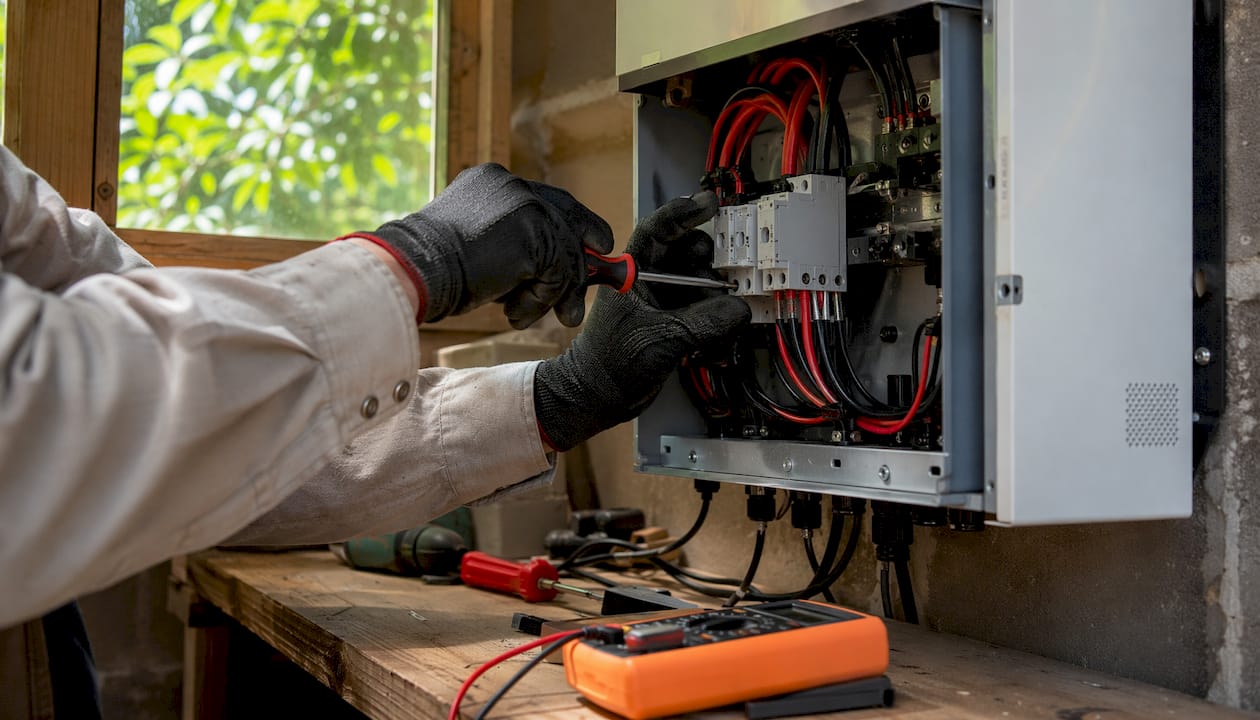
Grid switching events, capacitor bank adjustments, and inverter switching all produce transient overvoltages that travel through your wiring and accumulate damage over time. A large motor starting up in a neighbouring property, or the grid operator switching a section of the network, can send a voltage spike down your supply cable that your inverter was never designed to absorb repeatedly.
External surges are the other half of the picture:
- Direct lightning strike to the building or array: the highest-energy event, capable of destroying equipment instantly.
- Indirect or induced lightning: a strike within several hundred metres can induce a transient voltage in your DC cabling without touching the building at all.
- Conducted surges via the supply cable: a strike to the distribution network travels along the grid connection into your consumer unit.
Long, exposed DC cable runs on a rooftop act as an antenna, increasing the area over which a nearby strike can couple energy into your system. A typical domestic array with strings running from ridge to inverter in the loft can have ten metres or more of exposed DC conductor. That geometry matters.
Induced surges vs grid switching: An induced surge arrives as a fast, high-voltage spike lasting microseconds. A grid-switching event tends to be a lower-amplitude transient but can repeat dozens of times a day, gradually weakening varistors and semiconductor junctions inside your inverter.
Pro Tip: If your inverter is in the loft directly below the array, the DC cable run is short — but the coupling risk from a nearby strike is actually higher because the cables are closer to the roof surface. Do not assume a short run means low risk.
Which parts of your solar system are most at risk?
The inverter takes the most punishment. Its MPPT (maximum power point tracking) input stage and DC link capacitors sit directly in the path of any surge arriving from the panels, and the semiconductors involved are sensitive to voltage spikes that exceed their rated tolerance by even a small margin.
Other vulnerable components include:
- Power optimisers and microinverters: mounted on or near the panels, they are exposed to both induced transients and thermal stress, making them particularly susceptible to latent damage.
- Battery storage systems: the charge controller and battery management electronics are sensitive to overvoltage; a surge that does not kill the battery outright can degrade cell management circuits, shortening the battery’s usable life.
- Combiner and junction boxes: junction box faults are a common consequence of unprotected DC-side surges, particularly where multiple strings connect.
- Monitoring controllers and data loggers: often overlooked, these are connected to both the power circuit and signal lines, giving surges two entry routes simultaneously.
Damage is not always immediate. A surge that does not destroy a component outright can degrade insulation, weaken solder joints, and reduce the breakdown voltage of semiconductors. The inverter then fails six months later, and the cause is rarely traced back to the original event. This cumulative wear is why internal switching events are often more damaging in aggregate than a single dramatic lightning strike.
Cost reality check: Replacing a residential string inverter costs £1,500–£3,000. A commercial three-phase unit runs £5,000–£8,000. A pair of coordinated DC and AC SPDs costs a fraction of either figure.
What do UK regulations and BEAMA guidance actually require?
BS 7671:2018 section 712.443.101 is the regulatory baseline. It requires that transient overvoltage protection be applied to both the DC and AC sides of a solar PV installation where the risk assessment under section 443 determines it is necessary. In practice, section 443 applies to almost every UK residential installation: the assessment considers the number of thunderstorm days per year, the type of supply, and the consequences of equipment failure. Most UK homes meet the threshold.
BEAMA goes further, treating SPDs as a necessity rather than an option for modern homes that combine PV, battery storage, and EV chargers. Their guidance reflects the reality that electronically complex homes have more to lose from a surge event and more entry points for transients to exploit.
The standards that govern SPD testing and classification are the BS EN 61643 series for low-voltage SPDs and BS EN 62305 for lightning protection. These define the waveform tests used to classify devices:
- Type 1 SPDs: tested with a 10/350µs waveform, designed to handle the high-energy lightning current at the service entrance or where a structural lightning protection system (LPS) is present.
- Type 2 SPDs: tested with an 8/20µs waveform, designed to limit transient overvoltages at equipment level — the standard choice for most residential PV installations without an external LPS.
- Combined Type 1+2 arresters: available for PV applications and useful where space in the combiner box is limited.
“Surge protective devices are a necessity for modern homes with solar PV, battery storage and EV chargers — not an optional add-on.” — BEAMA guidance
Pro Tip: When your installer hands over the system, ask for the SPD datasheet, the device type and test classification, and the electrical installation certificate. If they cannot produce these, the installation is incomplete.
Where should SPDs be fitted in a home solar system?
Protection works in layers. A single SPD at one point in the system leaves other entry routes unguarded.
DC side
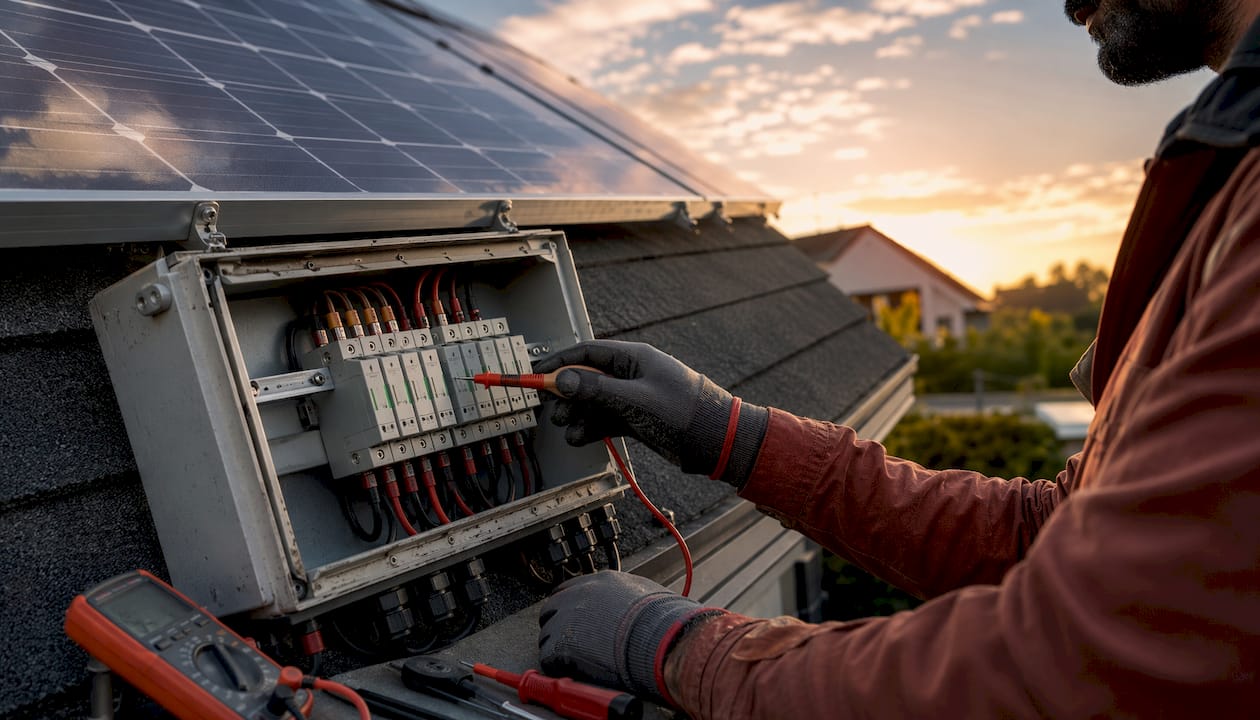
The first SPD goes at the DC input to the inverter, or inside the combiner box if the array has multiple strings. This device catches surges arriving from the panels before they reach the inverter’s sensitive input stage. For most residential systems without a structural LPS, a Type 2 SPD rated for PV DC voltages is the correct choice here.
AC side
A second SPD belongs at the inverter’s AC output, close to the consumer unit. This protects against surges arriving from the grid and prevents any residual transient energy from the DC side reaching downstream appliances.
Signal and communications lines
RS485 and Ethernet monitoring lines are a frequently overlooked entry point. A surge that couples into the monitoring cable can destroy the data logger or the inverter’s communications board even when the power-side SPDs are intact. Signal-line SPDs should be fitted at the point of entry to the sensitive device and matched to the signalling characteristics of the circuit.
Earthing and coordination
An SPD can only divert surge current if it has a low-impedance path to earth. Long, coiled, or corroded bonding conductors raise impedance and force current through equipment instead. The bonding conductors should be as short and straight as possible, and the SPD earth connection should be made to the same earthing point as the equipment it protects.
| Location | SPD type | Purpose |
|---|---|---|
| DC combiner box / inverter DC input | Type 2 (PV-rated) | Protects inverter from panel-side surges |
| Inverter AC output / consumer unit | Type 1+2 or Type 2 | Protects against grid-borne transients |
| Signal lines (RS485, Ethernet) | Signal-line SPD | Protects monitoring and comms equipment |
Pro Tip: Ask your installer to confirm that all SPD earth conductors are bonded to the same earthing terminal as the inverter chassis. Separate earth points create a potential difference during a surge event that can damage equipment even with SPDs fitted.
Does the cost of surge protection actually stack up?
The cost for a DC SPD for a residential PV system is relatively low, and adding an AC SPD plus labour remains affordable compared to potential replacement expenses.
| Item | Typical cost range |
|---|---|
| DC SPD (Type 2, PV-rated) | £40–£200 |
| AC SPD (Type 1+2 at consumer unit) | £40–£200 |
| Residential string inverter replacement | £1,500–£3,000 |
| Commercial three-phase inverter replacement | £5,000–£8,000 |
| Battery management electronics repair | cost varies |
The payback logic is straightforward: one avoided inverter replacement pays for SPDs many times over. For a system with battery storage and an EV charger, the exposure is higher still, because a single surge event can damage multiple expensive components simultaneously.
From an insurance perspective, some home insurers are beginning to ask about surge protection as part of underwriting solar and battery systems. Fitting SPDs to BS 7671 standards and holding the relevant certificates is the clearest evidence you can provide that the installation meets current wiring regulations.
Who should fit SPDs, and how often should they be checked?
SPD installation is notifiable electrical work under Part P of the Building Regulations. It must be carried out by a competent person registered with an approved scheme, or notified to the local authority. For PV systems specifically, the installer should also hold relevant solar installation competence, such as MCS certification or equivalent.
At commissioning, the installer should:
- Confirm SPD type, rating, and location against the risk assessment.
- Measure earth-loop impedance and verify the bonding conductor path.
- Check SPD status indicators and record the baseline condition.
- Issue an electrical installation certificate that includes the SPD details.
After commissioning, SPDs should be inspected as part of the periodic inspection recommended under BS 7671, typically every five years for a domestic installation. After any significant storm or known surge event, a voltage check and SPD inspection should be carried out promptly.
SPD components degrade with each surge they absorb. Most devices have a visual status indicator (a window that changes colour or a flag that drops) to show when the varistor has reached end of life. Silent failure is also possible, particularly in older devices without clear indicators. Do not assume an SPD is still functional just because the system appears to be working normally.
Pro Tip: Keep a folder with your electrical installation certificate, SPD datasheets, and any post-storm inspection reports. If you sell the property, this documentation demonstrates compliance and can support the sale.
What surge protection cannot do
SPDs reduce risk substantially, but they do not make a system invulnerable.
- A direct, high-energy lightning strike to the building or array can overwhelm any SPD. The only effective protection against a direct strike is a structural lightning protection system designed to BS EN 62305, which is a separate and more involved installation.
- Integrated inverter protection typically covers only the AC output side. It does not replace a dedicated DC-side SPD, and it does not protect signal lines or battery electronics.
- SPDs age and degrade with every partial surge they absorb. A device that has handled several significant transients may be at or near end of life without showing obvious signs of failure.
- Earthing alone is not surge protection. A good earth reduces the risk of electric shock and helps fault protection operate, but it does not clamp transient overvoltages the way an SPD does.
Pro Tip: If your solar system is on a coastal or elevated property, the surge exposure is higher than average. Coastal installations face additional corrosion risk on bonding conductors too. Check solar panel considerations for coastal homes before finalising your SPD specification.
How Smarthometechnical approaches surge protection on UK installs
At Smarthometechnical, surge protection is scoped into every solar installation from the outset, not added as an afterthought. Simon and the team work across Dorset, Hampshire, and Devon, installing solar PV, battery storage, and EV chargers, and the SPD specification is coordinated across all three systems where they are co-located.
The approach on a typical residential install:
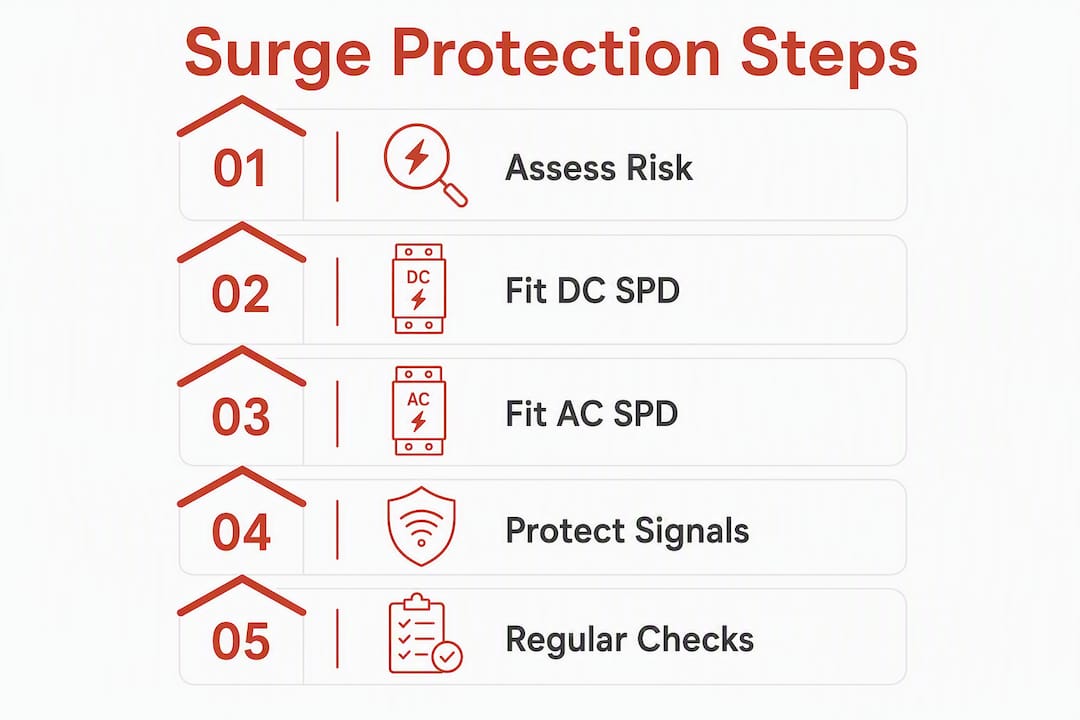
- Risk assessment first: the section 443 assessment is completed before any equipment is specified, taking into account the property’s location, supply type, and the presence of battery storage or EV charging.
- Coordinated DC and AC protection: Type 2 PV-rated SPDs at the inverter DC input and a coordinated device at the AC side, with bonding conductors kept short and routed to the same earthing point as the inverter chassis.
- Signal-line protection: where monitoring systems use RS485 or Ethernet, signal-line SPDs are fitted at the device entry point.
- Documentation at handover: every installation includes the electrical installation certificate, SPD datasheets, earth-loop impedance test results, and a written record of SPD baseline condition.
When a system includes a hybrid battery setup or an EV charger, the SPD coordination is extended to cover those circuits too, because a surge that enters via the EV charger cable can reach the battery management electronics just as easily as one arriving from the panels.
Pro Tip: Ask your installer to walk you through the SPD locations at handover and show you the status indicators. Knowing where to look means you can spot an operated device before the next storm season.
Key takeaways
UK solar panels require coordinated DC and AC surge protection under BS 7671 section 712.443.101, and the cost of fitting SPDs (£40–£200 each) is a small fraction of what a single inverter replacement (£1,500–£3,000) would cost.
| Point | Details |
|---|---|
| BS 7671 requires SPDs | Section 712.443 mandates DC and AC protection where the section 443 risk assessment applies. |
| Internal surges cause cumulative damage | Grid switching and inverter switching degrade electronics over time, not just lightning strikes. |
| SPD cost vs replacement cost | DC SPDs cost £40–£200; replacing a residential inverter costs £1,500–£3,000. |
| SPDs are consumable | Varistors degrade with each surge; inspect status indicators after storms and at every periodic inspection. |
| Smarthometechnical | Installs coordinated DC, AC, and signal-line SPDs with full documentation across Dorset, Hampshire, and Devon. |
The case for treating SPDs as standard, not optional
Most of the homeowners I speak to assume surge damage means a lightning bolt hitting the roof. The reality is quieter and more persistent: dozens of low-level transients from grid switching, appliance starts, and inverter operation accumulating inside the electronics of a £10,000 system over several years. By the time the inverter fails, the cause is invisible.
What frustrates me about the current state of the market is that SPDs are sometimes presented as an upsell rather than a baseline requirement. BS 7671 is clear, BEAMA is clear, and the financial arithmetic is not complicated. The only reason SPDs get omitted is that they add a line to the quotation that a price-sensitive buyer might push back on. That is a false economy.
The other thing worth saying: installation quality matters as much as device selection. An SPD on a long, looped bonding conductor is not doing the job. The device, the earthing, and the conductor routing all have to be right together.
Get a surge protection assessment from Smarthometechnical
Smarthometechnical offers a complete SPD service for UK homeowners: risk assessment under BS 7671 section 443, coordinated device selection for DC, AC, and signal lines, professional installation, and full certification at handover. For systems that already include battery storage or an EV charger, the SPD scope covers all connected circuits, not just the panels.
Every quotation includes the SPD types and ratings, earthing and bonding details, and the test certificates you need to satisfy your insurer and meet wiring regulations. Aftercare and monitoring support are available for ongoing peace of mind.
If your current system has no SPDs, or you are planning a new solar installation, get in touch with Smarthometechnical for a no-obligation assessment. Call or use the contact form on the website to book a site visit across Dorset, Hampshire, and Devon.
Useful sources and further reading
The sources below are the authoritative references underpinning this guide. Ask your installer to provide the relevant datasheets and certificates at handover.
| Source | What it covers |
|---|---|
| IET / BS 7671 guidance | The wiring regulations including section 712.443 on PV SPD requirements |
| BEAMA guidance on surge protection | Industry guidance on SPD selection, application, and necessity for modern homes |
| BEAMA SPD selection and application guide | Detailed guidance on Type 1/2 classification, BS EN 61643 and BS EN 62305 |
| LSP — surge protection for solar panels | Technical overview of SPD placement, costs, and internal surge sources |
| Elvatec — lightning and surge protection for rooftop PV | Detailed technical guidance on DC cable coupling and rooftop exposure |
- Always request the SPD datasheet, device classification, and electrical installation certificate from your installer.
- For periodic inspection intervals and post-storm checks, refer to the IET Guidance Note 3 on inspection and testing.
- If your system includes battery storage or an EV charger, confirm that the SPD scope explicitly covers those circuits in the quotation.
Recommended
- Why solar panels lose efficiency: a UK homeowner’s guide – Smart Home Technical Ltd
- How solar reduces your household bills: a homeowner’s guide – Smart Home Technical Ltd
- The role of solar optimisers: a homeowner’s guide – Smart Home Technical Ltd
- How solar panel hail resistance works: 2026 guide – Smart Home Technical Ltd
