
Solar panels on coastal homes deliver measurable reductions in electricity bills, a documented increase in property value, and reliable power resilience against the storms and outages that coastal living brings. For homeowners along the Dorset coastline or anywhere on the British seaboard, the combination of strong sun exposure, rising grid tariffs, and the unique demands of a marine environment makes the case for solar installation particularly compelling. This guide covers the specific advantages coastal properties gain from photovoltaic systems, including what makes a coastal installation different from an inland one and why getting the specification right matters more than most installers will tell you.
1. Benefits of solar panels for coastal homes: lower energy bills
The fundamental financial advantage of residential solar is turning a recurring energy bill into self-generated power. For coastal homeowners, this shift is amplified by two factors: coastal properties tend to have higher-than-average energy consumption due to heating demands and larger floor areas, and many coastal locations receive strong, consistent sun exposure across the year.
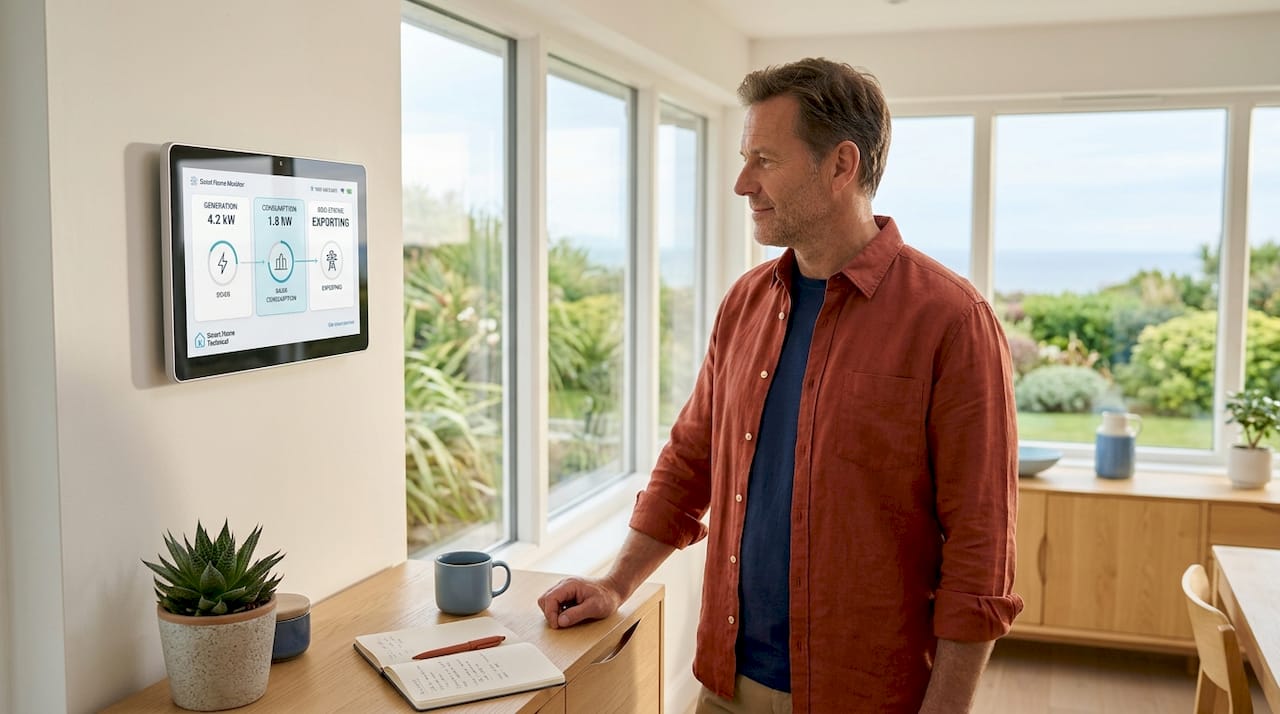
Savings depend on electricity usage, system size, and the amount of power generated. A well-sized system on a south-facing coastal roof can cover a significant portion of daily consumption, with any surplus fed back to the grid.
Key factors that shape your bill savings:
- System size: A 4kWp system is a common starting point for a three-bedroom coastal home.
- Roof orientation: South-facing roofs in the UK generate the most output, though south-west and south-east orientations still perform well.
- Tariff rates: With UK electricity prices remaining elevated, every unit generated on-site avoids a unit purchased at retail cost.
- Net metering: Selling excess electricity back to the grid through the Smart Export Guarantee reduces net costs further and shortens payback periods.
Pro Tip: Size your system to your annual consumption, not just your summer usage. Coastal homes often have higher winter heating loads, and a slightly larger array will capture more of that demand across the full year.
2. How solar panels increase coastal property value
Buyers pay a measurable premium for homes with owned solar systems. Research from Lawrence Berkeley National Laboratory found that buyers pay around $4 per watt for host-owned photovoltaic systems, equating to roughly £12,000 to £15,000 added to a home’s sale price for a typical residential installation. This premium holds across different property types and locations, which means coastal homes are not an exception.
Solar is increasingly viewed by buyers in the same category as a modernised kitchen or a new bathroom. It signals lower running costs and a well-maintained property.
The premium applies specifically to owned systems. Leased panels do not transfer the same value because the buyer inherits a contract rather than an asset. If you are installing solar with resale in mind, ownership is the only route that delivers the full financial uplift. The value does depreciate gradually as the system ages, but a well-maintained installation with a current performance record will still command a meaningful premium at the point of sale.
3. Why corrosion resistance is non-negotiable for coastal solar
Salt spray is the defining challenge of coastal solar installation, and it is one that inland installers frequently underestimate. Airborne salt particles accelerate corrosion in aluminium frames, electrical connectors, junction boxes, and mounting hardware. Left unchecked, this corrosion degrades performance and can cause component failure within years rather than decades.
The industry standard for evaluating this risk is IEC 61701 salt-mist testing, which simulates marine exposure by subjecting PV modules and balance-of-system components to controlled salt solution environments. The test measures corrosion rates and identifies failure points before a product reaches the market.
Steps to protect your coastal solar investment:
- Specify panels and mounting systems that carry IEC 61701 certification, not just the modules themselves.
- Confirm that connectors, junction boxes, and cable management components are also rated for marine environments.
- Ask your installer for documentation of component certifications before any equipment is ordered.
- Schedule annual inspections to catch early-stage corrosion on fixings and frames before it spreads.
Beyond the panels themselves, every balance-of-system component must meet the same corrosion-resistance standard to protect overall system longevity. A certified panel fitted with uncertified mounting hardware is still a system at risk.
Pro Tip: Request the specific IEC 61701 test report for any panel you are considering. Reputable manufacturers publish these documents. If a supplier cannot produce one, treat that as a red flag.
4. Solar-plus-battery storage for coastal resilience
Coastal properties face a disproportionate share of grid outages. Storms, high winds, and flooding regularly disrupt supply in exposed coastal areas, and a solar-only system without battery storage goes offline when the grid fails. A solar-plus-battery system removes that vulnerability entirely.
Solar paired with battery storage provides electricity during grid disruptions, making it a genuine resilience tool rather than just a cost-saving measure. Research shows that approximately 63% of homes with solar-plus-storage can meet around half their electricity needs during a blackout. For a coastal household that may lose power for 24 to 48 hours after a significant storm, that capability is not a luxury.
The financial case for adding battery storage depends on several variables:
- Self-consumption rate: The more solar energy you use directly rather than export, the faster the battery pays back.
- Local outage frequency: Coastal homes with a history of frequent outages gain more non-monetary resilience value from storage.
- Time-of-use tariffs: Batteries charged during off-peak periods and discharged during peak hours can reduce bills beyond what solar alone achieves.
- Battery economics: Solar-only versus solar-plus-battery investments have distinct return profiles, and the right choice depends on your usage patterns and local grid reliability.
Popular battery options installed alongside residential solar in the UK include the Tesla Powerwall and the GivEnergy range, both of which are compatible with most modern inverter systems.
5. Year-round solar output in coastal climates
A common concern among coastal homeowners in the UK is whether solar panels generate enough power during the shorter, greyer winter months to justify the investment. The answer is yes, with the right system sizing. Solar panels generate sufficient electricity even with reduced daylight, and winter sunlight still powers average homes effectively when the system is correctly specified.
The table below illustrates approximate monthly solar generation for a 4kWp system at a south-facing coastal location in southern England:
| Month | Estimated output (kWh) | Typical household daily use (kWh) |
|---|---|---|
| June | 480 | 8 |
| September | 320 | 9 |
| December | 120 | 12 |
| March | 280 | 10 |
December output is lower, but it is not negligible. A 4kWp system still generates roughly 4 kWh per day in midwinter, covering a meaningful share of lighting, appliances, and hot water. Pairing the system with a battery means surplus generated on brighter winter days carries forward into the evening, extending the benefit further.
Regional test centres across the UK validate panel performance under the specific temperature and irradiance conditions found at British latitudes, which means the performance data you receive from a reputable manufacturer reflects real-world coastal conditions rather than laboratory ideals.
6. Reduced carbon footprint and eco-friendly credentials
Coastal communities are among the most directly affected by climate change. Rising sea levels, increased storm frequency, and coastal erosion are visible, local consequences. Installing solar panels is one of the most direct ways a coastal homeowner can reduce their household’s carbon output and contribute to the broader shift away from fossil-fuel-generated grid electricity.
A typical 4kWp residential solar system in the UK offsets approximately 1.3 to 1.6 tonnes of CO2 per year. Over a 25-year system lifespan, that represents a cumulative reduction of 30 to 40 tonnes per household. For eco-friendly homes in coastal regions, this is a tangible, measurable contribution rather than a symbolic gesture.
Beyond the carbon numbers, solar panels signal environmental commitment to neighbours, guests, and potential buyers. In coastal communities where environmental awareness tends to be high, that signal carries genuine social and reputational value.
7. Protection against rising energy tariffs
UK electricity prices have risen sharply over the past four years and are not expected to return to pre-2021 levels. Every unit of solar-generated electricity consumed on-site is a unit that bypasses the retail tariff entirely. This tariff-shielding effect compounds over time: as grid prices rise, the value of each self-generated unit increases proportionally.
A coastal home generating 3,500 kWh per year from a 4kWp system and consuming most of that output on-site avoids purchasing those units at the current average UK unit rate. At 24p per kWh, that represents £840 per year in avoided costs. If tariffs rise by 5% annually over ten years, the cumulative saving grows substantially beyond a simple year-one calculation.
This is why solar economics improve the longer you hold the system. The upfront installation cost is fixed. The value of the energy it generates increases every time the grid tariff rises.
Key takeaways
Solar panels on coastal homes deliver financial, structural, and resilience benefits that are distinct from inland installations, making certified corrosion resistance and battery storage the two most important specification decisions.
| Point | Details |
|---|---|
| Bill savings are real and compounding | Self-generated power avoids rising retail tariffs, with net metering reducing costs further. |
| Property value increases with owned systems | Buyers pay a documented premium of around £4 per watt for host-owned solar installations. |
| Corrosion resistance is a coastal-specific requirement | IEC 61701 certification for panels and all balance-of-system components is non-negotiable near the sea. |
| Battery storage transforms resilience | Solar-plus-storage keeps coastal homes powered during the grid outages that storms routinely cause. |
| Year-round output is viable at UK latitudes | A correctly sized system generates meaningful electricity even in December, especially when paired with storage. |
What I have learned specifying solar for coastal properties
I have been involved in solar installations along the south coast for long enough to know that the biggest mistakes are not made on the roof. They are made in the specification stage, weeks before any panel is fitted.
The most common error I see is treating a coastal installation like an inland one and simply ordering whatever panels are cheapest or most readily available. Salt-mist corrosion does not announce itself immediately. A system installed with uncertified mounting hardware or standard connectors will look and perform perfectly for two or three years. Then the corrosion reaches the electrical connections, and the repair bill arrives.
My honest view is that the IEC 61701 certification conversation should happen before any quote is accepted. If an installer cannot tell you which specific components carry that certification, they are not the right installer for a coastal property.
On battery storage, I would push back against the purely financial framing that dominates most conversations. The resilience value of keeping your home powered through a 36-hour storm outage is real and significant, even if it does not appear in a payback calculation. For families with medical equipment, young children, or elderly relatives, that value is not abstract.
The long-term picture for coastal solar is genuinely positive. Rising tariffs, strong sun exposure, and increasing buyer awareness of running costs all work in the homeowner’s favour. The key is getting the specification right from the start rather than cutting corners that the sea will eventually find.
— Simon
How Smarthometechnical can help with your coastal solar installation
Smarthometechnical specialises in solar installations designed specifically for the demands of coastal environments, from corrosion-resistant panel and mounting specifications to fully integrated battery storage systems.

Every project is managed from initial site assessment through to commissioning, with component selection based on IEC 61701 certification and real-world coastal performance data. Whether you are looking to reduce electricity costs, add battery resilience, or increase your property’s market value, Smarthometechnical’s team understands the marine conditions that make coastal installations different. Explore our coastal solar solutions to see the full range of options available for your home, and request a detailed estimate tailored to your property.
FAQ
Are solar panels worth it for coastal homes in the UK?
Yes. Coastal homes benefit from strong sun exposure, rising tariff protection, and documented property value premiums. The key requirement is specifying corrosion-resistant components certified to IEC 61701 to ensure long-term performance near the sea.
What makes coastal solar installation different from inland?
Salt-mist corrosion affects frames, connectors, junction boxes, and mounting hardware in marine environments. Coastal installations require IEC 61701-certified components across the entire system, not just the panels themselves.
Do solar panels work in winter on the UK coast?
Solar panels generate electricity year-round, including during winter. A correctly sized 4kWp system in southern England still produces around 120 kWh in December, covering a meaningful share of daily household consumption.
How much does solar increase a coastal home’s value?
Research shows buyers pay approximately £4 per watt premium for owned solar systems, equating to roughly £12,000 to £15,000 for a typical residential installation. This premium applies to owned systems, not leased ones.
Should I add battery storage to my coastal solar system?
Battery storage is strongly recommended for coastal properties. Research indicates that 63% of solar-plus-storage homes can meet approximately half their electricity needs during a blackout, which is a critical advantage in storm-prone coastal locations.
