
A solar system voltage check is the process of measuring electrical voltage at key points in your solar installation to confirm safe operation and peak energy output. For Hampshire homeowners, this check is not optional maintenance. It is the difference between a system generating full power and one quietly losing output or, worse, creating a fire risk. Standard 400 W residential panels produce roughly 41–45 V open-circuit under standard test conditions, and grid overvoltage above 253 V AC can force your inverter to shut down by law. The industry term for this process is photovoltaic (PV) system commissioning verification, though “voltage check” is the phrase most Hampshire homeowners and property managers use day to day. Both terms refer to the same essential task.
What tools do you need for a solar system voltage check in Hampshire?
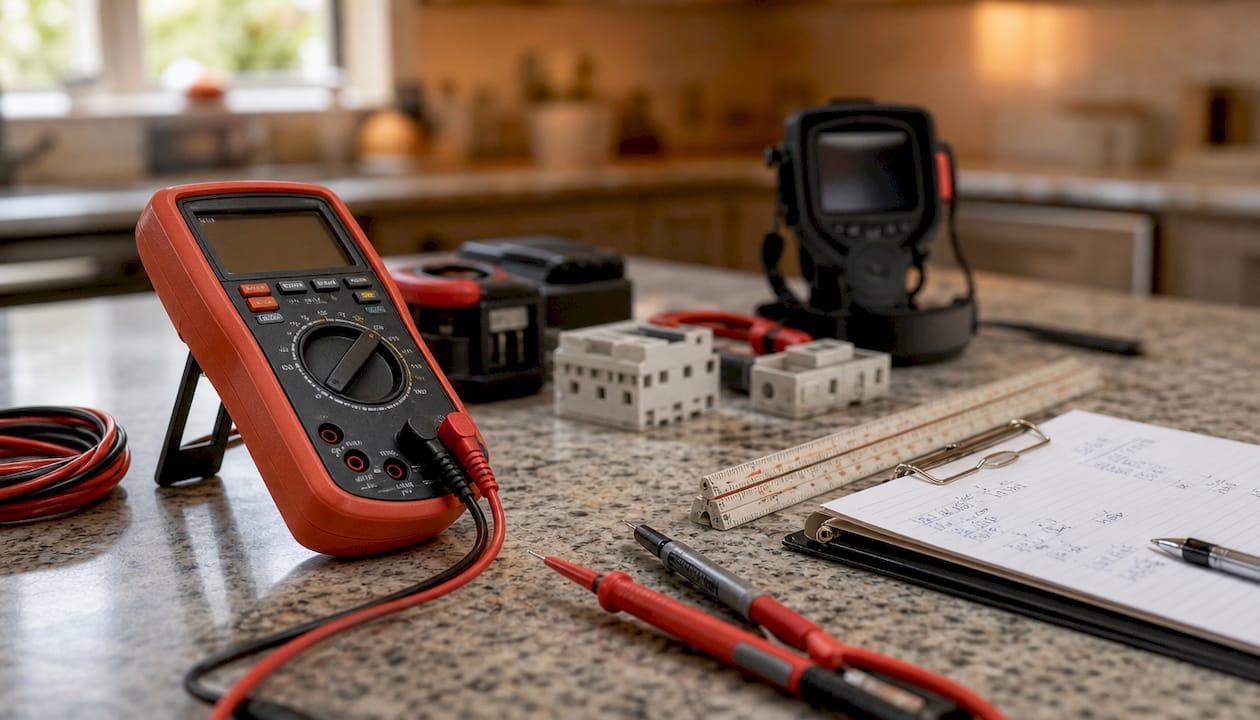
Safe and accurate voltage testing starts with the right equipment. DC-rated insulated tools and personal protective equipment are non-negotiable before you touch any part of a live solar circuit. Using household multimeters or unrated test leads on a DC solar string is genuinely dangerous.
The core toolkit for a Hampshire solar panel voltage check includes:
- Digital multimeter rated for DC voltages above the maximum string voltage of your system (typically 600 V DC or higher for residential arrays)
- Insulated gloves rated to the appropriate voltage class
- Voltage tester to confirm circuits are live or isolated before probing
- Personal protective equipment (PPE) including safety glasses and non-conductive footwear
- System documentation including your installer’s string sizing calculations and inverter datasheet
Optional but highly useful tools include thermal imaging cameras, which detect hot spots and overheating cables invisible to the eye. Thermal imaging drone inspections follow IEC 62446-3 standards and identify micro-cracks, hot spots, and cable overheating early. For most Hampshire homeowners, booking a professional thermal inspection alongside a voltage check gives the most complete picture of system health.
| Tool | Purpose |
|---|---|
| Digital multimeter (DC-rated) | Measures open-circuit voltage and string voltage |
| Insulated gloves | Protects against electric shock from live DC cables |
| Voltage tester | Confirms live or isolated status before probing |
| PPE (glasses, footwear) | Prevents injury from arcing or accidental contact |
| Thermal imaging camera | Detects hot spots, micro-cracks, and cable faults |
Pro Tip: Always check your multimeter’s DC voltage rating before use. A meter rated only to 300 V DC is inadequate for a two-string residential system, which can exceed 400 V DC on a cold Hampshire morning.
If you are not confident using DC-rated test equipment, call a qualified electrician. The safety risk from an incorrectly performed test is real and serious.
How to perform a solar system voltage test safely in Hampshire
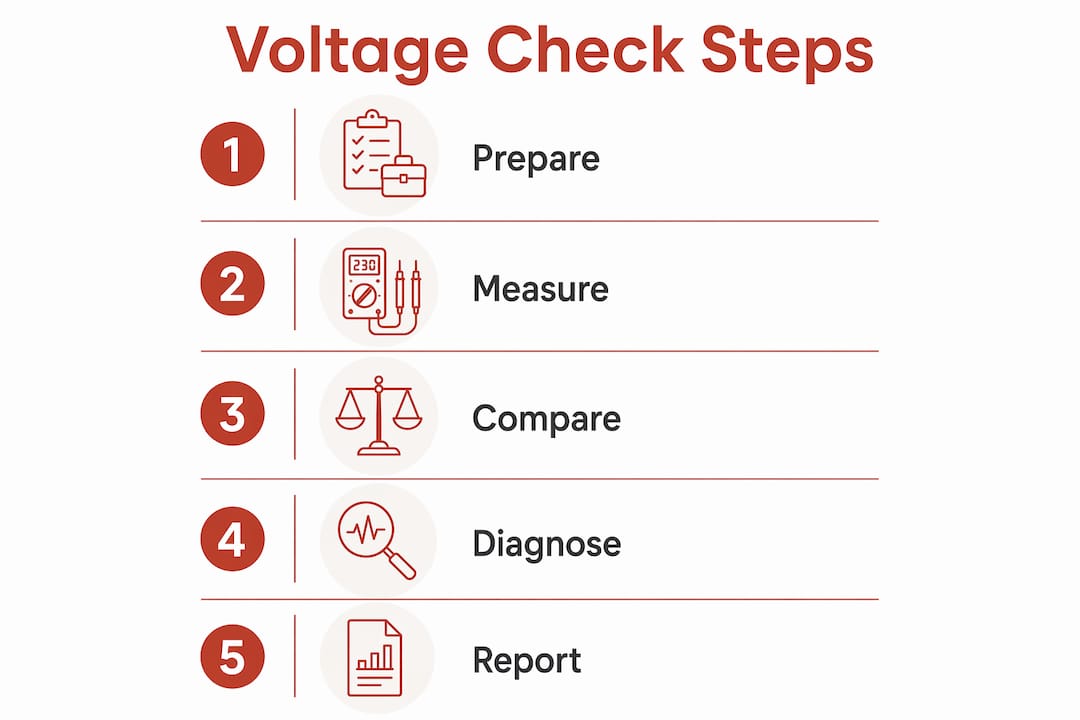
A structured approach to voltage testing solar panels protects both you and your equipment. Follow these steps in order, and do not skip safety stages.
-
Check weather conditions. Perform tests on a clear day with stable irradiance for consistent readings. Avoid testing immediately after heavy rain or during storms.
-
Review your system documentation. Confirm the expected open-circuit voltage (Voc) and voltage at maximum power (Vmp) from your panel datasheet before you measure anything.
-
Isolate the AC side at the consumer unit. Switch off the solar circuit breaker at your consumer unit. This isolates the inverter’s AC output but does not de-energise the DC string from the panels. DC cables from panels remain live in daylight regardless of any switch position.
-
Identify measurement points. The three key points are: panel terminals (individual panel Voc), string terminals at the inverter DC input (string Voc), and inverter AC output terminals (grid voltage).
-
Set your multimeter to DC voltage. Select a range above your expected string voltage. For a 10-panel string of 400 W panels, expect roughly 410–450 V DC open-circuit under standard conditions.
-
Measure string open-circuit voltage (Voc). Connect your multimeter probes to the positive and negative string terminals at the inverter DC input. Record the reading.
-
Apply temperature correction. Cold Hampshire mornings matter here. A 42 V panel at 25°C can produce 44–46 V at −10°C. Multiply your measured Voc by the panel’s temperature coefficient to get the corrected value, and confirm it stays within your inverter’s maximum input voltage rating.
-
Measure inverter AC output voltage. With the AC circuit restored, use your multimeter on AC voltage to confirm the inverter output sits within the UK grid tolerance of 230 V AC, nominally not exceeding 253 V AC.
-
Document every reading. Record date, time, ambient temperature, irradiance conditions, and all voltage figures. These records become your baseline for future solar system inspection Hampshire comparisons.
String voltage calculations must account for the lowest expected ambient temperature at the installation site. NEC 690.7 requires this for string design, and experts warn it is frequently overlooked, leading to cold-weather inverter shutdowns. Hampshire’s winter lows regularly push panel voltage beyond what summer-only calculations predict.
Pro Tip: Take readings at the same time of day on each inspection visit. Mid-morning on a clear day gives the most repeatable irradiance conditions and makes year-on-year comparisons meaningful.
Comparing today’s readings against your installation baseline is where real value lies. A string voltage that has dropped by more than a few percent without a temperature explanation points to a failing panel, a corroded connector, or a wiring fault worth investigating.
Common voltage-related issues in Hampshire solar systems
Hampshire solar systems face a specific set of voltage problems driven by local grid conditions and the county’s variable winter temperatures. Knowing the warning signs lets you act before a minor fault becomes an expensive repair.
Grid overvoltage and inverter shutdown
Grid overvoltage is the most misunderstood fault Hampshire homeowners encounter. When the local grid voltage exceeds 253 V AC, your inverter is legally required to reduce output or shut down entirely. This is not a system failure. It is a protection mechanism. However, repeated shutdowns indicate a grid quality problem worth reporting to your Distribution Network Operator (DNO).
Inverter error codes and firmware faults
Inverter faults are the most common cause of solar system stoppage. Grid voltage spikes and outdated firmware can both trigger fault codes that look alarming but are often resolvable without a site visit. Check your inverter display for error codes and cross-reference them with the manufacturer’s manual before assuming hardware failure.
Temperature-driven voltage spikes
Cold snaps push string voltage higher. Voltage readings depend on ambient temperature, and cold conditions can push string voltage beyond inverter input limits, causing shutdowns. This is particularly relevant in Hampshire between november and february, when overnight temperatures regularly drop below 5°C.
Warning signs that need immediate attention
Stop using your system and call a qualified professional if you notice any of the following:
- Burning smells from the inverter or cable runs
- Scorch marks or discolouration on panels, junction boxes, or wiring
- Audible arcing or crackling sounds from electrical components
- Repeated tripping of the solar circuit breaker or RCD
- Inverter display showing persistent fault codes that do not clear after a restart
Never touch DC cables or open inverter enclosures. They remain live whenever panels are exposed to light. Detect burning smells or scorch marks and isolate the system immediately by switching off at the consumer unit, then call a qualified electrician.
Remote solar system health audits offer a practical first step for diagnosing performance drops without a site visit. These audits analyse over 12 months of generation data, battery health, and settings, typically delivering a detailed report within 24 hours. That turnaround makes them useful for property managers overseeing multiple Hampshire sites.
How often should Hampshire homeowners schedule voltage checks?
Annual voltage checks are the minimum for any Hampshire solar installation. Systems exposed to severe weather events, such as the storms that regularly cross the Solent between october and march, warrant an additional check afterwards.
The right schedule for most Hampshire homeowners looks like this:
- Annual check every spring, after winter temperature extremes have passed and before peak summer generation begins
- Post-storm check following any significant weather event with high winds or hail
- Performance-triggered check whenever your monitoring app shows a generation drop of more than 10% against the same period in a previous year
- Pre-warranty-expiry check to catch degradation or faults while manufacturer cover still applies
Combining a voltage check with a thermal imaging inspection gives you the most complete picture of system health in a single visit. Thermal surveys detect faults that voltage readings alone cannot reveal, including micro-cracks and partial shading from soiling.
Pro Tip: Book your annual voltage check and thermal inspection together in march or april. You get stable, predictable irradiance for accurate readings, and you catch any winter damage before the high-generation summer months.
Remote audits complement on-site checks well. A remote audit takes roughly two hours and delivers a written report within 24 hours, making it a low-effort way to monitor Hampshire solar panel voltage trends between physical inspections.
Key takeaways
A solar system voltage check in Hampshire requires DC-rated tools, temperature-corrected measurements, and professional support for any fault involving burning smells, arcing, or persistent inverter shutdowns.
| Point | Details |
|---|---|
| Know your expected voltage | Standard 400 W panels produce 41–45 V open-circuit; confirm this against your datasheet before testing. |
| Temperature correction is non-negotiable | Cold Hampshire mornings raise string voltage; always apply the panel’s temperature coefficient to winter readings. |
| Grid overvoltage causes legal shutdowns | Inverters must reduce output above 253 V AC; repeated shutdowns indicate a DNO grid quality issue. |
| Annual checks are the minimum | Schedule every spring, after storms, and before your manufacturer warranty expires. |
| Burning smells mean stop immediately | Isolate the system at the consumer unit and call a qualified electrician without delay. |
What I’ve learned from Hampshire solar voltage checks
The single biggest mistake I see Hampshire homeowners make is assuming their system is fine because it is still generating some power. A system can lose a meaningful portion of its output through a corroded DC connector or a partially failed panel and still appear to be working from the outside. Voltage readings catch this. Visual checks do not.
Temperature effects catch people out every winter. String sizing calculations done in summer often underestimate how high voltage climbs on a cold, clear january morning. I have seen systems where the string voltage on a cold day pushed right up against the inverter’s maximum input rating. That is not a comfortable margin. If your installer did not account for Hampshire’s winter lows using the panel’s temperature coefficient, your system may be operating closer to its limits than you realise. A hybrid solar battery system adds another layer of voltage management complexity that makes professional annual servicing even more worthwhile.
Thermal drone inspections are genuinely underused. Proactive maintenance with thermal imaging and voltage testing catches faults before warranties expire, and the cost of a combined inspection is a fraction of a panel replacement. I recommend them to every Hampshire homeowner I work with, particularly those with systems more than three years old.
Recording your voltage readings over time is where the real insight comes from. A single reading tells you the system is working today. A series of readings tells you whether it is degrading, and at what rate. That trend data is what lets you make a confident decision about whether a repair or a replacement makes financial sense.
— Simon
Professional solar voltage checks and maintenance in Hampshire
Hampshire homeowners who want complete confidence in their system’s safety and output should work with a qualified electrical contractor rather than rely solely on DIY monitoring.
Smarthometechnical specialises in solar panel installation and maintenance across Hampshire, covering everything from initial voltage commissioning to annual health checks and fault diagnosis. Every inspection includes documented voltage readings, temperature-corrected analysis, and a written report you can use for insurance or warranty purposes. Whether you have a standard rooftop array or a solar retrofit on an older Hampshire property, the team carries out thorough checks that meet current UK grid compliance standards. Get in touch with Smarthometechnical to book your next inspection.
FAQ
What voltage should my Hampshire solar panels produce?
Standard 400 W residential panels produce approximately 41–45 V open-circuit and 34–38 V at maximum power under standard test conditions. String voltage depends on how many panels are wired in series.
Can I perform a solar voltage check myself?
You can take basic readings with a DC-rated digital multimeter, but any fault involving burning smells, arcing, or persistent error codes requires a qualified electrician. DC cables remain live in daylight regardless of switch positions.
How does cold weather affect my solar panel voltage in Hampshire?
Cold temperatures increase panel voltage. A panel producing 42 V at 25°C can reach 44–46 V at −10°C, which may push string voltage close to or beyond your inverter’s maximum input rating during Hampshire winters.
What does grid overvoltage mean for my inverter?
Grid overvoltage occurs when the local grid exceeds 253 V AC. Your inverter is legally required to reduce output or shut down to protect the grid. Repeated shutdowns should be reported to your Distribution Network Operator.
How often should I book a professional solar system inspection in Hampshire?
Book a professional inspection at least once a year, ideally each spring. Add an extra check after any significant storm, or whenever your monitoring data shows an unexplained drop in generation.
Recommended
- Solar system fault finding Hampshire: 2026 guide – Smart Home Technical Ltd
- Hybrid solar battery system hampshire: 2026 guide – Smart Home Technical Ltd
- Solar in Hampshire retrofits: a homeowner’s guide – Smart Home Technical Ltd
- Solar system annual service Dorset: homeowner’s guide – Smart Home Technical Ltd
