
Solar panel wattage is defined as the maximum electrical power a panel can produce under Standard Test Conditions (STC), measured in watts (W). Typical residential panels range from 250W to 450W, with high-efficiency models reaching 500W or more. This figure, known as Pmax, is the number you see on every panel specification sheet and the starting point for sizing any home solar system. Understanding wattage ratings tells you how many panels you need, what inverter to pair them with, and how much roof space the system will occupy.
What is solar panel wattage and how is it measured?
Solar panel wattage is calculated using the formula Pmax equals Vmpp times Impp, where Vmpp is the voltage at maximum power and Impp is the current at maximum power. A 400W panel with a Vmpp of 34V and an Impp of 11.76A produces exactly 34 × 11.76 = 400W under test conditions. This formula gives manufacturers a single, comparable number for every panel they produce.
STC is the laboratory standard that makes those numbers comparable. It specifies three fixed conditions:
- Solar irradiance: 1,000 W/m²
- Cell temperature: 25°C
- Air mass: 1.5 (representing sunlight filtered through the atmosphere at a standard angle)
Every panel manufacturer tests against these same conditions. That consistency is what makes wattage a reliable benchmark when comparing panels from different brands or production runs.
Pro Tip: When reading a specification sheet, look for the Pmax figure rather than any marketing headline. Pmax is the standardised output number; marketing descriptions can vary widely.
Real-world conditions rarely match STC. Your roof in july is not a climate-controlled laboratory. That gap between the rated figure and actual output is where most homeowners get caught out, and the next section explains exactly why it happens.
Why does rated wattage differ from actual output on your roof?
Real-world output is typically 80–90% of the STC wattage rating. That reduction is not a fault. It is the predictable result of conditions that differ from the laboratory standard.
The main causes of output loss are:
- Heat: Cell temperatures on rooftops can reach 50–70°C in summer, well above the 25°C STC baseline. Higher temperatures reduce voltage and therefore reduce power output.
- Shading: Even partial shading from a chimney or tree branch can cut output significantly, because panels in a string are affected by the weakest link.
- Dirt and soiling: Dust, bird droppings, and moss reduce the light reaching the cells.
- Wiring losses: Resistance in cables and connections accounts for a small but real reduction.
A panel rated at 400W will rarely produce 400W on your roof. A realistic planning figure is 320–360W per panel, depending on your location, roof pitch, and the time of year. Treating the nameplate rating as guaranteed output leads to undersized systems and disappointed homeowners.
Temperature coefficient is the specification that quantifies the heat effect. It is expressed as a percentage loss per degree Celsius above 25°C. Panels with lower temperature coefficients maintain better output during hot weather. A panel with a coefficient of -0.30%/°C loses less power on a hot summer day than one rated at -0.45%/°C, even if both carry the same headline wattage.
Pro Tip: In the UK, summer output is often limited more by heat than by cloud cover on clear days. Choosing a panel with a low temperature coefficient can recover meaningful annual generation.
Peak sun hours also shape daily output. The UK averages roughly 2.5–4 peak sun hours per day depending on region and season. A 400W panel in southern England receives more usable irradiance than the same panel installed in northern Scotland, so location directly affects how much energy your system generates each year.
How to calculate the wattage you need for your home
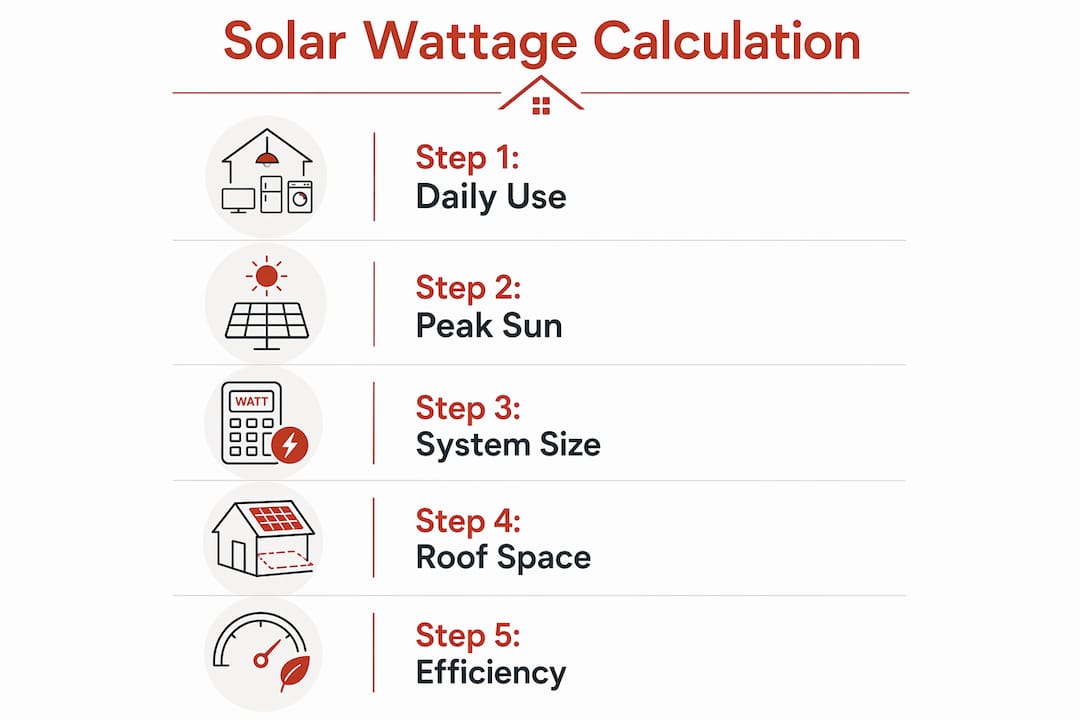
The standard formula for estimating required system wattage is straightforward. Divide your daily energy use in kWh by your local peak sun hours, then multiply by 1,000 to convert to watts.
Required wattage = (daily kWh usage ÷ peak sun hours) × 1,000
Here is how that works in practice for a typical UK household:
- Find your daily energy use. Check your electricity bill for annual kWh, then divide by 365. The average UK home uses roughly 8–10 kWh per day.
- Find your local peak sun hours. Southern England averages around 3.5 peak sun hours per day; northern regions average closer to 2.5.
- Apply the formula. A home using 9 kWh/day with 3.5 peak sun hours needs (9 ÷ 3.5) × 1,000 = approximately 2,571W, or a 2.6 kW system.
- Apply a derating factor. Derating factors account for losses from temperature, wiring, dirt, and shading. Divide your calculated figure by 0.80 to get a realistic installed capacity. In this example: 2,571 ÷ 0.80 = approximately 3,214W, so a 3.2–3.5 kW system is a sensible target.
- Divide by panel wattage to find panel count. A 3,200W system using 400W panels requires 8 panels.
| Variable | Example value |
|---|---|
| Daily energy use | 9 kWh |
| Peak sun hours | 3.5 hours |
| Raw system size | 2,571W |
| Derating factor | 0.80 |
| Realistic system size | 3,214W |
| Panels at 400W each | 8 panels |
Roof space and budget both constrain the final design. A south-facing roof with no shading gives you the most flexibility. East or west-facing roofs reduce output by roughly 15–20% compared to south-facing, which means you may need more panels to hit the same annual generation target. For guidance on planning your solar installation, including orientation and shading assessments, Smarthometechnical offers detailed site surveys as part of every design process.
Pro Tip: Do not size your system purely to cover your current bill. If you plan to add an EV charger or battery storage, factor that future demand into your calculation now. Retrofitting extra panels later is significantly more expensive than installing them at the outset.
For homeowners considering off-grid configurations, the calculation becomes more complex because battery capacity and seasonal variation both enter the equation. A homeowner’s guide to off-grid solar covers those additional variables in detail.
How do efficiency and other specs affect system design?
Wattage alone does not tell the full story. Efficiency measures power output per square metre of panel area. Two panels can both be rated at 400W but occupy very different amounts of roof space if their efficiencies differ.
A panel with 22% efficiency produces 400W from a smaller surface area than a panel with 18% efficiency producing the same wattage. That difference matters enormously on a constrained roof. If you have limited space, a higher-efficiency panel lets you fit more total capacity without expanding the array footprint.
Key specifications to read alongside wattage:
- Temperature coefficient (%/°C): Lower is better. Aim for panels below -0.35%/°C for UK conditions.
- Vmpp (voltage at maximum power): Determines how panels string together and whether they are compatible with your chosen inverter.
- Voc (open circuit voltage): The maximum voltage a panel produces with no load. Inverters have a maximum input voltage limit; Voc must stay within that limit across all panels in a string.
- Panel dimensions and weight: Structural loading and available roof area both constrain your options.
System design requires attention to voltage specs beyond wattage to ensure proper stringing and inverter compatibility. A string of panels whose combined Voc exceeds the inverter’s maximum input voltage will either trip the inverter or damage it. This is why wattage is just the starting point, not the end of the specification conversation.
For a deeper look at how efficiency ratings translate into real-world system performance, the Smarthometechnical guide on solar panel efficiency explains the trade-offs between efficiency, cost, and roof space in plain terms.
Panel efficiency often matters more than headline wattage for rooftop systems with limited area. Homeowners who focus only on the wattage number and ignore efficiency, temperature coefficient, and voltage parameters regularly end up with systems that underperform or require expensive inverter changes.
Key takeaways
Solar panel wattage is a standardised benchmark for comparison and sizing, not a guarantee of continuous output. Real-world generation depends on efficiency, temperature coefficient, location, and system design.
| Point | Details |
|---|---|
| Wattage is a lab figure | Pmax is measured under STC and represents maximum, not average, output. |
| Expect 80–90% in practice | Temperature, shading, and wiring losses reduce real output below the rated figure. |
| Use the sizing formula | Divide daily kWh by peak sun hours, multiply by 1,000, then apply a derating factor. |
| Efficiency shapes roof use | Higher-efficiency panels produce more power per square metre on constrained roofs. |
| Voltage specs drive design | Vmpp and Voc determine inverter compatibility and string configuration. |
What wattage ratings really mean in practice
Homeowners often ask me whether a higher-wattage panel is simply better. The honest answer is: not always. Wattage is a standardised figure for sizing and pricing comparisons, not a promise of continuous output. I have seen installations where a lower-wattage panel with a superior temperature coefficient outperformed a higher-rated panel across a full UK summer, because the rated figure told only half the story.
The specification that most homeowners overlook is the temperature coefficient. A panel losing 0.45% of output per degree Celsius above 25°C will underperform noticeably on a clear july day when roof temperatures climb past 60°C. That is a 15–16% reduction before you account for any other losses. Choosing a panel with a coefficient closer to 0.30%/°C recovers that gap and adds up to meaningful extra generation over a year.
My other consistent observation is that inverter compatibility gets treated as an afterthought. Stringing panels without checking Vmpp and Voc against the inverter’s input range is a design error that shows up only after installation, usually as clipped output or nuisance tripping. Get the electrical specifications right before you commit to a panel, not after.
Realistic expectations matter too. A standard residential panel produces roughly 1–2 kWh per day depending on conditions. That is the number to plan around, not the nameplate wattage. Homeowners who understand this from the start make better purchasing decisions and end up with systems that actually meet their energy goals.
— Simon
Solar installation designed around your actual energy needs
Getting the wattage calculation right is the foundation of a solar system that performs as expected. Smarthometechnical designs every residential installation around your specific energy use, roof geometry, and local sun conditions rather than a generic panel count.

Our team handles the full process: site survey, system sizing, panel and inverter selection, and MCS-compliant installation. We work with homeowners across southern England to specify systems that account for temperature coefficients, voltage compatibility, and future-proofing for battery storage or EV charging. If you are ready to move from calculation to installation, explore our solar installation services or get in touch with Smarthometechnical directly for a no-obligation consultation.
FAQ
What does solar panel wattage mean?
Solar panel wattage (Pmax) is the maximum power a panel produces under Standard Test Conditions: 1,000 W/m² irradiance, 25°C cell temperature, and air mass 1.5. It is a benchmark for comparison and system sizing, not a figure for continuous real-world output.
How much wattage does a typical home solar system need?
Most UK homes need a system in the range of 3–6 kW, depending on daily energy use and local peak sun hours. Divide your daily kWh consumption by your local peak sun hours, multiply by 1,000, and apply a derating factor of 0.80 to get a realistic installed capacity.
Why does my solar panel produce less than its rated wattage?
Real-world output is typically 80–90% of the rated figure because rooftop temperatures, shading, dirt, and wiring losses all reduce performance below STC conditions. Cell temperatures on rooftops regularly reach 50–70°C, well above the 25°C used in testing.
Is a higher-wattage panel always the better choice?
Not necessarily. A panel with a lower temperature coefficient can outperform a higher-wattage panel in warm conditions. Efficiency, voltage specifications, and physical dimensions all affect whether a panel suits your roof and inverter.
What is the difference between Pmax and PTC ratings?
Pmax is measured under Standard Test Conditions in a laboratory. PTC (PVUSA Test Conditions) uses a more realistic outdoor standard: 1,000 W/m² irradiance, 20°C ambient temperature, and a 1 m/s wind speed. PTC ratings are generally 10–15% lower than Pmax and closer to real-world performance.
Recommended
- How solar panel guarantee works: a homeowner’s guide – Smart Home Technical Ltd
- Solar panel efficiency explained for homeowners in 2026 – Smart Home Technical Ltd
- How solar planning works: a homeowner’s guide 2026 – Smart Home Technical Ltd
- The role of solar optimisers: a homeowner’s guide – Smart Home Technical Ltd
