
Solar panel efficiency is defined as the percentage of sunlight a panel converts into usable electricity under Standard Test Conditions (STC). Most modern residential panels achieve 20–24% efficiency, with premium TOPCon and HJT technologies sitting at the top of that range. The Shockley-Queisser limit sets the theoretical maximum for a single-junction silicon cell at around 32–33.7%, so today’s best panels are already operating close to what physics allows. Understanding this figure helps you compare panels honestly, plan your roof space, and set realistic expectations for your energy bills.
What is solar panel efficiency and how is it calculated?
Solar panel efficiency is calculated using a straightforward formula: Efficiency (%) = [Power output (W) ÷ (Panel area (m²) × 1000 W/m²)] × 100. A panel rated at 22% efficiency converts 22% of sunlight into electricity under STC. The remaining 78% is lost as heat or reflected light.
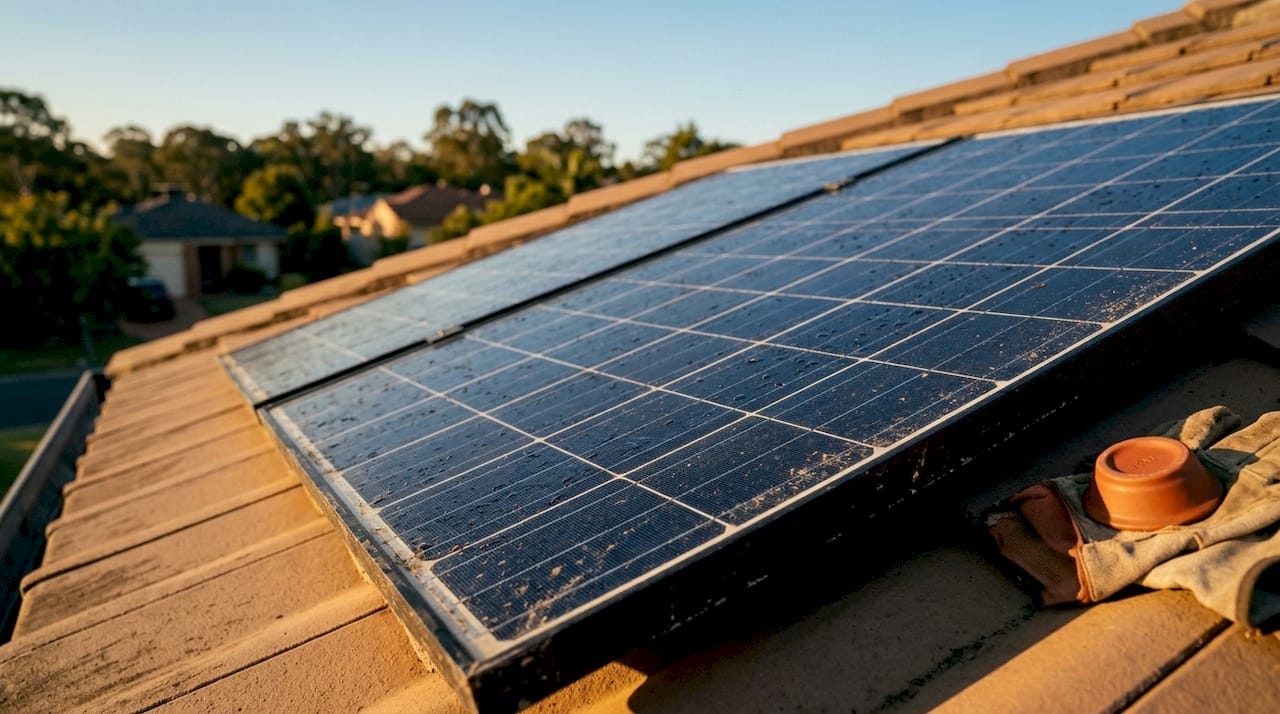
Standard Test Conditions use 1,000 W/m² irradiance, a cell temperature of 25°C, and the AM1.5 solar spectrum. These conditions represent a bright, clear day at moderate latitude. They exist so every manufacturer measures panels the same way, making comparisons fair.
One detail most homeowners miss is the gap between cell efficiency and module efficiency. Module efficiency runs 1–2 percentage points lower than individual cell efficiency. That gap comes from busbars, cell spacing, the frame, and optical losses through the glass. When you read a datasheet, you are seeing module efficiency, which is the number that actually matters for your roof.
Pro Tip: Never compare a cell efficiency figure from one brand with a module efficiency figure from another. Always check that both numbers refer to the full panel, not the individual cell.
| Metric | What it measures | Typical value |
|---|---|---|
| Cell efficiency | Individual solar cell performance | 1–2% higher than module |
| Module efficiency | Full panel output per m² | 20–24% (monocrystalline) |
| STC irradiance | Standard light intensity used in testing | 1,000 W/m² |
| STC temperature | Standard cell temperature used in testing | 25°C |
What efficiency range do modern solar panels offer?
Monocrystalline panels dominate new residential installations in 2026, and for good reason. They typically achieve 20–24% efficiency, with TOPCon and HJT cell technologies pushing towards the upper end of that range. These technologies reduce electron recombination losses, which is why they outperform standard monocrystalline cells.
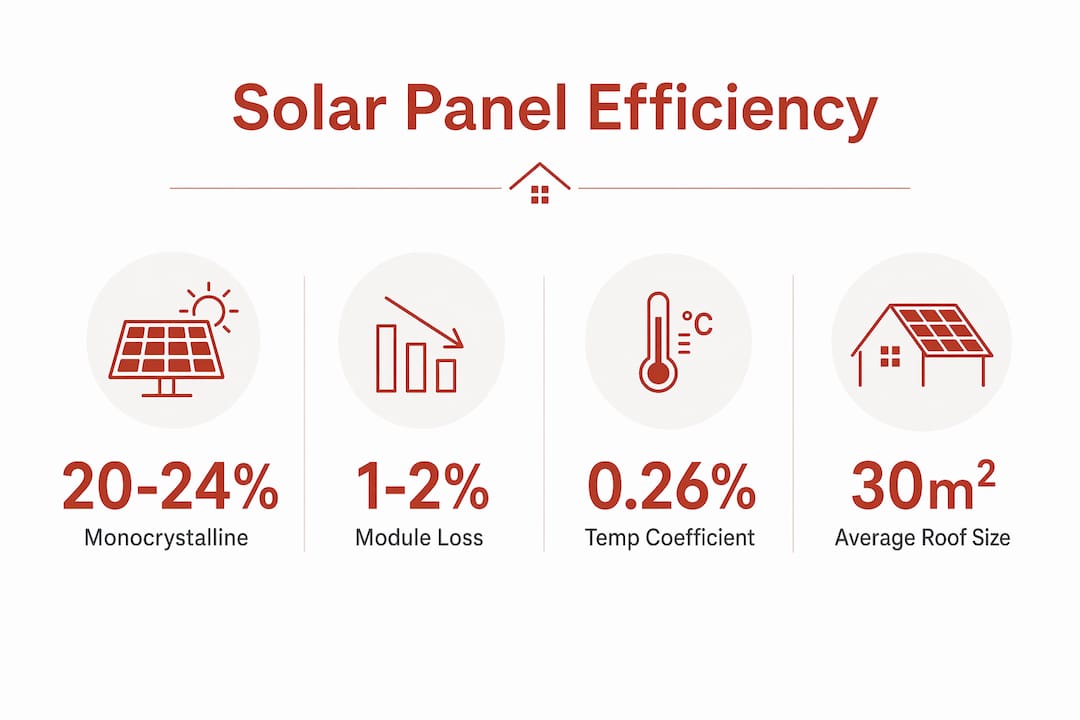
Polycrystalline panels, which were common a decade ago, now achieve around 15–17% efficiency. They are increasingly rare in new installations because the price gap between polycrystalline and monocrystalline has narrowed significantly. Paying a little more for monocrystalline now makes financial sense for most homeowners.
Here is a practical summary of what you can expect from each panel type:
- Standard monocrystalline: 20–22% efficiency, widely available, good balance of cost and performance
- TOPCon monocrystalline: 22–24% efficiency, lower degradation over time, slightly higher upfront cost
- HJT (Heterojunction Technology): up to 24% efficiency, excellent temperature performance, premium pricing
- Polycrystalline: 15–17% efficiency, rarely specified for new UK installations, lower cost per panel but larger footprint
The practical difference between a 21% and a 23% panel is smaller than most people expect. On a 30 m² roof, that 2% gap translates to roughly 60W of additional capacity per panel. Whether that justifies the price premium depends entirely on your roof space and budget.
What factors affect solar panel efficiency in real conditions?
Panel efficiency ratings reflect lab conditions, not your rooftop. Shading, soiling, and wiring losses all reduce real-world output beyond what the datasheet suggests. A panel rated at 22% under STC may perform noticeably below that on a warm summer afternoon.
Temperature is the most underestimated factor. Every panel carries a temperature coefficient, typically around 0.26% to 0.35% power loss per °C above 25°C. On a hot day, a panel surface can reach 65°C. That means a panel could lose 10–14% of its rated output simply because of heat. Panels with lower temperature coefficients, such as HJT types, hold their output better in warm weather.
Pro Tip: If your roof faces south-west and gets full afternoon sun in summer, prioritise a panel with a low temperature coefficient over one with a marginally higher efficiency rating. The real-world gain will be greater.
The main factors that reduce real-world solar panel performance are:
- Shading: Even partial shading from a chimney or tree branch can reduce output across multiple panels if they share a string inverter
- Soiling: Dust, bird droppings, and moss reduce light transmission through the glass
- Panel orientation and tilt: A south-facing roof at 30–35° tilt is optimal for most of the UK; east or west-facing roofs produce less
- Temperature: Higher ambient temperatures reduce output, particularly for panels with poor temperature coefficients
- Wiring and inverter losses: System-level losses of 10–20% are normal and are separate from panel efficiency
For homeowners in southern England, understanding how panel orientation affects output is particularly relevant given the region’s solar irradiance patterns.
How does efficiency affect cost, roof space, and system planning?
Higher efficiency panels do not automatically produce more electricity than lower efficiency panels at the same wattage rating. A 400W panel at 22% efficiency simply has a smaller physical footprint than a 400W panel at 18% efficiency. Both deliver 400W under STC. The difference is how much roof space each one occupies.
This distinction matters enormously depending on your property. For a terraced house with a compact south-facing roof, higher efficiency panels let you fit more total capacity into the available space. For a large detached home or a rural property with outbuildings, cost per watt often matters more than efficiency rating.
| Scenario | Best approach | Why |
|---|---|---|
| Small or restricted roof | Higher efficiency panels (22–24%) | Maximises kWp capacity in limited area |
| Large roof with no obstructions | Cost-per-watt focus | More panels at lower cost achieves same output |
| Mixed shading conditions | Microinverters or DC optimisers | Reduces shading losses regardless of panel efficiency |
| Budget-constrained project | Mid-range monocrystalline (20–21%) | Good performance without premium pricing |
Space-constrained installations justify the price premium of high-efficiency panels because every square metre of roof must work harder. For land-rich projects, such as ground-mounted arrays or large agricultural buildings, cost per watt is the more decisive metric. Smarthometechnical designs systems around your specific roof and energy goals, not around a single efficiency figure.
If you are planning a system for a garden cabin or outbuilding with limited roof area, the same logic applies. Properties with small installation footprints benefit most from higher efficiency panels because every available square metre counts.
What else should homeowners consider beyond efficiency?
Efficiency is one number on a datasheet. Long-term value depends on several other factors that are equally, and sometimes more, important.
Degradation rates and warranty terms influence lifetime energy yield more than small efficiency differences between competing panels. A panel that degrades slowly over 25 years produces more total electricity than a marginally more efficient panel that loses output faster. Always check the product warranty alongside the performance guarantee.
Key factors to evaluate alongside efficiency:
- Degradation rate: Premium panels typically guarantee less than 0.5% annual output loss; cheaper panels may degrade faster
- Product warranty: A 25-year product warranty signals manufacturer confidence in build quality
- Temperature coefficient: Critical for UK summers and for south-facing roofs that heat up quickly
- Manufacturer reliability: A panel is only as good as the company standing behind it in year 15
Understanding how solar panel guarantees work gives you a clearer picture of what you are actually buying. The efficiency rating gets you through the door; the warranty and degradation rate determine whether the investment pays off over time.
Homeowners should prioritise total system design over chasing the highest efficiency panel. Shading analysis, inverter selection, and battery storage integration often deliver bigger gains than a 1–2% efficiency improvement on the panel itself. Good solar system planning accounts for all of these variables together.
Key takeaways
Solar panel efficiency is the percentage of sunlight converted to electricity, but real-world output depends on temperature, shading, system design, and panel degradation, not efficiency rating alone.
| Point | Details |
|---|---|
| Efficiency definition | Efficiency is the percentage of sunlight converted to electricity under Standard Test Conditions. |
| Modern residential range | Monocrystalline panels achieve 20–24%; polycrystalline panels achieve 15–17% and are rarely specified now. |
| Temperature impact | Panels can lose 10–14% of rated output when surface temperatures reach 65°C. |
| Space vs cost trade-off | High-efficiency panels suit small roofs; cost-per-watt matters more for large or unrestricted installations. |
| Beyond efficiency | Degradation rates, warranty terms, and temperature coefficients often determine long-term value more than efficiency alone. |
What I have learnt from real rooftop installations
After working on residential solar installations across southern England, one pattern stands out clearly. Homeowners consistently overestimate how much a higher efficiency rating will change their bills, and underestimate how much shading and system design actually matter.
I have seen a well-designed 20% efficient system outperform a poorly planned 23% efficient one, simply because the installer accounted for afternoon shading from a neighbouring property. The panel efficiency figure on the brochure meant nothing once half the array was in shadow by 2PM.
The temperature coefficient conversation rarely happens during the sales process, yet it is one of the most practical numbers on the datasheet. Panels with lower temperature coefficients hold their output on hot days, which in a good UK summer makes a measurable difference to monthly generation figures.
My honest advice: focus on the total system design, ask your installer about shading analysis, and treat efficiency as one input among several. A reputable installer will tell you when a slightly less efficient panel is the smarter financial choice for your specific roof. If they only talk about efficiency, ask them about degradation rates and temperature coefficients. The answers will tell you a lot about their expertise.
— Simon
Professional solar installation from Smarthometechnical
Choosing the right panels is only part of the decision. How those panels are installed, oriented, and integrated into your home’s electrical system determines how much electricity you actually generate over 25 years.

Smarthometechnical specialises in residential solar installations across southern England, designing systems that balance panel efficiency, roof constraints, and long-term cost savings. The team assesses shading, orientation, and energy usage before recommending any panel technology, so you get a system built around your home rather than a generic specification. Whether you have a compact terraced roof or a large rural property, Smarthometechnical matches the right technology to your situation. Get in touch to discuss your installation and find out what your roof can realistically generate.
FAQ
What is solar panel efficiency in simple terms?
Solar panel efficiency is the percentage of sunlight a panel converts into usable electricity. A 22% efficient panel turns 22% of the light hitting it into power, with the rest lost as heat.
How efficient are solar panels for a typical UK home?
Most residential monocrystalline panels installed in the UK achieve 20–24% efficiency under standard test conditions. Real-world output is lower due to temperature, shading, and system losses.
Does higher efficiency always mean more electricity?
Not necessarily. A higher efficiency panel produces the same wattage as a lower efficiency panel but in a smaller physical area. Total electricity output depends on how many panels you install and how well the system is designed.
What is a good temperature coefficient for solar panels?
A temperature coefficient of around 0.26% per °C or lower is considered good. Panels with lower coefficients lose less output on hot days, which matters for south-facing UK roofs in summer.
How long do solar panels maintain their efficiency?
Premium panels typically guarantee less than 0.5% annual output degradation, meaning they retain most of their rated efficiency over a 25-year lifespan. Warranty terms are the clearest indicator of expected long-term performance.
Recommended
- The role of solar in 2026 homes: a complete guide – Smart Home Technical Ltd
- Solar panel benefits for rural properties: 2026 guide – Smart Home Technical Ltd
- Real examples of solar battery savings in 2026 – Smart Home Technical Ltd
- Why solar suits rural homes: the complete 2026 guide – Smart Home Technical Ltd
