
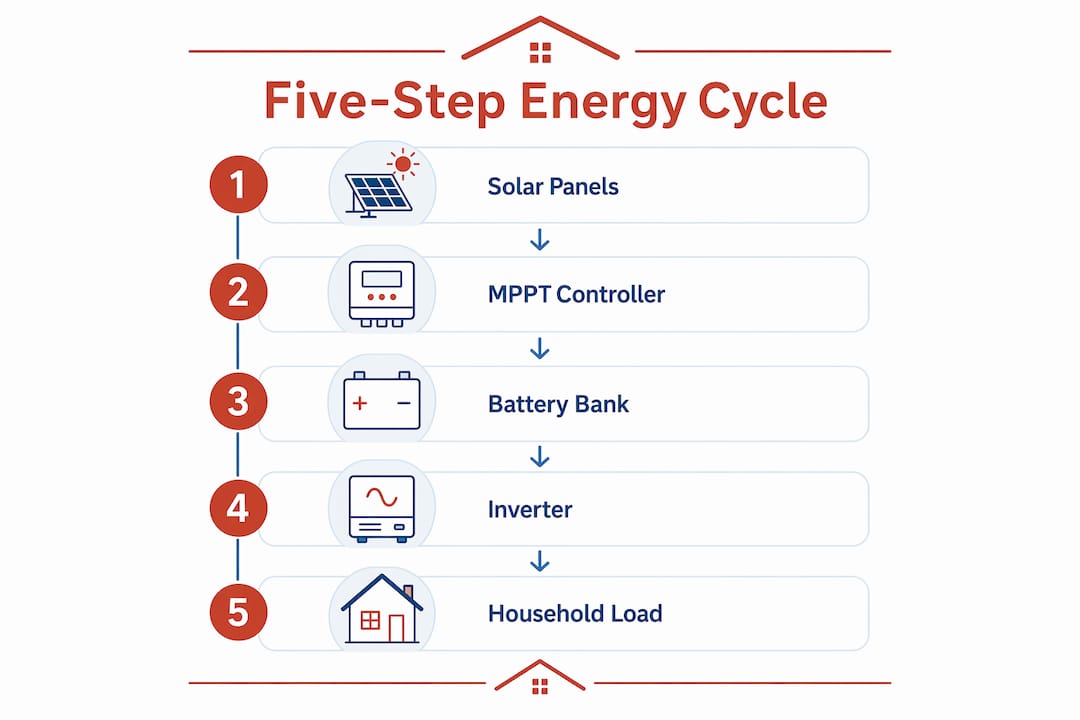
An off-grid solar system is a self-contained power source that generates, stores, and supplies electricity without any connection to the utility grid. Understanding how off-grid solar works means grasping five core steps: solar panels capture sunlight, a charge controller manages the flow, batteries store the energy, an inverter converts it to usable power, and your household loads consume it. This cycle runs independently, day and night, regardless of what the grid is doing. Systems are typically sized to meet a household’s daily energy demand, with 6 kWh per day being a common baseline for a modest rural home. Industry-standard components include MPPT charge controllers and LiFePO4 battery banks, both of which significantly improve reliability and lifespan over older alternatives.
How off-grid solar works: the five-step energy cycle
The energy path in a standalone solar system follows a clear sequence, and each component has a specific job. Understanding that sequence helps you make better decisions about sizing, component quality, and backup planning.
Solar panels sit at the start of the chain. They convert sunlight into direct current (DC) electricity through the photovoltaic effect. Output varies with the angle of mounting, shading, temperature, and time of day. Modern panels maintain at least 80% of their original output after 25 years under warranty, though real-world field efficiency typically lands between 70% and 85% depending on environmental conditions.
Charge controllers sit between the panels and the battery bank. Their job is to regulate voltage and current so the batteries charge safely and efficiently. MPPT (Maximum Power Point Tracking) controllers are the current industry standard. MPPT controllers capture 20–30% more energy than older PWM (Pulse Width Modulation) types by continuously adjusting to extract the maximum available power from the panels. That difference is meaningful when you are running on a finite daily solar budget.
Battery banks store the electricity for use after dark or during cloudy weather. LiFePO4 (lithium iron phosphate) batteries are the preferred choice for off-grid systems because of their deep discharge capability, long cycle life, and stable chemistry. Lead-acid batteries are cheaper upfront but degrade faster and cannot be discharged as deeply without damage.
Inverters convert the DC power stored in the battery into alternating current (AC), which is what your appliances use. Pure sine wave inverters prevent appliance damage that modified sine wave units can cause, particularly with sensitive electronics, motors, and medical equipment. An inverter must be rated for both the continuous load your home draws and the surge load that motors and compressors demand at start-up.
- Solar panels produce DC electricity from sunlight
- MPPT charge controllers regulate and maximise charging efficiency
- LiFePO4 battery banks store power for night and overcast days
- Pure sine wave inverters convert DC to AC for household use
- Household loads draw from the inverter as needed
Pro Tip: Size your inverter’s continuous rating to at least 25% above your calculated peak household load. Surge loads from fridges, pumps, and power tools can trip an undersized inverter instantly.
How does energy storage and seasonal output affect system reliability?
Solar panels only generate power during daylight hours, with roughly 5–6 effective peak sun hours per day being the working assumption for system design in the UK. Battery storage bridges the gap between generation and consumption, covering night-time use and short cloudy spells. The real design challenge is not the average day. It is the worst day of the year.
Off-grid systems are sized for worst-case conditions, which in the UK means short winter days with low sun angles and frequent overcast skies. Oversizing the solar array and using tilt mounting boosts winter output by 10–20%, which is critical for properties at higher latitudes. Bifacial panels, which capture reflected light from the ground or roof surface, add further gains in snowy or bright conditions.
Battery thermal management is a factor that many homeowners overlook. LiFePO4 batteries lose capacity and can suffer permanent damage if charged at very low temperatures. In cold climates, insulated and heated enclosures protect the battery bank and maintain efficiency through winter. This is not optional in exposed rural locations.
Extended low-production periods require a backup strategy. Backup generators are advisable as a fail-safe for around 15–25 days per year of genuinely low sunlight. Propane and diesel generators are both common choices, with propane favoured where fuel storage is easier and emissions matter.
| Condition | Impact on system | Mitigation |
|---|---|---|
| Winter low sun | Reduced daily panel output | Oversize array, use tilt mounts |
| Extended cloud cover | Battery depletion risk | Backup generator |
| Sub-zero temperatures | Battery capacity loss | Heated, insulated enclosures |
| High summer output | Potential overcharge | MPPT controller with absorption settings |
Pro Tip: When sizing your battery bank, calculate for three days of autonomy without any solar input. That buffer covers most UK winter cloudy spells without needing to run a generator.
What types of off-grid solar systems suit different properties?
Off-grid solar is not a single product. It covers a range of configurations, each suited to different property types, energy demands, and budgets. Knowing which type fits your situation is the first practical decision you will make.
Stand-alone systems are the most common configuration for rural homes, remote cabins, and farm buildings. They rely entirely on solar and battery storage, with a generator as backup. A Yukon off-grid home using 6 kW solar and 30 kWh LiFePO4 batteries with a propane generator came in at roughly $40,000 net cost, compared to over $50,000 per kilometre for grid extension in remote areas. The economics of going off-grid become clear when the grid is far away.
Hybrid systems combine solar, battery storage, and a generator in a managed configuration. A hybrid controller or inverter-charger switches between sources automatically, prioritising solar, drawing from batteries next, and starting the generator only when needed. This approach suits properties with higher or less predictable energy demands, such as small agricultural businesses or holiday lets.
Portable and small-scale systems serve campervans, narrowboats, and temporary site offices. These use foldable or flexible panels, smaller battery packs, and compact inverters. They are not designed for whole-house loads but are a practical introduction to off-grid thinking.
The benefits of off-grid solar extend beyond cost savings in remote locations. Generating your own power removes exposure to grid price fluctuations. It also eliminates the carbon footprint associated with diesel generator reliance, which is the default for many rural properties without mains electricity. For property developers, an off-grid solar installation can add measurable value to rural plots that would otherwise be difficult to sell as habitable.
- Stand-alone systems: best for remote homes, cabins, and farms
- Hybrid systems: suited to higher-demand or variable-use properties
- Portable systems: campervans, boats, and temporary installations
- Economic case: strongest when grid extension costs exceed system cost
- Sustainability benefit: replaces diesel generation with zero-emission power
What should you consider when designing an off-grid solar installation?
Good system design is the difference between a reliable off-grid setup and one that fails in february. The process starts with an honest assessment of your energy use, not an optimistic one.
Calculating your real energy needs
Add up every appliance’s wattage and the hours per day you use it. Include seasonal variation. A property used year-round in the UK will have a very different winter profile from a summer-only holiday cottage. Undersizing the battery bank is the most common and costly mistake in off-grid solar installation.
Choosing the right components
Specify MPPT charge controllers, LiFePO4 batteries, and pure sine wave inverters from the outset. The upfront cost is higher than budget alternatives, but the long-term reliability difference is significant. Pure sine wave inverters are critical for protecting sensitive electronics, and their continuous and surge power ratings must match your actual household loads. Check both ratings before purchasing.
Wiring and electrical safety
Off-grid systems carry high DC currents, which behave differently from AC mains wiring. Fuse placement, correct wire gauge, and proper earthing are not optional. A qualified electrical contractor should design and install the DC wiring. Incorrect wiring is a fire risk and will void component warranties.
Ongoing maintenance
Battery terminals need periodic inspection. Charge controller settings may need seasonal adjustment. Inverters should be checked for fault logs. A well-maintained system will perform reliably for 20 years or more. Neglected systems fail at the worst possible time, which is usually mid-winter.
- Audit your daily and seasonal energy consumption before sizing anything
- Specify MPPT controllers, LiFePO4 batteries, and pure sine wave inverters
- Oversize the solar array by at least 20–30% for winter worst-case production
- Use correct wire gauges and fuse ratings throughout the DC circuit
- Plan for battery thermal management if your location experiences sub-zero temperatures
- Include a backup generator sized to charge the battery bank within 4–6 hours
Pro Tip: Ask your installer for a month-by-month energy production estimate, not just an annual average. The winter months will tell you whether the system is genuinely sized for year-round use.
Key takeaways
An off-grid solar system works by capturing sunlight through photovoltaic panels, storing the resulting DC electricity in a battery bank, and converting it to AC power via a pure sine wave inverter to supply household loads independently of the utility grid.
| Point | Details |
|---|---|
| Five-step energy cycle | Panels, MPPT controller, LiFePO4 battery, inverter, and household loads form the complete system. |
| Size for worst-case conditions | Design around winter output and three days of battery autonomy, not average annual figures. |
| Component quality matters | MPPT controllers capture 20–30% more energy than PWM types; LiFePO4 batteries outlast lead-acid significantly. |
| Backup planning is non-negotiable | A propane or diesel generator covers the 15–25 days per year when solar production falls short. |
| Off-grid can be cheaper than grid connection | Remote grid extension can exceed $50,000 per kilometre, making a standalone system the more practical choice. |
Why I think most people underestimate what off-grid solar actually demands
The analogy I find most useful is a rainwater collection system. You collect what falls, store what you can, and manage consumption carefully because the resource is finite. Most homeowners who come to us imagining off-grid solar as a set-and-forget solution are surprised by that framing.
The technology has genuinely improved. LiFePO4 batteries and MPPT controllers have transformed what is achievable compared to systems from a decade ago. A well-designed system today is far more reliable than anything built with lead-acid batteries and PWM controllers. That progress is real and worth acknowledging.
What has not changed is the need for honest system design. I have seen properties where the solar array was sized for a sunny july week, not a grey january fortnight. Those systems run generators constantly in winter, which defeats much of the purpose. The fix is always the same: oversize the array, oversize the battery bank, and plan for the worst month.
The economic case for off-grid solar is strongest when the alternative is a long and expensive grid connection. For rural properties and remote developments, the numbers often favour a standalone system decisively. For homeowners closer to the grid, the calculation is more nuanced, but the appeal of genuine energy independence and zero exposure to rising tariffs is a legitimate long-term argument.
Off-grid solar is a long-term investment in resilience. Treat it like one.
— Simon
Smarthometechnical’s off-grid solar installation services
Smarthometechnical specialises in off-grid solar installations for rural homes, remote properties, and property developers across the UK. The team handles everything from initial energy audit and system design through to component sourcing and full electrical installation, including DC wiring, battery enclosures, and inverter commissioning.
Every system is designed around your specific site, energy profile, and seasonal demands. Smarthometechnical uses MPPT charge controllers, LiFePO4 battery banks, and pure sine wave inverters as standard. If you are assessing whether off-grid solar is the right choice for your property, or you need a detailed quote for a rural solar installation, contact Smarthometechnical for a no-obligation consultation.
FAQ
What is the difference between off-grid and grid-tied solar?
An off-grid solar system operates entirely independently, storing power in batteries for use at any time. A grid-tied system feeds surplus electricity back to the utility network and draws from it when generation is low, so it offers no protection during grid outages.
How many solar panels does an off-grid home need?
The number depends on your daily energy consumption and your location’s peak sun hours. A modest rural home using around 6 kWh per day typically requires a 6 kW array, oversized further to account for winter production losses.
How long do off-grid solar batteries last?
LiFePO4 batteries are the current standard for off-grid systems and typically last 10 years or more with proper thermal management and correct charge settings. Lead-acid alternatives have a significantly shorter usable lifespan under deep-cycle conditions.
Do off-grid solar systems work in winter in the UK?
Yes, but they require careful design. Tilt-mounted or oversized arrays, combined with adequate battery storage and a backup generator, allow year-round operation. Winter output is lower, so systems must be sized for that worst-case scenario rather than summer averages.
Is off-grid solar cheaper than connecting to the grid?
For remote properties, off-grid solar is frequently the more cost-effective option. Grid extension in rural areas can cost more than $50,000 per kilometre, while a complete standalone system for a modest home can be installed for considerably less.
Recommended
- How rural solar installation works: 2026 guide – Smart Home Technical Ltd
- Why solar suits rural homes: the complete 2026 guide – Smart Home Technical Ltd
- How solar works in winter: what homeowners need to know – Smart Home Technical Ltd
- Why switch to solar energy: a 2026 homeowner’s guide – Smart Home Technical Ltd
