
Solar panels lose efficiency through a combination of chemical changes inside the cells, physical stress from weather, and electrical faults that build up over years of use. The industry term for this gradual decline is photovoltaic degradation, and it is entirely normal. Modern solar panels degrade at roughly 0.5% per year, meaning a quality panel retains well over 86% of its original output after 25 years. Most manufacturers back this with a 25-year performance warranty guaranteeing at least 80% output. The key distinction every homeowner needs to understand is the difference between expected, slow degradation and a sudden drop that signals a fault requiring repair.
Why solar panels lose efficiency: the core mechanisms
All solar panels degrade over time. The rate and cause depend on the cell technology, the installation quality, and the local environment.
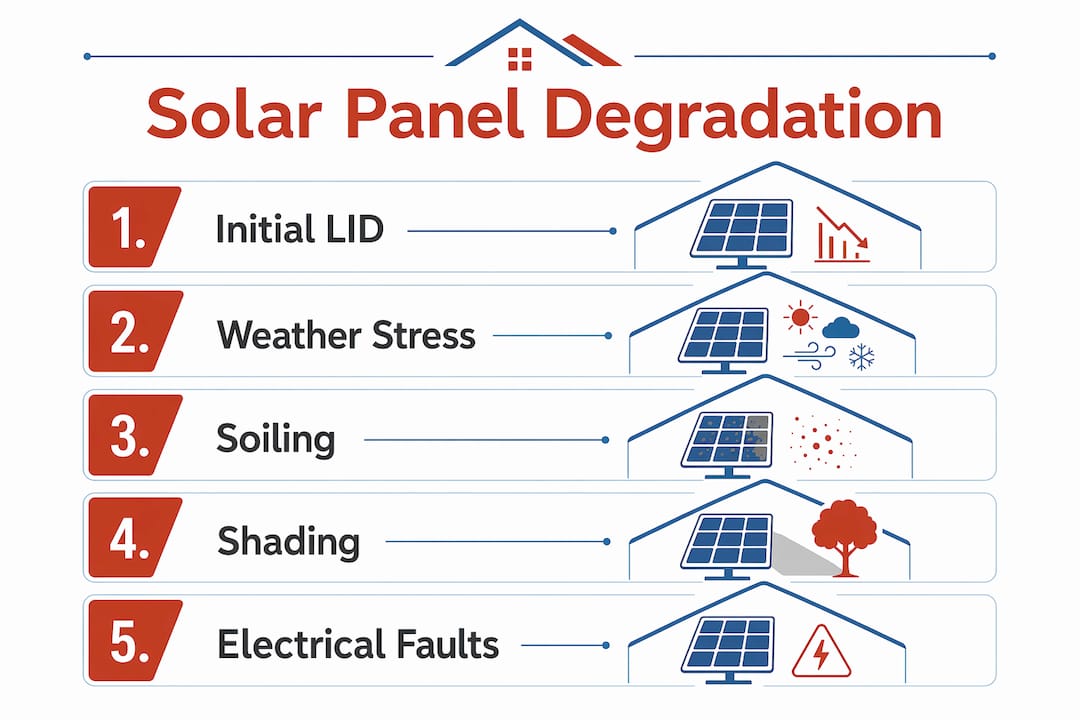
The process starts before your system even completes its first week of operation. Light-induced degradation (LID) causes an initial 1–3% efficiency drop in P-type panels within the first few days of sunlight exposure. This happens because boron-oxygen complexes in the silicon lattice react with light, reducing the material’s ability to convert photons into electricity. Newer N-type technologies such as TOPCon and HJT experience LID losses of under 1%, making them a better long-term choice for homeowners who want to minimise early losses.
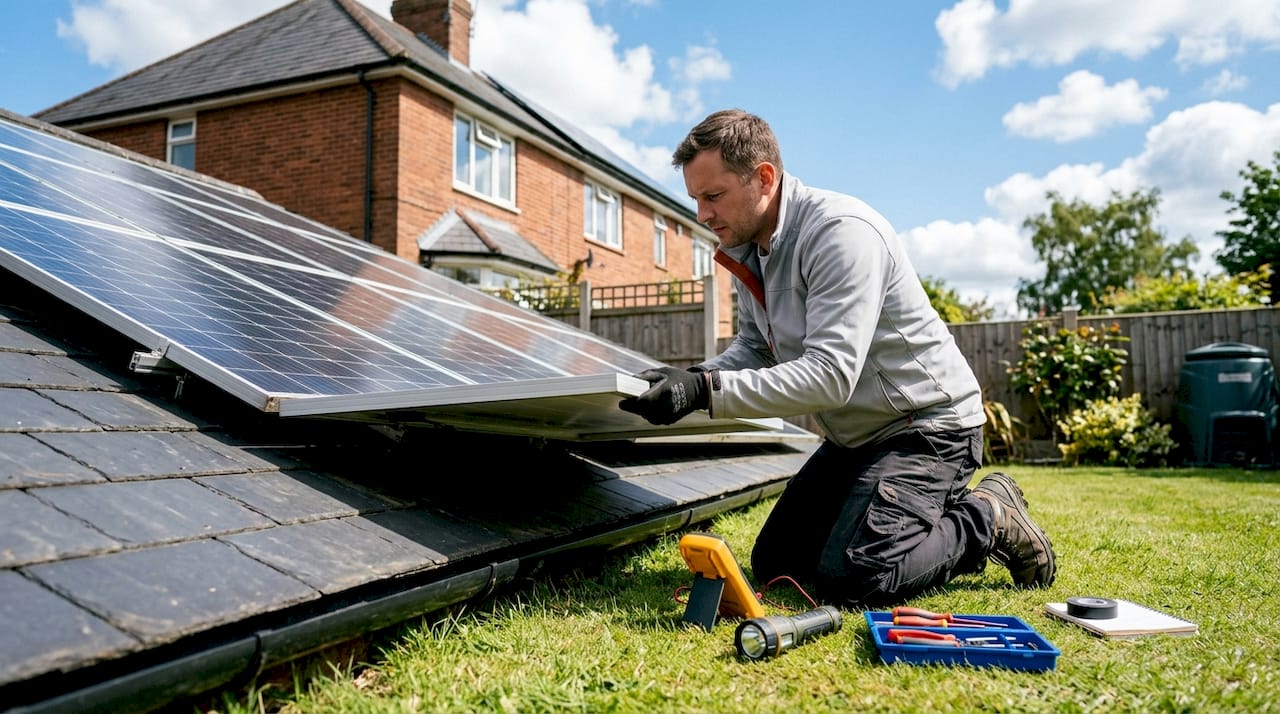
After that initial drop, degradation slows to a steady annual rate. Standard monocrystalline PERC panels degrade at around 0.5% per year. Advanced cell types like HJT and TOPCon achieve rates of 0.3–0.4% annually. That difference compounds significantly over a 25-year system life.
What happens inside the panel as it ages
Several physical and chemical processes drive long-term efficiency decline:
- EVA encapsulant yellowing: The ethylene-vinyl acetate layer that protects the cells turns yellow with UV exposure, reducing the light that reaches the cells.
- Delamination: The bond between the encapsulant and the glass or backsheet weakens, allowing moisture to enter and corrode cell contacts.
- Solder joint fatigue: Thermal cycling causes solder bond fatigue and microcracks, accelerating irreversible performance losses over time.
- Potential-Induced Degradation (PID): High voltage combined with humidity drives leakage currents through the panel frame, degrading the cells progressively.
Pro Tip: If your panels are P-type and installed in a humid location, ask your installer about PID-resistant coatings or anti-PID inverter settings. These are low-cost interventions that can prevent a very expensive problem.
How does the UK environment affect solar panel performance?
The UK climate creates a specific set of stresses that homeowners in sunnier countries do not face in the same way. Understanding these helps you set realistic expectations and spot genuine problems.
Weather and thermal stress
Temperature fluctuations are the primary physical stressor for UK panels. Panels heat up during sunny spells and cool rapidly when clouds return, sometimes multiple times in a single day. Thermal cycling stresses materials and joints, and this repeated expansion and contraction is a leading cause of microcracks and solder fatigue over a system’s lifetime. The UK’s mild but variable climate means panels experience a high number of thermal cycles annually, even if peak temperatures are lower than in southern Europe.
UV exposure also degrades the encapsulant and backsheet over time, regardless of whether the day feels particularly sunny. Even diffuse light on overcast days carries UV radiation.
Soiling and shading in the UK
Soiling is a more significant issue than most homeowners realise. Panel soiling in the UK typically causes a 2–5% annual output loss, with coastal and industrial sites experiencing higher losses from salt spray and particulate deposits. Bird droppings are a particular problem because they are concentrated and opaque, blocking light from an entire cell rather than reducing it uniformly.
Shading deserves equal attention. Shadowing of even a single panel in a series string can disproportionately reduce the entire string’s output due to how electrical current flows through the circuit. A tree that cast no shadow when your system was installed in 2018 may now shade two panels for three hours each morning. That growth alone could account for a meaningful drop in annual yield. Reviewing shading conditions every two to three years is a practical habit worth forming. The solar planning guide from Smarthometechnical covers how shading assessments are carried out during the design stage.
What faults are mistaken for normal degradation?
This is where many homeowners lose money unnecessarily. A genuine fault can look exactly like slow, natural ageing if you are only watching your annual generation figures.
The most common culprits are:
- Inverter decline: Inverter ageing commonly reduces system output and is more likely to cause underperformance than panel failure. Inverters typically last 10–15 years, and their efficiency drops gradually before they fail. A system that was performing well in year eight may start underperforming in year twelve simply because the inverter is ageing.
- Microcracks: Microcracks reduce panel efficiency by about 2.5% per crack and can develop into hotspots that pose a fire risk. They are invisible to the naked eye and require electroluminescence (EL) imaging or thermal imaging to detect.
- PID faults: Potential-Induced Degradation can cause output drops exceeding 20%, yet it develops gradually and is frequently misdiagnosed as normal panel ageing. It is identifiable through monitoring data and EL imaging.
- Connector corrosion and string faults: MC4 connectors exposed to moisture over many years corrode and increase resistance, reducing output from an entire string. This is a common finding in systems over eight years old.
Pro Tip: If your system’s output has dropped by more than 10% compared to the same period last year and the weather has been similar, do not assume it is normal ageing. Book a diagnostic inspection. The cause is almost always a repairable fault, not worn-out panels.
Panel-level monitoring systems give you the granularity to spot these faults early. A string inverter shows you total system output; panel-level monitoring shows you which individual panel is underperforming. That distinction can save you years of lost generation. Solar optimisers are one technology that provides this panel-level visibility while also mitigating shading losses.
How can homeowners monitor and maintain solar panel efficiency?
Proactive monitoring is the single most effective thing you can do to protect your system’s output over its lifetime.
- Use PVGIS as your benchmark: PVGIS accounts for local irradiance, tilt, and shading to give you a realistic annual yield estimate for your specific location. Comparing your actual generation to a PVGIS estimate is far more meaningful than comparing it to a manufacturer’s peak-condition figure. Real-world performance at 75–85% of estimated potential is normal and healthy.
- Carry out visual inspections twice a year: Look for soiling, bird droppings, physical damage, and any new shading from tree growth or building work. Spring and autumn are the best times in the UK.
- Clean panels when needed, not on a fixed schedule: Rainfall in the UK removes most dust and pollen naturally. Clean only when you can see visible soiling or when output drops during a dry spell. Over-cleaning with the wrong equipment can scratch the glass.
- Book a professional inspection every five years: A qualified engineer with thermal imaging equipment can identify hotspots, microcracks, and PID damage that no visual inspection will catch. This is particularly important for systems approaching the ten-year mark.
- Check your inverter data regularly: Most modern inverters provide daily and monthly generation logs. A consistent downward trend that does not match seasonal patterns is a clear signal to investigate.
For homeowners who want to go further, extending your panel’s lifespan involves a combination of monitoring discipline, timely cleaning, and prompt fault repair rather than any single silver-bullet solution.
Key takeaways
Solar panels degrade at a predictable rate of around 0.5% per year, but faults including PID, inverter decline, and microcracks cause abnormal losses that require diagnosis and repair rather than acceptance.
| Point | Details |
|---|---|
| Normal degradation rate | Quality panels lose roughly 0.5% output per year, retaining over 86% after 25 years. |
| LID is expected | An initial 1–3% drop in the first days of operation is normal for P-type panels, not a fault. |
| Soiling causes measurable loss | UK soiling typically reduces output by 2–5% annually; clean when visible, not on a fixed schedule. |
| Faults mimic ageing | PID, inverter decline, and microcracks can look like normal wear but require professional repair. |
| PVGIS sets realistic expectations | Comparing output to PVGIS benchmarks is more accurate than using manufacturer peak figures. |
What I have learned from years of solar installations in the UK
The question I hear most often from homeowners is some version of “is my system supposed to be doing this?” Nine times out of ten, the answer is yes. Panels are genuinely durable, and the slow, predictable decline that manufacturers describe in their warranties is exactly what most systems deliver.
What surprises people is how often the problem is not the panels at all. Inverters are the silent underperformers in most ageing systems. I have seen systems where the panels were in excellent condition but the inverter was operating at a fraction of its rated efficiency. The homeowner had spent two years assuming their panels were worn out. A replacement inverter restored the system to near-original output within a day.
My honest view on cleaning is that it is overrated as a fix. Rainfall in the UK does most of the work. The homeowners who obsess over cleaning schedules are often the same ones who ignore their inverter data for months at a time. Monitoring your generation figures weekly takes five minutes and tells you far more than a clean panel surface does.
The one thing I would urge every homeowner to take seriously is a professional inspection around the ten-year mark. Thermal imaging at that stage catches problems that are invisible to the eye and cheap to fix if caught early. Leave them another five years and the repair cost multiplies. The panels on your roof are a long-term asset. Treat them like one.
— Simon
How Smarthometechnical can help you get the most from your solar system
Smarthometechnical installs and maintains solar panel systems across the UK, with a particular focus on getting the design right from day one to minimise shading losses and system faults. Every installation includes a site-specific shading assessment and system design matched to your roof’s orientation and local irradiance conditions.

For existing systems, Smarthometechnical offers diagnostic inspections, inverter health checks, and thermal imaging surveys to identify faults that routine monitoring may miss. If your system is underperforming or approaching its ten-year mark, a professional assessment is the fastest way to understand what is happening and what to do about it. Visit the solar installations page to find out more or to book a consultation with the team.
FAQ
How much efficiency do solar panels lose per year?
Modern solar panels degrade at roughly 0.5% per year, with advanced N-type technologies achieving 0.3–0.4%. A drop of more than 5% in a single year indicates a fault rather than normal ageing.
Does rain clean solar panels sufficiently in the UK?
Rainfall removes most dust and pollen from panels in the UK, making manual cleaning unnecessary in most cases. Soiling typically causes a 2–5% annual output loss, but visible deposits such as bird droppings warrant targeted cleaning.
What is PID and how serious is it?
Potential-Induced Degradation is an electrical fault caused by high voltage and humidity that can reduce output by more than 20%. It develops gradually and is often mistaken for normal panel ageing, so professional diagnosis is needed to identify and treat it.
How do I know if my solar panels are underperforming?
Compare your actual generation to a PVGIS estimate for your location and system size. Output consistently below 75% of the PVGIS figure, or a year-on-year drop of more than 5%, warrants a professional inspection.
When should I replace my solar inverter?
Most inverters last 10–15 years before efficiency declines noticeably. If your system is in that age range and output has dropped without an obvious cause, inverter ageing is the most likely explanation and replacement is usually more cost-effective than repair.
Recommended
- The role of solar optimisers: a homeowner’s guide – Smart Home Technical Ltd
- How solar planning works: a homeowner’s guide 2026 – Smart Home Technical Ltd
- Solar panel installation explained for southern England – Smart Home Technical Ltd
- Why solar panels are recyclable: 2026 guide – Smart Home Technical Ltd
