
Solar panel aerial interference in Dorset is caused primarily by inverter electromagnetic noise and poor installation positioning, not by the solar panels themselves. Homeowners and property developers across Dorset are increasingly finding that a well-planned solar installation can coexist with strong aerial reception. The problems arise when installers prioritise roof coverage without considering aerial line-of-sight, or when inverter electronics leak radio frequency noise into ageing coaxial cabling. Understanding the technical standard known as Bit Error Rate (BER) helps explain why even minor signal reflections can cause complete picture failure on digital TV. This guide explains the causes, the fixes, and how to get it right from the start.
How does solar panel aerial interference affect Dorset homes?
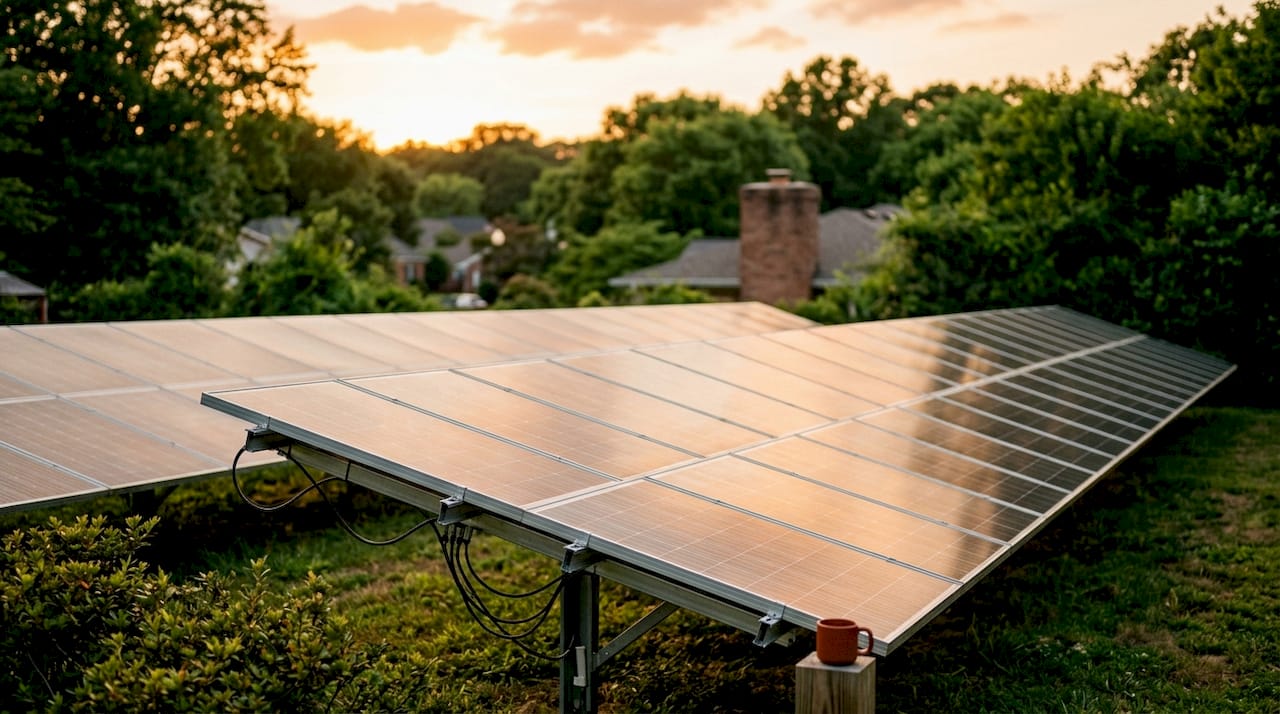
Solar panels do not generate interference by themselves. The real problem begins when a panel array physically blocks the aerial’s line-of-sight to the transmitter, creating what engineers call a “signal shadow.” Dorset properties served by the Rowridge transmitter on the Isle of Wight are particularly vulnerable, because the signal path runs at a low angle across many south-facing rooflines where panels are typically mounted.
Reflective glass and aluminium frames on solar arrays cause a separate problem called multipath interference. The broadcast signal bounces off the panel surface and arrives at the aerial a fraction of a second after the direct signal. Digital TV tuners cannot reconcile these two versions of the same signal, which spikes the Bit Error Rate and produces pixelation, freezing, or a complete loss of picture.
The table below shows the two main physical causes and their typical symptoms on Dorset properties.
| Cause | Mechanism | Typical symptom |
|---|---|---|
| Signal shadow | Panel array blocks direct path to transmitter | Weak signal, frequent dropouts |
| Multipath reflection | Signal bounces off panel glass or frame | Pixelation, picture freeze, ghosting |
| Aerial repositioned too close to panels | Installer mounts aerial on same roof section | Persistent low signal strength |
Common installation mistakes that create these problems include:
- Mounting the aerial on the same roof section as the panels without checking the transmitter bearing
- Fitting panels in a continuous run that wraps around the chimney stack, eliminating the only clear sightline
- Failing to record a baseline signal reading before installation begins, making it impossible to prove what changed
- Assuming a signal booster will compensate for a blocked aerial path (it amplifies noise along with the signal)
Installers often prioritise maximum south-facing coverage, neglecting aerial line-of-sight entirely. The result is a costly aerial relocation that could have been avoided with ten minutes of planning at the design stage.
Does inverter EMI cause signal disruption on Dorset properties?
Inverter electromagnetic interference (EMI) is the second major cause of Dorset aerial interference after physical obstruction. A solar inverter converts DC power from the panels into AC power for the home by switching at high frequency, typically in the kilohertz to megahertz range. That switching generates radio frequency noise that radiates from the inverter unit and travels along poorly shielded cables.
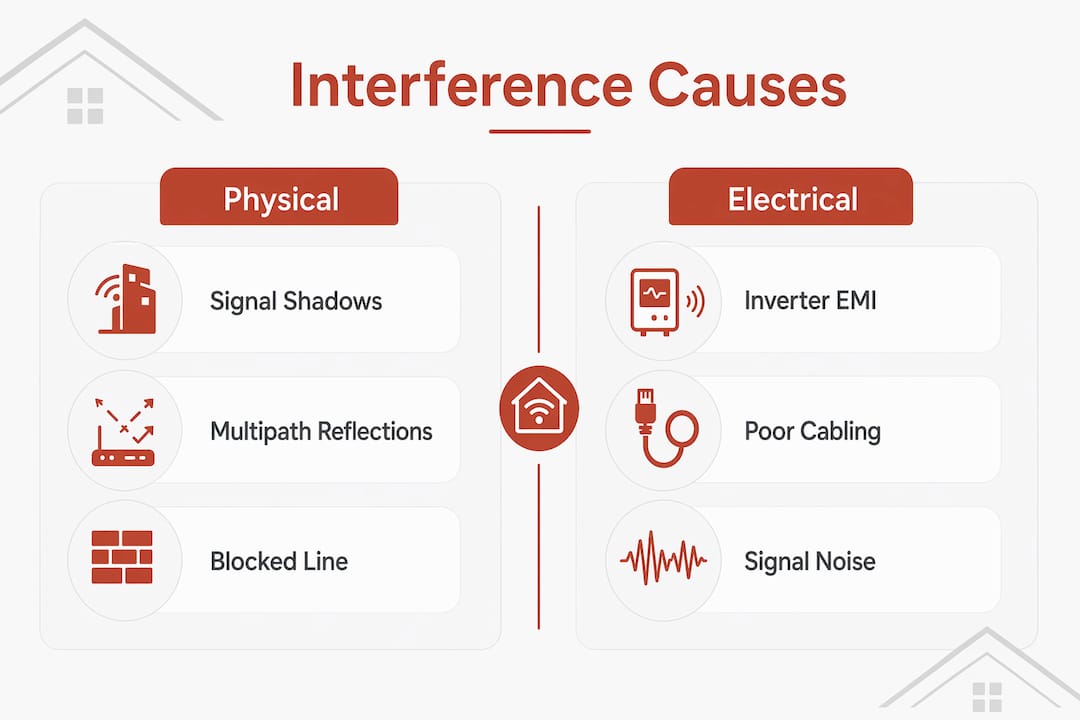
Cheaper solar inverters leak EMI more readily, and the problem worsens when the property’s existing coaxial aerial cabling is old or single-screened. The noise couples into the coaxial cable and reaches the TV tuner, producing symptoms that look identical to a weak aerial signal but behave differently. A signal meter will show adequate signal strength while the picture still breaks up.
The most common symptoms of inverter EMI are:
- Pixelation that appears only during daylight hours when the inverter is active
- Sound cutting out while the picture remains briefly stable
- Signal dropouts that correlate with cloud cover (the inverter changes switching frequency as output varies)
- Interference that affects one TV but not another on the same property, depending on cable routing near the inverter
Double-screened coaxial cables such as WF100 or WF125 reduce EMI coupling significantly. The standard recommendation is to keep aerial cabling at least 2 metres from the inverter and its DC wiring. Where that separation is not possible, the cable route should cross the inverter wiring at a right angle rather than running parallel to it.
Pro Tip: If your picture breaks up only on sunny days and clears up after sunset, inverter EMI is the most likely cause. Switch off the inverter at the isolator and check whether the picture immediately improves. That single test saves hours of unnecessary aerial work.
How to plan solar installations in Dorset to avoid aerial problems
Pre-installation signal testing is the single most effective step a Dorset homeowner or developer can take. Record the signal strength and quality reading at every aerial point before any work begins. That baseline makes it straightforward to identify what changed and who is responsible if problems arise later.
Aerial relocation is sometimes unavoidable, but it should be planned before installation rather than treated as an afterthought. Relocating aerials to gable ends or chimney brackets restores the direct signal path in most cases. A gable-end position on the side of the property facing the transmitter is usually the cleanest solution for Dorset homes, because it places the aerial entirely outside the panel array’s shadow zone.
Key planning steps for Dorset properties include:
- Identify the transmitter bearing using the Ofcom checker before the solar design is finalised
- Mark the aerial’s current sightline on the roof plan and treat it as a protected zone
- Specify double-screened coaxial cable (WF100 or WF125) in the installation contract
- Keep the inverter location at least 2 metres from all aerial cabling
- Mount communications equipment on dedicated galvanised brackets, independent of the solar frame, to prevent vibration damage and signal degradation
The comparison below shows the difference between a planned and an unplanned approach to aerial and solar coordination.
| Approach | Aerial outcome | Typical cost implication |
|---|---|---|
| Pre-installation signal test and aerial relocation planned upfront | Signal maintained or improved | Included in project budget |
| No pre-installation test, aerial left in place | Signal shadow or multipath interference likely | Reactive relocation cost added later |
Dorset planning rules under permitted development rights generally allow solar panels on residential roofs without full planning permission, but listed buildings and properties in Areas of Outstanding Natural Beauty require consent. The solar planning process for these properties adds a stage where aerial impact can be formally assessed, which is an advantage worth using.
Pro Tip: Ask your solar installer to confirm in writing that they have checked the aerial sightline before installation begins. If they cannot answer the question, that tells you everything you need to know about their process.
How to troubleshoot aerial interference after solar panel installation
Identifying the correct cause of interference before spending money on fixes is the step most Dorset homeowners skip. The three most common causes after a solar installation are physical signal shadow, inverter EMI, and unrelated 4G/5G interference from mobile masts. Each requires a different fix, and treating the wrong cause wastes money.
Follow these steps in order:
- Check whether the problem exists only during daylight hours. If it clears at night, inverter EMI or signal shadow from the panels is the cause.
- Switch off the inverter at the isolator and test the picture quality. Improvement confirms inverter EMI. No change points to physical obstruction or an unrelated cause.
- Check the Ofcom transmitter checker for any scheduled maintenance or known outages affecting your area.
- High-pressure weather systems cause nationwide signal issues that resolve naturally. Retuning during such events does not improve reception and may delete channel data unnecessarily.
- If the problem persists regardless of inverter state or time of day, 4G/5G signals can interfere with Freeview reception, particularly on amplified systems. A 4G/5G filter fitted at the aerial head often resolves this, but it will not fix alignment or cabling problems.
A professional signal audit uses a calibrated meter to measure signal strength, signal quality, and Bit Error Rate at each outlet. That data tells you precisely whether the aerial needs realignment, the cable needs replacing, or the inverter needs better shielding. Guesswork and boosters are not substitutes for measurement.
Once the cause is confirmed, the fix is usually one of three things: aerial relocation to a clear sightline, cable upgrade to double-screened coaxial, or inverter repositioning. After relocation, the aerial’s gain and tilt must be adjusted to account for the new cable length and to balance signal strength across all receiver points without overloading closer ones. This is not a DIY task. An incorrectly set gain can cause as many problems as the original interference.
Key takeaways
Solar panel aerial interference in Dorset is almost always preventable with a pre-installation signal test, correct aerial positioning, and double-screened coaxial cabling throughout.
| Point | Details |
|---|---|
| Panels are not the direct cause | Signal shadows and inverter EMI cause interference, not the panels themselves. |
| Inverter EMI is identifiable | Interference only during daylight hours points to inverter noise as the source. |
| Plan aerial relocation upfront | Gable-end or chimney-bracket relocation planned before installation avoids costly reactive fixes. |
| Use the right cable | Double-screened WF100 or WF125 coaxial cable reduces inverter EMI coupling significantly. |
| Measure before you fix | A professional signal audit with a calibrated meter identifies the true cause before any money is spent. |
What I have seen on Dorset rooftops after years of solar work
The pattern I see most often on Dorset properties is entirely avoidable. A solar installation goes in beautifully, the panels are south-facing, the output is excellent, and then the homeowner calls three weeks later because their television no longer works. Nine times out of ten, nobody checked where the aerial was pointing before the panels went up.
What frustrates me is that the fix is rarely complicated once you know the cause. The problem is that most homeowners do not know what questions to ask at the design stage, and some installers do not volunteer the information. Asking “will this affect my aerial?” before signing a contract takes thirty seconds. Paying for a reactive aerial relocation after the fact takes considerably longer and costs more.
The other thing worth saying is that not every signal problem after a solar installation is caused by the solar installation. I have attended properties where the aerial was already marginal before the panels went in, and the installation simply exposed a pre-existing weakness. A baseline signal test before work begins protects both the homeowner and the installer. It removes the guesswork and the arguments.
Dorset’s mix of rural properties, listed buildings, and coastal locations creates specific challenges that a generic installer from outside the area may not anticipate. Local knowledge of transmitter bearings, planning constraints, and typical roof configurations makes a real difference to the outcome.
— Simon
Smarthometechnical solar installations in Dorset: done right from the start
Smarthometechnical installs solar panels across Dorset with aerial interference built into the planning process, not bolted on as an afterthought. Every installation begins with a signal assessment and a roof survey that identifies aerial sightlines before a single panel is positioned.
The team uses double-screened coaxial cabling as standard, positions inverters away from aerial routes, and mounts communications equipment on independent brackets. For Dorset homeowners and developers who want professional solar installation that protects existing aerial reception, Smarthometechnical brings the technical knowledge and local experience to get it right first time. Whether you are planning a new installation or troubleshooting an existing one, the team is ready to help.
FAQ
Do solar panels directly cause TV aerial interference?
Solar panels do not generate interference themselves. The causes are physical signal shadows created by panel arrays and electromagnetic noise from the inverter unit.
How do I know if my inverter is causing signal disruption?
Switch off the inverter at the isolator during daylight hours. If the TV picture improves immediately, inverter EMI is the cause.
What cable should I use to reduce solar panel signal disruption?
Double-screened coaxial cable such as WF100 or WF125 reduces inverter EMI coupling and is the recommended standard for properties with solar installations.
Can I fix Dorset aerial interference myself with a signal booster?
A booster amplifies noise along with the signal and will not fix a blocked sightline or inverter EMI. A professional signal audit identifies the correct fix before any equipment is purchased.
Does 4G or 5G interference look the same as solar-related signal problems?
The symptoms can appear similar, but 4G/5G interference affects reception regardless of whether the inverter is active. A 4G/5G filter at the aerial head resolves mobile interference but does not correct aerial alignment or cabling faults.
Recommended
- Solar panel junction box repair dorset: 2026 guide – Smart Home Technical Ltd
- Solar system fault finding Hampshire: 2026 guide – Smart Home Technical Ltd
- Solar system voltage check Hampshire: 2026 guide – Smart Home Technical Ltd
- Solar panel installation explained for southern England – Smart Home Technical Ltd
