
Yes, Octopus Go and Intelligent Octopus Go both work with home batteries, and adding Charge Pack can bring guaranteed monthly credits on top of your overnight savings. The catch sits with Intelligent Octopus Go: its dynamic daytime dispatch sessions can quietly drain stored solar if your battery isn’t coordinated properly. Before switching, check your smart meter and inverter compatibility, or ask an installer to verify your reserve settings.
TL;DR:
- Octopus Go’s fixed overnight window from 00:30 to 05:30 suits most battery households by providing predictable charging times.
- Intelligent Octopus Go offers a wider window from 23:30 to 05:30 plus dynamic daytime sessions, but requires compatible EVs or smart chargers for optimal savings.
- Charge Pack schedules battery sessions to maximize value, guarantees a minimum monthly credit, and may result in billing credits that don’t always match actual energy flow.
- Compatibility depends on specific battery models, firmware versions, smart meter capabilities, and EV integration, requiring thorough verification before setup.
- Properly configuring reserves, firmware, and device communication is essential, especially for Intelligent Octopus Go, to ensure daytime sessions don’t deplete evening stored solar energy.
Table of Contents
- How Octopus Go and Intelligent Octopus Go differ for battery homes
- What Charge Pack does and how session credits actually work
- Compatibility checklist for UK batteries, inverters and smart meters
- Setting up your battery so daytime sessions don’t drain your evening reserve
- Which tariff fits your home: a quick decision checklist
- What UK installs actually reveal about battery and tariff mismatches
- Get your battery and tariff working together properly
- Where to check live rates and eligibility
- Sources
How Octopus Go and Intelligent Octopus Go differ for battery homes
Octopus Go gives you a fixed off-peak window of about five hours, typically from 00:30 to 05:30 each night. That predictability is exactly why it suits most battery-only households: you know precisely when to charge, and your inverter schedule barely needs to change once it is set.
Intelligent Octopus Go extends the off-peak window to about six hours, usually from 23:30 to 05:30, and includes additional smart EV charging sessions dispatched dynamically throughout the day. That’s a genuinely wider off-peak opportunity, but it comes with strings attached. Intelligent Go requires an eligible EV or a compatible smart charger to unlock its automated features, and Octopus needs to talk directly to your devices to schedule those sessions.
That communication is where things get complicated for battery owners:
- Octopus Go: fixed overnight window, no vehicle required, minimal setup.
- Intelligent Octopus Go: wider window plus dynamic sessions, but needs an eligible EV or charger and ongoing coordination.
If your setup is straightforward, overnight-only battery charging with nothing plugged in during the day, Octopus Go is the simpler, lower-risk choice. If you’ve got an EV and the appetite to configure things properly, Intelligent Octopus Go has a higher ceiling. Independent analysis backs this up directly: Intelligent Go’s extra savings only materialise when battery, EV and tariff schedules are actually coordinated — otherwise the fixed predictability of standard Go often wins on real-world outcomes.
What Charge Pack does and how session credits actually work
Charge Pack is Octopus’s smart battery add-on. Rather than you managing charge and discharge manually, Octopus runs scheduled sessions that shift energy in and out of your battery to capture the best value for both you and the grid, and it guarantees a minimum monthly payment to participating households.
Sessions typically follow four stages:
- Pre-charge — the battery tops up ahead of a session window, often overnight.
- Charge up — Octopus draws extra energy into the battery when it’s cheap or beneficial to the grid.
- Power out — stored energy is exported or used to offset your household demand.
- Pre-discharge — the battery is brought down to a target level ahead of the next cycle.
Octopus credits the difference between what you’d have paid on standard rates and what the session actually cost, then tops that up with a session bonus. If your combined credits fall short of the guaranteed minimum, currently around £12 a month, Octopus makes up the difference. There’s a subtlety worth understanding here too: Octopus is explicit that billing credits don’t always match the physical flow of electricity. A mid-day charge might get billed retrospectively at an off-peak rate through credits, even though the electrons moved during the day. It’s a financial adjustment, not a rewrite of physics, and it matters because your app graphs and your bill can tell slightly different stories.
Compatibility checklist for UK batteries, inverters and smart meters
Not every battery on the market works with Charge Pack, and support changes regularly. Octopus currently lists AlphaESS, EcoFlow, Enphase, FoxESS, GivEnergy, HanchuESS, Huawei, Sigenergy and SolarEdge as supported brands, with others marked “coming soon.” Model-level support varies within each brand, so don’t assume compatibility just because the manufacturer’s name appears on the list.
Before signing up, confirm the following with your installer or the battery manufacturer:
- Your battery model is specifically supported, not just the brand family.
- Your inverter or gateway has firmware and API access current enough for Octopus to communicate with it.
- You have a smart meter capable of half-hourly readings, and ideally an export tariff such as Outgoing Octopus paired alongside it.
- Hold and reserve scheduling on your inverter can be set and adjusted without a factory reset wiping your changes.
- If you have an EV, your charger integrates cleanly with the tariff rather than fighting your battery for the same stored energy.
Pro Tip: If your battery brand shows as “coming soon”, such as Tesla, GoodWe or Solis at the time of writing, get written confirmation from your installer or Octopus support before assuming Charge Pack will work on day one. Brand lists shift, but your contract commitment doesn’t wait for that.
For a wider look at how batteries pair with solar to cut import costs overnight, our guide on solar plus battery storage covers the fundamentals in more depth.
Setting up your battery so daytime sessions don’t drain your evening reserve
Getting the tariff signed up is the easy part; however, to optimize your setup, consider following best practices for battery storage to ensure safety and performance. Stopping Intelligent Octopus Go’s daytime dispatches from eating into the stored solar you were saving for the evening takes a bit more care.
- Check firmware and API compatibility first. Confirm your inverter and battery are running versions Octopus can actually talk to, and update if not.
- Set a conservative reserve. A hold state of charge around 20% keeps enough capacity free for the battery to absorb the overnight window fully, which lines up with how Octopus typically manages Charge Pack cycles.
- Configure inverter scheduling around the off-peak window. Enable any native “hold for tariff” setting if your inverter offers one.
- Verify EV coordination separately. If you’re on Intelligent Octopus Go, make sure EV charging sessions aren’t quietly pulling from the same battery reserve. A charger-native link, such as Octopus Charge or a verified compatible charger, avoids the two systems competing for the same stored energy.
- Monitor for two to four weeks. Check your app’s consumption graphs to confirm evening state of charge holds where expected, and flag any unexplained daytime drains to your installer.
Pro Tip: Don’t judge the setup after a single week. Weather, EV usage patterns, and Octopus session timing all vary enough that you need a fortnight of data before you can tell a genuine misconfiguration from normal variation.
Which tariff fits your home: a quick decision checklist
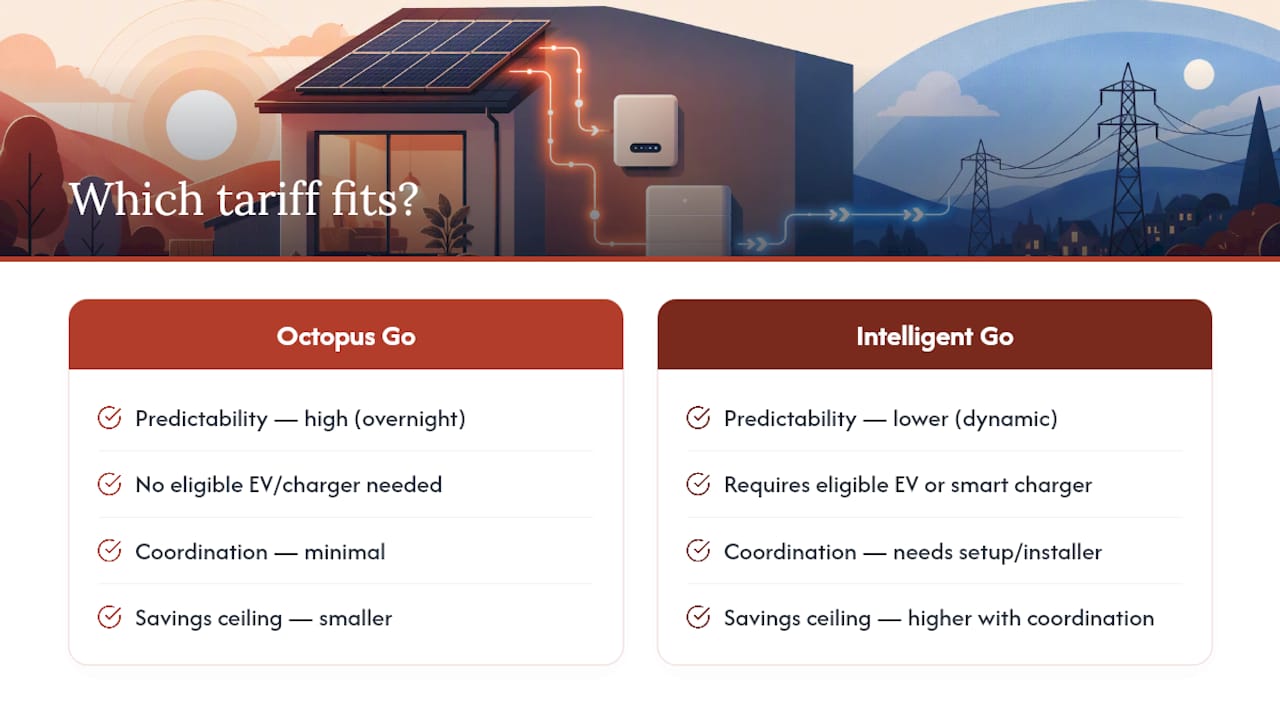
The right tariff depends less on theoretical savings and more on how much coordination your household is realistically willing to manage.
Choose Octopus Go if: you don’t have an eligible EV or smart charger, you want simple overnight-only battery charging, and predictability matters more to you than squeezing out every last pound.
Choose Intelligent Octopus Go if: you’ve got an eligible EV or charger, you’re happy configuring or paying an installer to configure a coordination layer, and you want the higher savings ceiling that comes with the wider window and dynamic sessions.
The trade-off in one line: Octopus Go trades a slightly smaller window for total predictability, while Intelligent Octopus Go trades that predictability for a bigger opportunity that only pays off with proper coordination. If you’re not confident your devices can be reliably coordinated, favour Go. If you can commission the coordination properly, Intelligent Go paired with Charge Pack tends to earn more.
What UK installs actually reveal about battery and tariff mismatches
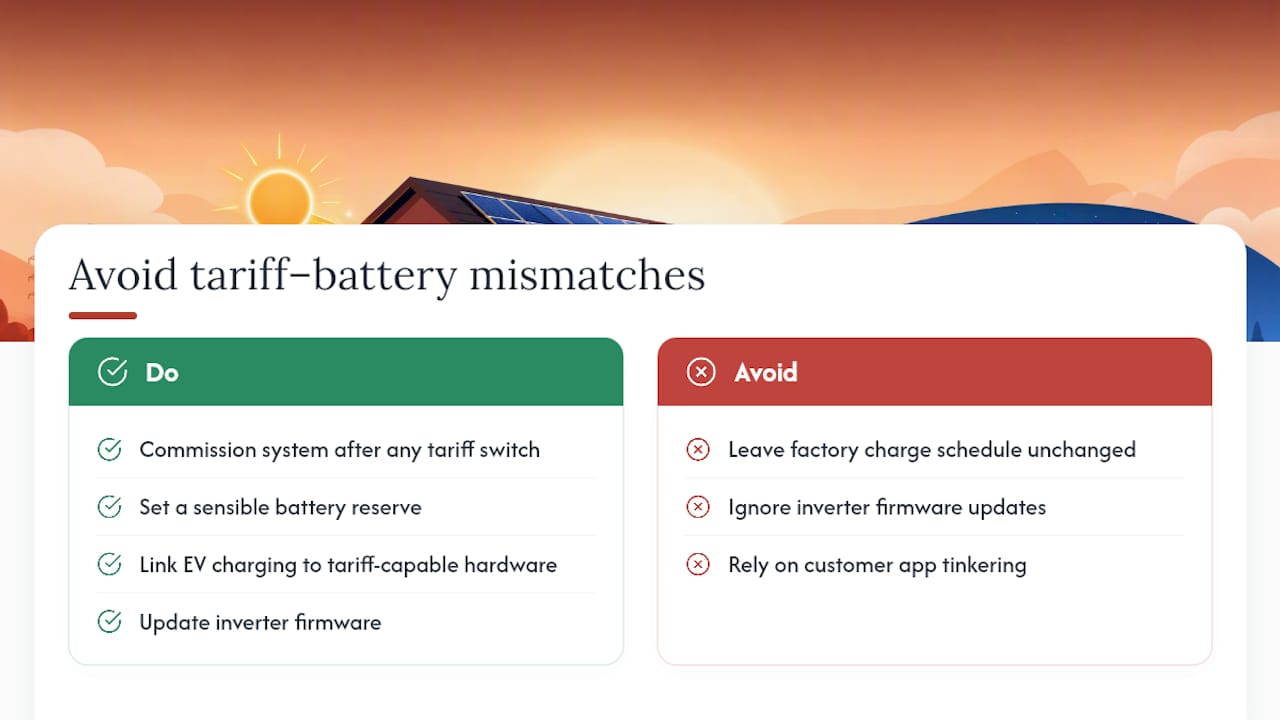
The most common mistake we see isn’t a bad tariff choice, it’s a good tariff choice left half-finished. Homeowners switch to Intelligent Octopus Go, get excited about the wider window, and never touch the factory charge schedule on their inverter. The battery keeps behaving as if nothing changed, and the tariff’s extra sessions start fighting the old settings instead of working with them.
Firmware is the second blind spot. An inverter running an outdated version simply won’t accept the API calls Octopus needs to send, and no amount of app tinkering fixes that from the customer side. The fix is almost always the same: commission the system properly after any tariff switch, set a sensible reserve, and link EV charging to hardware that’s actually built to cooperate with the tariff rather than override it.
— Simon
Get your battery and tariff working together properly
Reading about hold percentages and firmware versions is one thing; actually getting your GivEnergy, FoxESS or SolarEdge system talking correctly to Octopus is another. Checking your inverter’s real compatibility, setting reserves that protect your evening supply, and pairing your EV charger so daytime sessions don’t quietly undo your overnight savings can be challenging for many homeowners.
A proper quote from us includes a firmware check, a commissioning report showing your actual export and consumption graphs, and ongoing support if Octopus adjusts session behaviour down the line. Our solar and battery installation service covers everything from initial system design through to the configuration work that makes tariffs like Charge Pack pay off rather than quietly underperform. Get in touch for a quote and we’ll tell you honestly whether your current setup needs a full install or just a reconfiguration.
Where to check live rates and eligibility
For current windows, rates and sign-up requirements, go straight to Octopus’s own pages: Octopus Go and Charge Pack eligibility. For independent comparison, 1app.energy’s battery-home analysis is worth a read, and Ofgem’s market reporting gives useful context on where standard unit rates sit.
Sources
- Charge Pack | Smart battery add-on earns you £12+ a month | Octopus Energy
- 1app
- State of the Market: Energy Retail highlights January 2026 | Ofgem
