
Pairing solar panels with battery storage and a smart tariff is what actually stops your meter spinning after dark. The battery captures daytime generation you would otherwise export, then discharges it during the evening peak when grid electricity costs most. Add a time-of-use tariff and you can top up cheaply overnight too, rather than paying full retail rates.
- Batteries store surplus solar and release it during the 4pm to 8pm peak
- Smart tariffs let you top up from the grid at off-peak rates if the battery runs dry
- The Smart Export Guarantee pays you for exported solar if you have no battery at all
Without storage, a typical UK household exports 50 to 60% of its daytime solar generation and then buys back electricity at full price once the sun goes down. That gap between what you export cheaply and what you import expensively is exactly what a battery is built to close.
Key Takeaways
Pairing solar panels with a correctly sized battery and a time-of-use tariff is the most reliable way to reduce or eliminate night-time grid imports.
| Point | Details |
|---|---|
| Battery closes the night gap | Panels generate nothing after dark, so stored daytime solar is what actually displaces evening and overnight imports. |
| Size to usable capacity | Plan around 8 to 14kWh usable capacity for a standard home, scaling to 20 to 30kWh for heat pumps or EV charging. |
| Load shifting costs nothing | Moving flexible appliance use to cheap or solar hours captures savings even before you buy a battery. |
| Payback depends on your tariff | Your retail rate, SEG credit and night-time consumption change the payback period more than the battery brand does. |
| Get a site-specific quote | Smart Home Technical Ltd sizes systems around actual night demand and offers aftercare and warranty support on every install. |
Table of Contents
- How solar reduces night-time import costs in practice
- How do you estimate your own night-time savings?
- How big a battery do you actually need?
- What can you do right now to cut night-time imports?
- What does it cost, and when does it pay back?
- What should you check before installing?
- An installer’s view on sizing for night-time savings
- Get a night-time savings assessment from Smarthometechnical
- Frequently asked questions
- Sources
How solar reduces night-time import costs in practice
Every kilowatt-hour your panels generate during the day has three possible destinations: you use it immediately, you export it for a Smart Export Guarantee credit, or you store it. Storing it is what changes your night-time bill. A battery charges from surplus generation through the afternoon, then discharges through the evening, covering cooking, lighting, television and charging loads that would otherwise pull straight from the grid at peak rates.
Round-trip efficiency matters here. A battery rated at 10kWh doesn’t return 10kWh to your home. Depending on the chemistry and inverter, you typically get 85 to 95% of stored energy back, so usable capacity is always a little less than the nameplate figure.
Smart tariffs add a second layer. If your battery runs low before morning, a time-of-use tariff lets you top it up from the grid at cheap overnight rates instead of paying peak prices later. Ember’s analysis of solar-plus-battery systems found that pairing storage with solar can let a single grid connection support up to five times more solar capacity, because the battery smooths out what would otherwise be a sharp midday spike and evening cliff.
- Daytime surplus charges the battery instead of exporting at a lower rate
- Evening discharge avoids peak-rate imports
- Overnight grid charging (where needed) uses cheap tariff windows, not standard rates
Battery costs have fallen enough, and tariff structures have matured enough, that a modest system paired with a smart tariff now often pays back faster than panels alone.
How do you estimate your own night-time savings?
You don’t need an engineering degree to get a workable estimate. Three steps get you there.
- Work out your night-time consumption in kWh. Check your smart meter data for the hours after sunset, roughly 6pm to 7am, over a typical week.
- Find your avoided import price. This is the retail rate you’d otherwise pay per kWh, minus any Smart Export Guarantee credit you’d have earned by exporting that same unit instead.
- Multiply by how many nights the battery can realistically cover, factoring in seasonal generation swings and round-trip losses.
Here’s a worked example. A household using 6kWh overnight, on a tariff charging 28p/kWh, with a battery covering that load roughly 300 nights a year, saves in the region of £504 a year on avoided imports alone, before accounting for the SEG income forfeited on the exported units it now keeps at home.
The maths only works if you use your own numbers. Two identical houses on different tariffs, with different roof orientations, can see genuinely different paybacks from the same battery.
Smart Home Technical Ltd’s real-world savings examples from installed systems are worth reading before you commit to a figure, because seasonal variability and tariff differences shift the outcome more than most people expect. Winter generation can be a fraction of summer output, which changes how many nights your battery can actually fill from solar rather than the grid.
How big a battery do you actually need?
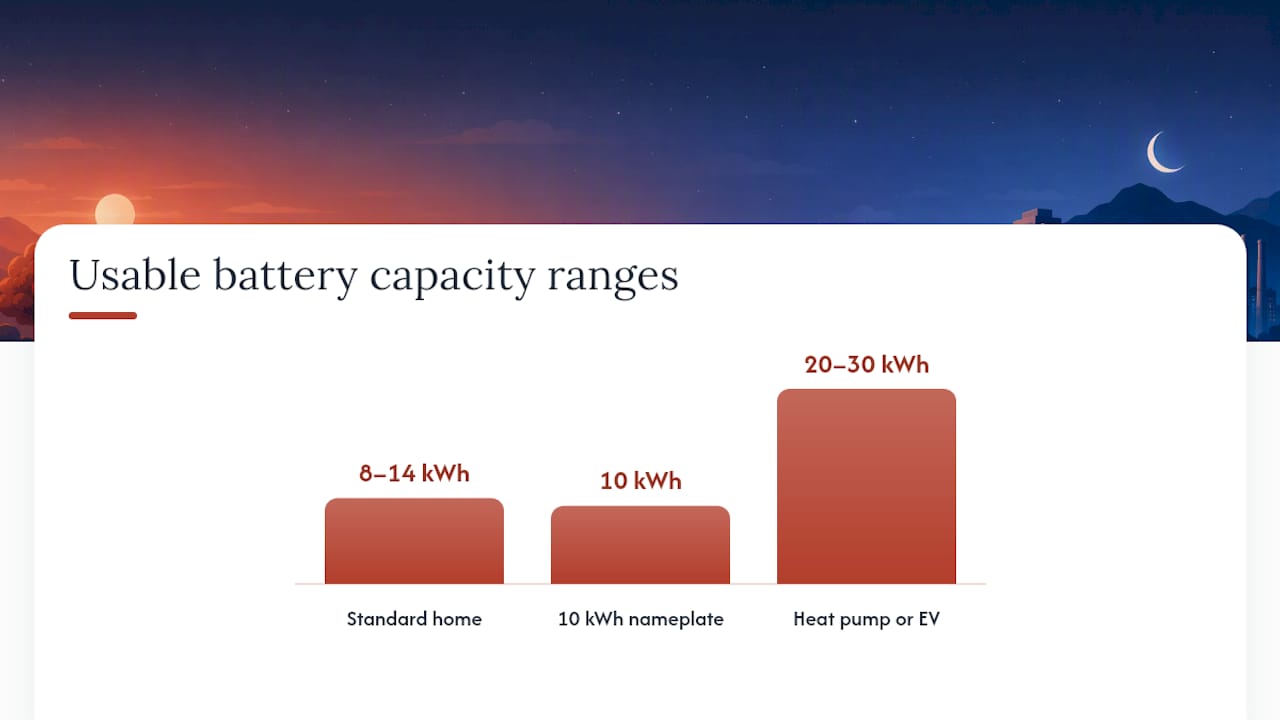
Sizing is where most people either overspend or under-deliver. A standard three or four-bedroom household with typical evening consumption usually needs 8 to 14kWh of usable capacity to cover a normal night. Homes with a heat pump, or those planning overnight EV charging on top of standard use, often need to scale up to 20 to 30kWh to avoid falling back on grid imports every night.
Bigger isn’t automatically better. Every extra kilowatt-hour of capacity adds capital cost, and beyond a certain point you’re paying for storage that sits half full most of the year. Inverter rating and round-trip efficiency also cap how much of that capacity you can genuinely use, so a battery on paper is never quite a battery in practice.
Three broad strategies exist, and they suit different budgets:
- Full overnight coverage: a larger battery sized to your worst-case winter night, giving near-total independence from evening and overnight imports.
- Partial evening coverage: a smaller, cheaper battery that handles the peak hours (4pm to 9pm) and lets the grid pick up the rest at off-peak rates.
- Tariff-only, battery-less load shifting: no battery at all, just moving flexible consumption to the cheapest hours on your tariff.
Before you buy, run through a short checklist: usable capacity (not nameplate), expected cycles per year, warranty throughput limits, inverter compatibility, and whether the unit can be expanded later if your needs grow.
Pro Tip: Ask any installer to quote usable capacity, not just the headline battery size. A 10kWh unit with 90% round-trip efficiency and an 80% depth-of-discharge limit gives you a lot less than 10kWh to play with overnight.
What can you do right now to cut night-time imports?
You don’t need a full installation to start saving. Several steps cost nothing beyond a bit of planning.
- Shift flexible loads overnight or into your solar window. Run the dishwasher, washing machine and tumble dryer on a timer, ideally during peak generation or your tariff’s cheapest hours.
- Set your EV charger to an off-peak schedule. Most modern EV charge points let you programme charging windows to match cheap tariff rates automatically.
- Switch to a time-of-use or smart tariff. Shifting flexible consumption to cheap overnight hours is consistently the single biggest lever available to smart-metered households, even before you add a battery.
- Add a starter battery with simple automation once budget allows, sized to your evening peak rather than full overnight coverage.
Pro Tip: Get quotes from more than one installer and ask each one to confirm inverter compatibility with your existing panels and your Distribution Network Operator’s export limit before you sign anything.
What does it cost, and when does it pay back?
A solar-plus-storage system has three main cost components: the PV installation itself, the battery (priced per usable kWh rather than nameplate capacity), and the inverter plus labour and permits. None of these scale in isolation. A bigger battery needs a bigger, or at least compatible, inverter, and installation labour rises with system complexity.
Payback depends on factors specific to your property: your retail import rate, your Smart Export Guarantee rate, the shape of your tariff, and how much you actually consume at night. The Department of Energy’s three-step payback method, which is to subtract any incentives, estimate your annual saving, then divide the net cost by that saving, works just as well for a UK household as it does anywhere else.
- Panel-only systems typically pay back faster than panel-plus-storage systems, because batteries add upfront cost without generating extra electricity
- Solar-plus-storage paybacks are highly sensitive to cheap overnight tariffs and your SEG export rate
- Oversizing panels or batteries beyond your actual night-time demand raises your system’s overall cost per kilowatt-hour without adding proportional savings
There’s a point of diminishing returns here. A battery sized well beyond your realistic evening and overnight demand pushes up your levelised cost of energy without shifting your bill much further, because it spends most of its life half empty.
What should you check before installing?
Ask the right questions before signing a quote, and you avoid most of the expensive surprises that come later.
- Usable battery capacity and round-trip efficiency, not just the headline kWh figure printed on the box
- Inverter compatibility with your existing or planned PV array, plus any export limit set by your network operator
- Smart meter compatibility and how your export meter arrangement is configured
- Warranty duration and throughput limits, since battery warranties are often capped by cycles or total energy throughput, not just years
- Workmanship guarantee, commissioning process and ongoing monitoring, so you know who to call if performance drops
Pro Tip: A warranty that only covers the battery cell, not the inverter or installation workmanship, leaves you exposed if the fault sits elsewhere in the system.
When choosing an installer, look for certification, genuine client case studies, and a written aftercare commitment rather than a verbal promise. Smart Home Technical Ltd’s solar installation service sets out exactly this kind of commissioning and aftercare process for anyone comparing quotes.
An installer’s view on sizing for night-time savings
We start every quote by asking what a household or business actually draws overnight, not what the roof can theoretically generate. Oversizing a battery to a number that sounds impressive rarely matches real consumption, and it wastes money.
We sequence tariff switches alongside the install itself, so the system is earning from day one rather than sitting on a standard rate for months. If you want a rough sense of what’s realistic for your property, our case studies from completed installations are a fair starting point, and we’re happy to run a site-specific calculation before you commit to anything. Aftercare includes monitoring and warranty handling, so performance issues get caught early rather than discovered on next year’s bill.
Get a night-time savings assessment from Smarthometechnical
Solar panels alone leave you exposed after sunset, but Smarthometechnical fits and sizes battery storage specifically around your evening and overnight demand, not a generic capacity chart. That means a system built to actually close your night-time import gap, rather than an oversized battery that sits half empty and never pays for itself.

As specialists in solar panel installation, battery storage and EV charger installation across Dorset, Hampshire and Devon, we handle the whole job: sizing, inverter compatibility, export arrangements and aftercare, under one contract with one point of contact. If you’re weighing up a battery, a tariff switch, or both, get a solar and battery storage quote and we’ll work out what your property actually needs before you spend a penny.
Frequently asked questions
How does solar reduce night-time import costs without a battery?
Without storage, you rely on Smart Export Guarantee credits from exported solar and on switching flexible loads to your tariff’s cheapest overnight hours. It reduces costs, but not as much as storing the power yourself.
What size battery do I need to cover a typical night?
Most standard homes need 8 to 14kWh of usable capacity. Homes with a heat pump or overnight EV charging often need 20 to 30kWh to avoid regular grid imports.
Does battery storage pay back faster than solar panels alone?
Not usually on its own, since batteries add cost without generating electricity. Paired with a smart tariff and sized to your actual evening demand, storage can still deliver a reasonable payback period.
Do seasonal changes affect night-time savings from solar?
Yes, significantly. Winter generation is far lower than summer, so a battery that fully covers summer nights may only partially cover winter ones, changing your import costs across the year.
Sources
- Ember Report – Solar electricity every hour of every day is here and it changes everything – Google Docs
- Euenergy
- How solar panels work at night | Axiom Eco Homes
- Why Solar Panels Don’t Work at Night (Battery Storage Fix) | Accelerate Solar
- Will I Save Money with Solar Energy? | Department of Energy
