
Yes, solar works well on most UK coastal properties — provided the installation uses coastal-grade materials, proper wind-load calculations, and a maintenance schedule that accounts for salt. The risks are real but well-understood, and the mitigations are practical.
Here is what every coastal homeowner should have in hand before signing a quote:
- Ask for a site-specific wind-load calculation referencing Met Office regional climate data
- Specify IEC 61701 Level 6 salt-mist rated panels and 316 stainless fasteners
- Confirm the inverter will be installed indoors or in a sealed, rated enclosure
- Request a pre-install roof structural check and roofer sign-off
- Schedule fresh-water rinsing every 3–6 months from day one
Pro Tip: The single most cost-effective coastal upgrade is specifying 316 stainless fasteners and EPDM isolation pads instead of standard hardware. Field guidance reports this typically adds 5–10% to component costs but prevents galvanic corrosion failures that can compromise an entire racking system within a few years.
Key takeaways
Solar suits UK coastal homes when the installation is specified and maintained correctly. The core requirement is coastal-grade materials, a site-specific wind-load calculation, and a cleaning schedule that keeps salt coverage low enough to protect annual yield.
| Point | Details |
|---|---|
| Salt causes measurable power loss | At 10% salt coverage, output falls by ~9.7%; at 20%, by ~14.5% — clean every 3–6 months. |
| Specify IEC 61701 Level 6 panels | Request the datasheet; verbal assurance is not sufficient for a coastal install. |
| 316 stainless fasteners with isolation pads | Prevents galvanic corrosion between aluminium rails and dissimilar metals at minimal extra cost. |
| Wind-load calculation is non-negotiable | Require a written site-specific calculation referencing Met Office wind-speed zone data. |
| Smarthometechnical covers coastal installs | Serving Dorset, Hampshire, and Devon with coastal-grade specification, roof checks, and maintenance contracts. |
Table of Contents
- How does coastal wind affect your roof-mounted solar array?
- How does salt spray damage solar panels and what stops it?
- What roof checks must happen before a coastal solar install?
- Which panels and components should you specify for a coastal home?
- Does coastal weather actually improve solar performance?
- What maintenance schedule does a coastal solar system need?
- How do you choose an installer with real coastal experience?
- What does the research say about salt, glass and power loss?
- An installer’s perspective on what actually goes wrong
- Smarthometechnical’s coastal solar installations: what to expect
- Sources
How does coastal wind affect your roof-mounted solar array?
Coastal roofs face wind loads that inland sites rarely see. Uplift — the aerodynamic force that tries to peel panels off a roof — is the primary structural concern, and it is not uniform. A cliff-top property in Dorset faces very different peak gusts than a sheltered bay property two miles away. Exposed gable ends and ridge lines concentrate pressure further. Met Office regional climate data documents the higher average wind exposure of UK coastal zones, and a competent installer must reference these maps when sizing fixings and ballast.
What this means practically: your installer should produce a written wind-load calculation that references the site’s wind speed zone, roof pitch, and array position. Without it, you have no way to know whether the racking will hold in a winter storm.
Mounting specification items to require on your quote:
- Wind-speed zone classification for the specific site (not a generic regional figure)
- Rafter attachment points confirmed against structural drawings, not estimated
- Manufacturer wind-uplift rating for the chosen racking system
- Ridge and soffit detailing to prevent pressure channelling under the array
- Ballast calculations if a flat or low-pitch roof is involved
Red flags to walk away from:
- No structural calculation document provided with the quote
- Fixings described only as “standard” with no grade or torque specification
- Single-point attachments at panel corners rather than distributed rail fixing
- No mention of ridge or soffit detailing in the design drawings
Pro Tip: Ask the installer to show you the manufacturer’s wind-uplift test certificate for the racking system. A reputable coastal installer will have this on file; if they cannot produce it within a day, treat that as a signal about their coastal experience generally.
How does salt spray damage solar panels and what stops it?
Salt is the coastal installer’s main adversary. Chloride particles travel inland on wind, deposit on glass surfaces, and trigger two distinct damage mechanisms: optical soiling that reduces the light reaching the cells, and electrochemical corrosion that attacks metal frames, fasteners, and connectors.
Field guidance reports chloride deposition rates near the shore as significant, enough to damage unprotected materials within a few years (https://www.surgepv.com/blog/coastal-solar-installation) — a wide range that reflects how dramatically exposure varies with distance, prevailing wind direction, and local topography. A property 50 metres from the waterline in a south-westerly exposure will accumulate salt far faster than one 500 metres back in a sheltered valley.
Salt coverage and power loss: A 2026 experimental study found that seawater-induced salt deposition and glass corrosion reduced module output by approximately 9.7% at 10% salt coverage and 14.5% at 20% coverage. Left unaddressed, those losses compound year on year.
Materials and certification checklist:
- IEC 61701 salt-mist rating: Level 6 is the highest and the one to specify for properties within 500 metres of the shore
- 316 stainless fasteners: not 304 stainless, which corrodes noticeably faster in marine air
- Anodised aluminium frames: confirm anodisation thickness of at least 20 microns for marine environments
- IP66-rated junction boxes as a minimum; NEMA 4X for any enclosure in a particularly exposed position
- UV- and salt-resistant cable jackets throughout the DC string runs
Pro Tip: Anti-deposition and anti-corrosion coatings on glass are an active research area. Specifying panels with hydrophobic glass coatings reduces salt adhesion and can lower cleaning frequency, a small premium at purchase that pays back over the expected system life.
What roof checks must happen before a coastal solar install?
A coastal roof takes more punishment than an inland one. Salt-driven moisture cycles accelerate timber rot, and wind loading means any pre-existing weakness in the structure becomes a liability the moment panels add weight and uplift forces. Getting the roof right before installation is not optional — it protects both the solar system and the roof warranty.
Pre-install inspection checklist:
- Tile or slate condition: check for salt-etched surfaces, cracked edges, and loose fixings
- Rafter and joist integrity: probe for soft spots, particularly at eaves and around existing penetrations
- Felt or membrane condition: coastal roofs often show accelerated UV and salt degradation here
- Existing flashings: any corrosion or lifting is a waterproofing failure waiting to happen under panel edges
Waterproofing details to require from your installer:
- Integrated lead-free flashings (or approved alternatives) at all panel-to-roof junctions
- Sealed cable penetrations with marine-grade grommets, not just silicone beads
- Apron details at the lower panel edge to prevent wind-driven rain ingress
- Written confirmation that the installation does not void the existing roof warranty
Pro Tip: Sequence matters: complete any necessary roof repairs before racking goes on. Trying to lift a panel array to fix a failed flashing costs significantly more than doing the roof work first. Ask your installer explicitly whether they will pause installation if the pre-install inspection reveals unexpected structural issues.
Which panels and components should you specify for a coastal home?
Component selection is where coastal installs diverge most sharply from standard ones.
Panel-level requirements:
- IEC 61701 Level 6 salt-mist certification (request the datasheet, not just a verbal assurance)
- Anti-reflective, hydrophobic glass coating where available
- Full-black or anodised silver frames with confirmed marine-grade anodisation
Racking and fasteners:
- 316 stainless steel fasteners throughout — not mixed grades
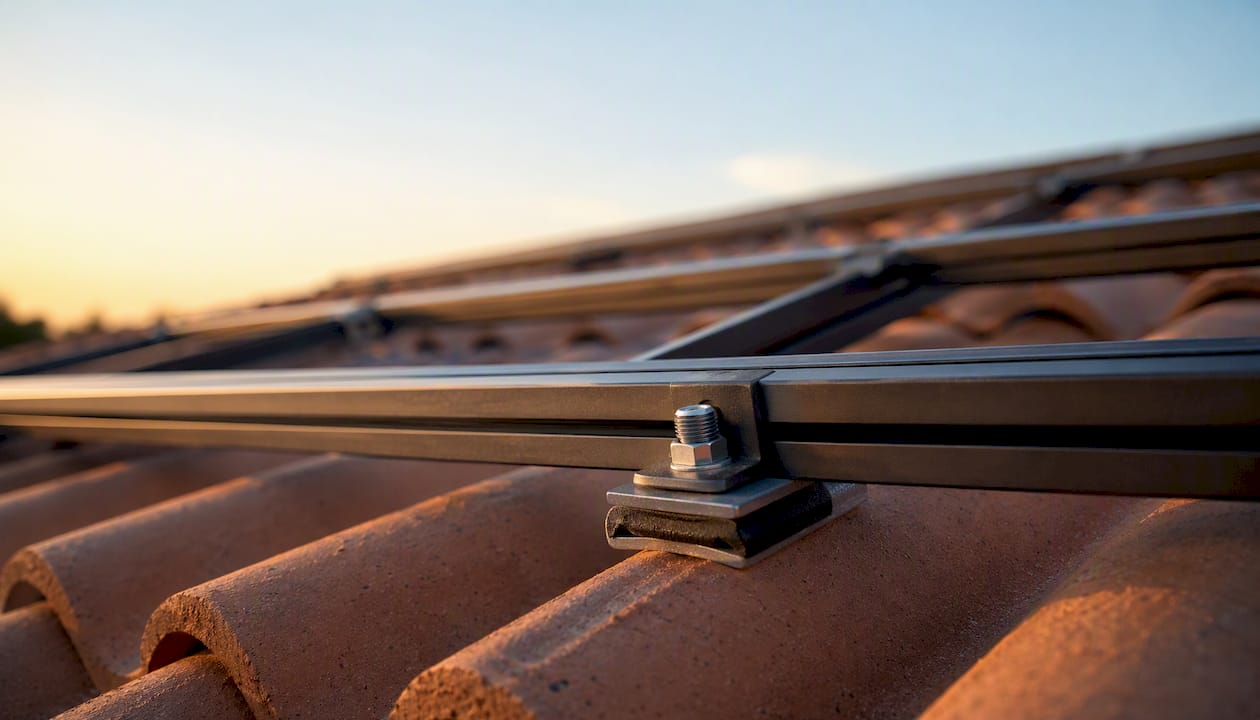
- EPDM or polymer isolation pads between aluminium rails and any dissimilar metal surface to prevent galvanic corrosion
- Marine-grade anodised aluminium rails, minimum 20-micron anodisation
- Torque specifications documented and applied with a calibrated torque wrench
Electrical components:
- Junction boxes: IP66 minimum, NEMA 4X for exposed positions
- Connectors: MC4 or equivalent with confirmed IP68 mating rating
- Cable jackets: double-insulated, UV-stabilised, and salt-resistant throughout
Inverter placement: install indoors wherever the building layout allows. A garage, utility room, or internal wall is always preferable to an external enclosure on a seaward-facing elevation. If outdoor installation is unavoidable, specify an IP65 or better enclosure positioned on the most sheltered elevation.
Pro Tip: Galvanic corrosion between aluminium rails and carbon-steel fasteners is one of the most common coastal failure modes. The fix costs almost nothing at installation — EPDM isolation pads and 316 stainless bolts — but retrofitting after corrosion has set in means stripping the entire racking system.
Does coastal weather actually improve solar performance?
Coastal microclimates offer a genuine yield advantage that is easy to overlook when the conversation focuses on risks, as discussed in Harnessing the Sunshine State: Top Benefits of Solar Panels in Florida. Wind keeps panel temperatures lower than on still, hot inland days, and solar cells produce more power when cool.
Reflected irradiance from open water can also increase the light reaching south- and south-east-facing arrays, particularly at lower sun angles in spring and autumn. This is not a dramatic effect, but it is measurable on waterfront properties.
The US Department of Energy’s Regional Test Centres validate panel performance across different climate conditions, confirming that well-specified panels can perform reliably in coastal and marine environments. For UK homeowners, the practical takeaway is that coastal siting does not inherently reduce annual yield — salt soiling and corrosion do, and both are preventable.
What affects net annual yield on a coastal roof:
- Distance to shore and prevailing wind direction (salt deposition rate)
- Cleaning frequency — uncleaned panels lose output progressively
- Panel temperature coefficient (lower is better for warm, still days)
- Orientation and tilt relative to reflected water irradiance
- Shading from coastal vegetation or neighbouring buildings
For context on how coastal solar efficiency compares with inland sites, the cooling benefit typically offsets a portion of soiling losses when maintenance is kept up — making the net position broadly comparable to a well-maintained inland system, and sometimes better.
What maintenance schedule does a coastal solar system need?
Salt accumulates continuously, so the question is not whether to clean but how often. Distance to shore is the primary variable.
Recommended cleaning frequency:
- Within 200 metres of the shore: every 3 months
- 200–500 metres: every 4 months
- Beyond 500 metres with clear coastal exposure: every 6 months
Use fresh water only for routine rinses. Deionised water with a soft brush removes salt crust without scratching the glass. Avoid detergents unless the panel manufacturer explicitly approves them — some surfactants degrade anti-reflective coatings. Never use a pressure washer directly on junction boxes or connectors.
Inspection checklist for each maintenance visit:
- Check frame fastener torque at accessible points — coastal vibration loosens fixings over time
- Inspect junction-box seals for cracking, lifting, or discolouration
- Examine cable sheaths for brittleness, cracking, or salt-whitening
- Look for delamination bubbles or snail-trail discolouration on the cell surface
- Check racking rail joints for white oxide deposits indicating early galvanic activity
Safety note: never walk on a roof without confirming it can take the load. Use a qualified installer or trained maintenance operative for any access work. For guidance on extending panel lifespan in Devon and similar coastal counties, the principles are the same regardless of county.
Pro Tip: Pair your bi-annual maintenance visit with an annual electrical check of any EV charger or battery storage system on the same property. One contractor visit covers multiple systems, and the inspector can check DC string voltages at the same time — catching a degrading string before it becomes a warranty claim.
How do you choose an installer with real coastal experience?
Coastal solar is a specialism. An installer who has only worked on sheltered suburban roofs will not automatically know to specify isolation pads, check anodisation thickness, or detail flashings for wind-driven rain. The questions below separate experienced coastal installers from those who are guessing.
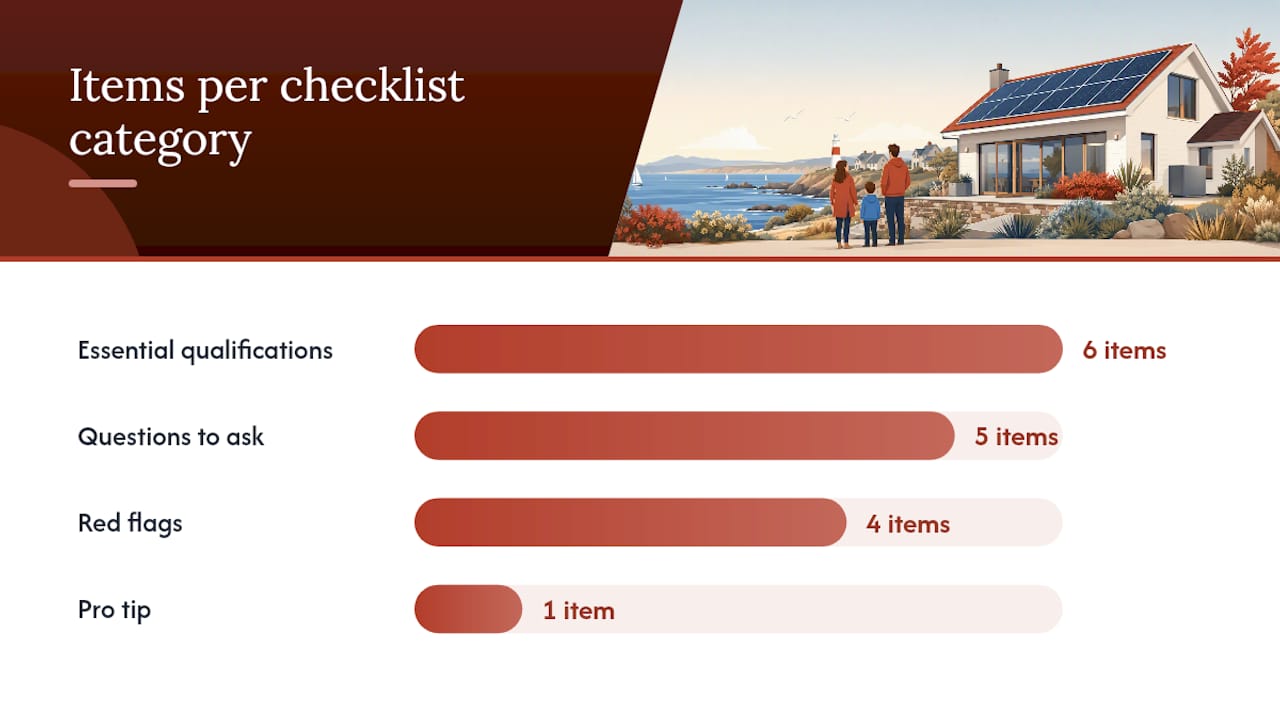
Essential qualifications and documentation to request:
- MCS (Microgeneration Certification Scheme) registration — non-negotiable for UK grid-connected systems
- References for at least two completed coastal installs within 10 miles of your property
- Written wind-load calculation for your specific site
- Component datasheets showing IEC 61701 Level 6 rating for panels
- Fastener specification (grade and standard) in writing on the quote
- Warranty terms that do not exclude coastal environments
Questions to ask every installer:
- What wind-speed zone have you assigned to this site, and what is your source?
- Which fastener grade are you specifying, and why?
- Where will the inverter be located, and what is its enclosure rating?
- How do you detail the cable penetrations through the roof?
- Does your workmanship warranty cover coastal corrosion damage?
Red flags:
- No coastal project references offered
- Fasteners described as “stainless” without specifying grade
- Inverter location left as “TBC” or defaulting to an external seaward wall
- Warranty documentation that excludes “marine environments” without offering an alternative
Pro Tip: Ask whether the installer offers a long-term service agreement that includes bi-annual cleaning and inspection. A contractor who is confident in their coastal specification will be comfortable committing to maintain it — one who hedges on this is often signalling uncertainty about how the system will hold up.
What does the research say about salt, glass and power loss?
The 2026 experimental study published in Solar Energy provides the clearest quantified evidence available: seawater-induced salt deposition and glass corrosion reduce optical transmittance, and at 10% salt coverage module output fell by approximately 9.7%, rising to 14.5% at 20% coverage. These are not worst-case projections — they are measured results under controlled illuminance conditions.
Engineering literature on metallic corrosion in coastal PV systems identifies two main pathways: surface oxidation of aluminium frames where anodisation is thin or damaged, and galvanic corrosion at dissimilar-metal contact points. Both are preventable with correct materials selection at installation, but neither is reversible once established without component replacement.
Research takeaway: Even moderate salt coverage measurably reduces output. A cleaning cadence that keeps coverage below 10% is not a luxury — it is the difference between a system that performs to its modelled yield and one that quietly underperforms for years before anyone notices.
What homeowners should take from the research:
- Request warranty terms that account for realistic coastal degradation rates, not just standard inland figures
- Anti-deposition coatings on glass are an emerging mitigation worth specifying where available
- Offshore siting studies confirm that even high-irradiance coastal locations require multi-factor screening — siting and exposure assessment matter as much as headline sunshine hours
- Lifecycle cost modelling should include cleaning costs and a realistic degradation curve, not a flat 0.5% per year inland assumption
An installer’s perspective on what actually goes wrong
The failure modes I see most often on coastal jobs are not dramatic — they are slow and quiet. A racking system installed with mixed-grade fasteners looks fine at handover. Eighteen months later, white oxide deposits appear at the rail joints. By year three, a fastener has corroded through and a panel is moving in the wind. The fix at that point costs more than the entire racking upgrade would have at installation.
The sequencing point matters more than most homeowners realise. Roof repair, then racking, then panels — in that order, without exception. I have seen installers fit racking on a roof that needed re-felting, only for the homeowner to face a choice between stripping the array or leaving a failing roof membrane in place. Neither option is cheap.
Inverter location is the other consistent oversight in coastal quotes. An external enclosure on a south-west-facing wall in Dorset or Devon gets salt-laden rain driven directly into it every winter. An IP65 rating is not a guarantee of indefinite performance under that kind of sustained exposure. Moving the inverter indoors costs almost nothing at installation and removes an entire failure mode from the system’s lifetime.
Pro Tip: When reviewing a coastal quote, check whether the inverter location is specified. If it simply says “external wall” with no enclosure rating or elevation noted, ask the installer to justify that choice against an indoor alternative. The answer tells you a great deal about how carefully they have thought through the coastal environment.
Smarthometechnical’s coastal solar installations: what to expect
Coastal homeowners in Dorset, Hampshire, and Devon face a specific set of challenges that a generalist installer may not be equipped to handle. Smarthometechnical specialises in exactly this: full-service solar installations built to coastal-grade specification, with pre-install roof assessments, documented wind-load calculations, and component choices that reflect the marine environment rather than ignore it.

Every coastal installation includes IEC 61701 Level 6 panel specification, 316 stainless fasteners with EPDM isolation pads, and inverter placement reviewed for the site’s specific exposure. Battery storage pairing is available for homeowners who want resilience alongside generation, and hybrid battery options are sized to the property’s actual load profile. Maintenance contracts covering bi-annual cleaning and inspection are offered alongside installation, so the system’s performance is protected from day one.
To request a coastal specification quote or book a site assessment, visit the solar installations page and get in touch with the team directly.
Sources
- Metoffice
- ScienceDirect article (seawater-induced deposition and corrosion on PV modules)
- MDPI applied sciences offshore PV site selection study
- Coastal solar installation 2026: Corrosion-resistant hardware, isolation & lifespan | SurgePV
Recommended
- How solar reduces your household bills: a homeowner’s guide – Smart Home Technical Ltd
- Why solar suits rural homes: the complete 2026 guide – Smart Home Technical Ltd
- How solar planning works: a homeowner’s guide 2026 – Smart Home Technical Ltd
- Solar panel benefits for coastal homes in 2026 – Smart Home Technical Ltd
