
Yes, you should clean your solar panels — but not on a fixed schedule. Most UK homeowners need to act only when panels show visible soiling, bird droppings, or a measurable drop in output. Rain handles light dust reasonably well in a temperate climate; it is the stubborn stuff that costs you generation.
Before you do anything else, run through these quick checks today:
- Stand on the ground and look up at your panels. Can you see bird droppings, a film of pollen, or dark patches?
- Log into your inverter app or monitoring portal and compare this week’s output to the same period last year or to the forecast.
- Note whether you are near farmland, a busy road, or the coast — all of these push soiling rates higher.
- Check the tilt of your array. Near-flat or low-pitch panels (under roughly 10°) do not self-clean well in rain.
Table of Contents
- Why do dirty solar panels lose power?
- How often should you clean your panels in the UK?
- How can you tell whether your panels actually need cleaning?
- DIY cleaning: a safe step-by-step method for accessible panels
- Cleaning from the ground: lower-risk options
- When should you hire a professional cleaner?
- A routine maintenance checklist for homeowners
- What does the evidence actually say about cleaning and output?
- Key takeaways
- The case for targeted cleaning, not routine washing
- Smarthometechnical: professional solar inspection and cleaning in Dorset, Hampshire, and Devon
- Selected sources and further reading
Why do dirty solar panels lose power?
The technical term for particles settling on panel glass is soiling, and it works against you in a straightforward way: anything sitting on the surface blocks incoming light before it reaches the photovoltaic cells beneath. Less irradiance in means less electricity out.
Soiling losses vary enormously by climate. In wet temperate regions like the UK, annual losses from soiling can be as low as 0.2%. In dustier climates they reach 25% annually, and in desert environments panels can lose up to 40% of output within a single month without rain. The UK sits at the mild end of that range under normal conditions, but local factors can push individual arrays well above the average.
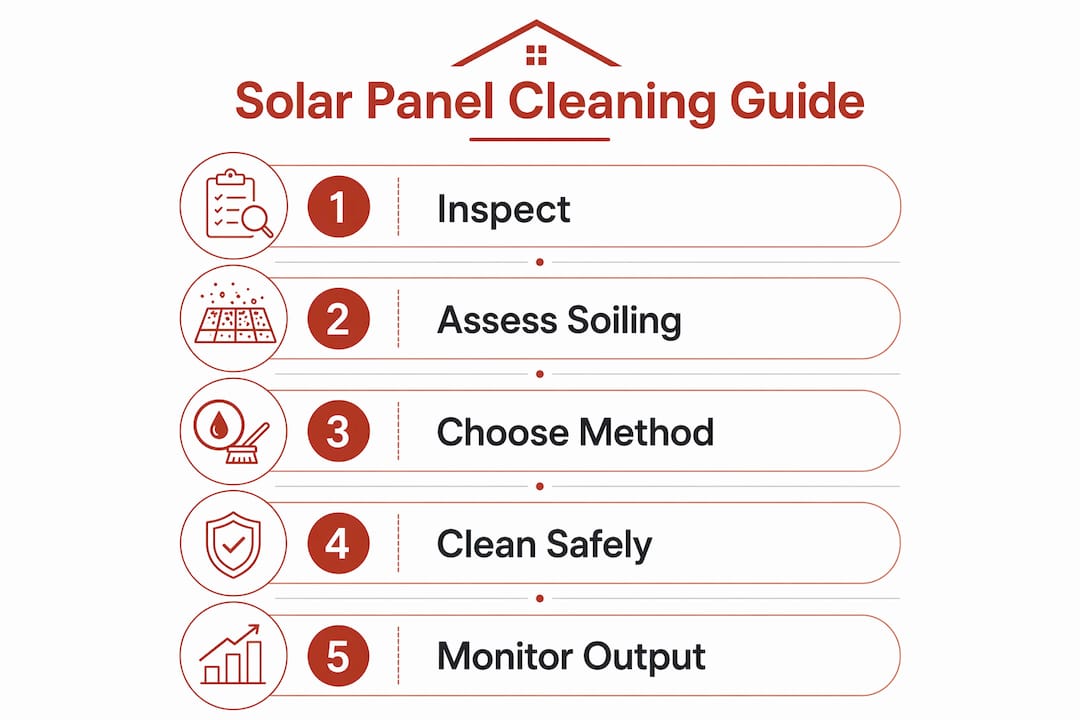
Not all soiling is equal. Bird droppings deserve special mention: a small opaque spot can reduce a panel’s output by several percentage points because of partial-shading and bypass-diode effects, and the heat build-up it causes can accelerate long-term cell degradation. Dust and pollen spread more evenly and cause gentler losses, but they accumulate faster than most homeowners expect.
Common soiling types and their relative impact:
- Bird droppings — disproportionately damaging; concentrated shading triggers hot spots
- Pollen and tree sap — seasonal, sticky, bonds to glass and resists light rain
- Dust and particulates — gradual, even coverage; worsens near roads, construction, or industry
- Sea spray and salt residue — coastal panels accumulate a mineral film that rain does not fully dissolve
- Agricultural residue — fertiliser drift and crop dust in rural areas; can be highly adhesive
Low-tilt installations (under roughly 5–10°) face a compounding problem: rainwater pools rather than running off, leaving behind mineral deposits that harden over time. A steep-pitched roof in the Welsh valleys and a near-flat ground-mounted array in a Hampshire field face very different soiling challenges, even in identical weather.
How often should you clean your panels in the UK?
For most UK homes, a visual inspection every 6–12 months is enough, with cleaning only when rainfall has not shifted stubborn soiling. GOV.UK guidance for homeowners reflects this: panels need minimal maintenance, and cleaning is warranted when rain alone cannot do the job.
That said, several situations call for more frequent attention:
- Low-tilt or near-flat arrays — inspect every three months; mineral residue builds up faster
- Coastal locations — salt film accumulates year-round; a rinse every six months is reasonable
- Near farmland or industry — agricultural residue and particulates can be heavy; check after harvest seasons
- Heavy bird activity — if pigeons roost above or near your array, check monthly during nesting season (roughly March to August)
- Urban rooftops near busy roads — traffic particulates settle steadily; twice-yearly cleaning is sensible
Seasonal timing matters. Spring is the highest-priority check: pollen season peaks between April and June, and panels that came through winter with a grime layer will have lost generation through the sunniest months if you leave them. Autumn is the second logical moment, clearing leaf debris and preparing panels for the lower-sun winter period when every watt counts.
How can you tell whether your panels actually need cleaning?
The fastest indicator is your monitoring data, not your eyes. Module-level monitoring via optimisers or microinverters can flag a soiling problem before it becomes visible. A consistent gap of more than roughly 5% between forecasted and actual output is a reliable triage signal that something is wrong — soiling, shading, or a fault. If your system uses a string inverter without module-level data, compare your total daily generation to the same day last year or to your installer’s estimated yield.
Visual inspection checklist (from the ground):
- Use binoculars or zoom in with your phone camera to get a close look without climbing
- Look for white or grey streaks (bird droppings or mineral deposits), dark patches, or a general dull film
- Check panel edges and lower margins where debris accumulates first
- After a dry spell of two weeks or more, a light haze across the glass surface is normal — a thick layer is not
- Drone photos give an excellent overhead view if you have access to one
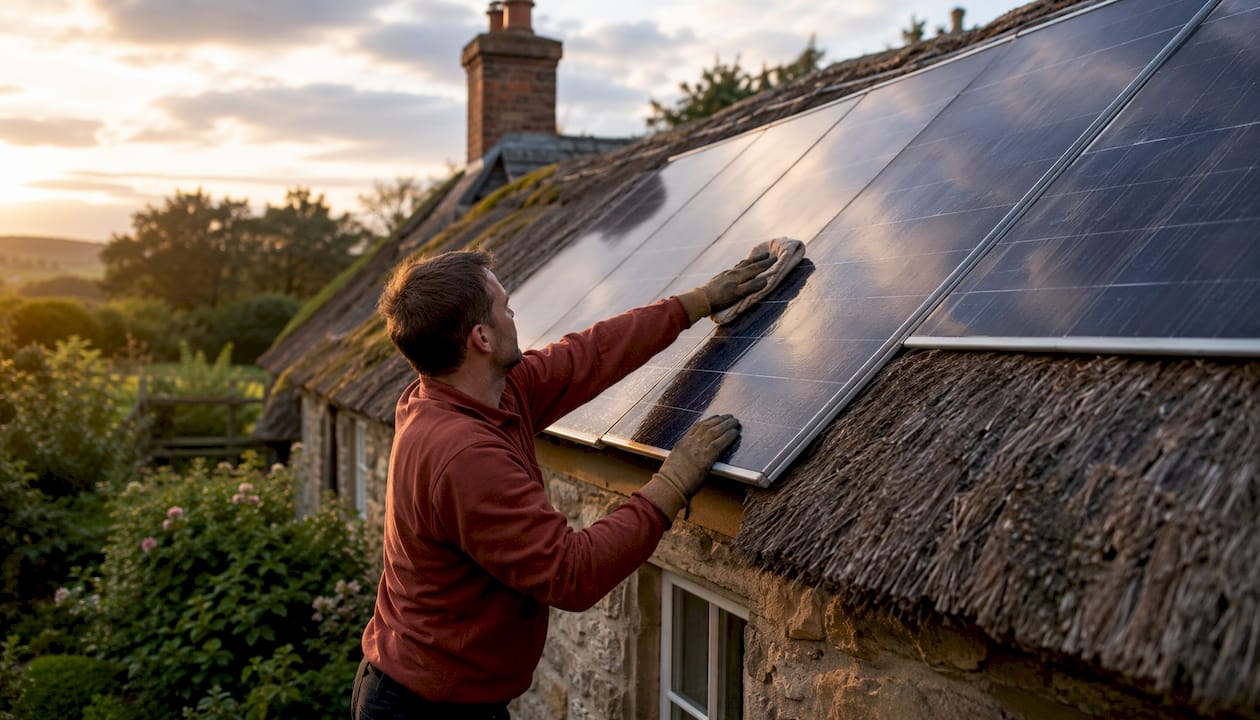
A quick field test: if you can safely reach one panel with a damp cloth, wipe a small section and compare the cleaned area to the rest. A visible difference in colour or brightness confirms cleaning will improve output. If the panel looks the same wet or dry, rain has probably done enough.
For a broader look at what drives output variation, solar panel output factors covers the full picture beyond soiling alone.
DIY cleaning: a safe step-by-step method for accessible panels
If your panels are on a single-storey roof or a low-pitch structure you can reach safely from the ground with a telescopic pole, DIY cleaning is straightforward. The key is using the right equipment and avoiding the two most common mistakes: pressure washing and cleaning hot panels.
What you will need:
- Deionised or distilled water (available from motor factors or online in 5-litre containers)
- A soft microfibre brush or specialist solar panel brush on a telescopic pole
- A very small amount of gentle washing-up liquid if needed for stubborn residue
- A garden hose with a gentle flow setting for the initial rinse
Step-by-step procedure:
- Check the time of day. Clean in the early morning or on a cool, overcast day. Never clean panels that are hot to the touch — thermal shock can crack the glass.
- Isolate the system. Follow your manufacturer’s guidance on isolating the DC isolator before any water comes near the array.
- Rinse first. Use a gentle hose flow to remove loose dust and debris. This prevents grit from scratching the glass during brushing.
- Soft scrub. Work from the top of each panel downward with the microfibre brush. Use minimal pressure. If there are stubborn bird droppings, let a damp cloth sit on the spot for a minute before wiping.
- Final deionised rinse. Finish with deionised water to prevent mineral spotting as the panel dries. Tap water leaves calcium deposits that reduce clarity over time.
- Visual check. Step back and inspect the surface. Any remaining marks? Repeat the damp-cloth step on those spots.
- Monitor output. Check your generation data the following day to confirm the improvement.
Two non-negotiables: never use a pressure washer (the force damages the anti-reflective microstructure on the glass and can void your warranty), and never use abrasive pads or scouring cloths.
Cleaning from the ground: lower-risk options
Ground-based cleaning is the safest approach for most homeowners, and it covers the majority of accessible residential arrays without any roof work at all.
Suitable equipment types:
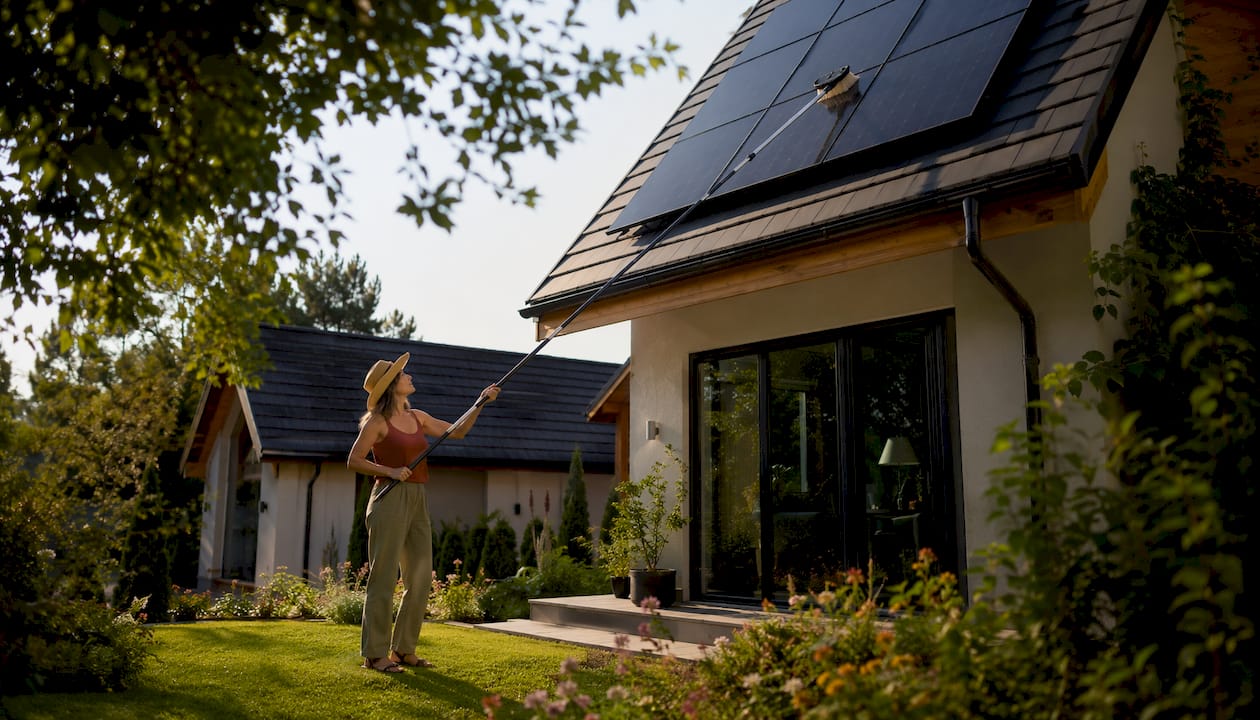
- Telescopic water-fed brushes — the most effective ground option; the brush head connects to a water supply via the pole, delivering a continuous rinse while you scrub. Reach up to 6–8 metres covers most single-storey installations.
- Long-handled soft-bristle brushes — good for dry brushing loose debris before a rinse; less effective on sticky residue without a water feed.
- Garden hose with a fan or gentle jet nozzle — adequate for a light rinse on lightly soiled panels; not sufficient for bird droppings or mineral deposits.
Ground cleaning works well when your panels are within reach of a 5–6 metre pole and the roof pitch is not so steep that water runs off before the brush can work. It is less effective on high-pitched roofs where the panel angle means you are brushing almost parallel to the surface, reducing contact pressure.
Compared with professional roof-level cleaning, ground-based DIY is slightly less thorough on panel edges and corners, but for routine maintenance it is entirely adequate. The difference in output recovery between a careful ground clean and a professional visit is small for most residential arrays.
When should you hire a professional cleaner?
Some situations make professional cleaning the right call, not just a convenience. Steep roofs above a single storey, multi-storey buildings, and arrays with extensive or hardened soiling all carry risks that outweigh the cost of hiring someone qualified.
Hire a professional when:
- Your roof pitch is steep or the array is on a second storey or higher
- You have stubborn residues (hardened bird droppings, salt crust, agricultural deposits) that a ground-based rinse has not shifted
- Your warranty documentation specifies professional cleaning to remain valid
- You have not checked the array in over two years and want a combined inspection and clean
- You notice physical damage, discolouration, or cracked cells during your visual check
Typical UK cost ranges vary with access difficulty, array size, and location. For a standard domestic array of 10–16 panels on a single-storey pitched roof, professional cleaning generally costs a moderate fee, which varies depending on access difficulty, array size, and location. Larger arrays, multi-storey access, or specialist equipment (cherry pickers, rope access) push costs higher. An annual service that combines cleaning with a full electrical inspection costs more but covers far more ground. Smarthometechnical’s solar annual service covers exactly this for homeowners in Dorset, Hampshire, and Devon.
Questions to ask any cleaning firm before booking:
- Are you insured for working at height?
- Do you use deionised water for the final rinse?
- Will the cleaning method preserve the anti-reflective coating?
- Can you provide references or evidence of previous residential work?
- Does your method comply with my panel manufacturer’s warranty terms?
A routine maintenance checklist for homeowners
Keeping on top of panel condition does not require much time. A simple log — even a note in your phone — makes it easy to spot trends and know when to act.
Monthly (2 minutes):
- Quick visual check from the ground: any obvious bird droppings or debris?
- Check inverter app for any fault alerts or unexplained output drops
Every 3–6 months:
- Compare generation to the same period last year or to your system’s forecast
- Look for a consistent gap above 5% that cannot be explained by weather or shading
- Inspect panel edges and lower margins for debris build-up
Annually:
- Full visual inspection with binoculars or phone zoom
- Check mounting brackets and cables for signs of corrosion or movement
- Consider a professional inspection if the system is more than five years old or output has declined without explanation
Escalate to a professional if:
- Generation has dropped more than 10% compared to a comparable period and weather does not explain it
- You can see cracked glass, discolouration, or burn marks
- Bird droppings have been present for more than a few weeks and cannot be reached safely from the ground
For a broader guide to what affects your system’s output, why solar panels lose efficiency is worth reading alongside this checklist.
What does the evidence actually say about cleaning and output?
The honest answer is that for most UK residential systems, soiling losses are modest and cleaning pays off only in specific circumstances. A UC San Diego study found a 7.4% output loss after 145 days without rain in a drought-affected California location, and concluded that most homeowners would not recover cleaning costs through increased generation unless local conditions were severe.
IEA-PVPS research puts annual soiling losses in wet temperate climates at as little as 0.2%, rising to 25% in dustier regions. The UK sits firmly in the lower range under normal conditions. SOMAH operational guidance suggests cleaning can improve efficiency by 5%–10% for significantly soiled arrays, and recommends 1–2 cleans per year depending on site conditions.
The economic conclusion most studies reach:
- For a typical UK home with moderate soiling, the financial gain from professional cleaning is often smaller than the cleaning fee
- The exceptions are high-soiling sites (coastal, agricultural, heavy bird activity), low-tilt arrays, and systems that have gone uncleaned for two or more years
- Spot-cleaning bird droppings as they appear is almost always cost-effective, because a single dropping can cause a disproportionate output loss through hot-spot effects
The practical rule: use your monitoring data to make the decision. If your system is consistently underperforming by more than 5% and weather or shading does not explain it, cleaning is likely to pay. If output looks normal, a visual check and a rinse after pollen season is all most UK homeowners need.
Key takeaways
Dirty panels reduce output, but for most UK homes the loss is modest — act when monitoring data or visible soiling justifies it, not on a fixed annual schedule.
| Point | Details |
|---|---|
| Soiling losses in the UK | Annual losses are typically low in temperate conditions (as little as 0.2%), but can reach 25% at high-soiling sites. |
| Clean when the data says so | A consistent gap of more than ~5% between forecast and actual output is the clearest signal to act. |
| Safe DIY method | Use deionised water, a soft microfibre brush on a telescopic pole, and never a pressure washer. |
| Hire a pro for steep or high roofs | Professional cleaning for a standard domestic array typically costs £50–£150 in the UK. |
| Smarthometechnical | Smarthometechnical offers inspection and cleaning services for homeowners in Dorset, Hampshire, and Devon. |
The case for targeted cleaning, not routine washing
There is a tendency in the solar industry to recommend annual professional cleaning as a default, and I think that does homeowners a disservice. For most UK rooftops, the evidence simply does not support it as a blanket rule. A wet British winter does a reasonable job of clearing light dust, and the financial return on a professional clean for a well-sited, adequately tilted array in, say, Dorset or Hampshire is often marginal at best.
What the evidence does support is targeted intervention: act when your monitoring data flags a problem, act when bird droppings are visible and persistent, and act when your array has characteristics — low tilt, coastal exposure, proximity to farmland — that make self-cleaning unreliable. That is a very different recommendation from “book a clean every spring.”
The safety argument is the one I feel most strongly about. Every year homeowners injure themselves attempting roof work without the right equipment. The correct answer for a steep second-storey array is not a longer telescopic pole — it is a qualified contractor with proper working-at-height training. Preserving the anti-reflective coating on your panel glass matters too: abrasive cleaning or the wrong detergent causes permanent efficiency loss that no amount of future cleaning will reverse. The cost of getting it wrong once outweighs years of careful maintenance.
Smarthometechnical: professional solar inspection and cleaning in Dorset, Hampshire, and Devon
If your panels are on a steep roof, you have not had them checked in a couple of years, or your monitoring data is showing an unexplained drop, a professional inspection is the right next step — not a DIY rinse.

Smarthometechnical provides safe, professional solar panel inspection and cleaning for residential and commercial customers across Dorset, Hampshire, and Devon. The team uses deionised water and specialist soft-brush equipment to clean without damaging anti-reflective coatings or voiding manufacturer warranties. Every visit includes a visual check of mounting hardware, cables, and inverter status alongside the clean itself.
For homeowners who want the full picture on their system’s health, Smarthometechnical’s solar installation and maintenance service covers everything from a routine inspection to a full annual service. Get in touch for a no-obligation quote and find out whether your panels are performing as they should.
Selected sources and further reading
The sources below back the claims in this article and are worth reading if you want to go deeper. The GOV.UK page is the most homeowner-friendly starting point for UK-specific guidance; the IEA-PVPS and SOMAH documents are more technical but give the best evidence base for soiling loss figures.
- GOV.UK — solar panel maintenance guidance for homeowners — UK authority guidance on inspection frequency and when cleaning is warranted
- IEA-PVPS — soiling research summary — primary source for soiling loss ranges across climate types, including temperate and arid extremes; also covers tilt and shading effects
- UC San Diego — cleaning often not worth the cost — empirical study on output loss and cost-effectiveness for residential systems
- SOMAH — Solar PV System Operation and Maintenance — operational guidance on cleaning frequency, monitoring thresholds, and efficiency recovery; technical but accessible
- Enphase — solar panel cleaning and maintenance guide — practical homeowner-friendly guide covering monitoring, cleaning methods, and when to call a professional
- Accelerate Solar — why cleaning solar panels matters — practical guidance on deionised water, brush selection, and avoiding pressure washers
Recommended
- Why solar panels lose efficiency: a UK homeowner’s guide – Smart Home Technical Ltd
- Why solar panels are recyclable: 2026 guide – Smart Home Technical Ltd
- How solar planning works: a homeowner’s guide 2026 – Smart Home Technical Ltd
- The role of solar optimisers: a homeowner’s guide – Smart Home Technical Ltd
