
Most UK three phase upgrades land somewhere between £2,500 and £12,000, and the figure that actually decides your position on that scale is how far your property sits from the nearest three-phase cable. A straightforward job where the network already runs nearby might cost £2,500 to £4,500. A property needing new cable or local reinforcement can push past £7,000. Budget on a 6 to 12 week timeline, longer if your distribution network operator has to strengthen the local network first.
TL;DR:
- The cost of a three phase upgrade in the UK primarily depends on the distance from your property to the nearest three-phase cable, with longer cable runs and reinforcement pushing costs above £7,000.
- The DNO connection charge, which can range from £1,000 to over £10,000, is usually the largest and most unpredictable component of the overall price.
- Internal wiring costs, including boards, protective devices, and certification, typically range from £2,500 to £7,000, depending on the property’s size and complexity.
- A site survey is essential to identify hidden issues like asbestos or outdated earthing, which can significantly impact costs and scheduling.
- Coordinating application and internal work early, with clear separate quotes for DNO and internal charges, reduces surprises and delays in the upgrade process.
Table of Contents
- What does a three phase upgrade cost cover?
- Why do three phase installation quotes vary so much?
- How long does a three phase upgrade take from application to power on?
- What internal wiring work does a three phase upgrade actually need?
- How do you get an accurate three phase upgrade quote?
- What do experienced installers wish homeowners knew before starting?
- Is the standard three phase advice actually right?
- Book a three phase survey with an electrical contracting company
- Where to check official three phase supply guidance
- Sources
- FAQ
What does a three phase upgrade cost cover?
The number on your quote is really two separate bills stitched together: what your distribution network operator (DNO) charges to bring three phase supply to your meter, and what your electrician charges to wire it up inside the building. Confusing the two is the single most common reason homeowners misjudge a quote.
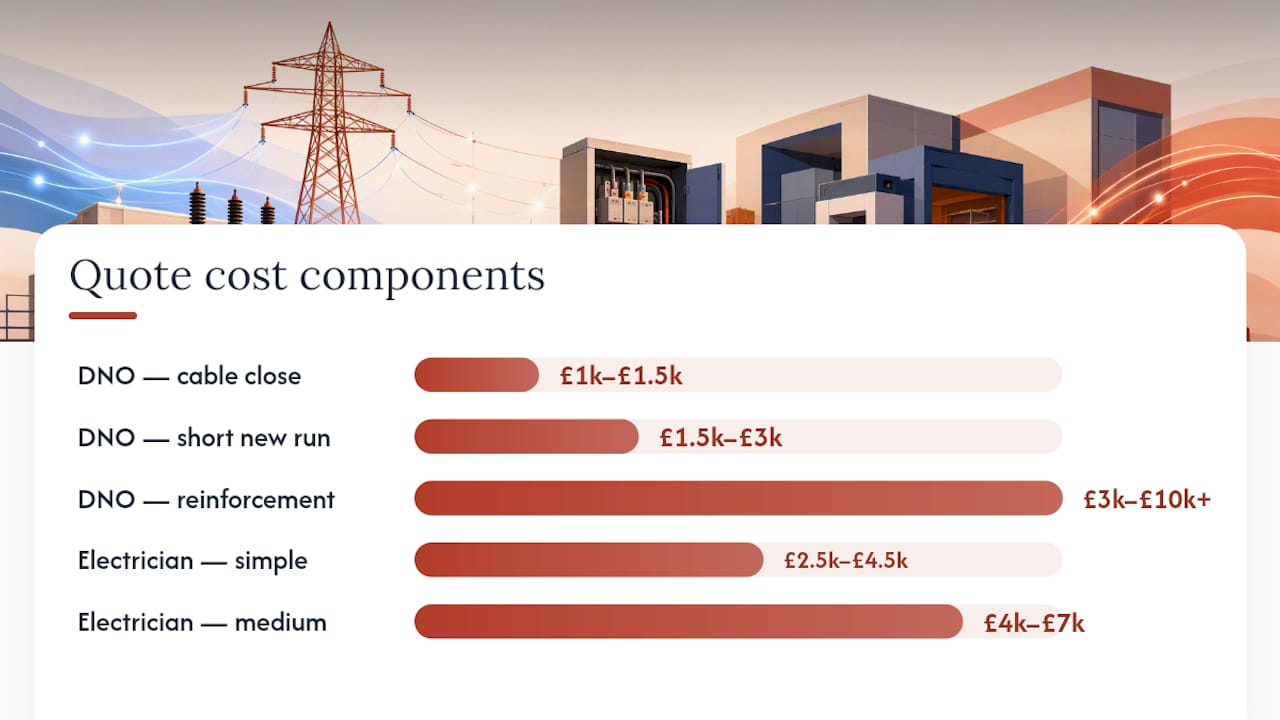
The DNO connection charge is usually the largest and most unpredictable line item. Where three phase cable already runs close to your boundary, connection can cost as little as £1,000 to £1,500. Add a short new cable run and you’re looking at £1,500 to £3,000. If your local substation or network needs reinforcing to handle the extra capacity, that figure can climb to £3,000 to £10,000 or more.
On the internal side, your electrician’s invoice typically breaks down like this:
- A three phase distribution board, ranging from a basic populated board to a larger commercial-grade unit
- Protective devices, including three pole MCBs, RCBOs and a surge protection device (SPD)
- SWA (steel wire armoured) tails connecting the meter to your new board
- Earthing upgrades, often needed to bring an older installation up to current standard
- Labour, typically one to three days depending on complexity
- Testing and certification, including the Electrical Installation Certificate (EIC) that proves the work is safe and compliant
Put together, a simple domestic or small workshop upgrade often totals £2,500 to £4,500. A medium-sized commercial premises with more circuits and a bigger board frequently lands at £4,000 to £7,000. Anything involving network reinforcement or long cable runs regularly clears £7,000, sometimes well beyond it.
Why do three phase installation quotes vary so much?
Two properties on the same street can get wildly different quotes, and it’s rarely down to the electrician overcharging one of them. Distance to the existing three phase network drives most of the gap. Trenching and reinstating a pavement or driveway for a new cable adds cost fast, particularly where the DNO has to dig through tarmac or reinstate a road surface to council standard.
Capacity matters too. Asking for a higher kVA supply, say for an EV charging bank or heavy workshop machinery, often triggers a network capacity check that can escalate straight into reinforcement territory. Site access plays its part on the internal side: long containment runs, multiple sub-boards, or a consumer unit buried behind existing pipework all add labour hours that a simple like-for-like swap wouldn’t need.
Where you live matters more than most homeowners expect. Properties in London and the South East typically pay 15 to 25% more than the national average, reflecting higher labour rates and more congested networks needing reinforcement more often.
- Distance to the nearest three phase cable
- Requested capacity in kVA or amps
- Trenching and road reinstatement needs
- Earthing condition of the existing installation
- Regional labour rates
Pro Tip: Ask your electrician to flag, in writing, whether your existing earthing arrangement (TN-S, TN-C-S or TT) is compatible with a three phase supply before work starts. A mismatched earthing system is one of the most common causes of unbudgeted extra cost.
How long does a three phase upgrade take from application to power on?
The process runs in a fairly fixed order, and skipping steps rarely saves time.
- Survey. Your electrician assesses maximum demand, existing fuse size, and the equipment you plan to run, then documents the site for the DNO application.
- DNO application. You or your electrician submit details to your regional operator, findable through the Energy Networks Association’s DNO lookup, or via the Gov for wider policy context.
- Connection offer. The DNO returns a formal quote and timeline, separate from any application fee already paid.
- Internal work. Your electrician fits the new board and cabling, ideally timed to finish just before DNO energisation.
- Energisation and certification. The DNO connects the supply, and you receive your EIC and any relevant generation paperwork (G98 or G99 if you’re also adding solar).
Most straightforward jobs complete in 6 to 12 weeks. Anything needing substation reinforcement can stretch considerably longer.
What internal wiring work does a three phase upgrade actually need?
Inside the building, the job centres on one main swap: replacing your single phase consumer unit with a three phase distribution board. Basic populated boards for a small workshop start in the low hundreds for the unit itself, rising into four figures for larger commercial boards with more ways and heavier duty breakers.
- Three pole MCBs and RCBOs to protect each circuit correctly across the three phases
- A surge protection device, now standard practice on most new boards
- New SWA tails from the meter position to the board
- Possible earthing remediation if the existing system doesn’t meet current regulations
A straightforward swap in an accessible location might take a single day. Add a partial rewire, new sub-boards, or a meter relocation and you’re looking at two to three days of labour, which is where quotes for seemingly similar jobs start to diverge sharply. If your consumer unit already needs attention, it’s worth reading about what a fuse box upgrade actually involves before committing to a full three phase board replacement.
How do you get an accurate three phase upgrade quote?
Give installers and your DNO the same information up front and you’ll get quotes you can actually compare, rather than three wildly different numbers with no obvious explanation.
- Your MPAN (meter point number) if you have it, plus your current fuse rating
- A list of expected loads, including any planned EV chargers, solar inverters or heavy machinery
- Clear photos of your meter position and existing consumer unit
- A request for separate line items covering DNO connection charges and internal electrician costs
Ask directly who’s responsible for wayleaves, road reinstatement, and any third-party land consents, since these can appear as surprise extras late in the process. A proper written offer should itemise materials, labour, and lead time separately, not bundle everything into one number.
Pro Tip: If a quote doesn’t separate DNO charges from internal work, ask for a revised breakdown before signing anything. It’s the fastest way to spot a supplier padding one side of the job to make the other look cheap.
What do experienced installers wish homeowners knew before starting?
Real-world costs rarely surprise installers, only homeowners. The gap usually comes down to what’s hidden until the walls come off.
A good survey photographs the meter, the consumer unit, and the intended cable route before we quote a penny. It also lists every appliance and charger the client actually plans to run, not just what’s installed today. Old earthing systems, unexpected asbestos in older properties, and long containment runs through multiple floors are the three surprises that blow budgets. Where solar or an EV charger is coming later, upgrading the supply first avoids paying for the same trench or board twice.
Sequencing genuinely matters here. Upgrading before fitting a larger solar and battery system avoids the cost of revisiting completed work once capacity runs out.
Is the standard three phase advice actually right?
Most guidance on three phase upgrades treats the internal wiring as the main event and mentions the DNO connection as an afterthought. That’s backwards. The connection charge, not the consumer unit, decides whether you’re paying £2,500 or £12,000, and it’s set almost entirely by geography and network capacity, factors no electrician controls.
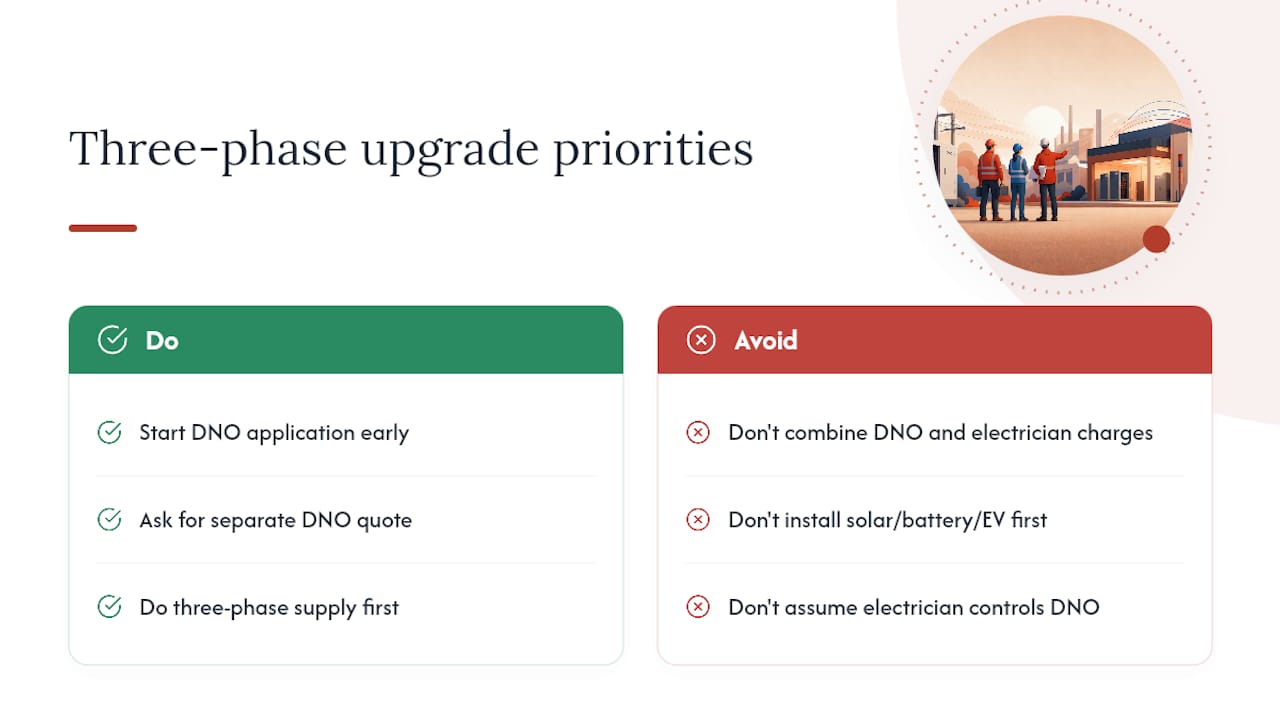
The advice worth following is simpler than most articles make it sound: get your DNO application moving early, because it sets your real timeline, and insist on a quote that separates their charges from your electrician’s. Homeowners who skip that separation routinely misjudge where their real costs sit, then feel blind sided when the DNO’s portion arrives as a second, larger bill.
If there’s one thing to prioritise, it’s sequencing. Anyone planning solar, a battery, or an EV charger alongside a capacity upgrade should get the three phase supply sorted first. Doing it the other way round means paying labour twice for the same trench, the same board, and often the same certification.
— Simon
Book a three phase survey with an electrical contracting company
Smarthometechnical separates every quote into two clear numbers: what your DNO charges for the connection, and what our electricians charge for the internal board, cabling and certification. No bundled guesswork, no vague estimate covering both. We handle the DNO liaison directly, carry out the internal installation, and issue your Electrical Installation Certificate on completion.

If you’re planning a three phase upgrade alongside solar panels, a battery system, or an EV charger, sequencing the electrical work correctly saves you paying for the same trench or board twice. Our solar installation service and EV charger installation teams work from the same survey data as the electrical upgrade, so nothing gets duplicated. For homeowners already running solar or battery storage, the Solar & Battery Service & Maintenance Plan at £175 per year keeps everything checked and certified going forward. Get in touch to book a site survey and receive a written quote with DNO and internal costs shown separately.
Where to check official three phase supply guidance
- Gov for national policy and DNO finder links
- UK Power Networks’ upgrade guidance for regional connection detail
- Independent cost breakdowns from Elec-Mate for current UK pricing bands
- Practical moving-house energy guidance from Van-247 if your upgrade coincides with a house move
Sources
- 3-Phase Installation Cost UK 2026 | Supply Upgrade Guide | Elec-Mate
- What do you need to upgrade? | UK Power Networks
- Gov
- How Much Does It Cost To Install Three-Phase Power in the UK? | EcoFlow
FAQ
How much does a three phase upgrade cost in the UK?
Most UK three phase upgrades cost between £2,500 and £12,000, with simple domestic connections at the lower end and jobs needing network reinforcement at the top. The DNO connection charge, driven mainly by distance to the existing network, is usually the biggest single factor in where your job lands.
How much does it cost to upgrade to three phase power at home?
Domestic upgrades typically run £2,500 to £4,500 where the network is already nearby, rising sharply if new cable or local reinforcement is required. Internal costs cover the distribution board, protective devices and certification, while the DNO charge covers the physical connection.
Can I get three phase power at my house in the UK?
Most UK homeowners can request a three phase connection, though your local DNO decides whether the existing network can support it without reinforcement. UK Power Networks and other regional operators handle applications directly, and a site survey is the fastest way to find out what your property needs.
Is three phase electricity more expensive to run?
Three phase electricity itself isn’t inherently more expensive per unit, but the upgrade to install it carries a one-off cost that varies widely by property and location. Running costs afterwards depend on your tariff and consumption, not the number of phases supplying your building.
What’s included in a typical three phase upgrade quote?
A typical written quote for a three phase upgrade separates DNO connection charges from internal electrician costs, covering the survey, distribution board, protective devices, and the Electrical Installation Certificate. Current pricing depends on the specifics of your site survey and is confirmed once that assessment is complete.
