
Size your usable battery capacity to match your average daily electricity use, typically 9 to 10 kWh for a UK home, then adjust that figure for depth of discharge and round-trip efficiency losses. The formula is gross capacity = (daily kWh × days of autonomy) ÷ (DoD × efficiency). Work through the calculator steps below with your own numbers before you buy anything.
TL;DR:
- Most households require a 10 to 13 kWh battery for full evening and overnight use, with 10 kWh being the common choice for UK homes.
- Proper sizing depends on actual daily energy use, desired autonomy, depth of discharge, and round-trip efficiency, not nominal capacity alone.
- Lead-acid batteries need roughly double the nominal size of LiFePO4 units to achieve the same usable energy due to lower DoD limits.
- Adding loads like EV charging or heat pumps significantly increases required battery capacity, often by stacking multiple units for higher demands.
- Choosing a system based on real consumption data and asking installers for detailed calculations improves long-term performance and avoids undersizing.
Table of Contents
- At-a-glance solar battery sizing for common scenarios
- What is the formula for solar battery sizing?
- Worked examples: three sizing scenarios you can copy
- What changes the calculation: chemistry, efficiency, and temperature
- Nominal kWh vs usable kWh: what the label actually means
- How do you choose the right battery and installer?
- Real installations: how Smarthometechnical sizes systems on-site
- Why most sizing guides get this backwards
- Get a bespoke battery sizing survey from Smarthometechnical
- Sources
At-a-glance solar battery sizing for common scenarios
You don’t need a calculator to work out roughly which size bracket you’re in. Most households and small businesses fall into one of four brackets, and knowing which one you’re aiming for saves a lot of wasted time reading spec sheets.
A 5 kWh battery covers overnight essentials: fridge, lighting, router, TV, and a few hours of standby load. It’s the minimum sensible size for anyone wanting genuine overnight cover rather than a token backup.
A 10 kWh battery is the sweet spot for an average UK household running a full evening and overnight cycle, including cooking appliances and some heating pump support, without draining the bank to zero.
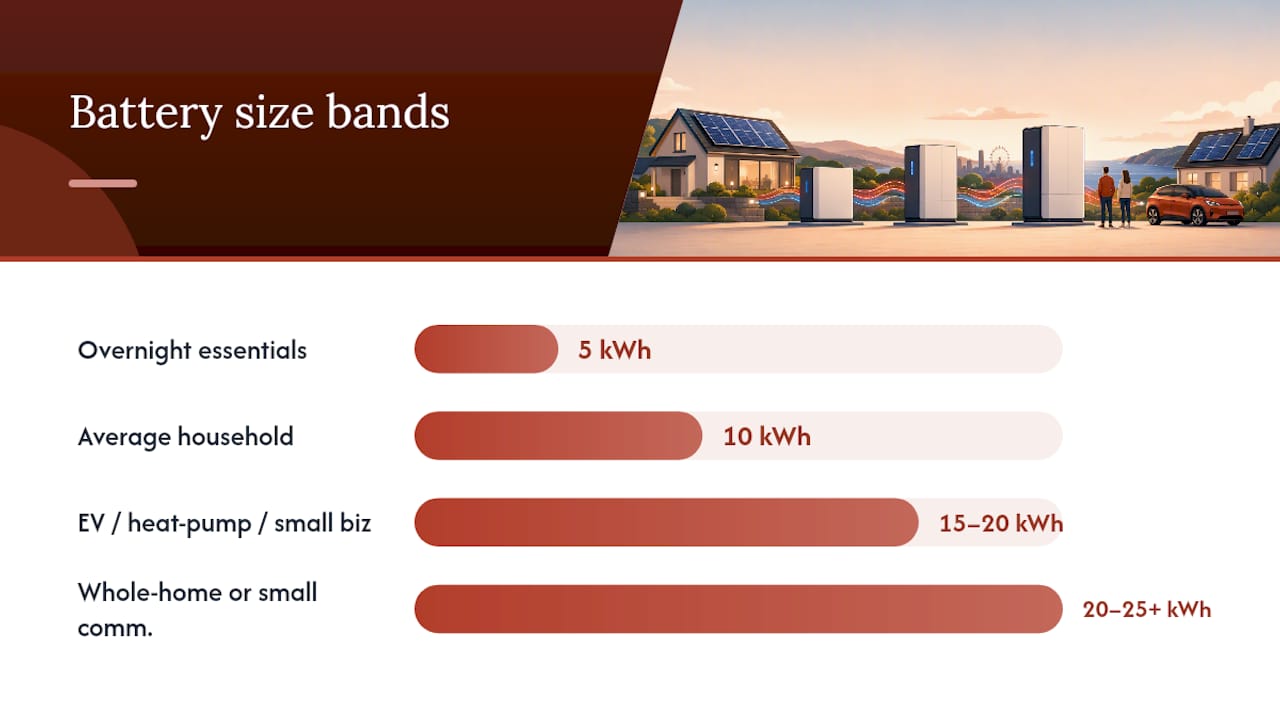
A 15 to 20 kWh battery suits homes with an EV charging routine, a heat pump, or higher daytime occupancy, plus small businesses running fridges, till systems, or light machinery overnight.
A 20 to 25 kWh+ battery or a stacked multi-unit system fits small commercial premises or households planning for near-total grid independence.
- 5 kWh — overnight essentials only (fridge, lights, router, standby loads)
- 10 kWh — full household evening/overnight cycle, average UK home
- 15–20 kWh — EV charging, heat pump, or small business overnight loads
- 20–25 kWh+ — whole-home autonomy or small commercial premises
These bands assume you haven’t added anything unusual to the load, like an EV charger running purely from stored solar. Add that in and the numbers shift fast, which is exactly why the formula below matters more than any generic band.
What is the formula for solar battery sizing?
The formula installers actually use is more forgiving of real-world losses than most online guides suggest, and it’s worth learning properly because guessing at nameplate capacity is the single most common reason people end up with an undersized system.
Gross capacity (kWh) = (Daily energy usage × Days of autonomy) ÷ (Depth of discharge × Round-trip efficiency)
Each variable does real work in that equation:
- Daily kWh usage — your average daily consumption, ideally pulled from a full year of smart meter data rather than a single winter bill. Ofgem’s guidance on average electricity use puts typical UK household consumption in the 9 to 10 kWh per day range, which is a sound starting default if you don’t have your own figures yet.
- Days of autonomy — how many days you want the battery to cover with no solar input at all. Grid-tied homes wanting backup typically choose 0.5 to 1 day; off-grid properties often need 2 to 3 days depending on winter sunlight.
- Depth of discharge (DoD) — the percentage of a battery’s capacity you can safely use. LiFePO4 batteries typically allow 80 to 90% DoD; lead-acid is usually capped nearer 50%, which roughly doubles the nameplate size you need for the same usable output.
- Round-trip efficiency — energy lost converting AC to DC and back through the inverter and battery management system, typically 90 to 95% for a well-specified LiFePO4 system.
Pro Tip: *Always divide by DoD and efficiency, never multiply.
Plugging in typical numbers: a 10 kWh daily load, 1 day of autonomy, 90% DoD, and 92% efficiency gives a gross requirement of roughly 12.1 kWh. That’s the nameplate figure you’d be quoted, not the usable energy you’ll actually draw day to day.
Once you have a gross kWh figure, convert it to amp-hours if you need to spec a bank at a particular voltage: Ah = (kWh × 1,000) ÷ voltage. Most home battery systems now run at 48V for efficiency and cable-sizing reasons, so a 12.1 kWh gross requirement becomes roughly 252Ah at 48V, a calculation VoltCalcs’ battery bank sizing tool walks through with the same logic.
Add a safety margin of 10 to 25% on top of the calculated gross figure. That headroom absorbs battery degradation over years of cycling, unexpectedly cold weather, and the fact that households almost always use slightly more energy than their own estimate.
Worked examples: three sizing scenarios you can copy
Numbers make more sense with real scenarios attached to them. Here are three, each built on the same formula with different inputs.
- Essential loads only (small flat or bungalow). Daily usage: 4 kWh. Autonomy: 1 day. DoD: 90% (LiFePO4). Efficiency: 92%. Gross capacity calculated by dividing daily usage by the product of DoD and efficiency, yielding just under 5 kWh. Round up to a standard 5 kWh unit, which leaves a small buffer for degradation.
- Average household, grid-tied with backup. Daily usage: 10 kWh (the Ofgem benchmark). Autonomy: 1 day. DoD: 90%. Efficiency: 92%. Gross capacity ≈ 12.1 kWh. This is why 10 to 13 kWh systems are the most commonly installed size for UK homes, and why quoting exactly “9 to 10 kWh usable” is realistic rather than optimistic.
- Small business or whole-home autonomy target. Daily usage: 18 kWh (small commercial premises with refrigeration and till systems). Autonomy: 2 days. DoD: 90%. Efficiency: 90%. Gross capacity = (18 × 2) ÷ (0.9 × 0.9) ≈ 44.4 kWh. This typically means stacking two or three battery units rather than sourcing a single large unit, both for redundancy and because most residential-scale inverters cap continuous output per unit.
Once you have a gross figure, round up to the nearest standard product size rather than down. A calculated 12.1 kWh requirement almost never maps to a battery sold at exactly that size, so you’re choosing between a slightly undersized 10 kWh unit or a comfortably sized 13 to 15 kWh unit.
What changes the calculation: chemistry, efficiency, and temperature
Two households with identical daily usage figures can end up with genuinely different battery recommendations, and the reason is almost always one of these variables rather than a sizing error.
- Chemistry and DoD. LiFePO4 typically allows 80 to 90% DoD against roughly 50% for lead-acid, meaning a lead-acid bank needs close to double the nameplate capacity for the same usable output. This is the single biggest lever in the whole formula.
- Round-trip efficiency losses. Energy bleeds away through the inverter and battery management system on every charge and discharge cycle. A system quoted at 95% efficiency loses noticeably less over a year of daily cycling than one running at 88%, even though both numbers sound “fine” in isolation.
- C-rate and continuous power. kWh tells you how much energy you can store, not how fast you can draw it. A battery rated for a high continuous kW output can run a kettle and an immersion heater together; one sized purely on kWh without checking the power rating might trip out under the same load.
- Temperature and derating. Cold, unheated locations reduce usable capacity, and Met Office regional climate data shows how much colder some UK regions run through winter than others. Engineering guidance recommends a derating factor of 1.2 to 1.4× for batteries sited in unheated garages or outbuildings, and LiFePO4 systems generally won’t charge below 0°C without built-in heaters.
- Added loads you haven’t accounted for yet. If you’re planning to charge an EV or run a heat pump substantially from stored solar, add that consumption to your daily kWh figure before running the formula, not after. It’s a different sizing exercise entirely, and one worth reading up on separately if you’re pairing solar with EV charging.
Nominal kWh vs usable kWh: what the label actually means
Every battery on the market is sold with a nominal kWh figure on the box, and it’s rarely the number that matters for your bill.
A nominal battery capacity is reduced to usable capacity after accounting for depth of discharge and efficiency losses, for example a 5 kWh nominal LiFePO4 battery delivers somewhat less usable energy. A 10 kWh nominal battery typically provides about 8 to 9 kWh of usable capacity after losses. Scale that up and a 13.5 kWh unit gives roughly 11 to 12 kWh usable, while a 20 kWh bank typically nets 16 to 18 kWh you can actually draw on.
- 5 kWh nominal ≈ 4.5 kWh usable
- 10 kWh nominal ≈ 8 to 9 kWh usable
- 13.5 kWh nominal ≈ 11 to 12 kWh usable
- 20 kWh nominal ≈ 16 to 18 kWh usable
Lead-acid systems widen that gap considerably, since their DoD ceiling sits far lower than LiFePO4’s. When you’re comparing quotes, ask for the usable figure in writing rather than accepting the nominal number printed on the spec sheet. It’s the single easiest way a quote can flatter its own numbers without technically lying.
How do you choose the right battery and installer?
A sizing calculation is only as good as the installer who turns it into a working system, so the questions you ask matter almost as much as the maths.
- Ask to see the calculation itself. A competent installer should be able to show you daily kWh, chosen autonomy, DoD, and efficiency figures used to reach their recommended size, not just hand you a number.
- Ask what chemistry they’re specifying and why. LiFePO4 has become the default for good reason, but the installer should be able to justify it against your specific site and budget rather than reciting it as a default line.
- Ask for continuous output rating alongside kWh. A battery that stores enough energy but can’t deliver enough power at once will trip under real household load.
- Check warranty length and what voids it. Ten-year warranties are standard for quality LiFePO4 units; watch for warranties tied to narrow operating conditions or specific usage patterns that don’t match how you’ll actually run the system.
- Ask about cycle guarantees, not just years. A warranty stated purely in years without a cycle count attached can hide a lot of degradation.
- Check fire safety documentation and installation location rules. Battery placement (garage, utility room, outbuilding) affects both safety compliance and the temperature derating discussed above.
Red flags worth walking away from: an installer who can’t produce the underlying kWh and DoD figures, a warranty document full of vague exclusions, or battery management system specs described only in marketing language rather than numbers.
Real installations: how Smarthometechnical sizes systems on-site
Every quote Smarthometechnical produces starts with a load audit on the actual property, not a generic household average, because two homes on the same street can have genuinely different daily consumption patterns depending on occupancy and appliance mix.
Site-specific derating gets applied where it’s relevant, particularly for unheated garages or north-facing outbuildings where winter temperatures run consistently lower. A standard headroom allowance gets built into every proposal so the system copes with real-world behaviour change, not just the load pattern recorded on the day of the survey.
Clients typically see a marked jump in self-consumption once a correctly sized battery is running, drawing far less from the grid during evening peak pricing. Real client outcomes and before/after figures are documented in Smarthometechnical’s case studies, including the kind of night-time import reduction a properly sized system consistently delivers.
Why most sizing guides get this backwards
The advice you’ll find scattered across most solar forums treats nominal kWh as the number that matters, and that’s precisely backwards. Nobody’s bill improves because a spec sheet says 10 kWh; it improves because 8 to 9 kWh of that is genuinely usable after DoD and efficiency losses are applied.
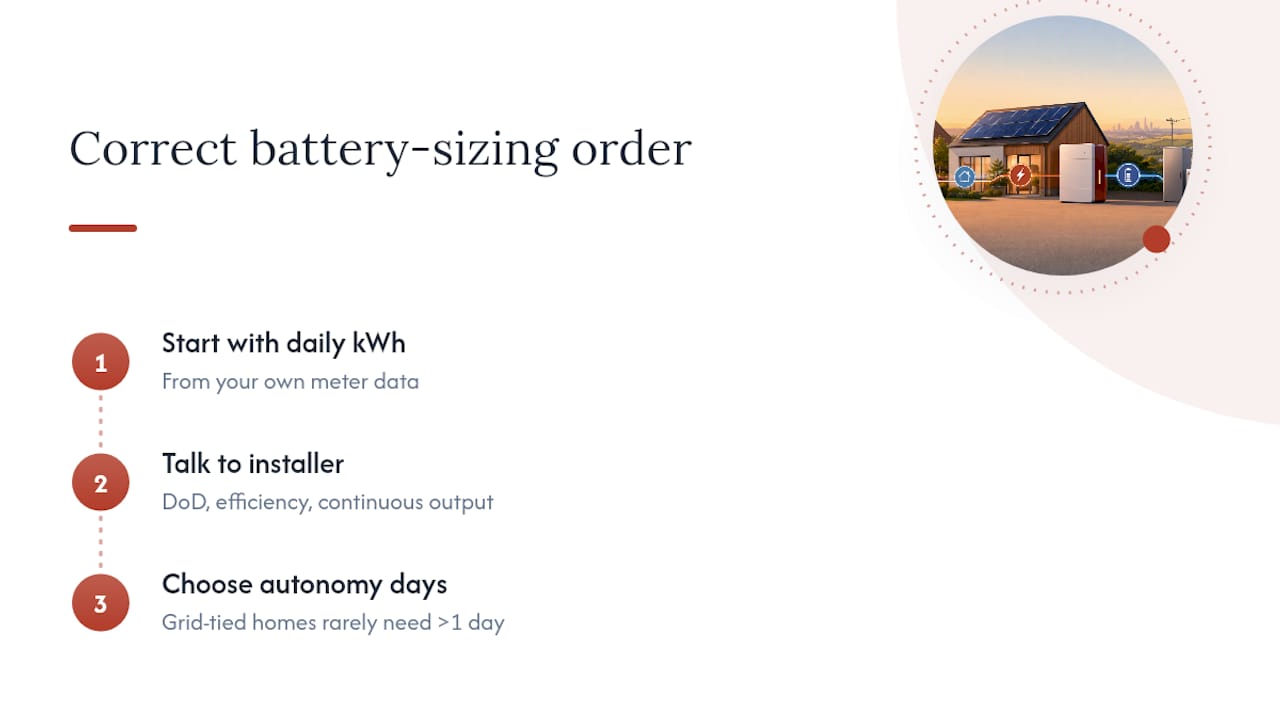
The bigger blind spot is autonomy. Most homeowners fixate on getting the biggest battery their budget allows, when the real decision is how many days of zero-solar cover they actually need. A grid-tied home rarely needs more than a day of autonomy; paying for three days of storage when you’ll never lose grid power for that long is money spent on a scenario that won’t happen.
What should come first isn’t chemistry, brand, or even price. It’s an honest daily kWh figure pulled from your own meter data, not a national average, followed by a straight conversation with an installer about DoD, efficiency, and continuous output. Get those three right and the nameplate number on the box stops mattering nearly as much as the marketing suggests it should.
— Simon
Get a bespoke battery sizing survey from Smarthometechnical
Skip the spreadsheet guesswork. Smarthometechnical runs a full on-site load audit, applies the same formula covered here to your actual consumption data, and hands you a written proposal with the usable kWh figure clearly stated, not buried behind a nominal number on a spec sheet.

A survey covers your daily and seasonal load, the right autonomy target for your property, LiFePO4 sizing calculated to your DoD and efficiency figures, and EV charger pairing if that’s part of your plan. Every proposal comes with warranty documentation and a commissioning report once installed, so you know exactly what you’re covered for and why the size was chosen. Book a site survey through the solar installations page and get a battery sized to your actual usage, not a rule of thumb.
Sources
- Average gas and electricity use explained — Ofgem
- Solar battery bank size calculator — VoltCalcs
- UK and regional series — Met Office
