
Export payments give you a direct income stream for every kilowatt-hour your panels send back to the grid, typically between 4p and 15p, with a smaller number of linked tariffs paying more for customers who meet extra conditions. Stacked on top of the bill savings you already get from using your own power, that income turns a solar system from a bill-reducer into something closer to a small, steady earner. The fastest ways to grow it: pick a tariff that actually suits your export profile, shift more of your usage to daylight hours so you export at the right moments, and weigh up whether a battery genuinely pays its way for your household.
- Compare SEG tariffs by rate, type, and linked conditions, not just the headline pence-per-kWh figure.
- Increase your exported volume or shift exports to higher-value time windows if your supplier offers one.
- Consider battery storage only where the maths for your usage pattern actually stacks up.
A typical 4 kWp system exporting around half its generation might earn a modest annual income on standard SEG rates, before you even count the money saved by using the rest yourself.
Key Takeaways
Export payments deliver a modest but real income stream, and combining the right tariff with smarter self-consumption habits typically outperforms chasing the highest headline export rate alone.
| Point | Details |
|---|---|
| Rate range varies widely | Standard SEG tariffs run roughly 4p to 15p/kWh, with linked offers sometimes paying more. |
| Self-consumption often beats export | Avoided import costs typically exceed 25p/kWh, well above most export rates. |
| MPAN delays are common | Export MPAN registration can take one to four weeks; confirm responsibility before installation finishes. |
| Battery trade-off is real | Batteries cut exported volume but usually raise total savings through higher self-consumption. |
| Smarthometechnical handles the groundwork | MCS certification, meter setup, and export MPAN registration are managed as standard on installations across Dorset, Hampshire, and Devon. |
Table of Contents
- What are the benefits of solar export payments and the Smart Export Guarantee?
- How does metering turn your exported power into a payment?
- How much can you actually earn from exporting solar power?
- What’s the best way to increase your export income?
- Do you pay tax on solar export payments?
- How do you compare SEG tariffs properly?
- What’s the truth behind the “20% rule” and other export myths?
- How Smarthometechnical helps you get paid what you’re owed
- Frequently asked questions
- Sources
What are the benefits of solar export payments and the Smart Export Guarantee?
The Smart Export Guarantee (SEG) pays you a set number of pence for every kilowatt-hour of electricity your solar panels export to the grid. It is the mechanism that turns your surplus generation, the power you produce but don’t use in the house, into cash rather than something you simply give away.
Eligibility is straightforward but non-negotiable. Your system needs MCS certification, an export-capable smart meter, and a signed SEG tariff agreement with a licensed supplier. Systems up to 5MW qualify, which covers virtually every domestic and small commercial installation.
- MCS-certified installation (Smarthometechnical handles this as standard on every job).
- A smart meter capable of recording exported units.
- Sign-up to a SEG tariff with any of the licensed suppliers, not necessarily your electricity supplier.
If you’re still on the older Feed-in Tariff, note the distinction: FIT paid you for generation and a deemed export assumption, with rates guaranteed for years. SEG pays only for what you actually export, metered rather than estimated, and rates aren’t fixed for the scheme’s lifetime. Ofgem administers the framework and publishes the current list of licence-holders.
How does metering turn your exported power into a payment?
Getting paid depends entirely on accurate measurement, and this is where most delays happen. Your smart meter records the electricity flowing out to the grid, and that reading is what your supplier bills against, not a guess based on your system size.
You’ll typically need a dedicated export MPAN, the meter point reference that identifies your export connection separately from your import supply. Without one, suppliers have nothing to attach a SEG payment to. SEG doesn’t do assumptions.
The usual sign-up sequence runs: MCS certificate issued, export MPAN created via the Distribution Network Operator (DNO), supplier enrolment on your chosen SEG tariff, then an initial meter reading or photo to activate payments. The MPAN step is where things stall. It commonly takes one to four weeks, sometimes longer, and confusion over who’s responsible is the most frequent cause of delay.
- Export-capable smart meter installed and communicating.
- Dedicated export MPAN registered with the DNO.
- MCS certificate and meter reading submitted to your chosen SEG supplier.
Pro Tip: Before your installation finishes, ask directly whether your installer or you will be the one contacting the DNO for the export MPAN. Getting this in writing at contract stage avoids weeks of chasing later.
How much can you actually earn from exporting solar power?
Rates vary more than most homeowners expect. Standard open-access SEG tariffs commonly sit between 4p and 15p per kWh, while some supplier-linked offers, ones tied to using that supplier for your import electricity or your original installation, pay noticeably more for customers who qualify.
Run the numbers on a typical household system. A 4 kWp array generating around 3,400 kWh a year, exporting roughly half of that after self-consumption, sends about 1,700 kWh to the grid. At 10p per kWh, that’s £170 annually from export alone. A larger 6 kWp system exporting 2,200 kWh at the same rate brings in around £220. Push that to a higher linked rate near 15p and the same export volume earns closer to £330.
- 4 kWp system, ~1,700 kWh exported, 10p/kWh → around £170/year.
- 6 kWp system, ~2,200 kWh exported, 10p/kWh → around £220/year.
- Same 6 kWp export volume on a 15p linked rate → around £330/year.
Here’s the detail worth sitting with: every kWh you use yourself instead of exporting typically saves you more than 25p in avoided import costs, well above most export rates. Export income is genuinely valuable, but it’s rarely your biggest lever. Self-consumption usually is.
What’s the best way to increase your export income?
Not every option here delivers equal value, and some genuinely conflict with each other. Work through these in order.
- Sort your paperwork first. Confirm your MCS certificate is filed correctly and your export MPAN is active before comparing tariffs, since a tariff switch means nothing if payments can’t start.
- Match tariff type to your export profile. Fixed-rate tariffs suit steady exporters; variable or time-of-use tariffs suit households that can shift consumption or storage to specific windows.
- Weigh up linked tariffs honestly. Supplier-linked SEG offers can pay several times more than standalone rates, but usually require switching your import supplier or having used that installer, so calculate the combined import and export cost, not the export rate alone.
- Consider a battery only if the maths supports it. Batteries reduce your exported volume, which cuts SEG income, but usually improve overall savings by increasing self-consumption, particularly when paired with a time-of-use import tariff or an EV you charge overnight.
Before switching anything, run this checklist:
- Confirm MCS certification is current and on file.
- Check your export MPAN is registered and active.
- Get a meter reading or photo ready for your new supplier.
- Calculate your actual export percentage from recent bills, not an estimate.
- Compare combined import plus export costs across suppliers, not export rate in isolation.
If you’re weighing storage, our real-world battery savings case studies show how the trade-off plays out for different household types. Households running an EV alongside solar have an extra lever too. Charging overnight or exporting to match EV demand can shift the whole calculation in your favour.
Pro Tip: Linked tariffs often carry an introductory rate that drops after 12 months. Diarise a review a month before that date so you’re not left on a lapsed high rate without noticing.
Do you pay tax on solar export payments?
For most homeowners, no. Residential export payments are generally not taxable when the system serves your own home and isn’t part of a wider income-generating business. That covers the overwhelming majority of domestic SEG customers.
It gets more nuanced for landlords and small businesses. If you’re generating income from a property you let out, or your business installation forms part of a commercial operation, export payments can fall into taxable income depending on your specific structure.
- Ask yourself: is the system generating income as part of a business, or purely offsetting your own household bills?
- Are multiple properties or tenants involved, which can change how HMRC views the income?
- Landlords and small business owners should get specific advice from HMRC or an accountant rather than assume the residential rule applies.
How do you compare SEG tariffs properly?
Rate alone is a misleading way to shop. A high headline pence-per-kWh figure attached to a poor import tariff can leave you worse off overall than a modest export rate paired with cheap import electricity.
Work through these dimensions every time you compare offers:
- Rate (p/kWh): the headline figure, but never the only one that matters.
- Tariff type: fixed rates give certainty; variable or time-of-use rates reward flexibility if you can shift consumption.
- Linked requirements: does the top rate require you to switch import supplier, use a specific installer, or own a battery?
- Payment frequency: monthly, quarterly, or annual settlement affects your cash flow.
- Battery support: some tariffs pay more for battery-stored export at peak times; others don’t distinguish.
- Contract length and exit terms: check for tie-ins or penalties if you want to switch again later.
When you call a supplier, ask for both the export rate and their standard import tariff in the same conversation, then work out your net annual position rather than comparing export rates in isolation. It’s the only comparison that reflects what actually lands in your account.
What’s the truth behind the “20% rule” and other export myths?
The metric that actually matters is your self-consumption ratio against your export share: if you’re exporting more than roughly 15%, focus on getting a better export rate; if you’re exporting less, focus on shifting consumption into daylight hours instead.
- Myth: Switching to SEG means losing your FIT payments entirely.
Fact: You can often switch just the FIT export portion to SEG while keeping FIT generation payments, though the switch has constraints and can be irreversible. - Myth: SEG rates are fixed for years like FIT was.
Fact: Rates vary by supplier and can change; there’s no long-term guarantee attached to the scheme itself. - Myth: Export rate is the main measure of solar value.
Fact: Avoided import cost per kWh self-consumed is usually worth more than the export rate.
A real installation: what changed when the tariff switched
Their annual export income sat under £90.
After we reviewed their setup and switched them to a linked tariff tied to a battery-optimised time-of-use plan, combined with a small battery retrofit, their export income rose to roughly £210 a year. Total bill savings, including the extra self-consumption the battery enabled, added a further £180 on top.
- Original tariff: 4.5p/kWh open-access, ~£85/year export income.
- After switch plus small battery: ~£210/year export income, plus ~£180/year in additional bill savings.
The numbers came from a genuine client project on our books, not a hypothetical. If you’d like to see the full breakdown, our battery savings case studies cover similar setups in more depth.
Where export payments fit in the bigger picture
Export payments matter most for households with a large export share and little flexibility to shift usage. Where I’d usually recommend a battery or tariff switch is when someone’s exporting well over half their generation, because that’s exactly the profile where self-consumption gains outweigh the export income you’d lose.
If you’re not sure which camp you fall into, get your export percentage checked properly rather than guessing from memory.
How Smarthometechnical helps you get paid what you’re owed
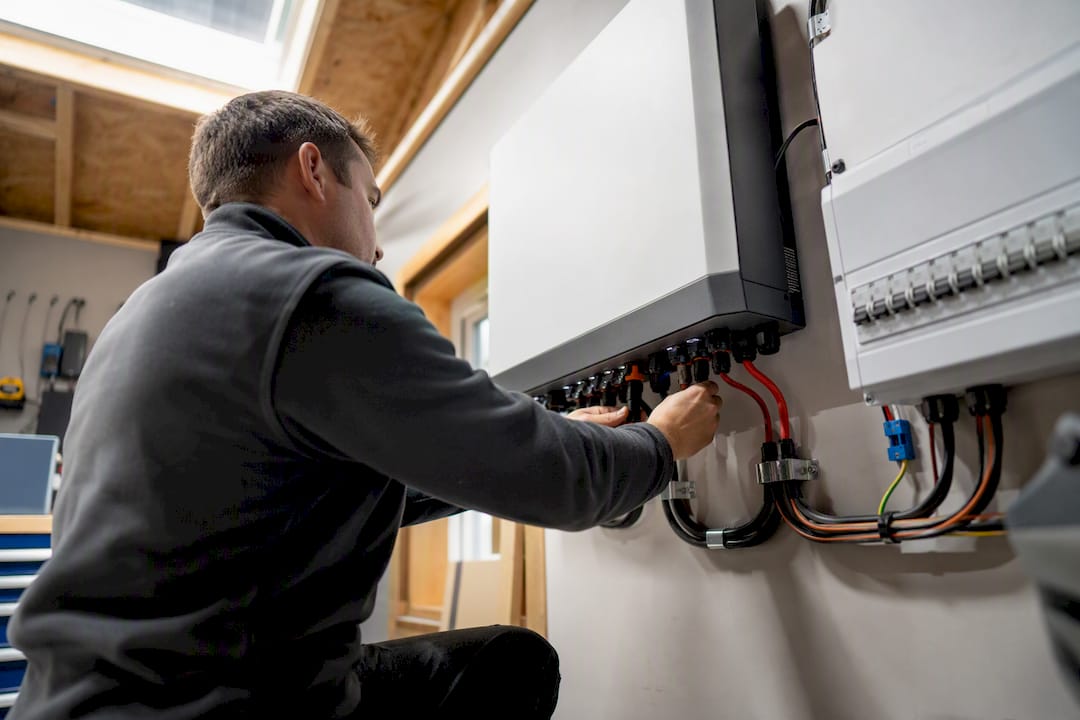
Getting the best from export payments isn’t just about picking a tariff, it’s about the paperwork behind it being right from day one: correct MCS certification, a properly registered export MPAN, and a meter that’s actually communicating with your supplier. That’s the groundwork Smarthometechnical handles on every installation, so you’re not the one chasing a DNO three weeks after your panels go live.
We install solar panel systems, retrofit battery storage, and pair EV chargers with existing arrays across Dorset, Hampshire, and Devon, and we’ll talk you through tariff options as part of the process rather than leaving you to work it out alone. A site survey covers your roof orientation, realistic export percentage, and whether a battery genuinely pays its way for your usage pattern, not a generic recommendation. If you’re weighing up a new solar installation or want an existing system’s export setup checked over, get in touch for a survey and we’ll give you a straight answer on what it’s actually worth to you.
Frequently asked questions
Do I need a new meter to get export payments?
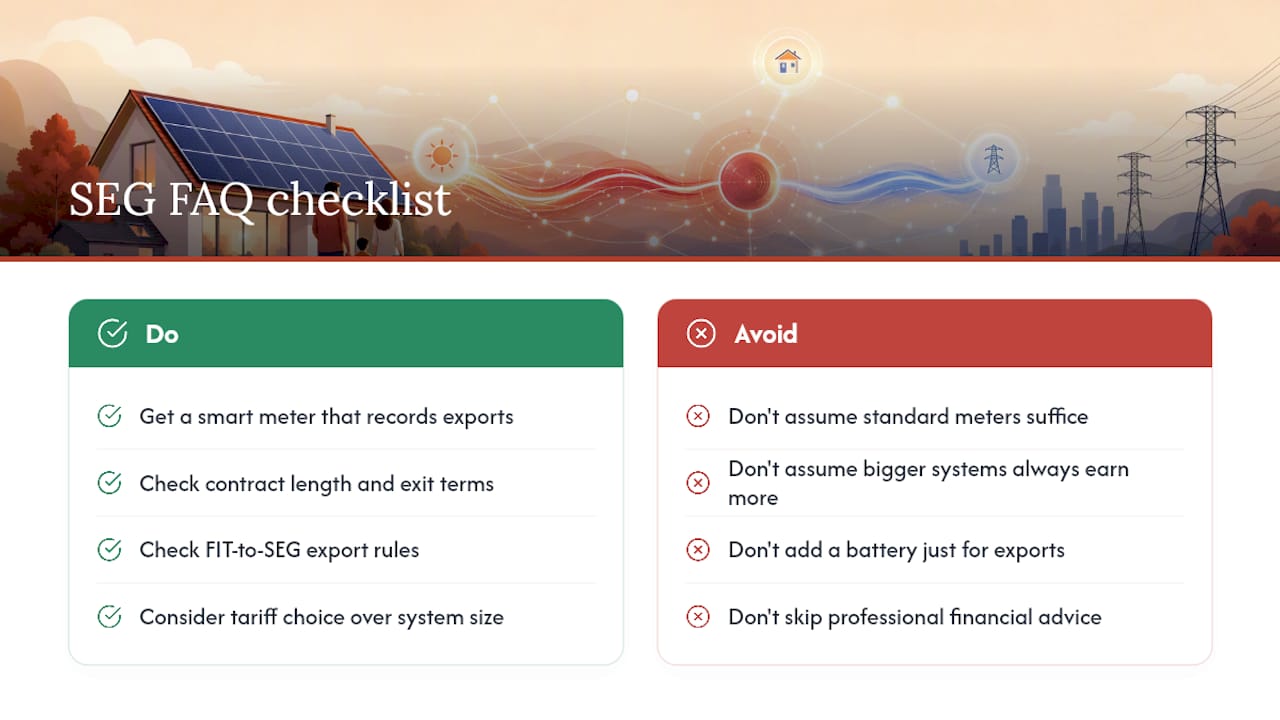
Yes, you need a smart meter capable of recording exported electricity separately from what you import. Standard meters can’t measure this.
Can I switch SEG suppliers if I find a better rate?
Generally yes, though check your contract length and exit terms first. Some linked tariffs carry conditions tied to your import supplier or installer.
What happens if I’m still on the Feed-in Tariff?
You can often switch only the FIT export element to SEG while keeping your FIT generation payments, though this has constraints worth checking with your supplier first.
Is a bigger system always better for export income?
Not necessarily. A larger system generates more, but if your household consumption doesn’t grow with it, you’ll simply export a higher volume at whatever rate you’re on, so tariff choice matters more than system size alone.
Should I add a battery just to increase export income?
No, batteries typically reduce export income by keeping more power in the house. They’re worth it when the resulting rise in self-consumption savings outweighs that loss, not as a way to boost SEG payments specifically.
This article is general information, not a substitute for advice from a qualified financial advisor. Consult a qualified financial professional about your own circumstances before acting on anything here.
Sources
For scheme rules and eligibility, Ofgem’s SEG guidance is the definitive regulator page, alongside its list of licensed SEG suppliers. The Energy Saving Trust’s SEG explainer covers documentation requirements and FIT interactions in plain terms, while MoneySavingExpert’s tariff comparison is useful for checking current rates before you commit to a supplier.
