
Solar panel brand differences are defined by four core factors: cell technology, manufacturing quality, financial stability, and post-sale support infrastructure. These are not marketing distinctions. They determine whether your system performs as promised, whether your warranty holds up in ten years, and whether the company you bought from still exists. Understanding why solar panel brands differ gives you the power to make a decision based on substance rather than a sales brochure.
Why solar panel brands differ: the technology gap
The most significant driver of differences in solar panels is cell technology. The industry divides broadly into P-type and N-type cells, and the gap between them is measurable.
N-type panels (TOPCon and HJT) achieve 22–25% efficiency, compared to legacy P-type panels at 20–23%. That difference matters most when your roof space is limited. A higher-efficiency panel produces more electricity per square metre, which directly affects how many panels you need and how much you generate annually.

Temperature coefficients separate brands further. This figure tells you how much output a panel loses as it heats up. HJT panels carry the lowest temperature coefficients, typically around -0.24%/°C, compared to standard P-type panels at around -0.35%/°C. On a hot summer day in southern England, that difference adds up across thousands of hours of operation.
Degradation rates also vary by technology. Light Induced Degradation (LID) and temperature coefficients vary significantly between panel types, affecting long-term energy output. N-type cells suffer far less LID than P-type, which means they hold their rated output for longer. A panel that degrades at 0.25% per year rather than 0.55% per year produces meaningfully more electricity over a 25-year lifespan.
Polycrystalline panels, once common in UK installations, are now largely obsolete for residential use. Their lower efficiency and higher degradation make them a poor choice against modern monocrystalline options.
| Technology | Efficiency range | Temperature coefficient | Best use case |
|---|---|---|---|
| P-type monocrystalline | 20–23% | ~-0.35%/°C | Standard roofs with ample space |
| N-type TOPCon | 22–24% | ~-0.30%/°C | Space-limited roofs, commercial |
| N-type HJT | 23–25% | ~-0.24%/°C | Premium installs, hot climates |
| Polycrystalline | 17–20% | ~-0.40%/°C | Low-budget, large-area only |
Pro Tip: Do not compare panel brands on peak wattage alone. Ask for the temperature coefficient and the annual degradation rate. These two figures tell you far more about real-world performance than the headline watt figure.
Does manufacturer financial stability affect your warranty?
The short answer is yes, and this is where many homeowners get caught out. A 25-year performance warranty is only as good as the company standing behind it. Over 100 solar PV manufacturers have exited the market since 2010, leaving customers with panels that carry warranties nobody will honour.
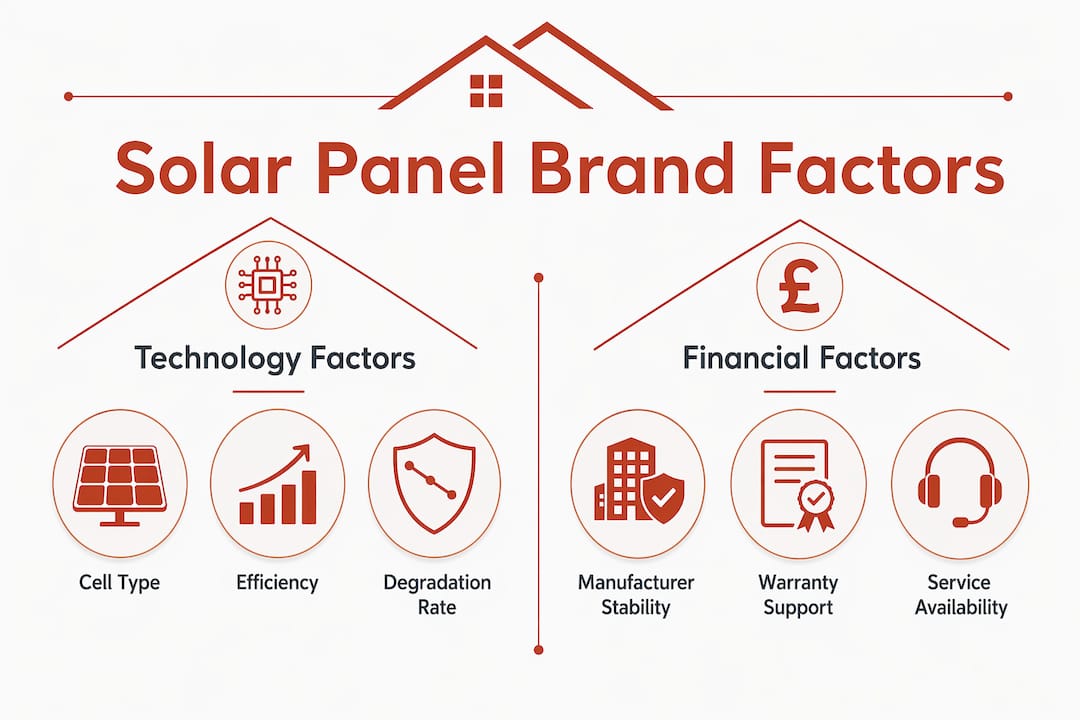
The term “Tier 1” is widely misunderstood. Tier 1 is a bankability rating assigned by lenders, not a product quality award. It means a manufacturer has secured project finance from banks, which requires demonstrating financial strength and supply chain transparency. It says nothing about whether their panels are better than a Tier 2 competitor’s.
Bankability, including financial stability, R&D investment, and supply chain transparency, is the criterion that lenders and developers prioritise above efficiency specs. Manufacturers like Sungrow and Huawei lead rankings by combining technology investment with financial strength and geographic manufacturing diversification. That combination reduces the risk of a company disappearing mid-warranty.
“Purchasing solar panels involves buying a service and support promise beyond hardware.” This is the lens every homeowner and developer should apply when comparing brands.
Supply chain transparency and local authorised service centres are the practical side of this equation. If a panel fails and the nearest authorised repair centre is three counties away, your system sits idle while you wait. That lost production has a real cost.
When assessing a brand’s reliability, look beyond the brochure:
- Check whether the manufacturer publishes audited financial results
- Confirm the brand has a UK-based service and warranty fulfilment operation
- Ask your installer how long the brand has traded and whether they have handled warranty claims with them before
- Verify that spare parts are available domestically, not solely through international shipping
The role of solar panels in homes and businesses extends well beyond installation day. The brand you choose needs to support your system for decades, not just sell it to you.
What do brand differences mean in practice for your home or development?
This is where solar panel brand comparisons become genuinely useful. The right brand for your property depends on your specific constraints, not on which name appears most in advertising.
-
Limited roof space. If you have a south-facing roof with limited usable area, N-type HJT panels from a premium brand justify their higher cost. You generate more per square metre, which can make the difference between a system that covers your energy needs and one that falls short.
-
Standard residential roof with ample space. Efficiency differences within Tier 1 mono P-type brands are small, around 2–3%, and real-world factors like shading, roof orientation, and inverter matching affect output more than brand premium. Here, a mid-range Tier 1 brand with strong UK warranty support often delivers better value than the most expensive option.
-
Commercial or development projects. Developers need bankable brands that satisfy lenders and insurers. Investors consider long-term support risk and supply chain durability more critically than marketing claims. A development financed with panels from a financially unstable manufacturer creates liability risk that outlasts the build.
-
Coastal or high-temperature locations. Panels in coastal areas face salt mist and higher ambient temperatures. HJT technology’s lower temperature coefficient and superior corrosion resistance make it a practical choice, not just a premium one. Smarthometechnical covers this in detail in their solar panel benefits for coastal homes guide.
-
Budget-conscious installs. Price premiums for Tier 1 brands range 15–30%, but site-specific needs often justify that investment. If budget is the primary constraint, prioritise bankability and UK warranty support over chasing the highest efficiency figure.
Pro Tip: Before committing to a brand, ask your installer to show you a completed installation using those panels and to provide contact details for a previous customer. Real-world feedback from someone with the same system in a similar climate is worth more than any spec sheet.
Understanding how solar works in winter is also relevant here. Brands with better low-light performance maintain output during the shorter days that define much of the UK year.
How to compare solar panel brands effectively
Comparing brands confidently requires a consistent framework. Chasing the highest wattage or the lowest price are both traps. The criteria below give you a structured way to evaluate what actually matters.
Technology and performance
- Cell type: N-type (TOPCon or HJT) outperforms P-type in efficiency and longevity
- Temperature coefficient: lower is better; aim for -0.30%/°C or below
- Annual degradation rate: look for 0.25–0.45% per year in warranty documentation
- Warranty terms: 25-year product and performance warranties are standard; anything shorter is a red flag
Financial and support criteria
- Tier 1 status: confirms bankability, not product quality
- Years in operation: brands with a 10-plus year track record carry lower exit risk
- UK service network: confirm authorised engineers exist in your region
- Historical warranty claim handling: ask your installer directly
Performance differences between Tier 1 brands are often negligible in real-world conditions. System design and installation quality frequently have a more substantial impact on energy generation than the brand choice itself. This means your installer’s expertise matters as much as the panel on the roof.
Resources worth consulting include Wood Mackenzie’s annual manufacturer rankings, which assess financial strength alongside technology, and independent comparison platforms that publish verified efficiency and degradation data. Avoid relying solely on manufacturer-published figures.
Key takeaways
Solar panel brand differences come down to technology, financial stability, and the quality of support you receive after installation. Choosing a bankable brand with a strong UK service network protects your investment far more reliably than chasing the highest efficiency figure.
| Point | Details |
|---|---|
| Cell technology drives real differences | N-type TOPCon and HJT panels outperform P-type on efficiency, temperature response, and degradation. |
| Tier 1 means bankable, not best | Tier 1 status confirms financial strength for lenders, not superior product quality. |
| Warranty orphaning is a genuine risk | Over 100 manufacturers have exited since 2010, leaving customers with unenforceable warranties. |
| Site conditions shape brand choice | Roof space, climate, and shading affect which brand and technology delivers the best return. |
| Installation quality often matters more | System design and installer expertise frequently outweigh small brand efficiency differences. |
What I have learned from years of solar installations
After years of specifying and installing solar systems across southern England, the pattern I see most often is this: homeowners who chose a brand based on the lowest quote frequently come back to us with warranty problems that go nowhere. The manufacturer either no longer trades in the UK, has no local service network, or simply does not respond.
The brands that consistently deliver are the ones where we can pick up the phone and speak to a UK-based technical team. That sounds basic, but it is rarer than you would expect. I have seen 25-year warranties rendered worthless within five years because the manufacturer exited the European market without notice.
My honest view is that the efficiency gap between a solid mid-range Tier 1 panel and a premium HJT panel is real but modest for most UK homes. What is not modest is the difference between a brand that honours its warranty and one that does not. I would always steer a client towards a financially stable manufacturer with a proven UK service record over a slightly higher-efficiency panel from a company with no local presence.
The spec sheet is the start of the conversation, not the end of it. Ask your installer who they have dealt with on warranty claims. That answer tells you more than any brochure.
— Simon
How Smarthometechnical can help you choose the right brand
Choosing between solar panel brands is straightforward when you have the right guidance. Smarthometechnical works with homeowners and property developers across southern England to assess site-specific needs and recommend bankable, well-supported brands that deliver long-term performance.
From initial consultation through to installation and ongoing support, the team at Smarthometechnical takes the guesswork out of brand selection. Whether you are fitting panels on a coastal property, a new development, or a standard residential roof, the right technology and the right manufacturer make a measurable difference. Visit the solar installations service page to find out how Smarthometechnical can match your property to a system that performs and a brand that stands behind it.
FAQ
Why do solar panel brands vary so much in price?
Price premiums for Tier 1 brands range 15–30%, reflecting differences in cell technology, manufacturing quality, warranty terms, and the cost of maintaining a UK service network. Budget brands cut costs in areas that affect long-term reliability.
What does Tier 1 actually mean for solar panels?
Tier 1 is a bankability classification assigned by project finance lenders, not a product quality rating. It confirms the manufacturer has the financial strength to support long-term warranties, but it does not guarantee their panels outperform Tier 2 alternatives.
How do I know if a solar brand will still exist in 20 years?
Check the manufacturer’s trading history, whether they publish audited accounts, and whether they have a UK-based service operation. Over 100 manufacturers have exited the market since 2010, so financial stability is a genuine selection criterion.
Does a higher-efficiency panel always mean better value?
Not always. Efficiency differences within Tier 1 mono P-type brands are small, and factors like shading, inverter matching, and roof orientation often affect output more than a 2–3% efficiency advantage. Higher efficiency justifies its cost primarily when roof space is limited.
What is the most important factor when comparing solar brands?
Bankability and local warranty support are the most critical factors. A technically superior panel from a financially unstable manufacturer with no UK service network carries more risk than a slightly less efficient panel from a brand with a proven support infrastructure.
Recommended
- Why switch to solar energy: a 2026 homeowner’s guide – Smart Home Technical Ltd
- The role of solar panels in homes and businesses – Smart Home Technical Ltd
- Solar panel installation explained for southern England – Smart Home Technical Ltd
- How solar works in winter: what homeowners need to know – Smart Home Technical Ltd
