
A hybrid solar battery system is defined as a combined installation of solar panels and a battery storage unit that captures surplus energy for use when sunlight is unavailable. For Hampshire homeowners, this means generating power during the day and drawing on stored energy in the evening, rather than paying the grid rate. Systems from brands such as GivEnergy and Tesla Powerwall are now widely installed across the county, and MCS certification governs whether you qualify for Smart Export Guarantee payments. This guide covers everything from local planning rules to choosing the right system for your home.
What are the hampshire rules for installing a hybrid solar system?
Most residential solar and battery installations in Hampshire fall under permitted development rights, meaning you do not need full planning permission. The key exceptions are listed buildings, properties in conservation areas, and some new builds with specific covenants. If you are unsure, your local authority planning portal is the first place to check.
Grid connection is a separate matter, and the picture is more complicated in 2026. The UK currently has significant over-capacity in battery energy storage grid connections, with 14.8 GW above the Clean Power 2030 target. That over-capacity can push back connection timelines for some Hampshire properties, so ask your installer for a realistic estimate before you commit.

MCS certification is the other critical requirement. MCS certification is mandatory to access the Smart Export Guarantee scheme, and it covers both the product and the installer. Without it, you cannot register for SEG payments.
Here is what to check before signing any contract:
- Confirm the installer holds MCS accreditation for both solar PV and battery storage. Battery storage MCS accreditation is separate from solar PV accreditation, and many installers only hold the latter.
- Ask to see the installer’s MCS certificate and verify the scope explicitly includes battery storage.
- Request a written grid connection plan, including an estimated connection date.
- Check whether your property falls within a Hampshire conservation area or has any planning restrictions.
Pro Tip: Ask your installer to show you the MCS Installation Certificate scope before any work begins. The certificate must list battery storage as a covered technology, not just solar PV, or your SEG application will be rejected.
SEG payments currently range from 3 to 15 pence per kWh exported. Over a year, that difference adds up significantly, which is why certification is worth prioritising from day one.
How does the installation process work in hampshire?
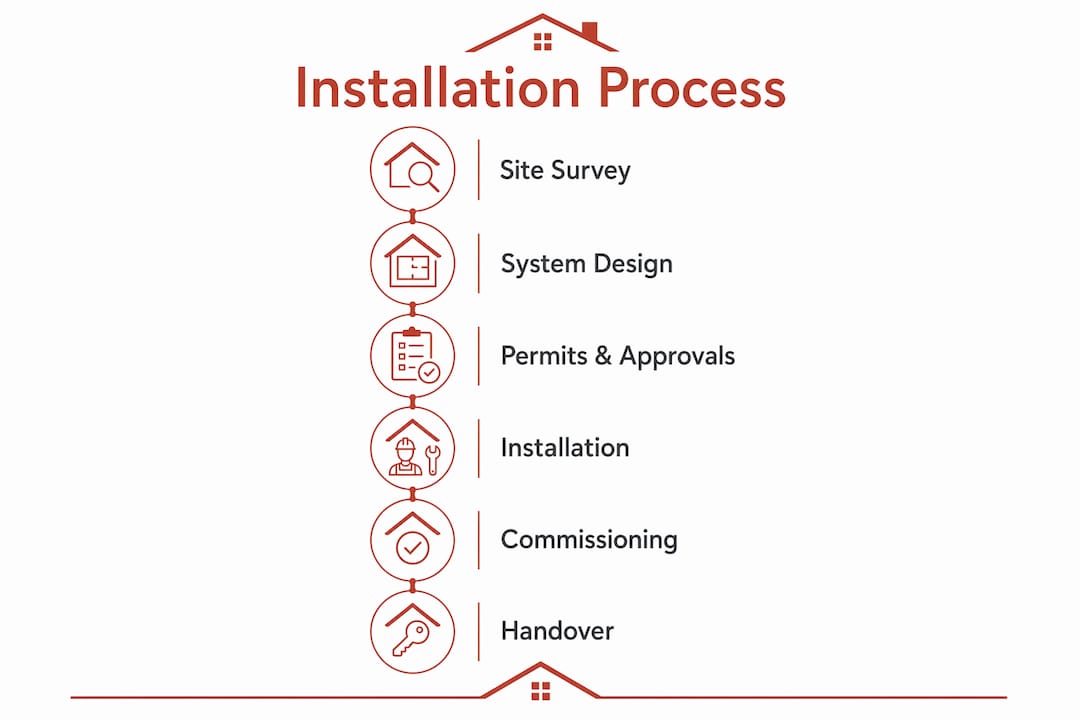
A well-run solar battery installation in Hampshire follows a clear sequence. Understanding each stage helps you hold your installer to account and know what to expect on the day.
- Energy audit and site assessment. Your installer surveys your roof orientation, shading, and current energy consumption. South-facing roofs in Hampshire typically generate the most output, but east-west configurations can also work well with the right system design.
- System design and product selection. Choosing the right battery capacity and hybrid inverter model depends on your household consumption patterns, roof space, and budget. A 10 kWh battery suits most three-bedroom homes, but larger properties may need more.
- Mounting and panel installation. Panels are fixed to roof rails, wired in strings, and connected to the hybrid inverter. The inverter manages power flow between the panels, battery, home circuits, and the grid.
- Battery installation and wiring. The battery unit is typically wall-mounted in a garage or utility room. Installers must follow BS EN 62619 safety standards for lithium-ion batteries, including fire compartmentation requirements.
- Integration with existing electrics. The system connects to your consumer unit. Your installer will check compatibility with any existing tariffs or smart meters.
- Commissioning and paperwork. The system is tested, settings are configured, and the installer submits the MCS Installation Certificate. You receive all documentation needed to register for SEG.
Pro Tip: Request a full handover session after commissioning. Ask your installer to walk you through the monitoring app, explain each operating mode, and confirm what happens during a power cut. Knowing this upfront saves a lot of confusion later.
For a detailed look at what the installation process involves in southern England, Smarthometechnical has published a practical breakdown specific to this region.
What problems should hampshire homeowners watch out for?
Even a well-installed system can underperform if you do not understand how it behaves day to day. These are the most common issues and how to manage them.
Export versus charging conflicts. System operating modes determine whether surplus solar energy is stored in the battery or exported to the grid. The control logic cannot maximise both simultaneously. In summer, when the battery fills quickly, excess energy exports automatically. In winter, the battery may rarely reach full charge, so export income drops. Set your expectations with your installer before commissioning.
Grid connection delays. As noted above, connection timing remains variable due to reform and over-capacity. Some Hampshire homeowners have waited longer than anticipated for their grid connection to be confirmed. Build this into your project timeline.
Seasonal performance shifts. Hampshire winters are mild compared to northern England, but solar generation still drops significantly between october and february. Understanding how solar works in winter helps you plan your energy use and avoid disappointment.
“A hybrid solar battery system’s value is not just in what it generates. It is in how intelligently it manages what it stores, exports, and draws from the grid across every season.”
Maintenance requirements. System maintenance involves periodic checks, firmware updates, and verifying electrical safety to sustain performance and lifespan. Schedule a professional check annually. If you notice unexpected drops in generation or battery capacity, contact your installer promptly rather than waiting for the annual visit.
- Check the monitoring app weekly during the first three months to spot anomalies early.
- Verify that fire compartmentation around the battery unit remains intact after any building work.
- Keep the area around the battery unit clear and well ventilated.
- Confirm your installer offers ongoing support before you sign the contract.
How do you choose the best battery storage system for your home?
The right system depends on three factors: your daily energy use, your budget, and your installer’s capability. Brand preference comes after those three.
Battery technology and capacity
Lithium-ion batteries dominate the Hampshire market in 2026. GivEnergy and Tesla Powerwall are the two most commonly installed brands locally, both using lithium iron phosphate chemistry for improved safety and cycle life. Most residential batteries offer between 5 kWh and 13.5 kWh of usable capacity. A household using 10–12 kWh per day typically benefits from a 10 kWh battery paired with a 4–6 kWp solar array.
Comparing popular systems available in hampshire
| System | Usable Capacity | Warranty | Key Feature |
|---|---|---|---|
| GivEnergy All-in-One | 9.5 kWh | 10 years | Integrated hybrid inverter |
| Tesla Powerwall 3 | 13.5 kWh | 10 years | High continuous power output |
| SolarEdge Home Battery | 9.7 kWh | 10 years | Module-level monitoring |
| Sungrow SBR | 9.6 kWh | 10 years | Modular, scalable design |
What to prioritise when comparing quotes
- MCS certification scope for battery storage (non-negotiable for SEG eligibility).
- Hybrid inverter compatibility with your chosen battery brand.
- Monitoring app quality and remote diagnostics capability.
- After-sales support and response times from the installer.
- Real savings examples from comparable Hampshire homes to benchmark your expected returns.
Cost varies considerably by system size and installer. A 4 kWp solar array with a 10 kWh battery typically costs between £8,000 and £14,000 installed in Hampshire in 2026. The payback period depends on your energy consumption, tariff, and SEG income.
Key takeaways
A hybrid solar battery system in Hampshire delivers the best returns when MCS certification, correct system sizing, and a reliable local installer are all confirmed before any work begins.
| Point | Details |
|---|---|
| MCS certification is non-negotiable | Both solar PV and battery storage scopes must be covered to qualify for SEG payments. |
| Grid connection timelines vary | Over-capacity in the UK grid means Hampshire homeowners should treat connection dates as estimates, not guarantees. |
| System sizing drives returns | Match battery capacity to your daily consumption; most Hampshire homes need 9–13 kWh of storage. |
| Operating modes affect income | Clarify export versus self-consumption settings with your installer before commissioning. |
| Annual maintenance protects performance | Schedule yearly checks covering firmware, electrical safety, and fire compartmentation. |
What i have learned installing these systems across hampshire
After working on solar battery installations across Hampshire for several years, the single biggest mistake I see homeowners make is choosing a system based on brand name before checking the installer’s MCS scope. A GivEnergy or Tesla Powerwall badge on the side of a battery means nothing if the installer cannot issue the correct MCS Installation Certificate. You will lose your SEG eligibility and have no straightforward route to recover it.
The second thing I would tell any Hampshire homeowner is to treat system sizing as the most important conversation you have with your installer. I have seen 5 kWh batteries installed in homes that use 15 kWh a day. The homeowner was sold on the lower upfront cost, but the system never delivered meaningful savings because the battery was full by mid-morning and the rest of the day’s generation went straight to the grid at a lower export rate. Get an energy audit done properly, not just a quick estimate from a sales call.
Grid connection delays are real in 2026. I would not let that put you off, but go in with realistic expectations. Ask your installer specifically what the current lead time is for your area of Hampshire and get it in writing. The installation itself can often be completed quickly. The connection paperwork is where delays tend to occur.
Finally, do not skip the annual service. Firmware updates alone can improve battery performance noticeably, and catching a degraded cell early is far cheaper than replacing a full battery unit. A service contract with a local installer who knows your system is worth every penny.
— Simon
Get a hampshire solar battery installation quote from Smarthometechnical
Smarthometechnical is a Hampshire-based electrical contractor specialising in solar panel installation, battery storage, and EV charger installation. Every system we install is backed by full MCS certification covering both solar PV and battery storage, so your Smart Export Guarantee registration is straightforward from day one.
If you are ready to find out what a hybrid battery installation would cost for your home, or you want to explore your options before committing, get in touch for a no-obligation site assessment. We cover Hampshire and the surrounding area, and we size every system to your actual energy use rather than a standard package. For homeowners already considering a retrofit, our Hampshire solar retrofit guide is a useful starting point.
FAQ
What is a hybrid solar battery system?
A hybrid solar battery system combines solar panels with a battery storage unit and a hybrid inverter that manages power flow between the panels, battery, home, and grid. It allows you to store surplus daytime generation and use it in the evening rather than buying electricity from the grid.
Do i need planning permission for solar batteries in hampshire?
Most residential installations in Hampshire fall under permitted development and do not require planning permission. Listed buildings and properties in conservation areas are the main exceptions, so check with your local authority if you are unsure.
How much can i earn from the smart export guarantee in hampshire?
SEG payments range from 3 to 15 pence per kWh exported, depending on your energy supplier’s tariff. You must hold a valid MCS Installation Certificate covering battery storage to register.
How long does a solar battery installation take in hampshire?
The physical installation typically takes one to two days. Grid connection paperwork and approval can take longer, particularly in 2026 given current over-capacity in UK grid connections. Ask your installer for a written timeline before work begins.
How often does a hybrid solar battery system need servicing?
System maintenance should be carried out annually and includes firmware updates, electrical safety checks, and inspection of fire compartmentation around the battery unit. Regular servicing protects both performance and warranty validity.
Recommended
- Hampshire new build solar options: 2026 guide – Smart Home Technical Ltd
- Solar in Hampshire retrofits: a homeowner’s guide – Smart Home Technical Ltd
- Real examples of solar battery savings in 2026 – Smart Home Technical Ltd
- Extending solar panel lifespan in Devon: 2026 guide – Smart Home Technical Ltd
