
Solar photovoltaic (PV) installation is the single most effective retrofit measure for reducing electricity bills and carbon emissions in Hampshire homes. The role of solar in Hampshire retrofits has moved from optional upgrade to strategic necessity, particularly as energy prices remain volatile and the county pushes toward net zero targets. Local projects from Wickham Community Land Trust to Winchester City Council’s 2026 initiative demonstrate that solar PV, paired with battery storage, delivers measurable results that insulation alone cannot match.
How does solar PV improve energy efficiency in Hampshire retrofits?
Solar PV systems generate electricity directly from sunlight, reducing the amount of power a household draws from the National Grid. In a retrofit context, this matters enormously because older Hampshire homes typically rely on fossil fuel electricity for heating, lighting, and appliances. Adding panels cuts that dependency at source.

Battery storage takes the benefit further. Panels generate most electricity during daylight hours, but household demand peaks in the morning and evening. A battery stores surplus daytime generation and releases it when the sun is down, meaning a retrofitted home can run largely on its own power for much of the year. Real-world battery savings from 2026 show this combination cutting grid imports to single-digit kilowatt hours per home during summer months.
Solar PV also works in direct synergy with heat pumps, which are increasingly common in Hampshire retrofits. Heat pumps run on electricity, so without solar generation they can increase a household’s grid consumption significantly. Solar offsets that increased demand, keeping running costs low and improving EPC ratings toward the Band C threshold that many landlord and social housing standards now require.
- Solar panels reduce grid electricity demand throughout the day
- Battery storage captures surplus generation for evening and overnight use
- Combined systems can cut summer grid imports to near zero
- Solar offsets the increased electricity demand from heat pump heating
- EPC Band C targets become achievable with solar where fabric measures alone fall short
Pro Tip: If your retrofit plan includes a heat pump, always size your solar array with that additional electricity load in mind. A system sized only for your current consumption will underperform once the heat pump is running.
Solar versus other retrofit measures: which delivers more?
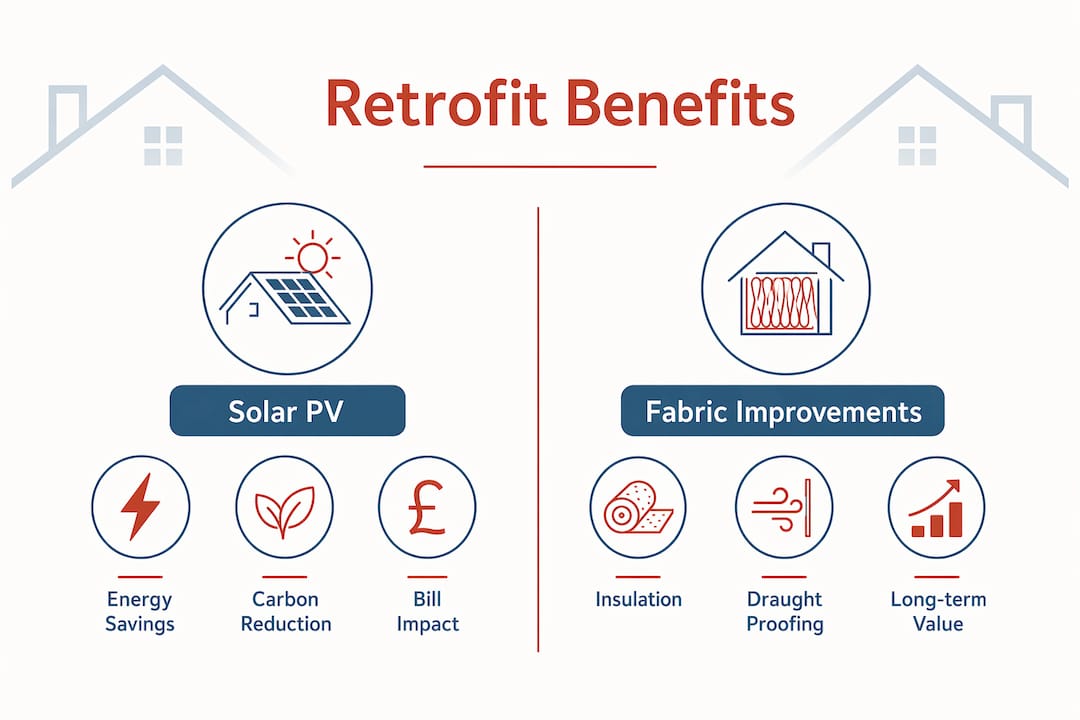
Fabric improvements, specifically loft insulation, cavity wall fill, and draught-proofing, form the foundation of any credible retrofit. They reduce the amount of energy a home needs in the first place. Solar PV does something different. It changes where the energy comes from rather than reducing the need for it. Both approaches are necessary, and neither replaces the other.
The table below compares the primary retrofit measures available to Hampshire homeowners, showing their relative impact on energy use, carbon emissions, and running costs.
| Retrofit measure | Energy use reduction | Carbon impact | Running cost effect |
|---|---|---|---|
| Loft and wall insulation | High | Moderate | Reduces heating bills directly |
| Double or triple glazing | Moderate | Low to moderate | Reduces heat loss |
| Heat pump installation | Neutral to negative | High if grid-powered | Depends on electricity source |
| Solar PV with battery storage | Moderate to high | High | Cuts electricity bills significantly |
| Solar PV combined with fabric measures | Very high | Very high | Maximum bill and emissions reduction |
The table makes one thing clear. Solar PV combined with fabric improvements delivers the greatest overall impact. Solar PV is essential for creating genuinely cheap-to-run homes, particularly where structural constraints prevent full fabric upgrades. Some Hampshire properties, especially Victorian terraces and older rural cottages, cannot achieve sufficient insulation levels due to solid walls or listed building restrictions. In those cases, solar becomes the primary lever for hitting energy performance targets.
Roof suitability is a genuine constraint. Panels require a structurally sound roof with adequate pitch and orientation. South-facing roofs at 30 to 45 degrees perform best, but east or west-facing roofs still generate useful output. Flat roofs require mounting frames, adding cost. Any retrofit assessment should include a structural survey before specifying a solar installation.
Local Hampshire solar retrofit projects: what the data shows
The most instructive Hampshire example from 2026 is the Wickham Community Land Trust project. The trust retrofitted four homes with 32 panels and 4 batteries at a total cost of £35,000. The results were striking. Summer grid imports fell to just a few kilowatt hours per home, demonstrating that a well-specified solar and battery system can make a household nearly self-sufficient during the warmer months. The project also highlighted a common challenge: older homes often carry legacy solar hot water systems that must be removed before PV panels can be installed, adding time and cost to the programme.
Winchester City Council launched its own initiative in February 2026, targeting 50 council homes for solar and battery upgrades. The scheme uses a savings-sharing model where tenants receive 50% of the energy savings generated after the first year, with the remaining share covering maintenance and repaying the capital investment. This structure makes the project financially sustainable without requiring tenants to fund upfront costs. It also reduces fuel poverty directly, which is a stated priority for the council.
Pro Tip: If you are a Hampshire landlord considering solar for rental properties, the savings-sharing model used by Winchester City Council offers a practical template. Tenants benefit immediately, and the system pays for itself over time without requiring rent increases.
Key lessons from these local projects include:
- Structural surveys must precede any solar specification to identify roof issues early
- Legacy systems such as solar hot water panels need removal before PV installation
- Battery storage is not optional if the goal is maximum grid independence
- Savings-sharing schemes make solar viable for landlords and social housing providers
- Professional retrofit coordination under PAS 2035 standards reduces costly errors
The Winchester and Wickham projects together confirm that solar retrofits in Hampshire deliver real, measurable savings. They also confirm that the process requires careful planning, particularly in older housing stock.
What does the future hold for solar in Hampshire’s net zero plans?
Hampshire’s energy position is stark. Only 10 to 13% of the county’s total energy currently comes from zero-carbon sources, according to DESNZ 2025 data. Reaching net zero locally requires generating at least 24 times more green electricity than the county currently produces. Rooftop solar on retrofitted and new homes is a critical part of that equation, even though it cannot carry the full load alone.
New Hampshire housing developments increasingly embed solar PV as standard. Zero-carbon-ready new builds now include solar panels and EV chargers as baseline features rather than optional extras, reflecting planning requirements that are tightening year on year. This shift matters for existing homeowners too. Homes without solar will face growing pressure to upgrade as EPC requirements for rental properties and mortgage lending tighten.
The table below outlines the key policy drivers shaping solar adoption in Hampshire over the coming years.
| Policy driver | Impact on solar adoption |
|---|---|
| EPC Band C requirements for rentals | Landlords must install solar to meet minimum standards |
| Net zero housing targets | New builds must include solar PV as standard |
| Social Housing Decarbonisation Fund | Funds solar retrofits in council and housing association stock |
| EV charging infrastructure growth | Solar generation offsets EV charging costs at home |
| Planning policy for zero-carbon-ready homes | Solar embedded in new development approvals |
Rooftop solar has real limitations in terms of scale. The UK does not have sufficient rooftop space to meet all electrification needs from domestic panels alone, which is why ground-mounted solar farms remain part of the regional strategy. However, every retrofitted roof contributes to the collective target, and the financial case for individual homeowners remains strong regardless of the broader policy picture. Combining solar with smart home technology and EV charging infrastructure, as Smarthometechnical installs across Hampshire, multiplies the return on investment further.
Key takeaways
Solar PV combined with battery storage and fabric-first improvements delivers the greatest energy savings and carbon reductions available to Hampshire homeowners through retrofit.
| Point | Details |
|---|---|
| Solar PV reduces grid dependency | Panels cut electricity imports significantly, especially when paired with battery storage. |
| Battery storage is essential | Without a battery, surplus daytime generation is exported rather than used at home. |
| Fabric measures come first | Insulation and draught-proofing reduce energy demand before solar addresses supply. |
| Local projects prove the case | Wickham and Winchester schemes show real savings and near-zero summer grid imports. |
| Policy pressure is increasing | EPC requirements and net zero targets make solar retrofits a practical necessity, not a luxury. |
Why I think most homeowners underestimate solar’s role in a retrofit
I have worked on solar installations across Hampshire for years, and the same misconception comes up repeatedly. Homeowners treat solar as the finishing touch, something to add after the insulation and the heat pump are sorted. The reality is that solar should be part of the retrofit plan from day one, not an afterthought.
The reason is straightforward. A heat pump installed without solar generation can actually increase a household’s electricity bill in the short term, particularly in winter. When you plan the solar array alongside the heat pump from the start, you size the system correctly and avoid that problem entirely. I have seen retrofits where the heat pump was installed first, then the homeowner came back two years later for solar because the bills were higher than expected. That sequencing costs money and causes frustration.
The structural survey point also gets underestimated. Older Hampshire homes, particularly those built before 1950, frequently have roofs that need attention before panels go on. The Wickham project removed legacy solar hot water panels before installing PV. That kind of preparatory work is not glamorous, but skipping it creates problems later. A good retrofit coordinator will flag these issues upfront.
My honest view is that solar is not just an energy measure. It is a cost stabiliser. With electricity prices unpredictable, generating your own power insulates you from market volatility in a way that no other retrofit measure does. Combine that with battery storage and you have a home that is genuinely resilient, not just efficient.
— Simon
Ready to add solar to your Hampshire retrofit?
Smarthometechnical specialises in solar panel installation, battery storage, and EV charger fitting across Hampshire. Whether you are planning a full whole-house retrofit or adding solar to an existing property, the team provides bespoke system design, professional installation, and ongoing support.

Every installation is planned around your specific roof, energy use, and retrofit goals. Battery storage and smart monitoring are included as standard options, so you get maximum value from every unit of electricity your panels generate. If you are a landlord or housing provider, Smarthometechnical can advise on savings-sharing structures and compliance with current EPC requirements. Explore the full range of solar installation services or get in touch directly to discuss your retrofit plans.
FAQ
What is the role of solar in Hampshire retrofits?
Solar PV reduces a home’s reliance on grid electricity by generating power on-site, cutting bills and carbon emissions. Combined with battery storage, it is one of the most impactful measures available in a whole-house retrofit.
Do I need battery storage with solar panels in a retrofit?
Battery storage is not legally required, but it significantly increases the benefit of solar panels by storing surplus daytime generation for use in the evening. Without a battery, much of that surplus is exported to the grid at a lower rate than you pay to import.
Can solar panels help my home reach EPC Band C?
Solar PV is one of the most reliable ways to reach EPC Band C in older homes where fabric improvements alone are insufficient due to structural constraints. It improves the energy performance score directly by reducing the home’s calculated energy demand from the grid.
Are there grants available for solar retrofits in Hampshire?
Winchester City Council’s 2026 scheme offers solar and battery upgrades to council tenants through a savings-sharing model rather than a direct grant. The Social Housing Decarbonisation Fund also supports solar retrofits in social housing stock across Hampshire and the wider region.
How much can solar panels save on energy bills in Hampshire?
The Wickham Community Land Trust project reduced summer grid imports to just a few kilowatt hours per home after installing 32 panels and 4 batteries across four properties. Savings vary by household size, roof orientation, and battery capacity, but well-specified systems consistently deliver significant reductions in annual electricity costs.
