
Yes, most Devon farm buildings can host rooftop solar PV — provided they pass a short checklist of site, structural, and planning conditions first. Treat this as a 25-year infrastructure decision, not a quick retrofit. The 25+ year system life means the asset outlasts most farm equipment, and the energy savings compound across every harvest cycle.
Before anything else, run through these checks:
- Roof orientation and usable area — south-facing pitches above 15° are ideal; east/west orientations still work but yield less
- Roof condition and asbestos — pre-2000 agricultural buildings commonly have asbestos cement cladding; under the Control of Asbestos Regulations 2012, PV cannot go directly onto these roofs
- Shading — trees, silos, and adjacent buildings all cut output; a shading analysis is non-negotiable
- Structural survey — panels add load; older timber frames need a qualified engineer’s sign-off
- Meter type — half-hourly metering is required for G99 export applications
- Planning constraints — check whether your site falls within an AONB, National Park, Conservation Area, or carries a listed building designation
Pro Tip: If your roof contains asbestos cement, bundle the HSE-licensed removal, profiled steel re-cladding, and PV installation into one project. The 25-year energy cashflow frequently covers 60–100% of the re-roofing cost, turning a compliance liability into a funded capital upgrade.
Table of Contents
- How much does farm solar cost, and which finance model fits?
- Which Devon farm buildings suit solar best?
- Does Devon’s climate affect solar yield?
- What grants and incentives are available for Devon farms?
- Environmental and community considerations
- What does a proper site assessment involve?
- Smarthometechnical: local solar expertise for Devon farms
- Key takeaways
How much does farm solar cost, and which finance model fits?
System size drives cost more than anything else. Dairy parlours typically run 30–150 kW with payback periods of around 4.5–5.5 years, due to their continuous 24/7 baseload. Grain stores, sized 50–500 kW, generally see payback periods closer to 6–7 years because of their seasonal demand. Livestock sheds typically fall between these two payback benchmarks.
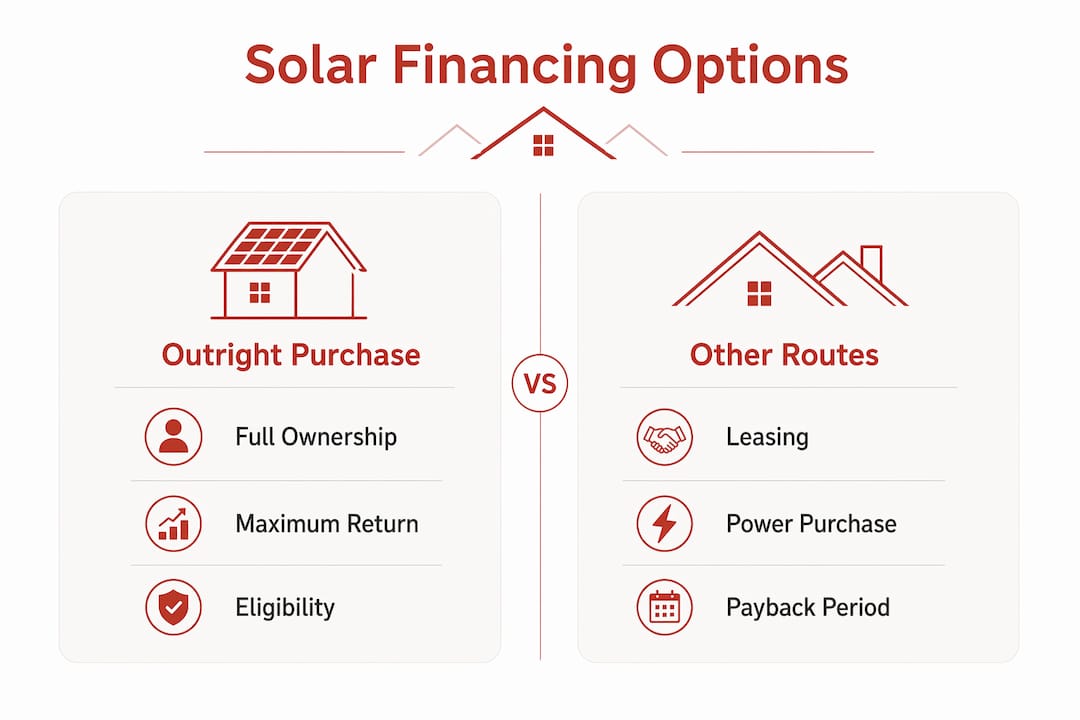
Three finance routes are available. Outright purchase gives you full ownership, maximum long-term return, and eligibility for capital allowances. A lease or Power Purchase Agreement (PPA) removes upfront cost but transfers ownership and some returns to the finance provider. Smarthometechnical’s leasing vs buying guide walks through the Devon-specific trade-offs in detail. The Smart Export Guarantee (SEG) pays for surplus electricity exported to the grid, and pairing PV with battery storage or EV chargers pushes self-consumption higher, shortening payback regardless of which finance model you choose.
Which Devon farm buildings suit solar best?
Metal-roofed livestock sheds and modern grain stores are the easiest starting point — standing-seam metal roofing accepts clamp-on mounting without penetrations, and large unobstructed roof planes mean fewer design complications. Traditional stone barns with slate or tile can work, but structural assessments are more involved and ridge heights sometimes create shading issues. Dairy parlours are the strongest financial case because solar offsets continuous ventilation, lighting, and cooling loads around the clock. Polytunnels and equipment stores are lower priority unless they carry significant electrical loads. See agricultural solar setup examples for layout ideas across different building types.
Does Devon’s climate affect solar yield?
Devon receives good solar irradiance for the UK, particularly across South Devon and the coastal belt. Overcast Atlantic weather does reduce peak output compared with the south-east of England, but modern monocrystalline panels perform well in diffuse light. Annual yield estimates for Devon typically fall in the range used for southern England planning models. The southern England installation guide covers regional yield expectations in more detail. Wind-driven rain and salt air near the coast mean corrosion-resistant mounting hardware is worth specifying from the outset.

What grants and incentives are available for Devon farms?
The UK government’s current primary support mechanism is the Smart Export Guarantee, which requires licensed suppliers to offer export tariffs for surplus generation. Beyond that, the Rural Payments Agency administers Countryside Stewardship and Farming in Protected Landscapes schemes, some of which include capital grants for energy efficiency measures — check current round eligibility directly with the RPA, as funding windows open and close. The Farming Investment Fund has previously supported on-farm energy infrastructure; confirm current availability at GOV.UK. VAT on agricultural solar installations is currently zero-rated, which meaningfully reduces upfront cost on larger systems.
Environmental and community considerations
Rooftop PV on farm buildings carries a far lighter planning footprint than ground-mounted arrays, but biodiversity and neighbour impact still deserve attention. Devon’s large-scale solar projects demonstrate what good practice looks like: the Derril Water Solar Park in Torridge integrates sheep grazing and habitat creation across its 42 MWp site, while the Living Energy Solar Farm saves approximately 1,500 tCO₂ per year and operates under a biodiversity management plan including hedgerows and wildflower swards. For rooftop installations, practical steps include fitting bird and bat boxes to the building, avoiding panel layouts that block existing nesting sites, and discussing any export cable routes with neighbouring landowners early.
What does a proper site assessment involve?
A roof check is only the start. A thorough assessment covers:
- Structural load calculation — panels typically add 10–20 kg/m² depending on mounting system; a structural engineer must confirm the roof can carry this plus wind and snow loads
- Purlin and rafter condition — corrosion in steel purlins and rot in timber rafters are common on older Devon farm buildings and must be addressed before installation
- Roof loading capacity documentation — required by the DNO for G99 applications on larger systems
- Electrical infrastructure audit — existing switchgear, cable runs, and meter position all affect design and cost
- Half-hourly meter data — 12 months of consumption data lets the designer size the array accurately and model export versus self-consumption
G99 technical study responses can take 65–90 working days, and full grid connection on rural Devon feeders commonly runs 6–14 months. Start the DNO process as early as possible. For end-of-life planning, the solar panel recycling guide covers Devon-specific disposal and recycling options.
Smarthometechnical: local solar expertise for Devon farms
Devon farms need an installer who understands asbestos re-roofing workflows, rural DNO timelines, and the planning nuances of AONBs and listed buildings — not a generalist who treats a barn like a house roof.

Smarthometechnical specialises in solar panel installation, battery storage, and EV charger integration for agricultural and rural properties across Devon. Services relevant to farm projects include:
- Combined asbestos re-roof and PV design
- Rooftop PV system design and G99/G98 grid application handling
- Battery storage pairing to maximise self-consumption
- EV charger integration for farm vehicles
- Aftercare and performance monitoring
The process starts with a desktop feasibility review using your half-hourly meter data and building dimensions, typically completed within seven working days. A fixed-price proposal follows, covering structural survey coordination, DNO application, installation, and commissioning. MCS accreditation, public liability insurance, and panel and inverter warranties are standard. To get a site assessment for your farm buildings, visit the solar installations page and request a quote.
Key takeaways
Rooftop solar on Devon agricultural buildings is a viable 25-year infrastructure investment when the site, structure, and planning conditions are confirmed before committing to a system.
| Point | Details |
|---|---|
| Asbestos roofs need re-cladding first | Under the Control of Asbestos Regulations 2012, PV cannot go directly onto asbestos cement; bundle removal, re-cladding, and PV into one funded project. |
| Payback varies by building type | Dairy parlours typically achieve payback in around 4.5–5.5 years due to continuous loads; grain stores commonly see payback periods in the 6–7 year range because of seasonal demand. |
| Grid connection takes time | G99 technical study responses take several weeks; full rural connection in Devon commonly takes many months. |
| Planning constraints apply in some areas | Listed buildings, AONBs, Conservation Areas, and National Parks in Devon may require consent beyond standard permitted development. |
| Smarthometechnical handles the full process | From desktop feasibility and DNO applications to installation and aftercare, Smarthometechnical covers agricultural solar projects across Devon. |
