
Solar water heating refers to technologies that use solar energy to heat water for household use, primarily through roof-mounted thermal collectors or heat pump systems. The most practical examples of solar water heating for UK homes are flat plate collectors, evacuated tube collectors, and heat pump water heaters. Each system type suits different roof structures, climates, and budgets. Solar thermal systems can reduce annual hot water costs by 70–80%, making them one of the most cost-effective renewable upgrades available to UK homeowners. The right choice depends on your roof, your household’s hot water demand, and how much you want to spend upfront versus save over time.
1. What are flat plate solar water heating systems?
Flat plate collectors are the most common solar water heating system in the UK. They consist of a glass-covered box containing a dark metal absorber plate with copper pipes running through it. Sunlight passes through the glass, heats the absorber plate, and that heat transfers to water or a heat-transfer fluid circulating through the pipes.
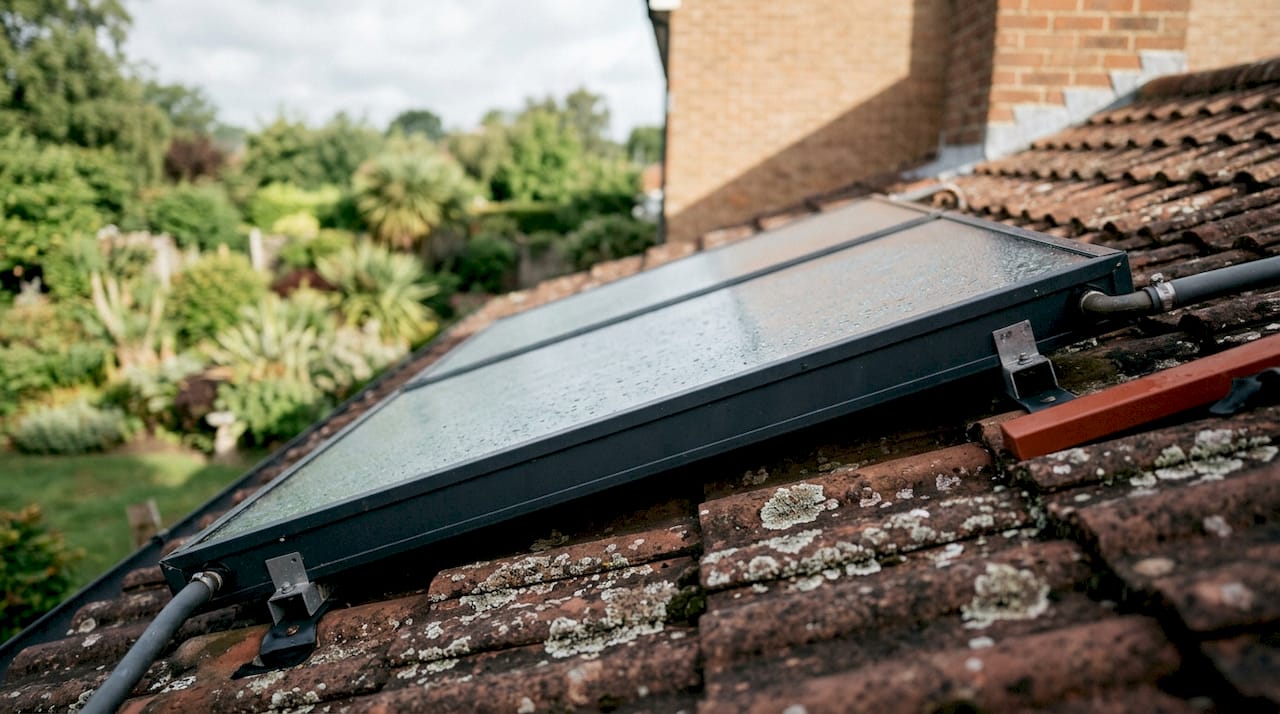
Flat plate collectors use glass panel boxes with copper pipes to absorb sunlight and heat water directly. This makes them a simple, proven design with fewer components to fail. They suit the UK’s mild-to-moderate climate well, particularly in southern England where solar irradiance is higher.
Key characteristics of flat plate systems:
- Roof-mounted panels, typically 2–4 square metres for a family home
- Connected to a hot water cylinder indoors via insulated pipework
- Work in diffuse light, not just direct sunshine
- Less efficient than evacuated tubes in very cold or overcast conditions
- Generally lower upfront cost than evacuated tube alternatives
Pro Tip: Angle your flat plate collectors at 30–40 degrees from horizontal and face them south. This orientation captures the most solar energy across the UK year, including during lower winter sun angles.
2. How do evacuated tube solar water heaters work?
Evacuated tube collectors outperform flat plate systems in cold or overcast conditions. Each collector consists of a row of glass tubes, with a vacuum sealed between the inner and outer tube walls. That vacuum acts as insulation, dramatically reducing heat loss to the surrounding air.
Evacuated tube collectors use vacuum insulation to reduce heat loss, making them better suited to colder climates than flat plate collectors. This is a significant advantage for UK homeowners in northern England, Scotland, or Wales, where winter temperatures drop further and cloud cover is more persistent.
Inside each tube, a heat pipe absorbs solar energy and transfers it to a manifold at the top of the array. The manifold then heats the water or antifreeze fluid circulating to your hot water cylinder. Solar thermal collectors can heat water to 60–90°C on sunny days, covering significant domestic hot water needs.
Considerations for evacuated tube systems:
- Higher upfront cost than flat plate collectors
- Individual tubes can be replaced if damaged, without replacing the whole array
- More fragile than flat plate systems, particularly in hail-prone areas
- Slightly bulkier roof profile, which may affect planning permission in conservation areas
- Require periodic maintenance to check the heat pipes and manifold seals
3. What are heat pump water heating systems?
Heat pump water heaters extract warmth from ambient outdoor air and use it to heat water, rather than relying on roof-mounted thermal collectors. They work on the same principle as a refrigerator in reverse. A refrigerant absorbs heat from the air, compresses it to raise the temperature, and transfers that heat to your water tank.
Heat pump water heaters use around 75% less electricity than conventional electric resistance heaters. That efficiency gain is substantial for any household currently on electric immersion heating. When paired with a solar photovoltaic (PV) system, heat pumps can run largely on free electricity generated by your own roof panels.
Heat pumps are generally easier to install than solar thermal systems, often requiring less plumbing modification. They are typically installed outdoors with an integrated water tank. One practical consideration is noise: heat pumps produce a low hum during operation, so placement away from bedroom windows matters.
Practical points for UK homeowners:
- Effective down to around 0°C, with efficiency reducing in very cold snaps
- Pair well with solar PV to maximise use of self-generated electricity
- No roof penetrations or collector panels required
- Integrated tank models take up outdoor or utility space
- A backup electric element activates automatically when demand exceeds heat pump output
Pro Tip: If you already have solar PV panels, a heat pump water heater is often the fastest route to cutting your hot water bills further. Set it to run during peak solar generation hours using a timer or smart controller.
4. What are thermosiphon and pumped split solar water heating systems?
Beyond collector type, solar water heating systems also differ by their installation configuration. The two main arrangements are thermosiphon systems and pumped split systems. Understanding the difference helps you match the right design to your home’s roof structure and layout.
Thermosiphon systems require a roof-mounted water tank and rely on natural water circulation driven by the principle that hot water rises. As the collector heats the fluid, it rises into the tank above. Cooler water falls back down to be reheated. There is no pump, which reduces mechanical complexity and maintenance needs.
Pumped split systems separate the collector on the roof from the water storage cylinder inside the home. A small electric pump circulates the heat-transfer fluid between them. This arrangement is far more common in the UK because it avoids placing a heavy water tank on the roof.
| Feature | Thermosiphon | Pumped split |
|---|---|---|
| Tank location | Roof-mounted | Indoors (airing cupboard or utility room) |
| Pump required | No | Yes |
| Roof load | Higher | Lower |
| Maintenance | Minimal | Pump and controls need periodic checks |
| UK suitability | Limited by roof strength | Well suited to most UK homes |
Pro Tip: Before choosing a thermosiphon system, have a structural engineer assess your roof. Roof load capacity must be professionally assessed before installing a roof-mounted tank, as the combined weight of water and tank can exceed what standard UK roof timbers support.
5. How to choose the right solar water heating system for your UK home
Selecting the right system starts with your climate zone and roof. UK homeowners in the south can extract good performance from flat plate collectors year-round. Those in Scotland or northern England benefit more from evacuated tubes, which maintain efficiency in lower temperatures.
Freeze protection is the critical design factor for UK solar water heating, making indirect systems with antifreeze solutions the industry standard. A direct system, where potable water circulates through the roof collector, risks freezing and pipe damage in winter. Indirect systems circulate a glycol antifreeze mixture through the collector and transfer heat to your water via a heat exchanger in the cylinder. You can read more about how solar performs in winter on the Smarthometechnical blog.
Key factors to assess before choosing:
- Roof orientation and pitch: South-facing roofs at 30–40 degrees deliver the best output
- Available roof area: Flat plate panels need more space than evacuated tubes for equivalent output
- Existing hot water system: Compatibility with your current cylinder or boiler affects installation cost
- Household demand: Larger families need bigger collector arrays and higher-capacity cylinders
- Budget: Evacuated tubes and heat pumps cost more upfront but often deliver better long-term returns
A solar water heater usually includes a backup heater, such as an electric immersion element or gas boiler, to maintain hot water supply during cloudy periods and at night. This backup integration is not optional in the UK. It is a practical necessity given the variability of British weather.
Key takeaways
Solar water heating systems reduce hot water costs by 70–80% when correctly matched to your home’s roof, climate, and demand.
| Point | Details |
|---|---|
| Flat plate collectors | Cost-effective and reliable for mild UK climates, best on south-facing roofs at 30–40 degrees. |
| Evacuated tube advantage | Vacuum insulation makes these the better choice for colder or cloudier UK regions. |
| Heat pump efficiency | Heat pump water heaters use 75% less electricity than resistance heaters and pair well with solar PV. |
| Freeze protection is mandatory | UK installations require indirect antifreeze circulation to prevent winter pipe damage. |
| Backup heating is standard | All UK solar water heating systems need a boiler or immersion backup for cloudy days and nights. |
What I’ve learned from solar water heating installations in UK homes
The question I hear most often is: “Which system is best?” The honest answer is that there is no single best system. There is only the right system for a specific home, roof, and household.
Flat plate collectors get underestimated. Homeowners see evacuated tubes and assume they are always the superior choice. In practice, a well-sized flat plate array on a south-facing roof in Hampshire or Dorset performs excellently and costs less to install and maintain. Evacuated tubes earn their premium in Scotland or on north-facing roofs where every degree of efficiency matters.
The detail that catches most homeowners off guard is installation complexity. Solar thermal systems require comprehensive plumbing modifications and cannot replace a failed conventional heater overnight. Plan the installation before your old system fails, not after. Rushing the decision leads to poor system sizing and missed savings.
Maintenance is the other underestimated factor. Periodic maintenance for closed-loop indirect systems is not optional. Antifreeze degrades over time and must be tested and replaced on schedule. A system that runs for five years without a check will quietly lose efficiency. Annual solar system servicing is the single best way to protect your investment.
The homeowners who get the most from solar water heating are those who combine it with other solar technologies. A solar PV system feeding a heat pump water heater, paired with battery storage, creates a genuinely self-sufficient hot water solution. The long-term savings justify the upfront cost many times over.
— Simon
Solar water heating installations from Smarthometechnical
Smarthometechnical works with UK homeowners across Hampshire, Dorset, and southern England to design and install solar water heating systems that fit their homes properly. Whether you are considering flat plate collectors, evacuated tubes, or a heat pump paired with solar PV, the team assesses your roof, your existing plumbing, and your household demand before recommending anything.

Every installation includes freeze protection as standard, backup heating integration, and a full system handover so you understand how to get the most from your setup. If you are ready to cut your hot water bills with a system sized for your home, visit the solar installations page to find out what Smarthometechnical can do for you.
FAQ
What are the main types of solar water heaters?
The main types are flat plate collectors, evacuated tube collectors, and heat pump water heaters. Each suits different climates, budgets, and roof configurations.
How much can solar water heating save on bills?
Solar thermal systems reduce hot water heating costs by 70–80% compared to conventional electric or gas storage heaters. Actual savings depend on system size, household demand, and local solar irradiance.
Do solar water heaters work in the UK winter?
Yes, but output reduces significantly. Evacuated tube collectors perform better in cold conditions due to their vacuum insulation. All UK systems require a backup heater, such as an immersion element or gas boiler, to maintain supply during winter months.
What is the difference between a thermosiphon and a pumped split system?
A thermosiphon system uses natural water circulation with a roof-mounted tank and no pump. A pumped split system keeps the storage cylinder indoors and uses a small pump to circulate fluid, making it better suited to most UK roofs.
Does a solar water heating system need maintenance?
Closed-loop indirect systems require periodic antifreeze checks and replacement to maintain efficiency. Annual servicing is the industry standard and protects the system’s long-term performance.
