
Solar energy is now an economic imperative for British homeowners, not simply an environmental choice. The role of solar in 2026 homes spans bill reduction, energy independence, and climate resilience, all at a time when installation costs have dropped 89% since 2010. Technologies like integrated energy hubs, GaN microinverters, and plug-in solar kits have made solar accessible to a far wider range of properties. Whether you are building new or retrofitting, understanding what solar delivers in 2026 is the first step to making a sound investment.
What are the financial benefits of solar energy for homes in 2026?
Solar delivers measurable savings over its lifetime, but the numbers depend heavily on your location, system size, and local energy policy. A typical 12 kW system costs around $30,505 before incentives, with installed costs ranging $2.50–$3.50 per watt and projected 25-year savings of $37,000–$148,000. That wide range reflects how much local electricity rates and net metering policies shape real-world returns.
The policy landscape shifted significantly in mid-2026. The 30% federal residential tax credit expired in june 2026, pushing payback periods for cash purchases to 8–15 years. In high-rate electricity markets, however, payback periods remain under eight years. Leasing options still pass incentive savings through lower monthly payments until at least the end of 2027.
Utility prices have historically spiked 15–30%, making fixed solar costs a genuine financial shield. Homeowners who lock in solar generation today protect themselves from those unpredictable rises across a 25-year system lifespan. That predictability is one of solar’s most underrated advantages.

| Scenario | System cost (before incentives) | Estimated 25-year savings | Payback period |
|---|---|---|---|
| High-rate market, full net metering | $25,000–$30,000 | $80,000–$148,000 | Under 8 years |
| Average market, partial net metering | $25,000–$30,000 | $37,000–$80,000 | 8–12 years |
| Low-rate market, avoided-cost metering | $25,000–$30,000 | $37,000–$50,000 | 12–15 years |
Key factors that affect your return:
- Local electricity rate: Higher rates mean faster payback and greater lifetime savings.
- Net metering policy: Full retail credit for exported power delivers far better returns than avoided-cost rates.
- System size: Larger systems cost more upfront but reduce grid dependence proportionally.
- Financing method: Cash purchases maximise long-term savings; leases lower upfront costs.
Pro Tip: Before committing to a system size, pull 12 months of electricity bills and calculate your average daily usage. Oversizing a system in a low-rate market with poor net metering is one of the most common and costly mistakes homeowners make.
How is solar technology evolving in 2026 residential systems?
The most significant shift in solar technology in homes 2026 is the move away from piecemeal installations toward fully integrated energy platforms. The first 9-in-1 integrated energy hub combines a heat pump, solar inverter, battery storage, and home energy management into a single system. This integration improves total system efficiency by over 10% by cutting redundant AC/DC power conversions and coordinating loads intelligently.
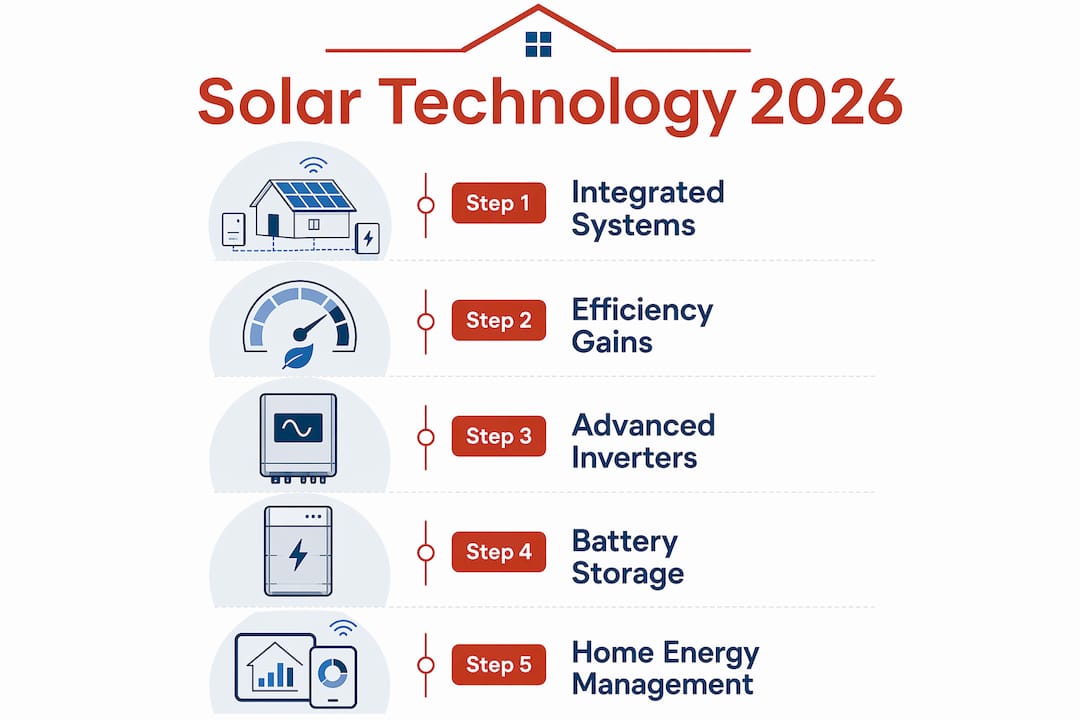
That 10% gain matters more than it sounds. Across a 25-year lifespan, reduced conversion losses translate directly into lower bills and a smaller battery requirement to cover the same household demand. Builders specifying new homes in 2026 are increasingly treating these hubs as the default energy architecture rather than an upgrade.
On the inverter side, Enphase has launched GaN microinverters across Europe. Gallium Nitride architecture runs cooler than traditional silicon-based electronics, which reduces thermal losses and extends component lifespan. Cooler operation also means greater reliability during the high-output summer months when your system works hardest.
What this means for you as a homeowner or builder:
- Integrated hubs cut installation time and reduce the number of separate components requiring maintenance.
- GaN microinverters deliver better performance in hot weather, which matters as UK summers grow warmer.
- Home energy management within these platforms allows automatic load shifting, so your dishwasher or washing machine runs when solar output is highest.
- Whole house solar systems built around integrated hubs are now a realistic option for most three and four-bedroom properties.
Pro Tip: When comparing quotes, ask specifically whether the inverter uses GaN or silicon architecture. GaN units carry a higher upfront cost but typically outperform silicon equivalents in warm conditions and require less maintenance over a decade.
What alternative solar options exist for homes where panels are impractical?
Not every home has a south-facing roof with unobstructed access to sunlight. Flats, terraced houses with shared roofs, and properties in conservation areas all face barriers to standard rooftop installation. Plug-in solar kits address this gap directly.
Plug-in solar kits priced around £400 allow homeowners and renters to offset baseload electricity by connecting panels to a standard mains socket. Expected annual savings run £70–£110, which means a payback period of roughly four to six years with no planning permission required in most cases. These kits suit balconies, garden walls, and flat roofs where a full installation is not viable.
The savings are modest compared to a full rooftop system, but the principle is sound. Baseload appliances such as fridges and freezers run continuously, so even a small panel feeding directly into the circuit reduces grid draw around the clock. For flat-dwellers, this is currently the most accessible entry point into solar generation.
- Plug-in kits: Around £400, no installer required, saves £70–£110 per year.
- Balcony panels: Suitable for south or west-facing balconies with at least two hours of direct sun daily.
- Shared ownership schemes: Some local authorities and housing associations now offer community solar arrangements for blocks of flats.
- Rooftop solar: Best for detached and semi-detached homes with unshaded south-facing roofs.
Pro Tip: Use a free online solar irradiance tool to check your postcode before purchasing a plug-in kit. A north-facing balcony in a shaded street will generate far less than the headline figures suggest.
How do market and policy differences affect solar value in 2026?
The real economic value of solar depends more on your local utility policy than on the panels themselves. Net metering rules determine how much you earn for electricity exported to the grid, and the difference between full retail credit and avoided-cost credit can halve your lifetime return.
Full retail net metering means the grid credits you at the same rate you pay to buy electricity. Avoided-cost metering pays you only the wholesale generation cost, which is substantially lower. In the UK, the Smart Export Guarantee (SEG) operates on a similar principle, with rates varying by supplier. Choosing a supplier with a competitive SEG rate is as important as choosing the right panels.
| Policy type | Export payment | Impact on payback | Best suited to |
|---|---|---|---|
| Full retail net metering | Same as import rate | Fastest payback | High-rate markets |
| Smart Export Guarantee (UK) | Varies by supplier | Moderate payback | UK homeowners |
| Avoided-cost metering | Wholesale rate only | Slowest payback | Low-rate markets |
Local electricity rates compound this effect. A homeowner paying 28p per kWh saves far more per unit self-consumed than one paying 18p. This is why solar panel benefits for coastal homes in high-rate areas of southern England often outperform national averages. Research your supplier’s current SEG rate and your average import tariff before finalising a system size.
How does solar energy support climate adaptation and home resilience?
Solar panels supply power for air conditioning during hotter summers, and peak solar output coincides almost exactly with peak cooling demand. This alignment is one of the strongest practical arguments for solar in a warming climate. The hotter the day, the more your panels generate, and the more your air conditioning needs to run.
UK summers are delivering more sustained heat events than at any point in recorded history. Homes without solar face rising electricity bills precisely when grid demand and wholesale prices peak. Solar-equipped homes absorb that cost spike internally, using their own generation to power cooling loads. That energy independence is a genuine form of home resilience.
Battery storage extends this benefit into the evening. A hybrid solar battery system stores surplus daytime generation and releases it after sunset, covering evening cooling loads without drawing from the grid. For homes in southern England, this combination of solar and storage is increasingly the standard specification rather than a premium option.
“Solar is no longer just about saving money on bills. For homes in southern England, it is becoming a core part of how we design for summer comfort and energy security.”
Pro Tip: If you are specifying a new build or major retrofit, size your battery storage to cover at least four hours of evening load. This covers the post-sunset demand peak and maximises the value of your daytime generation.
Key takeaways
Solar in 2026 homes delivers financial savings, climate resilience, and energy independence, but the return depends on local policy, system integration, and the right technology choices.
| Point | Details |
|---|---|
| Financial returns vary by location | Payback periods range from under 8 years in high-rate markets to 15 years in low-rate areas. |
| Integrated hubs outperform piecemeal systems | 9-in-1 energy hubs improve total system efficiency by over 10% through reduced power conversion losses. |
| Plug-in kits open solar to more homes | At around £400, plug-in solar kits save £70–£110 annually for flats and homes with unsuitable roofs. |
| Net metering policy shapes your return | Full retail net metering delivers significantly higher lifetime savings than avoided-cost arrangements. |
| Solar and storage suit UK summers | Pairing solar with battery storage covers evening cooling loads and protects against grid price spikes. |
What I have learned installing solar across southern England
The conversation around solar has changed noticeably in the past two years. Homeowners used to ask whether solar was worth it. Now they ask which system to choose. That shift reflects a genuine change in the economics, not just marketing.
What surprises most clients is how much local policy affects their return. Two neighbours with identical roofs and identical systems can see very different payback periods depending on their energy supplier and export tariff. I always recommend checking your supplier’s current Smart Export Guarantee rate before signing anything. A difference of 3p–5p per kWh exported adds up to thousands of pounds across a 25-year system life.
The integrated energy hub technology genuinely excites me. I have seen the difference a well-coordinated solar, battery, and heat pump system makes compared to three separate units bolted together. The efficiency gains are real, and the reduction in call-outs for compatibility issues is noticeable. For new builds especially, specifying an integrated hub from the start is the right approach.
My practical advice: do not let the expiry of the federal tax credit put you off. In the UK, the Smart Export Guarantee and zero-rate VAT on solar installations still make the numbers work. Get three quotes, compare SEG rates, and ask each installer whether they use GaN or silicon inverters. Those two questions will tell you a great deal about the quality of the advice you are receiving.
— Simon
Ready to install solar on your home?
Smarthometechnical specialises in residential solar installations, battery storage, and EV charger integration across southern England. Whether you are planning a new build or retrofitting an existing property, the team brings hands-on expertise in the latest integrated systems, including heat pump and battery combinations.

Explore solar installation options tailored to your property, or read the 2026 homeowner’s guide to understand costs, savings, and what to expect from the installation process. For homeowners in Hampshire and Dorset, Smarthometechnical also covers retrofit solar projects with region-specific guidance on planning and grid connection.
FAQ
What is the payback period for solar panels in 2026?
Payback periods range from under 8 years in high-rate electricity markets to 8–15 years for cash purchases following the expiry of the 30% federal tax credit in june 2026. Leasing options reduce upfront costs and can shorten the effective payback period.
Are plug-in solar kits worth buying for a flat?
Plug-in solar kits costing around £400 save £70–£110 per year, giving a payback period of roughly four to six years. They are a practical option for flats and homes where a full rooftop installation is not possible.
What is a 9-in-1 solar energy hub?
A 9-in-1 energy hub integrates a heat pump, solar inverter, battery storage, and home energy management into one platform. These systems improve total efficiency by over 10% compared to separate components installed individually.
How does net metering affect solar savings in the UK?
Net metering policy determines how much you earn for electricity exported to the grid. UK homeowners use the Smart Export Guarantee, and choosing a supplier with a competitive export rate can significantly improve lifetime returns from a solar installation.
Do solar panels help with air conditioning costs?
Solar panels generate peak output during the hottest parts of the day, which coincides directly with peak air conditioning demand. This alignment means solar-equipped homes absorb summer cooling costs internally rather than paying elevated grid prices.
Recommended
- Why switch to solar energy: a 2026 homeowner’s guide – Smart Home Technical Ltd
- What is a whole house solar system? 2026 guide – Smart Home Technical Ltd
- Solar panel benefits for coastal homes in 2026 – Smart Home Technical Ltd
- How rural solar installation works: 2026 guide – Smart Home Technical Ltd
