
An EPS, or emergency power supply, is the backup output built into your solar inverter. It keeps chosen sockets or essential circuits running during a power cut, but whole-home backup demands different sizing and wiring. Transfer isn’t instant like a UPS, and solar only recharges the battery during a cut if your system is designed for it. The sections below cover backup levels, runtime, wiring and cost.
TL;DR:
- EPS backup is limited to specific circuits or outlets, with transfer delays of a few seconds that may affect sensitive devices like computers.
- Upgrading to whole-home automatic backup involves larger inverters, careful earthing, and may require rewiring or system modifications.
- Battery runtime for essential circuits ranges from about 10 to 30 hours, depending on usable capacity and inverter continuous power rating.
- Proper EPS installation relies on graduate site surveys including earth testing, load audits, and circuit segregation to ensure safety and reliability.
- Costs vary based on inverter capabilities, battery size, wiring, earthing, and installation complexity, with initial design being more economical than retrofits.
Table of Contents
- What is EPS and how does it work in a home inverter?
- What are the levels of home battery backup?
- Is EPS or a UPS better for my situation?
- How long will a battery actually last on backup?
- What UK wiring rules apply to EPS installation?
- How much does EPS backup cost and is it worth it?
- What should a good EPS installer check before quoting?
- Realistic expectations before you sign anything
- Getting EPS designed properly from the start
- Sources
- FAQ
What is EPS and how does it work in a home inverter?
EPS terminals sit inside most hybrid inverters, wired separately from the main consumer unit feed. When the grid disappears, the inverter switches its EPS output into “island mode”, drawing on the battery (and, in the right setup, the solar array) to power whatever’s connected to those terminals.
Grid-tied solar has to shut down the moment mains power fails. This is called anti-islanding, and it’s a safety rule, not a fault: without it, your panels could keep feeding electricity back into a “dead” network that engineers assume is safe to touch. EPS gets around this by physically isolating a small section of your wiring from the grid connection, so the inverter can safely energise it on its own.
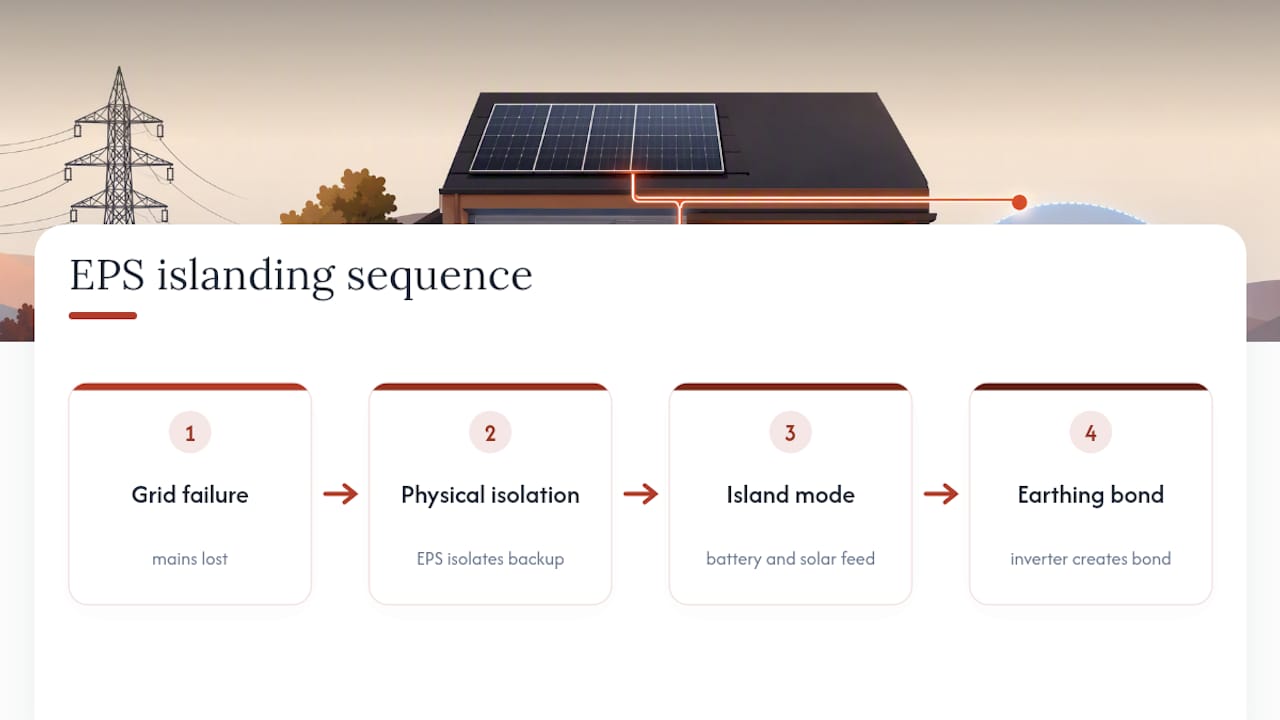
Switchover isn’t instant. GivEnergy’s installation documentation states the EPS transfer delay is typically a few seconds, which is fine for a fridge or a router but will reset a desktop PC or drop a video call. That’s the key difference from an uninterruptible power supply, which switches in milliseconds because it’s built for exactly that kind of sensitive load.
There’s also a wiring detail worth knowing: during island mode, the inverter has to create its own neutral to earth bond, because the grid’s bond is no longer present. This is exactly why island operation has specific earthing requirements, which we’ll come back to. And “bypass” only applies if the inverter itself fails; a grid outage is handled entirely by EPS switching, not bypass circuitry, according to the Connect EPS guide.
What are the levels of home battery backup?
Not every household needs, or can afford, the same level of protection. Backup comes in four broad tiers, and most UK homeowners land somewhere in the middle.
- EPS socket: One or two dedicated outlets wired to the EPS output. Cheapest option, good for a router, a laptop charger and a lamp, but you’re physically plugging things in.
- Essential circuits consumer unit: A small, separate board carrying the fridge freezer, boiler controls, lighting circuits and medical equipment. This is the sweet spot for most households: enough resilience to matter, without rewiring the whole house.
- Manual whole-home changeover: A changeover switch lets you flip the entire property onto EPS power, but you (or a family member) has to physically operate it and manage the load yourself. It works, but it depends on someone being home and knowing what to do.
- Automatic whole-home changeover: The system senses the outage and switches everything automatically, including higher-draw items like ovens and showers. This needs a larger inverter, careful earthing design, and genuine overload protection, because the risk of tripping the whole system rises sharply once you’re backing up the entire house.
Deciding on your desired level before installation matters more than most homeowners realise. Retrofitting essential circuits or whole-home changeover after the original install usually means additional rewiring and labour that could have been designed in from day one.
Is EPS or a UPS better for my situation?
The two solve different problems, and confusing them leads to disappointment.
- Choose a UPS if you need instant, regulated power for sensitive electronics: home servers, medical devices, or anything that can’t tolerate even a brief blip. UPS units switch in under 12 milliseconds and clean up voltage fluctuations, according to comparisons published by Growatt, but their battery capacity is small and runtime is measured in minutes, not hours.
- Choose EPS if you want hours of backup for fridges, lighting, boiler electronics and similar loads. It tolerates the inductive start-up surge of motors and compressors better than most small UPS units, but the multi-second transfer delay rules out anything that can’t handle a brief interruption.
- Consider a portable power station or a petrol/diesel generator as a complement, not a replacement. A power station is useful for camping-style backup or topping up medical devices; a generator suits homes without solar or battery storage at all, though it needs fuel, ventilation and manual starting, which EPS avoids entirely.
Most households with solar and battery storage get the best of both worlds by treating EPS as the everyday resilience layer and a UPS as extra insurance for one or two critical devices.
How long will a battery actually last on backup?
Battery specification sheets quote nameplate capacity, but usable capacity is what matters, and it’s typically lower once you account for the inverter’s depth-of-discharge limits and continuous power rating. A 10kWh battery might only deliver 8 to 9kWh usable, and how fast it can deliver that energy depends on the inverter’s continuous kW rating, not just the battery size.
Pro Tip: Ask your installer for the inverter’s continuous EPS output in kW, not just the battery’s kWh figure. A big battery paired with a small EPS output will run out of “power,” not “energy,” the moment you switch on the kettle.
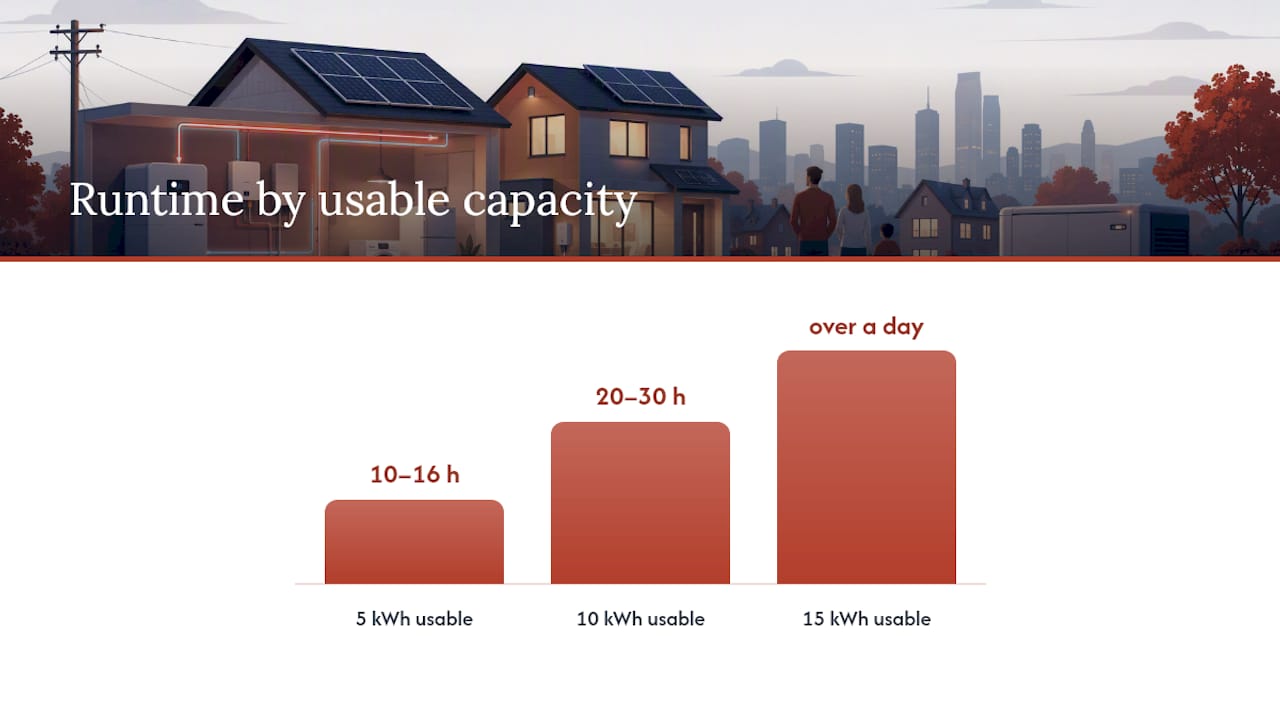
Rough runtime for essential circuits (fridge, lighting, router, boiler controls, TV) drawing around 0.3 to 0.5kW continuous:
- 5kWh usable: roughly 10 to 16 hours
- 10kWh usable: roughly 20 to 30 hours
- 15kWh usable: over a day, often into a second night
These figures use typical household consumption patterns rather than a single fixed load, in line with the government’s consumption-level review methodology, and they’ll shift substantially depending on whether the boiler pump, an electric shower, or cooking appliances are included on the backed-up circuit.
Solar can genuinely extend runtime during a daytime outage, topping the battery back up while the sun’s out, but only if the system is designed to let panels generate into island mode. Many grid-tied setups without proper EPS configuration lose solar generation entirely during a cut, battery or no battery. Sizing heuristic: match your inverter’s continuous EPS rating to the sum of the loads you actually want backed up, then add headroom for the inductive surge of anything with a compressor or motor.
What UK wiring rules apply to EPS installation?
EPS installations fall under BS 7671 wiring regulations, and the IET’s guidance on electrical energy storage systems sets out the baseline expectations installers should follow. This isn’t a DIY job for the wiring stage.
Earthing is the technical crux. During island mode, the inverter has to provide its own earth reference, and TT earthing is commonly specified for this reason, with GivEnergy’s own EPS documentation flagging earthing arrangement as a compliance requirement rather than an optional extra. Get this wrong and you risk a system that either fails to trip on a fault, or trips constantly for no obvious reason.
A competent installer will also segregate the EPS-fed circuits from the rest of the consumer unit, size protective devices correctly for the loads on that circuit, and label everything clearly so a future electrician (or a stressed homeowner during a blackout) understands what’s backed up and what isn’t.
Overload protection deserves particular attention. Push too much load through the EPS output and the inverter doesn’t just trip. Installer technical notes describe a minimum five-minute lockout after an overload event, and repeated overloading risks permanent damage to the inverter, based on GivEnergy’s installation guidance. Safe isolation procedures and earth resistance testing at commissioning aren’t box-ticking. They’re what stops a five-second transfer delay from becoming a five-minute lockout at the worst possible moment.
How much does EPS backup cost and is it worth it?
Costs stack up from several places: an inverter with EPS capability (some hybrid inverters include it, others charge extra), battery capacity in kWh, any rewiring needed to separate essential circuits, earthing work, and commissioning and testing labour. There’s no single “EPS price” because the answer depends entirely on which of the four backup levels you choose.
EPS earns its keep fastest for specific households: anyone running medical equipment that can’t tolerate downtime, homes in areas with genuinely frequent local outages, and rural or off-grid-adjacent properties where a fault can mean hours without power rather than minutes. For everyone else, it’s a comfort and resilience purchase rather than a strict necessity, and that’s a reasonable way to frame it when weighing the expense.
When you’re comparing quotes, ask exactly what’s included in the EPS output kW rating, whether the earthing arrangement has been assessed for your property, and what happens if you overload the circuit. A quote that skips earthing testing entirely is a red flag worth querying.
What should a good EPS installer check before quoting?
A properly run site visit isn’t a five-minute chat. Expect an installer to test your existing earthing arrangement, audit which circuits you actually want backed up, and confirm your chosen inverter and battery are compatible with each other, since not every battery pairs cleanly with every inverter brand’s EPS function.
- Earth loop impedance test and confirmation of the correct earthing method for island mode
- A load audit listing exactly what’s going onto the EPS or essential-circuits board
- Confirmation the inverter and battery combination is officially supported for EPS operation
- Clear consumer unit segregation between EPS circuits and the rest of the house
- Written guidance on manual changeover, if that’s the level you’ve chosen
Pro Tip: If an installer can’t explain what happens the moment you overload the EPS circuit, get a second opinion. That’s the failure mode that actually catches people out.
Realistic expectations before you sign anything
EPS is resilience insurance for the loads that matter, not a guarantee of business-as-usual during a cut. Whole-home automatic backup is achievable but costs meaningfully more than an essential-circuits setup. Get a site visit and an itemised quote before assuming either extreme.
— Simon
Getting EPS designed properly from the start
Retrofitting EPS after the fact almost always costs more than specifying it correctly the first time, and specialist installers can help homeowners avoid these extra costs from the start. Experienced installers often design the earthing, circuit segregation and inverter sizing into the original installation, rather than leaving customers to discover the limitations later.
A site survey generally covers earth testing, a load audit of what needs backing up, and inverter/battery compatibility checks, before customers commit to a design. If you’re planning a new solar and battery storage installation or want ongoing commissioning and testing built in, the Solar & Battery Service & Maintenance Plan at £175 a year covers regular checks so your EPS setup stays reliable when you actually need it. Get in touch for a survey and an itemised quote for your property.
Sources
The Connect EPS guide covers transfer delays and earthing detail; Ofgem’s distribution report gives outage frequency context; the government’s consumption methodology underpins runtime estimates.
FAQ
What is the best battery backup for home power outages in the UK?
There’s no single “best” system. It depends on whether you need a couple of sockets covered, essential circuits like the fridge and boiler, or full whole-home automatic backup, and each level needs different inverter and battery sizing. Get a site survey rather than relying on a generic recommendation, since compatibility between your existing solar setup and an EPS-capable inverter varies by brand.
Are blackouts coming to the UK?
Widespread blackouts aren’t a routine expectation, but localised outages from storms, faults and network events do happen, as tracked in Ofgem’s electricity distribution annual report. EPS backup is best thought of as protection against these localised, unpredictable events rather than a response to any specific nationwide risk.
How long will a 10kWh battery last?
A 10kWh battery typically delivers around 8 to 9kWh of usable capacity once you account for the inverter’s discharge limits. Powering essential circuits like a fridge, lighting and router at a modest continuous draw, that usable capacity generally lasts roughly 20 to 30 hours, though exact runtime depends heavily on what’s connected and whether solar can top the battery up during the outage.
What is EPS in electricity?
EPS stands for emergency power supply, the dedicated backup output on a hybrid solar inverter that keeps chosen circuits running when the grid fails. It switches into island mode after a short transfer delay, typically around five seconds, using stored battery power and, where the system is designed for it, solar generation.
