
Solar energy is the primary source of clean, onsite electricity that makes zero carbon homes viable. In the context of net zero housing, the term “zero carbon home” refers to a property that produces as much energy as it consumes, with solar photovoltaic (PV) panels forming the backbone of that energy supply. The role of solar in zero carbon homes extends beyond simply cutting bills. The UK government now mandates rooftop solar for all new residential builds from 1 january 2028, signalling that solar is no longer optional for developers or forward-thinking homeowners. When paired with heat pumps and high-performance insulation, solar can reduce a household’s carbon footprint by over 80% compared to a traditional gas-heated home.
What UK policies and regulations mandate solar in zero carbon homes?
The UK government’s 2028 mandate is the most significant policy shift for residential solar in a generation. From 1 january 2028, all new homes must have rooftop solar panels covering at least 40% of the building’s ground floor area. That requirement sits alongside a parallel obligation to install heat pumps, making solar and low-carbon heating a combined standard for new residential construction.
The Department for Energy Security and Net Zero (DESNZ) oversees these standards. DESNZ sets the policy framework that building regulations must follow, and developers who ignore these requirements face non-compliance with planning and building control. For homeowners commissioning new builds, this means solar is now a structural consideration from the design stage, not an afterthought.

Retrofit projects are not yet subject to the same mandatory rules, but the direction of travel is clear. Energy Performance Certificate (EPC) ratings increasingly reflect solar and heat pump installations, and lenders are beginning to factor EPC scores into mortgage products. Checking your property’s current rating through a service like EPC Choice gives you a baseline for understanding where solar investment will have the greatest impact.
For developers, the 40% ground floor area rule has real design implications. A 100 square metre ground floor footprint requires at least 40 square metres of rooftop solar. That shapes roof pitch, orientation, and shading decisions from the earliest planning stages. Developers who treat solar as a bolt-on will find compliance far more costly than those who integrate it from the outset.
Pro Tip: If you are planning a new build, commission a solar feasibility study alongside your architectural drawings. Identifying roof orientation and shading constraints early avoids expensive redesigns later.
The Hampshire new build solar guide from Smarthometechnical covers how these policy changes translate into practical installation decisions for developers working in southern England.
How does solar integrate with heat pumps and insulation to cut carbon?
Solar PV and heat pumps work together in a way that neither technology achieves alone. A heat pump converts electricity into heat at efficiencies of 300–400%, meaning every unit of electricity it consumes produces three to four units of heat. When that electricity comes from rooftop solar rather than the grid, the carbon intensity of your heating drops dramatically.
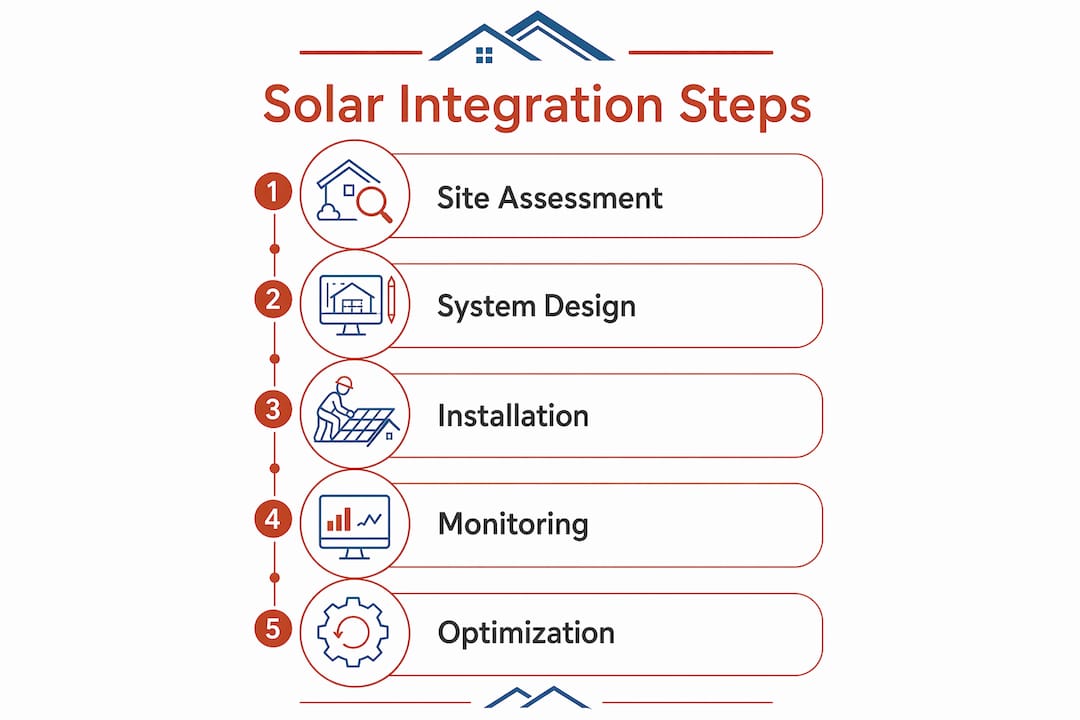
The combined effect is measurable. Solar, heat pumps, and high-performance insulation can reduce a household’s carbon footprint by over 80% compared to a traditional gas-heated, poorly insulated home. Financial payback on the full system typically falls within 7–12 years. That is a significant return for what amounts to a permanent infrastructure upgrade.
Insulation deserves more credit than it typically receives in solar conversations. A poorly insulated home loses heat faster than any heating system can replace it efficiently. Improving airtightness and wall or loft insulation reduces the total energy demand, which means a smaller solar array can meet a greater proportion of your needs. In a poorly insulated property, insulation delivers more carbon reduction per pound spent than solar panels alone.
The practical integration works like this:
- Solar panels generate electricity during daylight hours.
- A heat pump uses that electricity to heat water and living spaces.
- Surplus solar power charges a battery storage system for evening use.
- An electric vehicle (EV) charger draws from the battery or solar directly, replacing petrol consumption with zero-carbon miles.
- High-performance insulation retains the heat the pump produces, reducing run time and electricity demand.
Pro Tip: Size your solar array to match your heat pump’s daily electricity consumption, not just your lighting and appliance load. A typical air source heat pump uses 2,000–4,000 kWh per year. Factor that into your panel count from the start.
What is the evolving carbon impact of solar as the grid decarbonises?
Solar’s carbon benefit is real but not static. Every unit of solar electricity generated today displaces approximately 180 kgCO₂ compared to drawing the same power from the grid. That figure will shrink as the national grid incorporates more wind, nuclear, and other renewables. A cleaner grid means grid electricity carries a lower carbon intensity, so the relative advantage of solar narrows over time.
This does not make solar redundant. It changes solar’s primary value proposition.
“As the grid decarbonises, solar’s carbon-avoidance benefit per kWh diminishes, but it remains a permanent fixture providing onsite power and economic resilience. Its role shifts from carbon offset tool to energy security infrastructure.”
The long-term value of solar lies in its ability to generate power independently of grid pricing and availability. Homeowners who generate their own electricity are insulated from wholesale price spikes, which have been severe and unpredictable in recent years. The Smart Export Guarantee (SEG) also allows households to sell surplus generation back to the grid, creating a revenue stream that partially offsets system costs.
| Solar benefit | Current value | Future outlook |
|---|---|---|
| Carbon offset per kWh | High (grid still carbon-intensive) | Decreasing as grid cleans |
| Energy price protection | High (volatile wholesale prices) | Remains strong long-term |
| Heat pump power supply | Critical (onsite low-carbon electricity) | Grows in importance |
| Smart Export Guarantee income | Moderate (tariff-dependent) | Stable with policy support |
| Grid resilience | Growing (battery storage demand up) | Increasingly valued |
Lifecycle carbon accounting adds another layer of nuance. Solar panel manufacturing carries an embodied carbon cost that must be factored into true net zero calculations. End-of-life recycling of panels is an emerging priority, and material choices at the design stage influence how cleanly a system can be decommissioned decades from now. Responsible net zero planning accounts for the full lifecycle, not just operational emissions.
How can homeowners and developers implement solar in zero carbon designs?
Practical implementation starts with sizing. The 2028 mandate requires solar covering 40% of the ground floor area, but many homeowners benefit from going further. A larger array generates more surplus for battery storage and EV charging, improving the economics and the carbon outcome simultaneously.
- New builds: Integrate solar into the roof design from the planning stage. South-facing pitches at 30–40 degrees maximise generation in the UK. Avoid shading from chimneys, dormers, or neighbouring structures.
- Retrofits: Assess your roof’s structural capacity and orientation before specifying panels. Older properties may need reinforcement. A professional survey identifies constraints before you commit to a system size.
- Battery storage: Adding a battery system captures surplus daytime generation for evening use. Solar paired with battery storage improves resilience against grid volatility and reduces the proportion of expensive grid electricity you consume.
- EV charging: Pairing solar with a home EV charger extends the carbon benefit to transport. Solar-powered EV charging eliminates the carbon associated with petrol and reduces the cost per mile to near zero during daylight hours.
- Plug-in balcony panels: The UK government is supporting plug-in solar panels available from retail outlets for properties where full rooftop installation is not feasible. These smaller systems suit flats and rented properties, though their output is limited compared to a full installation.
Financial considerations are straightforward. Payback periods of 7–12 years apply to well-specified systems in average UK conditions. The SEG provides ongoing income from surplus export. Battery storage extends self-consumption, reducing the proportion of generation you export at lower tariffs and instead use at higher grid import rates.
Pro Tip: Always use a certified installer registered with the Microgeneration Certification Scheme (MCS). MCS certification is a prerequisite for Smart Export Guarantee eligibility and gives you access to manufacturer warranties and consumer protections.
The benefits of solar self-consumption are most pronounced when you align high-consumption activities, such as running a dishwasher or charging an EV, with peak solar generation hours between 10AM and 3PM.
Key takeaways
Solar is the foundational technology in zero carbon homes, providing onsite clean electricity that powers heat pumps, charges batteries, and reduces carbon footprints by over 80% when combined with insulation and low-carbon heating.
| Point | Details |
|---|---|
| 2028 mandate is binding | New UK homes from 1 january 2028 must have rooftop solar covering 40% of ground floor area. |
| Solar plus heat pump is the core pairing | Solar electricity powers heat pumps at high efficiency, delivering the greatest carbon reduction per pound spent. |
| Insulation comes first | Improving airtightness and insulation reduces total energy demand before solar is sized. |
| Carbon value evolves over time | Solar’s carbon offset per kWh decreases as the grid cleans, but its energy security value grows. |
| Battery storage multiplies the benefit | Pairing solar with battery storage improves self-consumption and protects against grid price volatility. |
Why I think most homeowners are still underestimating solar’s strategic value
After working with homeowners and developers across the south of England, the pattern I see most often is this: people treat solar as a single product decision rather than a systems decision. They ask “how many panels do I need?” before they have answered “how much heat do I need, and how well does my building retain it?”
The 2028 mandate will force developers to think in systems. But homeowners retrofitting existing properties still approach solar in isolation, and that is where the biggest missed opportunities lie. A 4 kW solar array on a draughty Victorian terrace will underperform a 3 kW array on a well-insulated modern semi every time. The building envelope is the multiplier.
What I find genuinely encouraging is the shift in how homeowners talk about solar in 2026. Two years ago, the conversation was almost entirely about bill savings. Now, energy security comes up in almost every consultation. People are thinking about solar and batteries as infrastructure, not appliances. That is the right mental model. A solar and battery system is closer to a boiler and a fuel tank than it is to a consumer electronics purchase.
The policy direction is unambiguous. The DESNZ mandate, the EPC reform agenda, and the SEG all point in the same direction. Homeowners who act now, before 2028, do so on their own terms and their own timeline. Those who wait will act under obligation, often at higher cost and with less design flexibility.
— Simon
Professional solar installation for zero carbon homes
Smarthometechnical specialises in solar panel installation, battery storage, and EV charger installation for homeowners and developers across southern England. Whether you are planning a new build that needs to meet the 2028 mandate or retrofitting an existing property, the right installation makes the difference between a system that performs and one that merely complies.

Every installation Smarthometechnical carries out is MCS-certified, which means you qualify for the Smart Export Guarantee and all manufacturer warranties apply in full. The team works with you from initial survey through to commissioning, ensuring your system is sized correctly for your heat pump, battery, and EV charging needs. Visit the solar installations page to request a survey or get a quote tailored to your property.
FAQ
What is the role of solar in zero carbon homes?
Solar panels generate clean electricity onsite, powering heat pumps, batteries, and appliances without drawing from the carbon-intensive grid. Combined with insulation and heat pumps, solar can reduce a household’s carbon footprint by over 80%.
Are solar panels mandatory for new UK homes?
From 1 january 2028, all new residential buildings in the UK must have rooftop solar panels covering at least 40% of the ground floor area, alongside a heat pump, under new building regulations.
How long does it take for solar panels to pay back their cost?
A well-specified solar system integrated with a heat pump and battery storage typically achieves financial payback within 7–12 years in UK conditions, after which generation is effectively free.
Does solar still reduce carbon as the grid gets greener?
Solar’s carbon offset per kWh decreases as the national grid decarbonises, but its value shifts to energy security, price protection, and onsite power for heat pumps and EVs, making it a permanent fixture in net zero homes.
Do I need battery storage with solar panels?
Battery storage is not mandatory, but it significantly improves self-consumption by storing surplus daytime generation for evening use. Demand for solar paired with batteries has grown sharply as homeowners prioritise resilience against grid price volatility.
Recommended
- The role of solar in 2026 homes: a complete guide – Smart Home Technical Ltd
- Solar in Hampshire retrofits: a homeowner’s guide – Smart Home Technical Ltd
- Why solar suits rural homes: the complete 2026 guide – Smart Home Technical Ltd
- Why switch to solar energy: a 2026 homeowner’s guide – Smart Home Technical Ltd
