
Solar finance is defined as the range of financial structures that allow individuals and businesses to fund solar energy installations without paying the full cost upfront. The main options include cash purchase, solar loans, leases, Power Purchase Agreements (PPAs), and Property Assessed Clean Energy (PACE) financing. Each structure carries different ownership implications, eligibility rules for incentives, and long-term cost profiles. Understanding solar finance is the first step to making a decision that fits your budget, tax position, and ownership goals. Smarthometechnical works with homeowners and businesses across southern England to match the right finance approach to each project.
What are the common solar finance options and how do they work?
Solar financing options fall into five broad categories. Each one handles ownership, payment, and risk differently, so the right choice depends on your financial situation rather than a single “best” answer.
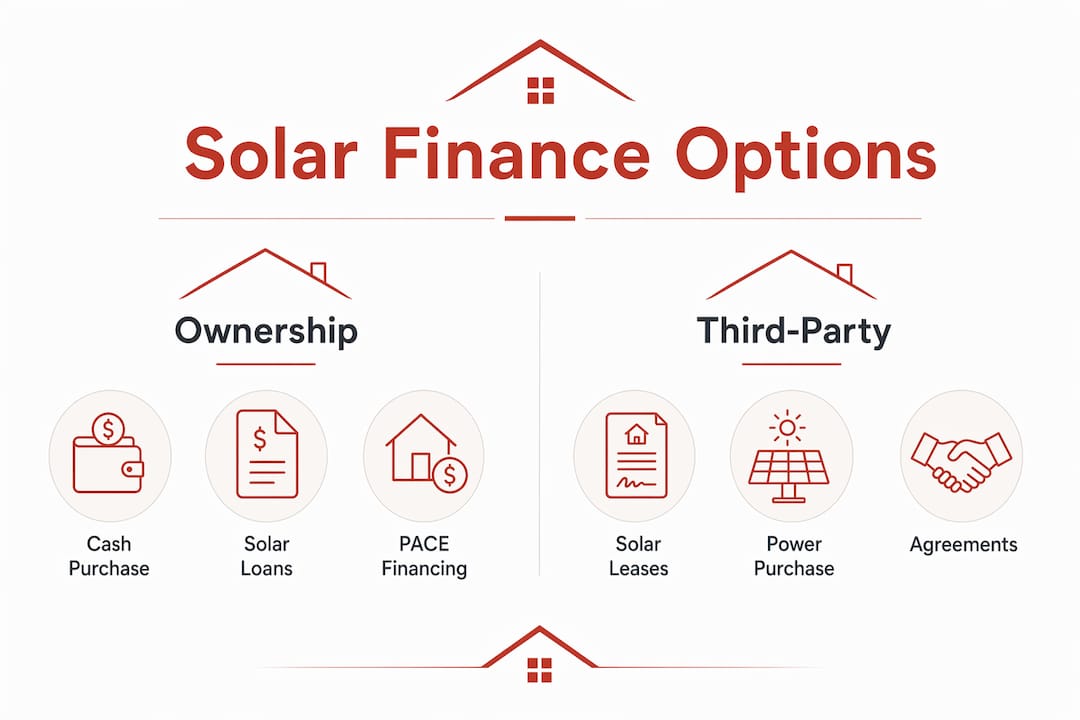
Cash purchase
Paying cash means full upfront ownership with no interest charges and no dealer fees. You claim all available incentives directly, and you carry all maintenance responsibility. Residential systems typically cost between £15,000 and £25,000 in the UK, though exact figures vary by system size and installer. Cash delivers the highest lifetime return, but it requires significant capital available immediately.
Solar loans
Solar loans let you borrow the capital needed and repay it over time, typically across loan terms of 7–25 years. You own the system from day one, which means you keep full eligibility for tax incentives and export tariffs. Loans come in two forms: unsecured solar loans, which carry no property risk, and secured options such as a Home Equity Line of Credit (HELOC), which use your home as collateral.

Pro Tip: Always ask your installer for the cash price alongside the financed price. Many solar loans embed dealer fees of 20–30% of the system cost into the loan principal to offset the advertised low interest rate. That fee inflates the true cost of capital significantly.
Solar leases
A lease means a third party owns the panels installed on your roof. You pay a fixed monthly fee, and the owner handles maintenance and insurance. The trade-off is straightforward: lower monthly costs, but you do not own the asset and cannot claim tax credits or export incentives directly. Lease contracts typically run for 20–25 years and often include annual cost escalators built into the agreement.
Power Purchase Agreements
A PPA works differently from a lease. Instead of paying a fixed monthly fee, you pay for the electricity the panels generate, priced at a rate typically 10–30% below your local utility rate. The third-party owner still claims the incentives. PPAs suit those who want lower bills without any ownership commitment, but the variable cost tied to production means your monthly outgoing fluctuates.
PACE financing
PACE financing ties repayment to your property tax bill rather than a personal loan. The obligation stays with the property if you sell, which can complicate a sale. Commercial PACE (C-PACE) is available for business properties and can extend repayment terms up to 30 years. For UK-based commercial projects, C-PACE structures offer a useful route for larger installations where upfront capital is limited.
How do ownership, incentives, and risks affect your solar finance choice?
Ownership status is the single biggest factor in determining which incentives you can claim. With a cash purchase or solar loan, you own the system and access all available benefits. With a lease or PPA, the third-party owner claims the federal or national tax credits, and you receive only the discounted energy rate.
The risk profile of each option also differs sharply:
- Cash purchase: No financial risk beyond the upfront spend. Full control, full reward.
- Solar loans (unsecured): You own the system and face no property risk, but interest and dealer fees raise total cost.
- HELOC: Converting unsecured to secured debt puts your home at risk if repayments fail. Lower interest rates do not always justify that exposure.
- Leases and PPAs: No ownership risk, but no incentive eligibility either. The third party claims all credits.
- PACE: Repayment obligation transfers with the property, which can deter buyers and complicate mortgage arrangements.
Financing choices must account for tax implications, planned ownership duration, and risk profile. A homeowner who plans to sell within five years faces very different trade-offs from one planning to stay for twenty. Matching the finance structure to your actual situation, rather than the lowest advertised rate, is what determines long-term value.
A cash purchase maximises lifetime returns, with savings estimated at 150–400% over 25 years depending on system size and energy costs. Loans suit those who want ownership without the upfront capital, provided they account for dealer fees. Leases and PPAs suit those who prioritise simplicity and lower monthly bills over long-term financial gain.
Pro Tip: Before signing any loan agreement, compare the total repayment figure against the cash price of the system. If the financed total is more than 30% above the cash price, the dealer fee is likely embedded and inflating your cost.
How to evaluate and choose the right solar finance option
Choosing the right structure requires an honest assessment of four factors: available capital, tax liability, how long you plan to own the property, and your tolerance for financial risk. Work through these in order before comparing products.
-
Assess your upfront capital. If you have the funds available and plan to stay in the property long term, cash purchase delivers the best return. If capital is limited, a solar loan preserves ownership while spreading cost.
-
Check your tax position. Ownership-based incentives, including export tariffs under the UK’s Smart Export Guarantee, only apply if you own the system. Leases and PPAs exclude you from these benefits. If your tax position makes incentives valuable, ownership is the priority.
-
Consider your ownership timeline. Short-term owners face complications with leases and PACE financing, both of which involve long contracts or obligations that transfer with the property. A shorter loan term may suit you better if you plan to sell within a decade.
-
Evaluate total cost, not monthly payments. A low monthly payment on a solar loan can mask a high total cost once dealer fees and interest are included. Always request the full repayment figure and compare it against the cash price.
-
Match the structure to project scale. Residential projects typically suit cash, loans, or leases. Commercial projects, particularly larger installations, benefit from C-PACE financing or PPAs structured around long-term energy contracts. Smarthometechnical advises on both residential and commercial options across southern England.
-
Consult a financial adviser and a qualified installer. A financial adviser can assess tax implications specific to your situation. A qualified installer, such as Smarthometechnical, can provide accurate system costs and help you compare finance structures against realistic energy savings projections. You can explore the leasing versus buying decision in detail before committing.
What emerging trends are shaping solar finance in 2026?
Solar finance is evolving quickly. Loan terms are lengthening, new structures are reaching more property types, and regulatory changes are reshaping the incentive landscape.
| Trend | Detail |
|---|---|
| Longer loan terms | Solar loans now commonly extend to 25 years, reducing monthly payments and widening access for lower-income households. |
| C-PACE expansion | Commercial PACE programmes are growing, with repayment terms up to 30 years available for business properties in many regions. |
| PPA growth in large-scale projects | PPAs are increasingly used in commercial and municipal solar projects, where long-term revenue certainty supports project finance models. |
| Third-party ownership models | Lease and PPA providers are expanding incentive pass-through structures, offering more competitive rates as the market matures. |
| 2026 regulatory context | Tax and export frameworks in the UK, including the Smart Export Guarantee, continue to favour system ownership for maximum financial return. |
Sophisticated project finance for large commercial or municipal solar installations involves stakeholder risk allocation and revenue-secured repayment models. These structures are increasingly bankable as lenders grow more familiar with solar as an asset class. For businesses considering larger installations, understanding these models early gives you a stronger negotiating position with lenders and installers alike. The role of solar in 2026 homes reflects this shift, with finance structures becoming as important as the technology itself.
Key takeaways
Solar finance is most effective when the chosen structure aligns with your ownership goals, tax position, and planned time in the property.
| Point | Details |
|---|---|
| Ownership determines incentives | Only cash buyers and loan holders can claim export tariffs and tax credits directly. |
| Dealer fees inflate loan costs | Solar loans often embed fees of 20–30% of the system price; always compare total repayment to cash price. |
| Lease and PPA suit simplicity seekers | Third-party ownership removes maintenance burden but also removes incentive eligibility. |
| PACE suits commercial projects | C-PACE offers repayment terms up to 30 years, making it viable for larger business installations. |
| Total cost beats monthly payment | Evaluate lifetime savings against total finance cost, not just the monthly figure. |
Why I think most people choose the wrong solar finance option
Most people I speak to have already decided on a solar loan before they understand what it actually costs. The advertised APR looks attractive, the monthly payment feels manageable, and the installer presents it as the obvious choice. What they have not seen is the dealer fee buried in the loan principal, quietly adding thousands to the total.
My honest view is this: if you have the capital, cash purchase is almost always the right answer. The lifetime return is unmatched, the incentive eligibility is clean, and there are no contract complications if you sell. If cash is not available, an unsecured solar loan with a transparent fee structure is the next best option. I would be cautious about HELOCs unless the interest saving is substantial and the property risk is clearly understood.
Leases and PPAs are not bad products. They suit people who genuinely want lower bills without any ownership complexity. But I see too many homeowners sign 25-year lease agreements without realising they have handed away their incentive eligibility and complicated their eventual property sale. Read the escalator clause before you sign anything.
The most important thing I can tell you is to get the cash price in writing before you discuss finance. That number is your reference point for every other calculation.
— Simon
How Smarthometechnical can help you move forward
Choosing the right solar finance structure is easier when you have an experienced installer working through the numbers with you.
Smarthometechnical specialises in solar panel installation across southern England, working with homeowners and businesses to design systems that fit both their energy needs and their financial situation. The team provides clear, jargon-free advice on finance options, system sizing, and expected returns before any commitment is made. Whether you are considering a cash purchase, a loan, or a commercial PACE structure, Smarthometechnical can help you compare the true costs and identify the best route for your project. Get in touch to request a personalised quote and start with a clear picture of what solar can deliver for you.
FAQ
What is solar finance in simple terms?
Solar finance refers to the financial structures used to fund a solar energy installation, including cash purchase, loans, leases, PPAs, and PACE financing. Each option handles ownership, cost, and incentive eligibility differently.
What are solar loans and how do they work?
Solar loans are borrowing arrangements that let you own a solar system immediately while repaying the cost over a fixed term, typically 7–25 years. You retain full eligibility for incentives such as the UK Smart Export Guarantee, but watch for embedded dealer fees that inflate the total cost.
Do leases and PPAs qualify for solar incentives?
No. With a lease or PPA, the third-party system owner claims all available tax credits and incentives. You receive only the discounted energy rate, not the ownership benefits.
What is PACE financing for solar?
PACE financing ties solar repayments to your property tax bill rather than a personal loan, with the obligation transferring to any future owner on sale. C-PACE extends this model to commercial properties, with terms up to 30 years available in many regions.
How do I choose the best solar finance option?
Assess your available capital, tax position, planned ownership duration, and risk tolerance before comparing products. Cash purchase delivers the highest lifetime return, while loans suit those who want ownership without upfront capital. Leases and PPAs suit those prioritising simplicity over long-term financial gain.
Recommended
- The role of solar in 2026 homes: a complete guide – Smart Home Technical Ltd
- Examples of solar for schools: a 2026 guide – Smart Home Technical Ltd
- Why switch to solar energy: a 2026 homeowner’s guide – Smart Home Technical Ltd
- Why solar suits rural homes: the complete 2026 guide – Smart Home Technical Ltd
