
Solar energy projects for schools are defined as photovoltaic installations that reduce a school’s electricity costs by 20% to 60% while generating live data for science and technology lessons. That dual return, financial and educational, is what separates school solar from almost every other capital investment a governing body can make. The examples of solar for schools in this guide span student-led arrays of 16 panels through to district-wide installations of 3.5 MW, giving you a clear picture of what is achievable at every budget level. Each project type is assessed on cost reduction, payback period, curriculum value, and community benefit.
1. Large-scale district solar installations
District-wide solar programmes deliver the largest financial returns and the most visible curriculum integration. A California school district recently completed a 3.5 MW solar project across 12 campuses, generating £48 million in projected energy cost savings over the contract duration. That figure demonstrates what happens when solar is treated as a long-term financial instrument rather than a one-off facility upgrade.
Large installations typically use a combination of rooftop arrays and solar canopies over car parks and playgrounds. Canopies serve a secondary purpose: they provide shade for pupils during outdoor activities and shelter for vehicles, adding value beyond electricity generation. Real-time generation data from these arrays feeds directly into STEM lessons, giving teachers live figures on kilowatt-hours, carbon offset, and grid export.
Key characteristics of district-scale projects include:
- Multiple megawatts of capacity spread across several sites
- Centralised monitoring dashboards accessible to teachers and pupils
- Canopy structures that double as outdoor learning shelters
- Stable energy pricing locked in for the contract period, protecting budgets from utility rate rises
- Integration with existing building management systems
Pro Tip: Request a live data feed as part of your installation contract. Many district-scale systems include monitoring portals that teachers can embed directly into lesson plans, turning the roof into a working science experiment.
2. Medium-scale rooftop solar projects
Rooftop solar on a single school building is the most common solar energy project for schools in the UK. Systems of around 500 kW can reduce grid electricity dependency by 57% to 78%, with payback periods modelled between 6.3 and 10.9 years depending on system size and local utility rates. That range reflects the importance of accurate financial modelling before committing to a specification.
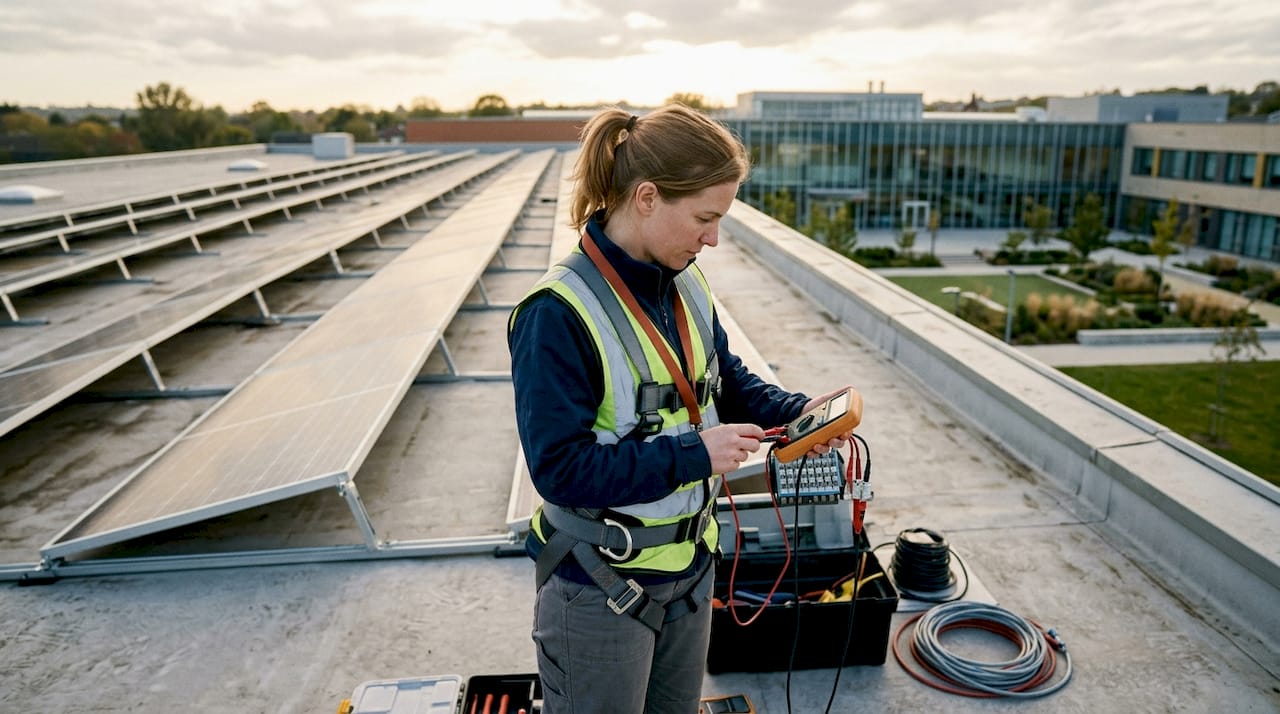
Roof condition is the factor most administrators underestimate. A solar installation adds load to the roof structure and requires a clear warranty position between the roofing contractor and the solar installer. Schools that have recently reroofed are in the strongest position to proceed quickly. Those with ageing roofs should factor a roof survey and potential remediation into the project budget.
| Factor | Lower-cost approach | Higher-specification approach |
|---|---|---|
| System size | 100–250 kW | 400–500 kW |
| Electricity offset | 20–40% | 57–78% |
| Payback period | 8–11 years | 6–9 years |
| Roof requirement | Minimal reinforcement | Structural survey required |
| Monitoring | Basic metering | Full STEM dashboard |
Administrator involvement in system design pays dividends. Choosing panel orientation, specifying monitoring equipment, and agreeing on maintenance schedules before contracts are signed prevents costly changes later. A solar calculations assessment from an independent energy consultant can validate the financial model before you commit.
3. Small-scale student-led solar arrays
Small arrays are the most accessible entry point for schools with limited capital budgets. A student-led project using approximately 16 panels can offset 2.7 metric tons of CO2 and generate roughly 2,500 kWh annually. Those figures are modest in financial terms but significant as a teaching tool.
The educational value of a student-led installation comes from the process, not just the output. Pupils who participate in site surveys, panel positioning decisions, and post-installation monitoring develop practical skills in physics, data analysis, and environmental science. Schools that document the project through a dedicated curriculum unit report higher pupil engagement with STEM subjects in the year following installation.
Key benefits of small-scale student projects:
- Low capital cost, often fundable through grants or community energy partnerships
- Measurable CO2 offset that pupils can track and report
- Direct connection between classroom theory and physical infrastructure
- Replicable model that can be expanded in future phases
Pro Tip: Apply for a community energy grant before approaching a solar installer. Several UK local authorities and energy funds offer grants specifically for educational solar projects, which can cover 30–50% of a small array’s cost without requiring a long-term financing agreement.
4. Solar-plus-battery installations for resilience
Solar paired with battery energy storage is becoming the standard specification for schools that want more than electricity savings. Pine Point Schools completed a project combining 500 kW solar with a 2.7 MWh battery system, enabling the school to function as a community storm shelter during grid outages. That community function changes the conversation with local authorities and funders, who often contribute to projects with a demonstrable public benefit.
The case for solar-plus-battery in schools rests on four practical points:
- Grid independence. A battery system stores surplus solar generation and discharges it during peak tariff periods or grid outages, reducing dependence on utility supply.
- Emergency resilience. Schools with battery backup can maintain lighting, heating controls, and communications during power cuts, making them viable emergency centres.
- Community benefit. Designating a school as a community shelter strengthens funding applications and builds goodwill with local stakeholders.
- Future-proofing. Solar-plus-battery systems are increasingly the baseline specification for new educational builds, meaning early adopters avoid retrofitting costs later.
Battery sizing requires careful modelling. A 2.7 MWh system suits a large secondary school or a school designated as a community hub. Smaller primary schools typically require 50–200 kWh of battery capacity to cover overnight loads and short outages. Smarthometechnical designs battery systems to match the specific load profile of each school, avoiding oversizing that inflates cost without adding proportionate benefit.
5. Community energy partnerships and funded projects
Community energy partnerships allow schools to deliver carbon savings and curriculum enrichment without significant upfront capital expenditure. In Pembrokeshire, two schools had solar panels switched on through a community energy model, with the partnership structure covering installation costs in exchange for a share of the energy savings. That model removes the largest barrier most school governing bodies face: capital outlay.
Community partnerships work best when the school contributes something the partner values. That might be roof space, a visible public profile, or a commitment to include the project in the curriculum. Administrators who frame the school as an active participant rather than a passive recipient negotiate better terms and retain more of the long-term savings.
The impact on EPC ratings is a secondary benefit worth noting. Solar installations improve a building’s energy performance certificate score, which matters for schools subject to public sector energy reporting obligations.
6. How to choose the right solar project for your school
The right solar project depends on four variables: available roof or ground space, capital budget, educational goals, and appetite for long-term financing commitments. Administrators who clarify these four points before approaching installers receive more accurate proposals and avoid scope creep during procurement.
| Criterion | Small-scale project | Medium-scale project | Large-scale project |
|---|---|---|---|
| Budget | Grant-funded, low capital | £150,000–£500,000 | £500,000+ or PPA |
| Electricity offset | Up to 20% | 57–78% | 80%+ across sites |
| Payback period | 8–12 years | 6–11 years | Contract-dependent |
| Educational integration | High (student-led) | Moderate | High (district dashboards) |
| Community benefit | Low to moderate | Moderate | High |
Power Purchase Agreements allow solar adoption with little upfront cost, but they require commitments of 20 years or more and careful legal review. Schools with strong legal support and a stable long-term outlook are well-placed for PPAs. Schools that prefer ownership and flexibility should prioritise grant funding or capital purchase, even if that means starting with a smaller system.
Administrators should treat solar as a funding avenue that supports reinvestment in education, not merely a facility cost. Energy savings redirected into classroom technology or staffing represent a compounding return that a simple payback calculation does not capture.
Key takeaways
School solar projects deliver their strongest return when financial savings, curriculum integration, and community benefit are planned together from the outset.
| Point | Details |
|---|---|
| Savings range is wide | Solar reduces school electricity costs by 20–60%, depending on system size and local tariffs. |
| Payback periods are predictable | Medium-scale rooftop systems of around 500 kW show payback periods of 6.3–10.9 years. |
| Small projects teach as well as generate | A 16-panel student-led array offsets 2.7 metric tons of CO2 and delivers direct STEM value. |
| Battery storage adds resilience | A 500 kW solar and 2.7 MWh battery system can make a school a functioning community shelter. |
| Financing shapes the project | PPAs reduce upfront cost but require 20-year commitments; grants suit smaller, ownership-based projects. |
Solar in schools: what the numbers actually mean for your budget
The financial case for school solar is clear, but I think most administrators underestimate the second-order benefit. When a school cuts its electricity bill by 40%, that money does not disappear into a facilities budget. It becomes available for teaching resources, support staff, or digital infrastructure. That is the argument I would make to any governing body that frames solar as a capital expenditure problem rather than an income generation opportunity.
The projects that impress me most are the ones that combine battery storage with community designation. A school that can keep its lights on during a storm and open its doors to the neighbourhood is not just saving money. It is building a relationship with the community that no marketing budget can replicate. I expect solar-plus-battery to become the standard specification for UK school builds within the next five years, not the exception.
The student-led small-scale projects are underrated. A 16-panel array is not going to transform a school’s energy bill, but it will transform how a cohort of pupils thinks about energy, infrastructure, and environmental responsibility. That is a return that does not appear on any payback calculation, and it is worth more than most administrators realise.
— Simon
Smarthometechnical: solar installations for schools
Schools considering solar need an installer who understands the specific constraints of educational buildings: roof warranties, term-time installation schedules, and the need for monitoring systems that serve both facilities teams and teachers.

Smarthometechnical specialises in solar panel installations for a range of building types, including educational settings. The team handles project planning, system design, and installation, with battery storage options available for schools seeking grid resilience. Whether you are starting with a small grant-funded array or planning a full rooftop system, Smarthometechnical provides the technical expertise to match the right specification to your school’s goals. Contact the team to discuss your project.
FAQ
How much can a school save with solar panels?
Schools with on-site solar systems reduce annual electricity costs by 20% to 60%, depending on system size and local utility rates. Larger installations and those paired with battery storage achieve savings at the higher end of that range.
What is a typical payback period for school solar?
Medium-scale rooftop systems of around 500 kW have modelled payback periods of 6.3 to 10.9 years. Smaller systems funded by grants may have longer payback periods but lower financial risk.
Can solar panels be used as a teaching resource?
Solar installations generate live generation data that teachers can use directly in STEM lessons. Student-led projects, such as small arrays of around 16 panels, engage pupils in site surveys, installation decisions, and ongoing performance monitoring.
What is a Power Purchase Agreement for schools?
A Power Purchase Agreement allows a school to adopt solar with little or no upfront cost. The school pays for the electricity generated rather than owning the panels, but PPA contracts typically run for 20 years or more and require careful legal review before signing.
Do schools need battery storage with solar panels?
Battery storage is not required but significantly increases the value of a solar installation. A system combining 500 kW solar with a 2.7 MWh battery can maintain power during grid outages and enable the school to serve as a community emergency shelter.
Recommended
- The role of solar in 2026 homes: a complete guide – Smart Home Technical Ltd
- Why switch to solar energy: a 2026 homeowner’s guide – Smart Home Technical Ltd
- Why solar suits rural homes: the complete 2026 guide – Smart Home Technical Ltd
- What is a commercial solar system? A 2026 guide – Smart Home Technical Ltd
