
A home energy management system (HEMS) is defined as a coordinating platform that automates energy flows between solar panels, batteries, EV chargers, and the grid to reduce costs and maximise renewable use. The role of smart home energy management goes well beyond a simple timer or thermostat. It acts as the brain of your home’s energy setup, deciding when to charge a battery, when to export to the grid, and when to shift a heavy load like a washing machine or dishwasher to a cheaper tariff window. Standards such as Matter and OpenADR now make it possible for these systems to communicate across devices from different manufacturers, turning a collection of separate gadgets into one coordinated whole.
How do smart home energy management systems coordinate home devices?
Integrated HEMS optimise multiple assets together rather than managing each device in isolation. That distinction matters enormously. A standalone solar inverter simply exports surplus power to the grid. A HEMS, by contrast, checks battery state, EV charge schedule, and current tariff rates simultaneously, then decides the most cost-effective action in real time.
The core devices a HEMS coordinates include:
- Solar PV panels generating power during daylight hours
- Battery storage absorbing surplus generation for later use
- EV chargers timed to charge during cheap-rate or solar-surplus periods
- Smart appliances such as heat pumps, washing machines, and dishwashers shifted to off-peak windows
- Grid connection for import and export balancing
Load scheduling and peak shaving are two of the most practical functions. Peak shaving means the system deliberately avoids drawing large amounts of power from the grid during expensive peak periods, using stored battery energy instead. This is not a manual process. The HEMS runs it automatically based on tariff data and forecast generation.
Interoperability standards like Matter and OpenADR enable home devices to receive utility signals and act on them without any input from the homeowner. A liaison agreement confirmed in may 2026 between the two standards bodies means demand-response automation is now far more accessible to ordinary households. Your smart thermostat, battery inverter, and EV charger can all respond to the same grid signal through a single home energy gateway.

Pro Tip: When choosing a HEMS, check whether it supports both Matter and OpenADR. A system that handles only one standard will struggle to participate in future demand-response tariff schemes offered by UK energy suppliers.
What are the key economic and environmental benefits?
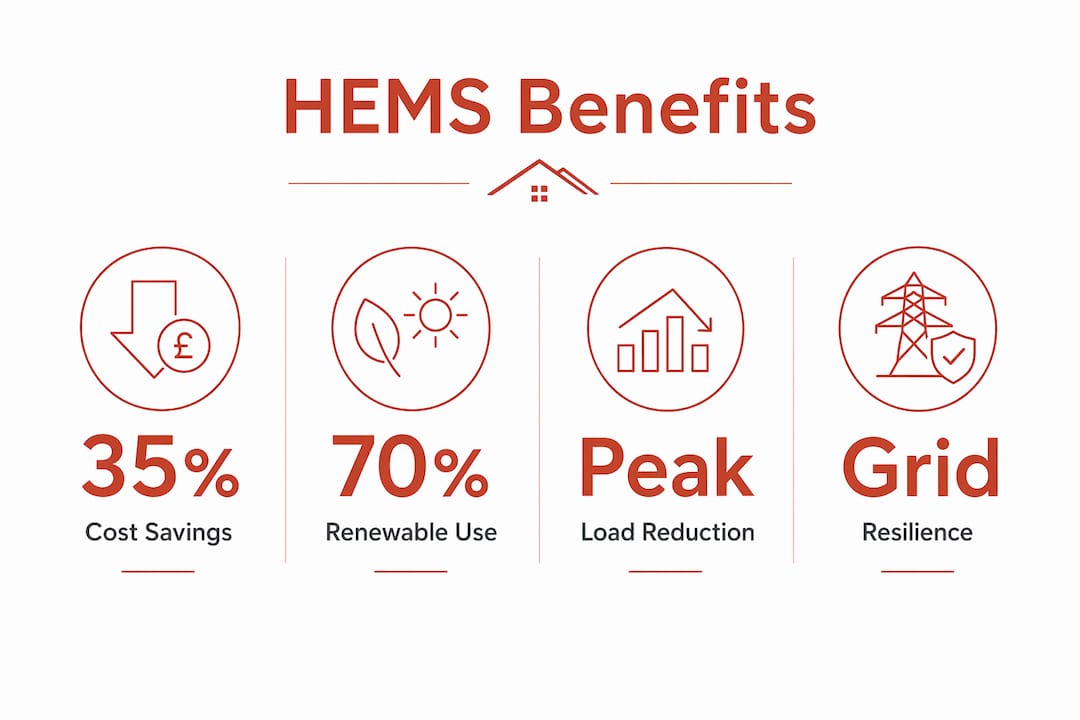
The financial case for home automation energy efficiency is now backed by solid research. A study using a fuzzy-logic reinforcement learning controller reported cost savings of 35.2% compared to unmanaged energy use. That is not a marginal improvement. For a household spending £2,000 a year on electricity, that figure represents a saving of over £700 annually.
The same research found renewable utilisation rising to 70% during peak hours. Without a HEMS, much of that solar generation would be exported at a low feed-in rate rather than consumed at home at full value. Smart energy solutions capture that value by directing surplus generation into the battery or scheduling high-demand appliances to run while the sun is shining.
| Benefit | What it means for your home |
|---|---|
| Up to 35.2% cost reduction | Lower annual electricity bills through automated scheduling |
| 70% renewable use at peak | More solar power consumed at home, less exported cheaply |
| Reduced grid import peaks | Less strain on local network, potential tariff rewards |
| Lower greenhouse gas emissions | Fewer fossil-fuel units drawn from the grid |
The environmental benefits follow directly from the economic ones. Every kilowatt-hour of solar power consumed at home displaces a unit that would otherwise come from the grid, which in the UK still carries a carbon intensity that varies by time of day. A HEMS that reduces grid import peaks by up to 98% via coordinated battery and load scheduling makes a measurable difference to a household’s carbon footprint. You can see real examples of solar battery savings from homes that have already made this transition.
What advanced technologies power modern HEMS?
The gap between a basic smart plug timer and a genuine HEMS lies in the intelligence behind the scheduling. Modern systems use machine learning forecasting models that predict solar generation, EV availability, and appliance demand hours in advance. Static schedules set once and forgotten cannot adapt to a cloudy afternoon or an unexpected trip in the car. Adaptive, forecasting-aware controllers can.
Digital twin technology takes this further. Digital twins continuously update home energy models with real-time data, enabling faster and more accurate control decisions. Think of it as a live simulation of your home running in parallel with reality. When conditions change, the twin updates instantly and the controller responds.
“Digital twin assisted real-time control can yield up to 10% additional savings at 15-minute scheduling resolution, with further gains achievable at 1-minute intervals.” — Energy and Buildings study
The resolution of scheduling matters more than most homeowners realise. A system that recalculates every 15 minutes will miss short windows of cheap grid power or sudden solar surges. A 1-minute resolution system catches those windows and acts on them. The improved responsiveness from fine-grained scheduling translates directly into lower bills.
Edge computing is the other piece of this puzzle. Processing decisions locally on a home gateway rather than sending data to a cloud server reduces response time and keeps your energy data private. Adaptive HEMS control under uncertainty is the direction the industry is moving, replacing rigid rule-based systems with controllers that learn your household’s patterns and adjust their behaviour accordingly.
How do HEMS support grid interaction and home resilience?
Smart home energy control does not just benefit the individual homeowner. It also benefits the wider electricity network. Demand response programmes pay households to shift loads away from peak periods. A HEMS participates automatically, without requiring the homeowner to monitor prices or manually switch devices.
The steps involved in demand-response participation are straightforward:
- The utility sends a signal indicating a grid stress event or high-price period
- The home energy gateway receives and interprets the signal via OpenADR
- The HEMS shifts flexible loads such as the dishwasher or EV charger to a later slot
- Battery storage covers any immediate demand during the shifted period
- The homeowner receives a credit or reduced tariff charge for their participation
Coordinated demand-response systems reduce peak loads and voltage drops significantly across low-voltage networks. This means your participation in a demand-response scheme directly reduces the risk of local grid instability for your neighbours as well.
Resilience is the benefit that often gets overlooked in discussions about the impact of smart homes on energy use. Batteries provide UPS-like backup supply during grid outages, keeping critical loads running. Electric vehicles add another layer through vehicle-to-load (V2L) capability, where the EV battery powers home circuits directly. A home with solar, battery storage, and a V2L-capable EV charger can maintain basic power for days during an outage. Smarthometechnical installs EV chargers compatible with these integrated setups.
Pro Tip: Ask your installer whether your battery inverter supports islanding mode. This is the feature that allows your home to disconnect from the grid and run independently during a power cut. Not all inverters include it as standard.
Key takeaways
Smart home energy management systems deliver the greatest value when they coordinate solar, battery, EV, and grid assets together rather than managing each device separately.
| Point | Details |
|---|---|
| HEMS as coordinator | Systems manage solar, battery, EV, and grid as one unit, not separate devices. |
| Proven cost savings | Research shows up to 35.2% bill reductions through automated load scheduling. |
| Renewable self-consumption | Smart scheduling raises solar use at home to 70% during peak hours. |
| Grid resilience | Batteries and V2L-capable EVs provide backup power during outages. |
| Interoperability matters | Matter and OpenADR standards are essential for demand-response participation. |
Simon’s view: why most homeowners underestimate what a HEMS actually does
Most people I speak to think of a smart home energy system as a fancy app that shows them a graph of their solar output. That misses the point entirely. The real value is in the decisions the system makes without you. Set-and-forget automation is what the UK Energy Systems Catapult identifies as the critical factor for mass adoption, and I agree completely.
The homeowners who get the most from their systems are not the ones who check the app every hour. They are the ones who set their preferences once, trust the system, and let it run. The challenge is that consumer confidence in this kind of automation is still fragile. One unexplained behaviour, such as the battery charging from the grid at an unexpected time, and people start overriding the automation manually. That defeats the purpose.
The industry needs to do better on transparency and support. When a system makes a decision that looks odd to the homeowner, it should be able to explain why in plain English. That is the gap between a product that gets switched off after six months and one that earns its place as a permanent part of the home. HEMS is not a gadget. It is infrastructure.
— Simon
How Smarthometechnical can help you get the most from your home’s energy
Smarthometechnical specialises in solar panel installation, battery storage, and EV charger installation across southern England. Every installation is designed with energy management in mind, not bolted on as an afterthought.
Whether you are starting from scratch or adding battery storage to an existing solar array, the team at Smarthometechnical designs systems that work together from day one. The solar installations service covers everything from survey to commissioning, with hybrid battery options that integrate directly with smart energy management platforms. If you are in Hampshire or the surrounding area, the hybrid solar battery system guide is a practical starting point for understanding what a full system looks like in a real home. Get in touch to discuss what the right setup looks like for your property.
FAQ
What is a home energy management system (HEMS)?
A HEMS is a platform that automates energy flows between solar panels, batteries, EV chargers, and the grid. It schedules loads, manages storage, and participates in demand-response programmes without requiring manual input from the homeowner.
How much can a HEMS reduce my electricity bills?
Research shows savings of up to 35.2% compared to unmanaged energy use. Actual savings depend on your tariff, solar array size, battery capacity, and household consumption patterns.
Do I need solar panels to benefit from a HEMS?
Solar panels are not strictly required, but they provide the greatest return when combined with a HEMS. A battery-only system can still benefit from time-of-use tariff optimisation by charging at cheap-rate periods and discharging during peak ones.
What are Matter and OpenADR, and why do they matter?
Matter is a smart home device communication standard, and OpenADR is a protocol for utility-to-device demand-response signals. Together, they allow your home devices to respond automatically to grid events and tariff changes without any manual action on your part.
Can a HEMS keep my home powered during a grid outage?
Yes, if your battery inverter supports islanding mode. Batteries provide backup supply during outages, and V2L-capable EVs can extend that backup capacity significantly for critical home loads.
