
Solar power is the most effective sustainable energy solution for rural homes because it generates electricity close to where it is used, cutting dependence on long, unreliable grid connections. Rural properties face higher outage risks, weaker grid infrastructure, and greater distances from substations than urban homes. Those same conditions make solar, especially when paired with battery storage, a natural fit. This guide covers the financial, environmental, and practical reasons why solar suits rural homes, drawing on real project data from the UK, the US, China, and Bangladesh.
Why solar suits rural homes for energy independence
Rural homes sit at the end of long distribution lines. That physical reality means power cuts are more frequent and last longer than in towns and cities. Decentralised solar generation reduces reliance on those long transmission routes and improves supply reliability where grid service is weak or intermittent. Generating power on your own roof removes the single point of failure that a distant substation represents.
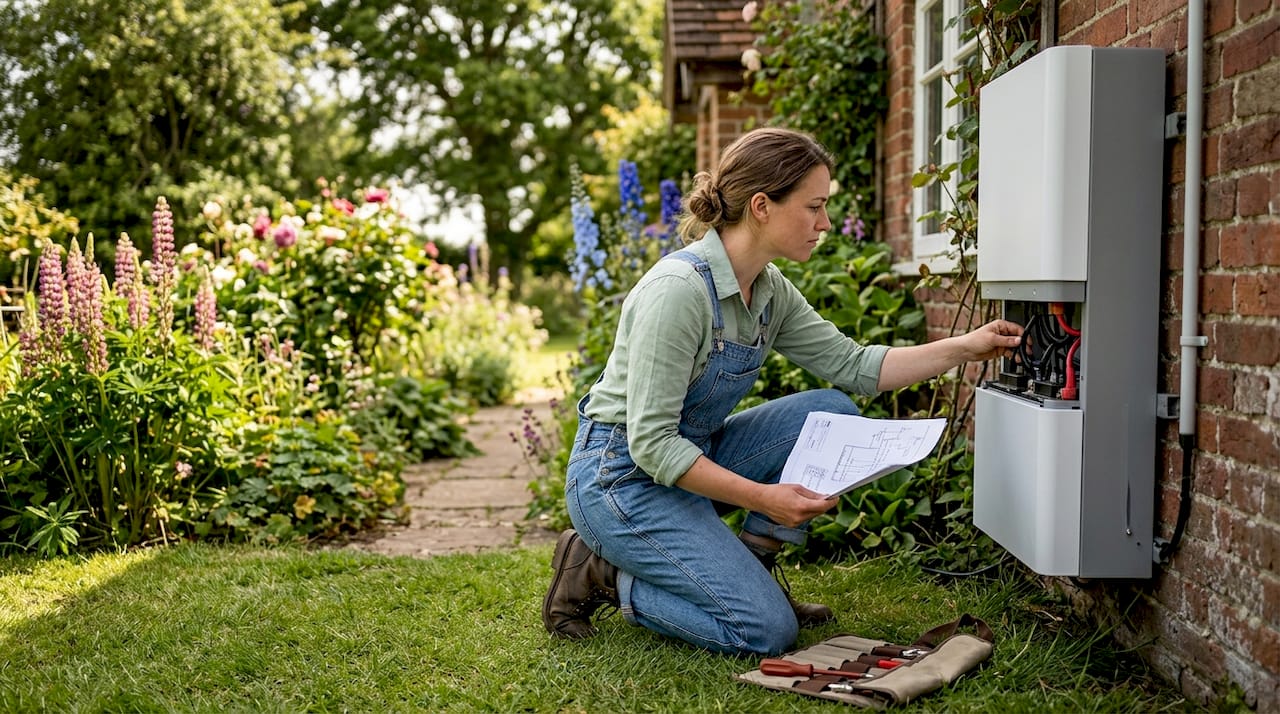
Battery storage turns that advantage into genuine resilience. A Stanford study found that 60% of US households could cover roughly half their electricity needs during blackouts using solar plus storage. For rural homeowners, that figure is more meaningful than it sounds. A half-day outage in a town is an inconvenience. The same outage on a farm in winter, with livestock, water pumps, and heating at stake, is a serious problem.
Solar with storage also functions as a risk management tool for rural homeowners, helping them cope with longer or more frequent outages caused by extreme weather. Storms, flooding, and high winds hit rural areas hardest and knock out power for days rather than hours. A well-sized system keeps the lights on, the freezer running, and the water pump working.
Key resilience advantages for rural properties include:
- Reduced grid dependence. Power generated on site does not travel through vulnerable overhead lines.
- Multi-day backup capability. Properly sized battery storage covers essential loads through extended outages.
- Protection against extreme weather. Solar plus storage acts as a buffer when storms cut grid supply for days.
- Lower exposure to grid price spikes. Self-generated power is not subject to wholesale market volatility.
Pro Tip: Size your battery storage for your worst-case outage scenario, not your average bill. Rural outages regularly last 12–48 hours, so a system designed only for overnight use will leave you short when it matters most.
What financial and environmental benefits does rural solar deliver?
The financial case for solar in rural settings is backed by hard data from multiple countries. Rural solar photovoltaic projects in China increased per-capita income by about 5%, with a net life-cycle benefit of 57,690 yuan per household. That figure covers a full project lifetime, not just the first few years of savings. The same study found that rural solar projects cut CO2 emissions by 22 million tonnes annually across the programme. Lower bills and lower carbon output are not a trade-off here. They arrive together.
Evidence from Bangladesh reinforces the point. A hybrid renewable microgrid serving 200 rural households achieved an energy cost of $0.02995/kWh with 73.9% of supply coming from renewables, while cutting CO2 emissions by 43,675 kg per year. That cost is competitive with grid electricity in many developed markets, and it was achieved in a flood-affected rural area with limited infrastructure. The lesson for UK rural homeowners is that solar economics work even in challenging conditions.
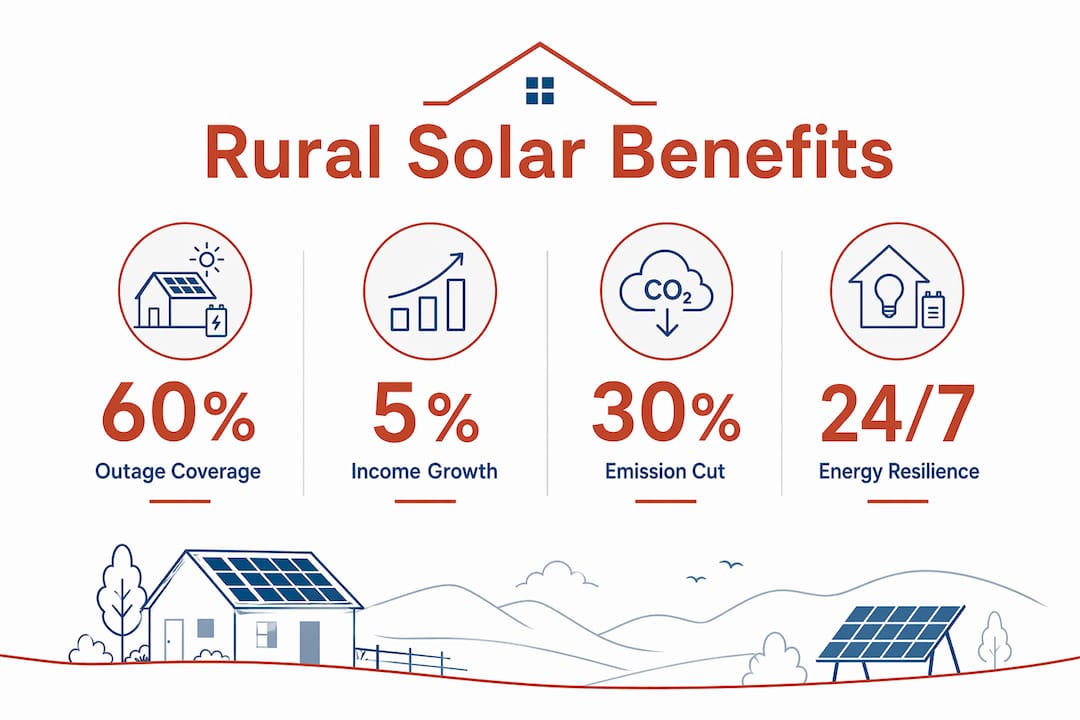
| Benefit | Evidence | Scale |
|---|---|---|
| Income growth | China rural solar projects | ~5% increase in per-capita income |
| Household net benefit | China life-cycle analysis | 57,690 yuan per household |
| CO2 reduction | China rural solar programme | 22 million tonnes per year |
| Energy cost achieved | Bangladesh rural microgrid | $0.02995/kWh with 73.9% renewables |
| Emissions cut | Bangladesh 200-household microgrid | 43,675 kg CO2 per year |
Health benefits follow the emissions reductions. Replacing diesel generators and solid fuel heating with solar removes particulate pollution from the immediate environment. Rural households that previously relied on oil boilers or log burners see air quality improvements indoors and outdoors. That is a benefit that does not appear on an electricity bill but is real and measurable.
The benefits of solar self-consumption are particularly strong for rural homeowners who use more power during daylight hours, such as those running agricultural equipment, workshops, or home offices. Every unit consumed directly from the panels is a unit not purchased from the grid. That self-consumption rate is typically higher in rural properties than in urban flats, where residents are often out during peak solar generation hours.
How does rural solar compare to urban solar installations?
Rural properties hold a structural advantage over urban and suburban homes when it comes to solar. The comparison is not close in several key areas.
| Factor | Rural property | Urban property |
|---|---|---|
| Roof space | Large, often south-facing | Limited, often shared or shaded |
| Shading | Minimal from trees or buildings | Frequent from neighbouring structures |
| Ground-mounted options | Readily available | Rarely possible |
| Grid connection quality | Often weak or single-phase | Generally stronger and more stable |
| Self-consumption potential | High, especially on farms | Lower, residents often absent in daytime |
| Agricultural building use | Barns and outbuildings add capacity | Not applicable |
Rural roofs are typically larger, less shaded, and more favourably oriented than urban equivalents. A detached farmhouse or countryside property can accommodate a 10 kW or larger system without compromise. An urban terrace might struggle to fit 4 kW without shading losses from neighbouring rooftops or chimney stacks.
Agricultural buildings add a further dimension. Barns, machinery stores, and polytunnel frames all offer south-facing roof space that can host panels without affecting the primary use of the building. Solar suits agricultural buildings precisely because the roof area is large, the loads below are substantial, and the daytime energy demand from pumps, ventilation, and refrigeration aligns well with solar generation hours.
The weaker grid connection that frustrates rural homeowners also works in solar’s favour. Where grid import is expensive or unreliable, the value of self-generated power is higher. A rural home that pays a premium for grid electricity, or that faces frequent cuts, gains more from each kilowatt-hour produced on site than a well-connected urban property.
Pro Tip: If your property has an outbuilding or barn, get it assessed alongside your main house. A combined system across multiple roofs often delivers better orientation diversity and higher annual yield than a single large array.
What should rural homeowners consider before installing solar panels?
Practical preparation separates a successful rural solar installation from a costly one. Rural properties often need electrical upgrades before solar can be installed safely, due to older or limited distribution infrastructure. A consumer unit that was installed decades ago may not support a modern inverter and battery system. Identifying that early avoids expensive surprises mid-project.
Grid interface is the first technical question to resolve. Many rural properties are connected on a single-phase supply, which limits the size of inverter that can be installed without a three-phase upgrade. Your installer needs to assess your existing supply before sizing the system. Getting this wrong means either an undersized system or a costly network upgrade that was not budgeted for.
Storage sizing deserves more attention in rural settings than general guidance suggests. Rural solar systems require design that accounts for multi-hour to multi-day outages, making storage capacity more valuable than it would be purely for bill savings. The Pine Point Schools project on the White Earth Reservation illustrates this principle at community scale: a 500 kW solar array with 2.7 MWh of battery storage was sized to keep a storm shelter powered through outages of approximately 6.75 hours. The same logic applies to a rural home. Size for the outage, not just the bill.
A structured approach to planning a rural solar installation covers these steps:
- Audit your current electrical infrastructure. Check the age and capacity of your consumer unit, incoming supply phase, and any existing generation equipment.
- Map your essential loads. Identify which circuits must stay live during an outage: water pump, freezer, heating controls, and medical equipment if relevant.
- Size storage for your outage risk. Calculate how many kilowatt-hours your essential loads consume over your worst-case outage duration, then add a margin.
- Assess all available roof and ground space. Include outbuildings and barns. A larger array charges batteries faster and increases self-consumption.
- Plan for expansion. Fit a battery-ready inverter and leave conduit space for additional panels or a second battery unit as your needs grow.
- Confirm grid interface requirements with your DNO. Your Distribution Network Operator must approve any generation above 3.68 kW on a single-phase connection. Get this confirmed before ordering equipment.
Selecting a qualified installer with rural experience is not optional. The combination of older wiring, agricultural loads, and outage-focused design requires knowledge that a standard domestic installation does not demand. Smarthometechnical specialises in exactly this type of project, with experience across rural and agricultural properties in southern England.
Key takeaways
Solar power suits rural homes because it delivers energy independence, outage resilience, and measurable cost savings where grid infrastructure is weakest and the need for reliable power is greatest.
| Point | Details |
|---|---|
| Energy independence | Solar generates power on site, cutting reliance on long, fault-prone rural grid lines. |
| Outage resilience | Battery storage sized for multi-day outages keeps essential loads running through storms and cuts. |
| Financial returns | Rural solar projects show income growth and life-cycle household benefits backed by empirical data. |
| Rural structural advantage | More roof space, less shading, and higher self-consumption make rural properties ideal for solar. |
| Installation preparation | Electrical upgrades and grid interface checks must happen before system sizing and ordering. |
What I have learnt from rural solar installations
Rural solar is not simply urban solar with more roof space. That is the misconception I encounter most often, and it leads to undersized batteries, overlooked electrical upgrades, and systems that disappoint when the first serious storm hits.
The homeowners who get the most from solar in rural settings are the ones who plan for resilience first and bill savings second. When you start the design conversation by asking “what do I need to keep running for 48 hours without the grid?”, the system that results is almost always better than one designed purely around payback period. The payback still comes. It just arrives alongside genuine peace of mind.
The electrical infrastructure question catches people out more than any other factor. I have visited rural properties where the incoming supply and consumer unit were simply not capable of supporting the system the homeowner had in mind. Catching that early, before equipment is ordered, saves real money and real frustration. If you are considering solar for a rural property, get a full electrical assessment done at the start, not as an afterthought.
Agricultural buildings are an underused asset. Farmers and smallholders often focus on the farmhouse roof and overlook the barn next door, which might offer twice the usable south-facing area. A combined system across house and outbuilding frequently delivers better results than either alone. If you want to see how rural solar installation works in practice, the detail is worth reading before you commit to a design.
Rural homeowners have more to gain from solar than almost any other property type. The grid is weaker, the roof space is greater, and the loads are often higher. That combination makes the case for solar compelling. Act on it with proper planning and the results will follow.
— Simon
Smarthometechnical: rural solar installations designed for resilience
Rural properties need solar systems built around their specific risks and loads, not off-the-shelf packages designed for urban terraces. Smarthometechnical designs and installs solar and battery systems for rural homes and agricultural buildings across southern England, with a focus on outage resilience and long-term performance.

Every project starts with a full electrical assessment, grid interface review, and load analysis. That preparation means the system delivered is sized correctly from day one. Whether you are looking at a farmhouse, a smallholding, or a property with multiple outbuildings, the team at Smarthometechnical has the experience to get it right. Visit the solar installations page to find out what a rural solar system could deliver for your property, or get in touch to arrange a site assessment.
FAQ
Why does solar suit rural homes more than urban ones?
Rural homes have larger roof areas, less shading, weaker grid connections, and higher self-consumption potential. Those four factors combine to make solar more productive and more valuable per panel installed than on a typical urban property.
How much battery storage does a rural home need?
Storage should be sized to cover essential loads for your worst-case outage duration, which in rural areas is often 24–48 hours. A standard domestic battery of 5–10 kWh is frequently insufficient for rural resilience requirements.
Do rural properties need electrical upgrades before installing solar?
Rural properties often require consumer unit upgrades and grid interface checks before solar installation, particularly where wiring is older or the incoming supply is single-phase. A full electrical assessment at the start of the project prevents costly surprises.
Can solar panels be installed on farm buildings and barns?
Solar suits agricultural buildings well because barns typically offer large, south-facing roof areas with substantial daytime energy loads below them. Combining house and outbuilding arrays in a single system often delivers better annual yield and self-consumption than a house-only installation.
What financial returns can rural homeowners expect from solar?
Returns vary by system size and usage, but empirical studies show rural solar projects delivering meaningful income growth and life-cycle household benefits. The real examples of solar battery savings available from Smarthometechnical give a clearer picture of what UK rural homeowners are achieving in practice.
Recommended
- How rural solar installation works: 2026 guide – Smart Home Technical Ltd
- Why switch to solar energy: a 2026 homeowner’s guide – Smart Home Technical Ltd
- Solar in Hampshire retrofits: a homeowner’s guide – Smart Home Technical Ltd
- What is a whole house solar system? 2026 guide – Smart Home Technical Ltd
