
By law, landlords must have a qualified person inspect the fixed electrical installation and produce an EICR at least every five years, and act promptly on any C1, C2 or FI findings, generally within 28 days or sooner if the report specifies. You must give tenants a copy within 28 days of the inspection and hand a copy to the local housing authority within 7 days if asked. The rest of this guide explains scope, result codes, costs and the exact steps to stay compliant.
TL;DR:
- Landlords must have electrical installations inspected every five years and act within the deadline specified in the report, which can be shorter than 28 days for urgent defects.
- An in-date EICR remains valid when a tenancy changes as long as the report hasn’t expired or been affected by recent electrical work.
- A satisfactory EICR only contains C3 codes, but C1, C2, or FI codes trigger immediate action within 28 days, with proper proof required from qualified electricians.
- Costs for inspections vary based on property size, typically ranging from £100 to £250, with larger or complex properties costing more.
- Proper recordkeeping and timely sharing of reports with tenants and authorities are essential to avoid enforcement actions and penalties.
Table of Contents
- EICR for landlords: which tenancies and properties are covered?
- What does an EICR actually check, and what do the codes mean?
- What remedial work timescales and proof must landlords keep?
- Finding a qualified electrician and budgeting for the work
- Recordkeeping, tenant copies and what happens if you don’t comply
- Practical checklist: a contractor’s view of the EICR process
- Where most landlords go wrong on EICR compliance
- How Smart Home Technical Ltd handles EICR compliance for landlords
- Sources
EICR for landlords: which tenancies and properties are covered?
The Electrical Safety Standards in the Private Rented Sector and Social Rented Sector (England) Regulations 2020 apply to most private tenancies in England, and the scope extended to cover social housing from 2025. Regulation 3 sets the core duty: get the fixed installation inspected and tested by a qualified person at intervals not exceeding five years, obtain a written report showing the date of the next inspection, and act on anything it flags.
A 2026 amendment to the Regulations tightened the definitions and confirmed, usefully for landlords managing several properties, that a valid, in-date EICR carries over when a tenancy changes. You don’t need to commission a fresh inspection every time a new tenant signs, provided the existing report hasn’t expired and nothing material has changed to the installation. That single clarification removes a lot of duplicated paperwork for landlords who re-let frequently.
Scotland, Northern Ireland and Wales run their own electrical safety regimes for rented property, with different inspection cycles and enforcement routes, so don’t assume the England rules transfer directly if you own stock across borders. Certain licensed HMOs and some lodger arrangements sit under separate or overlapping rules too, which is worth checking against your specific tenancy type before assuming you’re exempt.
Run through this quickly to confirm the duty applies to you:
- You let a property under an assured shorthold, regulated, or most other private residential tenancy in England.
- The property is social housing let after the 2025 extension of scope.
- Your existing EICR has expired, is due within the next few months, or doesn’t exist at all.
- You’ve had electrical work done since the last inspection that could affect the fixed installation.
- You’re about to re-let and aren’t certain the current report is still valid for the incoming tenant.
If any of those apply, the clock is already running.
What does an EICR actually check, and what do the codes mean?
An EICR examines the fixed electrical installation: the wiring buried in walls and under floors, the consumer unit (fuse board), earthing and bonding, and the sockets and switches wired into the circuits. It does not cover portable appliances like kettles, lamps or washing machines. That’s the territory of Portable Appliance Testing (PAT), a separate and optional check that many landlords confuse with the EICR.
Every inspection is judged against BS 7671, the IET Wiring Regulations, which is the technical rulebook electricians use to decide whether an installation is safe or needs work; for detailed standards and safe installation practice, refer to Grundlegende Anforderungen und Normen für Elektroinstallationen in Wohngebäuden. The inspector doesn’t invent their own standard for what counts as dangerous; they compare what they find on-site against BS 7671’s requirements, then classify any defect using a standard set of codes.
| Code | Meaning | What it requires of you |
|---|---|---|
| C1 | Danger present, risk of injury | Immediate remedial action, often before the inspector leaves |
| C2 | Potentially dangerous | Urgent remedial work, generally within 28 days |
| C3 | Improvement recommended | Not mandatory, but sensible to schedule |
| FI | Further investigation required | Needs a follow-up inspection to establish the real risk |
An EICR carrying only C3 codes is still marked “satisfactory” and needs no immediate remedial work. C1, C2 and FI codes all mark the report “unsatisfactory,” and that single word is what triggers your statutory 28-day clock.
What remedial work timescales and proof must landlords keep?
Once you hold an unsatisfactory EICR, you have 28 days to complete the remedial work and confirm it, unless the report itself sets a shorter deadline for a C1 or C2 finding. That shorter deadline is legally binding: a landlord who waits the full 28 days when the report demanded action within, say, 7 days, is already in breach even though the general limit hasn’t passed.
Acceptable proof of completed work isn’t limited to a fresh EICR. Depending on what was done, you can rely on:
- A new satisfactory EICR covering the whole installation.
- An Electrical Installation Certificate (EIC), issued when a circuit or consumer unit has been replaced or newly installed.
- A Minor Electrical Installation Works Certificate (MEIWC), issued for smaller jobs like adding a socket or replacing a faulty switch.
The workflow itself is simple in principle: instruct a qualified electrician to fix the flagged items, get written confirmation referencing BS 7671 compliance, then supply copies to your tenant and the local authority (if requested) and file your own copy. Miss any one of those steps and you have no defensible evidence trail if a dispute arises later.
Pro Tip: Keep the original unsatisfactory EICR alongside the remedial certificate. Councils often want to see both, because the certificate alone doesn’t prove which specific defects it resolved.
Finding a qualified electrician and budgeting for the work
“Qualified person” isn’t a phrase you can interpret loosely. Guidance from GOV.UK points landlords toward electricians registered with a competent person scheme such as NICEIC, NAPIT or the ECA, and HSE testing guidance reinforces why: electrical testing carries real risk when done by someone without the right training and equipment.
Before you book anyone, check for:
- Current registration with NICEIC, NAPIT, ECA or an equivalent scheme, verifiable online.
- Public liability insurance covering the value of the work.
- A sample EICR they’re willing to show you, referencing BS 7671 codes properly.
- Specific qualifications in inspection and testing, not just general electrical installation.
Worth asking directly: can they carry out minor remedial work on the same visit if something needs fixing there and then? How long will the inspection realistically take on a property your size? And how quickly will you get the written report afterwards, given that some firms take over a week to turn paperwork around.
Costs vary with property size, circuit count, age of the wiring and how easy the installation is to access. As a rough guide for 2026, expect around £100 to £150 for a one-bed flat, £150 to £200 for a two-bed property, and £175 to £250 for a three-bed house, with larger homes and HMOs costing more. A typical domestic inspection takes between one and three hours on-site, longer if the electrician also needs to trace and test an older or poorly labelled consumer unit.

Recordkeeping, tenant copies and what happens if you don’t comply
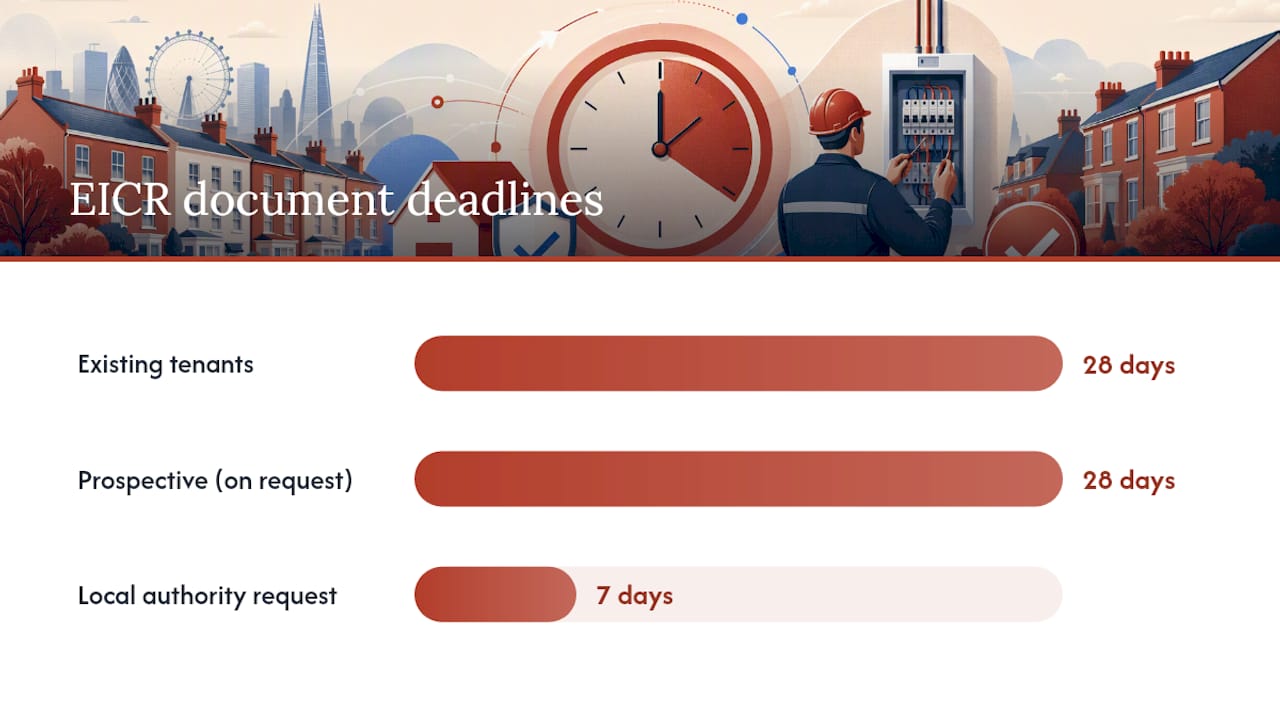
Timing matters as much as the paperwork itself. You must give a copy of the EICR to existing tenants within 28 days of the inspection, to new tenants before they move in, and to prospective tenants within 28 days of a request. If your local housing authority asks for a copy, you have 7 days to provide it.
Enforcement sits with the local housing authority, not central government, which means practice varies a little between councils. Broadly, they can issue a remedial notice requiring you to act, arrange the work themselves and recover the cost from you, or impose a civil penalty for non-compliance, with recent legislative changes pushing penalty levels upward. None of those routes are quick or pleasant, and all of them are avoidable with basic paperwork discipline.
A short checklist that covers most of what a council will actually ask for:
- Dated copy of the current EICR, plus any prior reports for the same property.
- Proof of when the report was sent to the tenant (email timestamp or signed acknowledgement).
- Remedial certificates (EIC or MEIWC) matched to the specific defects they resolved.
- A note of the next inspection due date, so it never sneaks up on you.
Practical checklist: a contractor’s view of the EICR process
Before booking, gather the previous EICR, the consumer unit’s age and any known modifications, and give tenants proper written notice of access, ideally 24 to 48 hours ahead. Plan for the inspector needing access to every room, the loft and any outbuildings wired into the installation.
During the visit, ask to see the sample report format in advance so you know what you’re getting, and flag anything the tenant has already mentioned, like flickering lights or tripping breakers.
- Book the inspection and confirm the report will reference BS 7671 codes clearly.
- Review the completed EICR the same day it arrives and identify any C1, C2 or FI items.
- Instruct remedial works immediately for anything urgent, don’t wait for a follow-up quote round.
- File the certificate, the original EICR and proof of tenant delivery together, digitally and on paper.
Pro Tip: Store EICR paperwork by property address and inspection year, not by tenant name. Tenants change; the compliance clock doesn’t reset when they do.
Where most landlords go wrong on EICR compliance
The mistake I see most often isn’t ignorance of the five-year rule. It’s landlords who read “28 days” on an EICR and assume that’s always the deadline, when the report itself sometimes specifies something shorter for a C1 or C2 finding. Miss that shorter window and you’re in breach even though the calendar says you’re within time.
The second mistake is treating PAT testing as interchangeable with an EICR. They test different things entirely, and a landlord who’s had appliances checked but never the fixed wiring has no compliance evidence at all.
If a consumer unit is decades old, replacing it outright is usually cheaper over five years than patching individual faults every time an EICR flags something. Spend on the board once rather than the call-out fee five times.
— Simon
How Smart Home Technical Ltd handles EICR compliance for landlords
Sorting an EICR shouldn’t mean chasing three different tradespeople for the inspection, the remedial work and the paperwork. We carry out the inspection, complete any remedial electrical work on the same instruction, and issue the certification you need to hand to tenants and the local authority, streamlining the process to avoid managing multiple contractors.

Operating regionally, we cover everything from the initial EICR through to consumer unit upgrades, rewiring, and ongoing service contracts for landlords who want their five-year cycle managed rather than remembered manually. If a report comes back unsatisfactory, the team that inspected the property can quote and complete the fix, then supply the EIC or MEIWC you need as proof, reducing the delay landlords often face waiting on additional contractors. For landlords also weighing up bigger electrical upgrades on the same visit, from solar installations to EV charging points, it’s worth asking what else the property might need while an electrician is already on-site. Get in touch to discuss inspection bookings or ongoing compliance contracts for your property portfolio.
This article is general information, not a substitute for advice from a qualified lawyer. Consult a qualified legal professional about your own circumstances before acting on anything here.
Sources
- Electrical safety standards in the private and social rented sectors: guidance
- The Electrical Safety Standards in the Private Rented Sector and Social Rented Sector (England) Regulations 2020 — regulation 3
- BS 7671 — IET Wiring Regulations
- HSE — Testing and electrical safety information
