
Article 17 of the Regulatory Reform (Fire Safety) Order 2005 makes you legally responsible for keeping emergency lighting in efficient working order, and BS 5266-1 sets the recognised testing rhythm most inspectors and insurers expect: regular indicator checks on central-battery systems, periodic functional tests each month, a full-duration discharge test annually, and photometric verification at intervals recommended by current standards. If your logbook has a gap in any of those, close it before your next inspection.
TL;DR:
- Emergency lighting must be regularly tested according to BS 5266-1 standards, including monthly functional tests and annual full-duration discharge tests.
- Photometric verification every five years is crucial to detect gradual light level reductions that daily and monthly tests might miss.
- Logbooks should document location, test results, remedial actions, and contractor certificates, with records kept for the entire lifespan of the installation.
- In-house staff can handle routine visual checks and monthly tests, but qualified electricians are essential for repairs, battery replacements, and annual discharge testing.
- Staggering annual discharge tests by zones and using automated self-testing systems can improve efficiency and ensure ongoing compliance.
Table of Contents
- What does the law actually require for emergency lighting testing?
- How often should emergency lighting be tested?
- How do you carry out the monthly functional test?
- How do you plan the annual full-duration discharge test?
- What should your emergency lighting logbook contain?
- Who should test and repair emergency lighting?
- What causes emergency lighting to fail testing?
- Practical tips for staying ahead of emergency lighting testing
- Why emergency lighting testing isn’t optional paperwork
- Get your emergency lighting testing sorted with Smart Home Technical
- Sources
What does the law actually require for emergency lighting testing?
Article 17 doesn’t mention emergency lighting testing by name. It says fire safety equipment must be kept in “efficient working order and good repair”, full stop. That’s a deliberately open standard, and it’s the Order itself, not any British Standard, that creates your legal duty as the responsible person.
BS 5266-1 fills the gap. It’s a code of practice, not statute, but it’s the document fire risk assessors and enforcing officers reach for when they ask “how do you know your system works?” It works alongside BS EN 50172 (the emergency escape lighting standard) and BS EN 1838 (which sets the photometric performance requirements your lux readings get checked against).
Follow BS 5266-1’s testing schedule and you have a defensible, industry-recognised answer ready for any inspector or insurance assessor who asks about your emergency lighting maintenance regime. Ignore it, and you’re relying on your own interpretation of “efficient working order” when someone else’s judgement decides whether that’s good enough.
How often should emergency lighting be tested?
The accepted intervals aren’t arbitrary. Each one exists to catch a different failure mode before it matters in a real evacuation.
- Daily — visual check of indicator panels on central battery or generator-fed systems. You’re looking for fault lamps, not testing performance.
- Monthly — a short functional test simulating mains failure, confirming every luminaire and exit sign lights up.
- Six-monthly — a closer inspection: cleaning diffusers and lenses, checking fittings for physical damage or corrosion.
- Annual — a full rated-duration discharge test, commonly the full rated duration, often around three hours, proving the batteries can genuinely hold the load for the time your escape plan assumes.
- Every five years — photometric verification, measuring actual illuminance in lux along escape routes.
That last one catches the failure nobody notices day to day. A battery can pass every monthly test and still leave a corridor under-lit, because lens contamination and ageing luminaires quietly reduce output long before the battery itself fails. Photometric checks are the only ones that measure light on the floor rather than assuming it’s there.
How do you carry out the monthly functional test?
The monthly test is deliberately brief. Run it properly and no one but you notices it happened.
- Locate the test facility, usually a key switch or fused spur, and simulate mains failure.
- Walk the escape routes, confirming every luminaire and illuminated exit sign comes on.
- Check output is even, not flickering or dim, on each fitting.
- Restore mains supply after no more than a few minutes.
- Record the date, result per luminaire, and any failures in your logbook immediately.
- Flag failed units for remedial action and set a retest date.
Keep the discharge short. The point is confirming the fitting switches over correctly, not draining the battery. A monthly test that runs too long eats into the battery’s reserve capacity and can leave it under-recovered before the next real outage.
Pro Tip: Number every luminaire on a building plan and use the same numbers in your logbook. When a fitting fails, you want to identify it in seconds, not walk the corridor comparing descriptions.

Basic staff training pays off here. Anyone competent to flick a test switch and walk a corridor with a checklist can run this test, which is exactly why it doesn’t need a contractor every month.
How do you plan the annual full-duration discharge test?
This is the test that actually proves your system will last through an evacuation, not just switch on.
- Confirm the rated duration first. Three hours is standard for most occupied premises. A one-hour rating is only acceptable where occupants evacuate immediately on supply failure and the building isn’t reoccupied until batteries have recovered fully.
- Schedule around occupancy, not convenience. Running the discharge after hours or over a weekend avoids the compliance gap of a building sitting unprotected while batteries recharge.
- Consider staging large sites in zones rather than testing the whole building at once, so at least some escape routes stay covered throughout.
- Confirm a pass properly: every luminaire must sustain rated output for the full duration, then recover to full charge afterwards, typically within 24 hours.
- Bring in a contractor for sites without in-house electrical competence. Expect a written test certificate and a remedial report listing any failures, not just a verbal “it’s fine”.
What should your emergency lighting logbook contain?
An inspector’s first question is rarely about the lighting itself. It’s “can I see the records?” A logbook with gaps looks the same as testing that never happened, whatever actually occurred on site.
- Inventory: location, type, and rated duration of every luminaire, numbered to match your building plan.
- Test entries: date, tester’s name, pass or fail per luminaire, remedial action taken, and retest date.
- Contractor certificates from annual discharge tests and any remedial visits.
- Photometric reports from five-year verification, showing measured lux against the required levels.
- Retention: keep records for the life of the installation, not just the current year. Trade body guidance is explicit that inspectors expect to see continuous history, not a fresh logbook started the week before a visit.
Who should test and repair emergency lighting?
Monthly functional tests and visual checks sit comfortably with trained in-house staff. Battery replacement, safe isolation, wiring faults, and any remedial electrical work don’t. That’s a job for a qualified electrician.
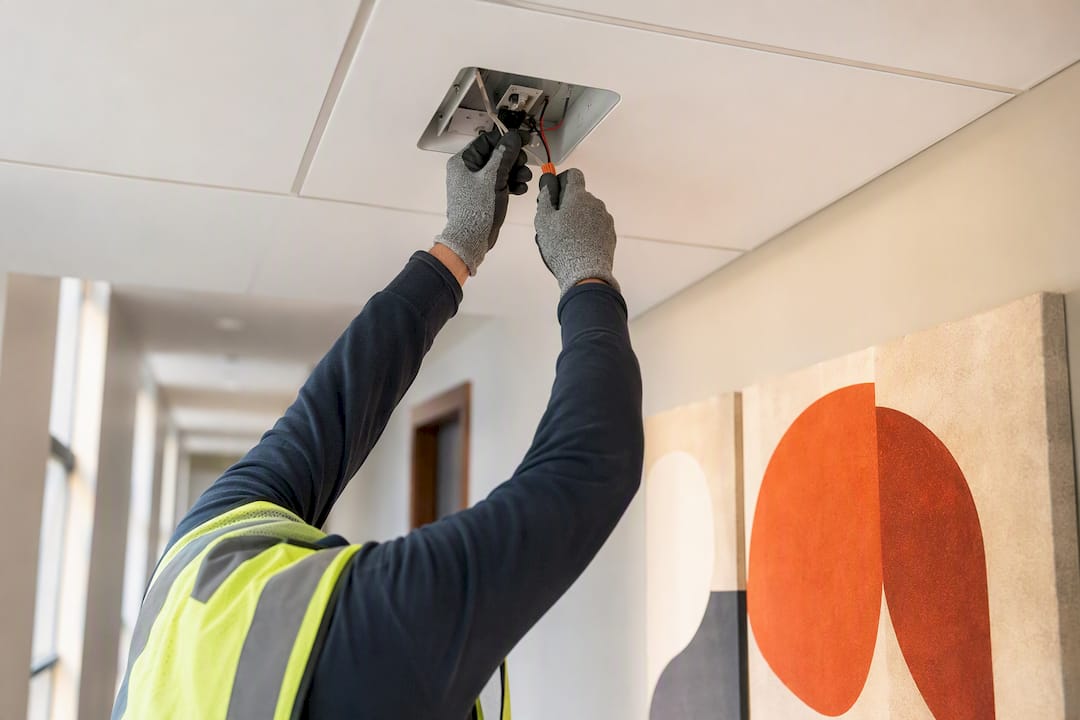
Look for contractors operating under a certificated scheme such as BAFE where the installation’s scope calls for it, and ask what you’ll actually receive: a written test report, a signed certificate, and ideally photographic or photometric evidence rather than a verbal assurance. If the same luminaire keeps failing test after test, that’s not a one-off fault. It’s a signal the fitting, or the wider circuit feeding it, needs proper diagnostic work rather than another temporary fix.
What causes emergency lighting to fail testing?
Most failures fall into a handful of predictable patterns, and knowing which one you’re looking at speeds up the fix.
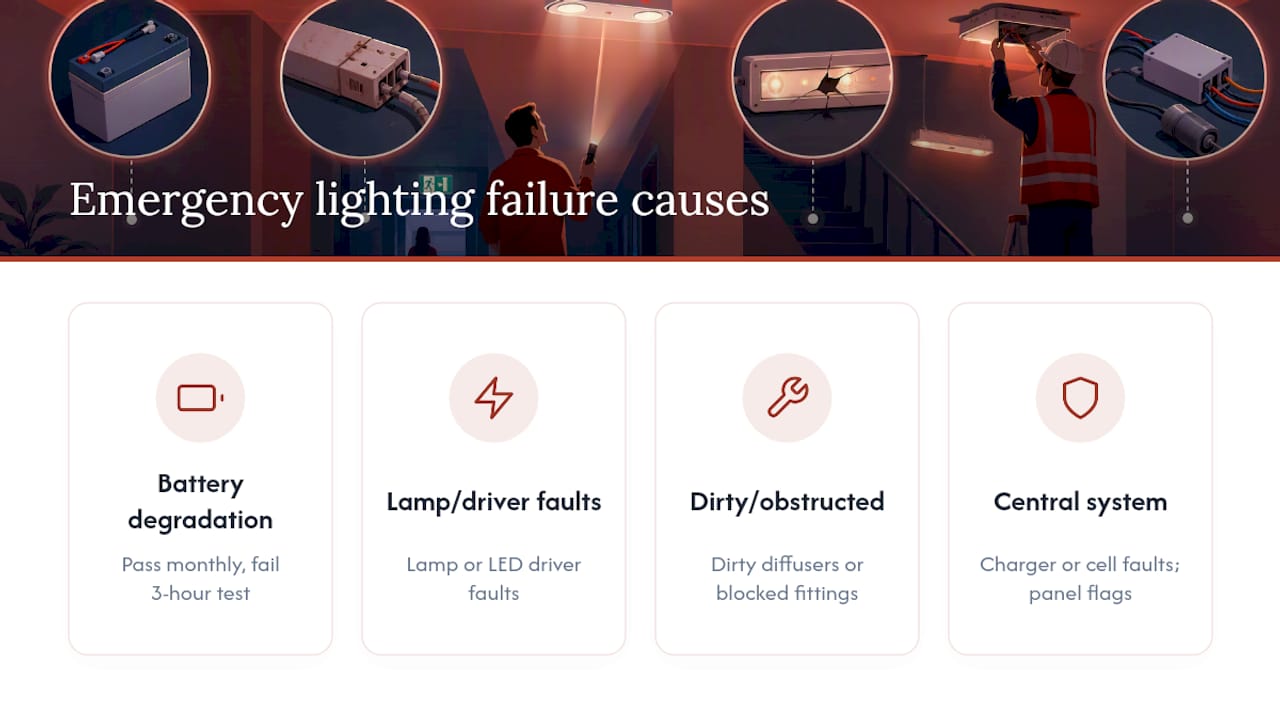
Batteries degrade on a curve: they’ll often pass monthly tests right up until they suddenly can’t hold the annual discharge, which is exactly why the three-hour test matters more than the short monthly one. Lamp and LED driver faults, dirty diffusers, and obstructed fittings are the next most common cause, often fixable on the spot. Central battery systems throw their own faults: charger failures or individual cell degradation, usually flagged on the panel before a luminaire visibly fails. Whatever the cause, log the fault, apply a temporary fix if the escape route is compromised, and set a firm retest date rather than leaving it open.
Practical tips for staying ahead of emergency lighting testing
Stagger your annual discharge test by zone rather than testing the whole site in one go, and note the sequence in your logbook so the approach itself is auditable, not just the results.
Self-testing luminaires, and central monitoring built to BS EN 62034, cut the labour of manual monthly checks considerably by logging faults automatically. Worth considering on larger sites where walking every corridor monthly is a real drain on staff time.
Pro Tip: When a contractor finishes annual testing, ask for battery health data alongside the certificate. It tells you which units are approaching end-of-life before they fail an actual discharge test.
Why emergency lighting testing isn’t optional paperwork
Skipped monthly tests and missing photometric records are the two gaps inspectors flag most, and both are entirely avoidable with a working logbook. This isn’t a compliance exercise you can defer to next quarter. It’s the difference between a corridor being lit or dark during the one event that matters.
Check your last test dates today. If anything’s overdue, book it this week, and if you’re not confident diagnosing a battery or panel fault yourself, bring in a qualified contractor rather than guessing.
— Simon
Get your emergency lighting testing sorted with Smart Home Technical
Smarthometechnical is the alternative to juggling spreadsheets and chasing contractors separately for your emergency lighting compliance standards work. We handle annual full-duration discharge testing, coordinate or carry out photometric verification, and hand you a proper logbook and certificate at the end of it, not a verbal “all good”.

Every visit produces written test reports and certificates you can hand straight to an inspector or insurer, plus a remedial report if anything needs fixing. If your last discharge test is more than a year old, or you’ve never had photometric levels measured, get in touch through our service contract page to arrange a site visit and quote.
Sources
The Regulatory Reform (Fire Safety) Order 2005 sets the statutory duty. BS 5266-1, alongside BS EN 50172 and BS EN 1838, provides the testing code of practice and photometric benchmarks referenced throughout this guide.
This article is general information, not a substitute for advice from a qualified lawyer. Consult a qualified legal professional about your own circumstances before acting on anything here.
