
A commercial solar system is a photovoltaic (PV) installation designed to generate electricity for business premises by converting sunlight into usable power through solar modules and inverters. Unlike residential setups, these systems are engineered specifically for offices, warehouses, retail centres, factories, and hospitals, where energy demands are substantially higher and electrical infrastructure is more complex. If you are a business owner or facility manager weighing up a solar investment, understanding how these systems work, what they cost, and what they deliver is the starting point for making a sound decision.
What is a commercial solar system and how does it work?
A commercial solar PV system converts sunlight into electricity through photovoltaic modules mounted on rooftops, ground frames, or carport structures above car parks. Each module contains silicon cells that produce direct current (DC) electricity when exposed to sunlight. That DC electricity then passes through an inverter, which converts it into alternating current (AC) electricity compatible with the building’s electrical supply. The result is on-site generated power that offsets what the business would otherwise purchase from the grid.
Commercial systems connect to three-phase electrical systems common in business premises, which operate at voltages such as 208V or 480V. This is a fundamental difference from residential solar, which typically uses a single-phase supply. The inverter architecture, wiring design, and protection systems must all be matched to the three-phase supply, which is one reason commercial installations require specialist electrical contractors rather than general solar fitters.
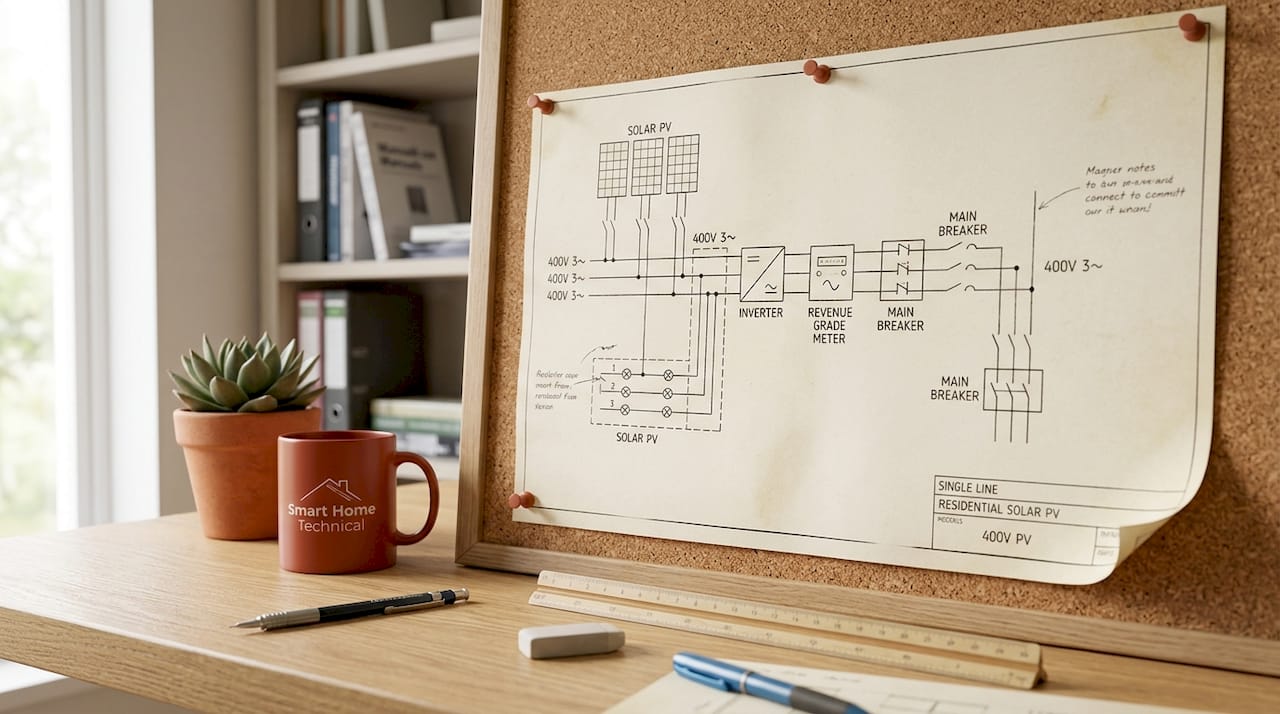
Key components of commercial solar energy systems
Understanding the main components helps you ask the right questions when speaking to an installer. A commercial solar energy system is built from several interdependent parts, each with a specific role.
- Solar modules: Monocrystalline panels offer higher efficiency in limited roof space. Polycrystalline panels are a lower-cost option where space is not a constraint. Both convert sunlight into DC electricity.
- Inverters: String inverters are common in straightforward commercial arrays. Central inverters suit large-scale installations. Microinverters or DC optimisers are used where shading or complex roof layouts reduce performance.
- Battery storage: Lithium-ion battery systems store surplus solar generation for use during evenings or peak demand periods, which is particularly valuable for managing demand charges (explained in the next section).
- EV chargers: Many businesses now integrate EV charging infrastructure directly with their solar system, allowing vehicles to charge from generated solar power rather than grid electricity.
- Monitoring systems: Real-time monitoring platforms track generation, consumption, and fault conditions, allowing proactive management of system performance.
- Switchgear and protection relays: Commercial interconnections require compliance with protection standards, including anti-islanding testing, to satisfy utility requirements before the system can be commissioned.
Pro Tip: Request a single-line electrical diagram from your installer before works begin. This document shows how every component connects and is your reference point for future maintenance, fault diagnosis, and any system expansion.
How do commercial tariffs and demand charges affect solar savings?
This is the section most business owners wish they had read before signing a contract. Commercial electricity tariffs are structured differently from domestic ones, and the difference has a direct bearing on how much a solar system actually saves you.
Commercial utility bills typically contain two distinct charges. The first is the energy charge, measured in kilowatt-hours (kWh), which is the unit cost of electricity consumed. Solar generation directly reduces this figure. The second is the demand charge, a fee calculated on the highest 15-minute power draw recorded during the billing period. Demand charges can represent 30% to 50% of a commercial electricity bill. That proportion means a solar system that cuts your kWh consumption by 40% may reduce your total bill by far less if demand charges remain untouched.
Demand charges are frequently misunderstood, and the gap between expected and actual savings catches many businesses off guard. Here is how to approach the problem systematically:
- Obtain interval meter data. Your energy supplier can provide 15-minute interval data showing your consumption profile. This reveals when your peak demand events occur and how large they are.
- Model demand charge impact. A competent installer will use this data to calculate how much of your bill is driven by demand charges versus energy charges before sizing the system.
- Consider battery storage for peak shaving. A battery system charged during low-demand periods can discharge during peak events, flattening the demand curve and reducing the charge. This is known as peak shaving.
- Evaluate load management options. Shifting energy-intensive processes such as HVAC pre-cooling or machinery start-up to solar generation hours reduces both energy and demand costs simultaneously.
- Build demand charge analysis into your ROI model. Any financial projection that ignores demand charges will overstate savings and understate payback periods.
Businesses that consume power during daylight hours achieve the strongest return on investment from commercial solar, with typical payback periods of three to five years and savings continuing across a 20-plus year system life. This is because on-site self-consumption is always more valuable than exporting surplus electricity to the grid, where feed-in tariff rates are considerably lower than the retail price of electricity.
Types of commercial solar installations and how sizing works
Commercial solar systems range from approximately 10 kW for a small retail unit to several megawatts for a large distribution centre or manufacturing facility. Choosing the right type and size requires a structured site evaluation rather than a rule-of-thumb estimate.
| Installation type | Typical application | Key consideration |
|---|---|---|
| Rooftop array | Offices, warehouses, retail units | Roof structural capacity and orientation |
| Ground-mount array | Sites with available land | Planning permission and land use constraints |
| Carport solar | Car parks, logistics hubs | Dual-use value: generation plus vehicle shelter |
| Façade or canopy | Urban commercial buildings | Lower generation yield but maximises available surface |
Sizing a system correctly depends on three inputs: your annual energy consumption in kWh, your available roof or ground space, and your network connection capacity. Installers use interval meter data to match system output to your consumption profile rather than simply filling every available surface with panels. Oversizing a system beyond your connection capacity wastes capital; undersizing it leaves savings on the table.
Structural analysis and permitting are non-negotiable pre-installation steps. Commercial roofs must be assessed by a structural engineer to confirm they can bear the additional load of a solar array. Permitting documentation includes electrical calculations, site plans, and compliance records. Skipping or rushing these steps creates liability and can delay grid connection by months.
What are the practical benefits and challenges of commercial solar?
The financial case for commercial solar is strong, but it comes with genuine complexities that deserve honest treatment.
Benefits worth quantifying:
- Reduced electricity bills, with savings directly proportional to self-consumption rates and the proportion of the bill driven by energy charges.
- Protection against future tariff increases, since on-site generation locks in a portion of your energy supply at a fixed cost.
- Tax incentives for eligible businesses, including a 30% investment tax credit for commercial solar projects, which accelerates return on investment significantly.
- Environmental credentials that support sustainability reporting, supply chain requirements, and brand positioning with environmentally conscious customers.
- Long system lifespan, with quality modules typically carrying 25-year performance warranties and inverters warranted for 10 years or more.
Challenges to plan for:
- Upfront capital cost, which for a 100 kW system can run into six figures before incentives are applied.
- Utility interconnection timelines, which in some regions extend to 12 months or longer due to grid capacity constraints and application backlogs.
- Complexity of engineering design, particularly where three-phase supply, demand charges, and battery integration must all be coordinated.
- Ongoing maintenance, including annual inspections, inverter servicing, and module cleaning to maintain performance over the system’s life.
Pro Tip: Commission an independent energy audit before approaching installers. Knowing your consumption profile, demand peaks, and tariff structure in advance puts you in a far stronger position to evaluate proposals and avoid being sold a system sized for commission rather than your actual needs.
How does ongoing management affect system performance?
A commercial solar system is not a fit-and-forget asset. Integration with building energy management systems and smart technologies significantly improves self-consumption and overall system responsiveness.
- Monitor generation and consumption in real time. Most commercial inverters support monitoring platforms that flag underperformance, faults, or grid export patterns that indicate a mismatch between generation and load.
- Coordinate EV charging with solar output. Smart EV charger controllers can schedule charging to coincide with peak solar generation hours, maximising the proportion of vehicle charging powered by on-site solar rather than grid electricity. Smarthometechnical installs integrated EV charging solutions designed to work alongside solar systems from day one.
- Use battery storage to extend self-consumption windows. Batteries charged during midday solar peaks can supply the building during early morning and evening periods when generation is low but consumption remains high.
- Review performance data quarterly. Comparing actual generation against the modelled output in your system design identifies soiling, shading from new obstructions, or inverter degradation before they compound into significant losses.
- Engage a qualified contractor for annual inspections. Thermal imaging of modules and connection checks on DC isolators and inverter terminals catch faults that monitoring software alone will not detect.
Smart building strategies that coordinate solar output with HVAC, lighting, and process loads are now a practical reality for commercial facilities, and they meaningfully extend the financial return of a solar investment.
Key takeaways
A commercial solar system delivers the strongest financial return when it is sized against your actual consumption profile, designed around your tariff structure, and actively managed after commissioning.
| Point | Details |
|---|---|
| Definition and scale | A commercial solar system is a PV installation ranging from 10 kW to multi-megawatt scale, built for business premises. |
| Demand charges matter | Demand charges can represent 30% to 50% of a commercial bill; solar alone does not reduce them without battery storage or load management. |
| Self-consumption drives ROI | Businesses that use power during daylight hours achieve payback periods of three to five years across a 20-plus year system life. |
| Permitting is non-negotiable | Structural assessments and compliance documentation must be completed before installation to avoid liability and grid connection delays. |
| Ongoing management is required | Real-time monitoring, quarterly performance reviews, and annual inspections protect long-term system output and financial returns. |
Why engineering rigour separates good commercial solar projects from expensive mistakes
I have seen businesses sign off on commercial solar proposals that looked compelling on paper but were built on flawed assumptions. The most common error is a financial model that treats the entire electricity bill as reducible by solar generation, ignoring the demand charge component entirely. When the first post-installation bill arrives and savings are half what was projected, the relationship with the installer deteriorates fast.
The projects that deliver on their promises share one characteristic: the engineering came first. That means a structural survey before any panel layout was drawn, interval meter data analysed before system sizing was finalised, and a utility interconnection application submitted before the equipment was ordered. Pre-installation engineering and planning is what separates a commercial solar project from a residential one, and cutting corners on it is where most disappointments originate.
My honest advice is to treat the design phase as the most important part of the project, not a formality before the installation crew arrives. Ask your installer to show you the demand charge analysis. Ask to see the structural engineer’s report. Ask how the system size was derived from your interval data. If those questions produce vague answers, find a different installer.
— Simon
How Smarthometechnical can support your commercial solar project
Smarthometechnical specialises in commercial solar panel installation for businesses across the UK, from initial site evaluation and engineering design through to commissioning and ongoing support. Every project begins with a detailed assessment of your energy consumption, roof structure, and tariff profile so the system is sized and designed to deliver the savings you are actually expecting.
Beyond solar, Smarthometechnical integrates battery storage, EV charger infrastructure, and building automation to maximise the return on your investment. Whether you are managing a warehouse, an office complex, or a retail facility, the team handles the full scope of electrical works under one contract. Contact Smarthometechnical for a site evaluation and tailored proposal.
FAQ
What is a commercial solar system in simple terms?
A commercial solar system is a photovoltaic installation that converts sunlight into electricity for business premises such as offices, warehouses, and retail units. It operates through solar modules and inverters connected to the building’s three-phase electrical supply.
How much does a commercial solar system cost?
Commercial solar system cost varies significantly by size and complexity, but a 100 kW rooftop installation typically runs into six figures before incentives. Tax credits such as the 30% investment tax credit for eligible businesses reduce the net outlay and accelerate payback.
What size commercial solar system do I need?
System size depends on your annual energy consumption, available roof or ground space, and network connection capacity. Commercial systems range from around 10 kW for small premises to several megawatts for large industrial facilities.
Will commercial solar reduce my demand charges?
Solar generation alone reduces your kWh consumption but does not automatically reduce demand charges, which are based on your highest 15-minute power draw in the billing period. Battery storage combined with peak shaving strategies is required to address demand charges directly.
How long does a commercial solar system last?
Quality solar modules carry 25-year performance warranties, and well-maintained systems routinely operate beyond that. Inverters typically carry 10-year warranties and may require replacement once or twice over the system’s operational life.
