
Open PEN protection stops your EV charger and isolates live conductors the moment the combined protective-earth/neutral conductor fails on the incoming supply. If your property runs an outdoor charge point on a PME (TN-C-S) supply, BS 7671 requires this protection, and the device or arrangement fitted must match the expectations set out in IET 01:2024.
TL;DR:
- An open PEN fault can push mains voltage onto earthed metal parts, creating a serious electric shock risk during EV charging on PME supplies.
- Protecting devices must measure utilisation voltage at the chargepoint and disconnect within five seconds if it exceeds 207 to 253 volts, according to BS 7671.
- Standalone OPDDs near the supply are generally more reliable than built-in options that can trip falsely due to voltage drop along long cables.
- Confirming that protection devices meet IET 01:2024 requirements, including manual reset and functional testing, is essential before installation approval.
- Proper installation involves measuring voltage at the chargepoint under load, recording test results, and reporting any suspected PEN faults immediately to the DNO.
Table of Contents
- What is an open PEN fault and why does utilisation voltage matter?
- Why an open PEN fault is genuinely dangerous
- BS 7671 and IET 01: the two documents that govern this
- OPDDs explained: built-in protection versus a standalone device
- A practical checklist before you sign off the installation
- Practitioner notes from Smart Home Technical Ltd
- Why the industry’s current approach still falls short
- Get a compliant EV charger installation from Smart Home Technical Ltd
- Sources
What is an open PEN fault and why does utilisation voltage matter?
The PEN conductor carries both earth and neutral current in a single cable on TN-C-S, or PME, supplies, the arrangement used by most UK homes. It works safely as long as it stays intact all the way back to the substation. Break it, and the earth reference disappears, letting neutral current push voltage onto anything connected to earth, including your car’s charging socket.
An open PEN doesn’t announce itself. Common causes include:
- Excavation damage from utility works or a neighbour’s fence post going in at the wrong depth
- Corrosion in an old underground joint, particularly in coastal soil
- A failed connection at the substation or a service cable joint under mechanical stress
This is why protection devices measure utilisation voltage, the actual voltage present at the chargepoint, rather than trusting the voltage recorded at the intake. A healthy supply sits close to 230 V. Once a PEN conductor opens, that figure can swing wildly depending on what else is drawing current on the network at that moment, and that swing is exactly what an open PEN detection device (OPDD) is built to catch.
Why an open PEN fault is genuinely dangerous
An open PEN fault can push mains voltage onto anything metal that’s earthed through your installation, including the charging cable, the car’s bodywork, and the charger enclosure itself. Touch that metalwork while standing on damp ground and you become part of the circuit. This isn’t a theoretical risk confined to old wiring; it applies to any PME installation the moment the network-side PEN conductor breaks, regardless of how new the consumer unit is.
RCDs won’t save you here. An RCD trips on an imbalance between live and neutral current, but a PEN fault doesn’t necessarily create that imbalance. It raises the earth reference itself, so the RCD can sit there doing nothing while the chargepoint stays live at a dangerous potential. That’s precisely the gap IET 01:2024 was written to close, and why regulators treat EV charging as a special case worth its own clause in the wiring regulations.
Responsibility for acting on a suspected fault sits with whoever notices it first, whether that’s the homeowner, the installer, or a passing DNO engineer, and the obligation to report it doesn’t wait for someone else to notice.
BS 7671 and IET 01: the two documents that govern this
BS 7671 clause 722.411.4.1 sets the legal baseline: an outdoor EV charging point on a PME supply must disconnect all live conductors and the protective earth connection within 5 seconds if the utilisation voltage at the chargepoint strays outside 207 to 253 V. That 5 second window and that voltage band are not guidelines open to interpretation; they’re the pass/fail test any protection device has to meet.
IET 01:2024 fills in what the wiring regulations don’t specify: how the protection device itself should behave. It isn’t a British Standard and carries no legal force of its own, but manufacturers and installers are expected to treat it as the reference for acceptable device design. It sets out:
- A manual reset requirement, so a tripped device can’t silently reconnect once voltage looks normal again
- A functional test button, letting installers prove the device actually works during commissioning
- Clear labelling of the permitted voltage range and device status
Pro Tip: Ask any charger manufacturer or supplier for written confirmation that their built-in protection meets IET 01 before you specify it. Some DNOs now check for this explicitly and will reject an application that can’t demonstrate it.
OPDDs explained: built-in protection versus a standalone device
An OPDD monitors utilisation voltage continuously and disconnects both live conductors and the protective earth connection the instant it drifts outside the safe band. Where that monitoring happens, inside the charger or in a separate box at the origin of the installation, makes a real difference to how reliably it performs.
- Built-in OPDDs sit inside the charger unit itself and measure voltage right at the point of use. That sounds sensible until you factor in voltage drop along a long final circuit. A charger fed by 30 metres of cable at full 7 kW draw can see the utilisation voltage sag enough to trip the device on a perfectly healthy supply, a nuisance trip that has nothing to do with an actual PEN fault.
- Standalone OPDDs, fitted near the consumer unit or the meter, measure voltage much closer to the true origin of the supply. They’re less susceptible to the final circuit’s own voltage drop, which is why many installers now favour them while the market catches up with IET 01.
- Earth electrodes remain an acceptable alternative on some installations, converting the system to TT-style earthing locally so the chargepoint no longer depends on the PEN conductor at all. Whether that’s practical depends on soil conditions and the earth resistance you can actually achieve.
Pro Tip: If your final circuit run exceeds 20 metres or the cable is undersized for the distance, ask specifically whether a standalone OPDD makes more sense than the charger’s built-in protection.
A practical checklist before you sign off the installation
Before calling any EV charger installation complete, run through this:
- Measure the utilisation voltage at the chargepoint itself, not at the consumer unit, and write the figure down.
- Calculate the expected voltage drop across the final circuit under full load and check it against the OPDD’s stated trip threshold.
- Get written confirmation the device meets IET 01, specifically the manual reset and functional test button requirements.
- Keep the measured voltage, cable details, and test button results with your paperwork. If your DNO application gets queried, that record is what speeds things up.
- If you ever suspect a PEN fault on the supply, isolate the charger and call 105 to report it to your Distribution Network Operator immediately.
Practitioner notes from Smart Home Technical Ltd
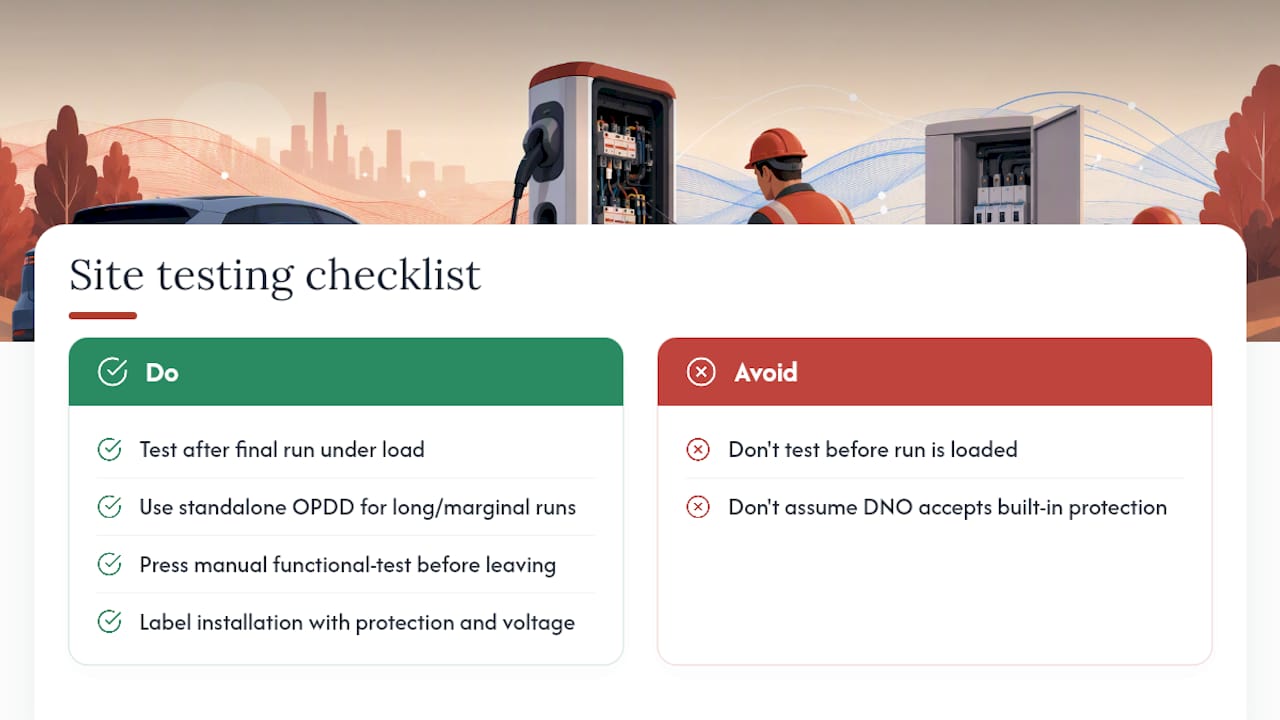
On real installations, the single biggest cause of callbacks is testing voltage too early, before the final cable run is actually connected and loaded. Test after the run is complete and under realistic load, and you’ll catch voltage-drop issues before they cause nuisance trips months later. Where the run is long or the supply is marginal, we default to a standalone OPDD rather than relying on the charger’s built-in protection, partly because some DNOs simply won’t accept the alternative. Always run the manual functional test button before leaving site, and label the installation clearly so anyone checking it later knows exactly what protection is fitted and its permitted voltage range.
Why the industry’s current approach still falls short
The conventional advice treats PEN protection as a box-ticking exercise: fit a device, get the certificate, move on. That misses the point entirely. A device that trips constantly on voltage drop gets bypassed or ignored by frustrated homeowners, which defeats the entire purpose of fitting it in the first place. The regulation solves the legal problem; it doesn’t automatically solve the practical one.
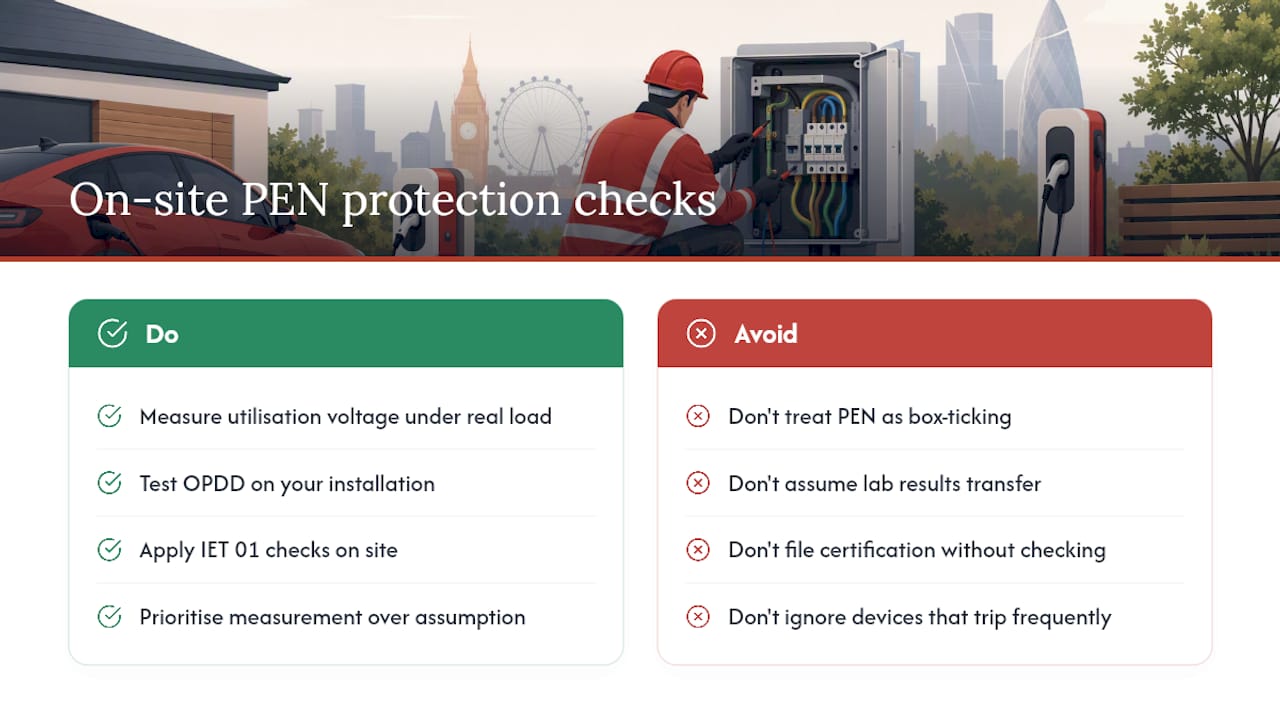
What the evidence actually supports is prioritising measurement over assumption. Don’t assume a built-in OPDD will behave the same on your installation as it did on the manufacturer’s test bench, because your cable run, your soil conditions, and your local network aren’t theirs. Measure the real utilisation voltage at the chargepoint, under real load, before deciding which type of device belongs on that job.
IET 01 is a genuine step forward because it finally gives installers a consistent standard to check devices against, rather than trusting marketing claims. But a specification only protects anyone if it gets checked and applied on site, not filed away with the paperwork. That’s the gap between what the regulation promises and what actually keeps someone safe when a PEN conductor fails at two in the morning.
— Simon
Get a compliant EV charger installation from Smart Home Technical Ltd
We install EV chargers with voltage measurement, device selection, and paperwork built into every job, not bolted on afterwards.

Where other installers fit whatever charger is in stock and hope the built-in protection copes, a proper site survey is run first: utilisation voltage checked at the actual chargepoint, cable run assessed for voltage drop, and the right OPDD, built-in or standalone, chosen to match what is found rather than guessed at. Every commissioning record, including the functional test result, is kept on file so any DNO application isn’t held up by missing evidence. If you’re planning an EV charger installation and want it done right first time, get in touch for a site survey and quote.
Sources
For the technical detail behind this guide, consult IET 01:2024 directly, alongside BS 7671:2018+A2:2022+A3:2024 clause 722.411.4.1 and the Wiring Matters explainer on voltage drop.
- Open combined protective and neutral (PEN) conductor detection devices (OPDDS), IET 01
- PEN protection in EV charging: Requirements explained and myths dispelled
- The requirements for PEN protection in EV charging applications
