
Yes, in most cases you need a CT clamp if you want your EV charger to manage household load safely or prioritise solar power. A CT clamp measures the current flowing through your incoming electricity supply in real time, feeding that data to the charger so it can throttle output before you trip a fuse or overload your supply. Without one, you either accept a fixed, conservative charge rate or risk overloading your consumer unit during peak demand.
TL;DR:
- Installing a CT clamp allows a charger to dynamically adjust its rate based on household demand, preventing overloads and unnecessary fuse upgrades.
- Proper placement, sizing, and compatibility with your supply type are critical to ensure accurate readings and safe operation.
- For homes with solar PV, a CT clamp is essential for prioritizing solar energy over grid power and avoiding excessive draw during peak generation.
- Most UK homes with a 100A supply and a 7kW charger typically require only a single clamp; higher loads or three-phase systems need additional or different clamps.
- Choosing a quality, correctly rated clamp that fits your cable diameter and connector type reduces risks of misreading, nuisance tripping, or incompatibility.
Table of Contents
- What a CT clamp is and what it does for your EV charger
- Do you need one in the UK? Standards, safety and when it becomes necessary
- How CT clamps work with EV chargers in practice
- Installation essentials: placement, sizing and supply type
- What to check before you buy or install a CT clamp
- Smart Home Technical Ltd’s perspective: how we approach CT clamp installs
- Why the “just get a bigger fuse” advice misses the point
- Get your CT clamp fitted properly
- Sources
What a CT clamp is and what it does for your EV charger
A CT clamp (current transformer clamp) is a small sensor that clips around a cable rather than being wired into the circuit. It sits around your incoming supply cable, usually inside or near your consumer unit, and reads how much current is flowing without any physical connection to the conductor itself. That reading gets sent back to the charger, usually via a low voltage signal wire, so the charger’s software knows exactly how much headroom it has to work with.
The CT clamp is what lets the charger dynamically adjust its output based on what else is drawing power in the house, rather than guessing.
In practice, this delivers two things homeowners actually care about:
- Load management: if you put the kettle on, run the oven, and start charging the car at the same time, the charger reduces its draw automatically instead of tripping the main fuse.
- Solar-priority charging: on a sunny day, the clamp detects surplus generation feeding back to the grid and the charger ramps up to soak up that free power instead of pulling from the grid.
Do you need one in the UK? Standards, safety and when it becomes necessary
There is no single UK law stating “every EV charger must have a CT clamp fitted.” But once you look at how installations are actually specified under current wiring practice, the answer stops being optional in most real-world setups.
Fitting a CT clamp can avoid a costly supply upgrade in many UK homes, because it enables dynamic load limiting instead of forcing you to increase your main fuse rating. That’s the practical trade-off installers weigh on almost every job.
Dynamic load management is expected under standard electrical practice wherever a charger could push a property’s demand past its supply capacity, and a CT clamp is the primary tool used to implement it. If you’ve got a 100A domestic supply and a 7kW charger, an electrician assessing the installation against IET wiring regulations will typically look at your main fuse size, whether you have solar PV, and whether you’re installing more than one charger, before deciding whether a clamp is the safer route or a genuine requirement.
For solar-equipped homes, a clamp is close to unavoidable if you want the charger to actually prioritise your own generation rather than blindly pulling from the grid.
How CT clamps work with EV chargers in practice
The control loop is simple once you see it laid out:
- The clamp continuously measures total current at the incoming supply.
- That data streams to the charger’s control unit, often several times a second.
- The charger compares it against your fuse rating or export limit.
- It adjusts charging current up or down in real time, no manual intervention needed.
So if the kettle, the oven, and the tumble dryer all run while the car is on charge, the charger quietly drops its rate rather than letting your main fuse take the strain. Flip the scenario: on a bright afternoon with panels exporting to the grid, the same clamp spots that surplus and nudges the charger to draw more, effectively giving you free miles instead of feeding the grid at a lower rate.
Multi-charger households benefit too. Where two EVs share one property, the same CT input can support dynamic load sharing between chargers, splitting available capacity between them rather than either one hogging the full allowance.
Pro Tip: If you’re pairing an EV charger with solar, ask your installer to show you the live current reading on the app during a test charge. It takes two minutes and confirms the clamp is actually seeing the right data before they leave site.

Installation essentials: placement, sizing and supply type
Getting the clamp in the wrong spot is one of the most common reasons a system behaves erratically after fitting. Correct placement around the incoming live conductor, before any outgoing spurs split off, is what gives an accurate reading of total household demand rather than a partial one that misses circuits downstream.
Key things an installer checks before fitting:
- Supply type: single-phase domestic supplies (the vast majority of UK homes) behave differently to three-phase, which needs additional clamps, one per phase.
- Current rating: most domestic UK supplies run at 100A, so the clamp needs a rating that comfortably covers that without being oversized to the point of losing accuracy.
- Jaw or window size: the clamp has to physically fit around your existing cable diameter. Too small and it won’t close; too large and readings drift.
- Connector type and lead length: some chargers use proprietary connectors that only accept their own branded clamp, others accept generic clamps with standard terminals.
None of this is a DIY job. Getting it wrong risks inaccurate readings, nuisance tripping, or a charger that simply won’t recognise the clamp at all. A qualified electrician tests the reading against a known load before signing off, which is the only reliable way to confirm the setup works as intended.
What to check before you buy or install a CT clamp
Before committing to a purchase or briefing an installer, run through this checklist:
- Supply type: confirm single-phase or three-phase, since this changes how many clamps you need.
- Jaw diameter: measure your existing supply cable so the clamp physically fits.
- Current rating: match it to your main fuse, typically 100A for UK domestic properties.
- Connector type: check whether it’s proprietary to your charger brand or a generic fit.
- Lead length: make sure it reaches from the supply position to the charger without strain.
- In-box or separate purchase: some chargers include a clamp as standard, others require you to buy one separately, so check the spec sheet before ordering hardware you don’t need.
- Warranty and support: confirm the clamp is covered under the same warranty as the charger, not sold as an unsupported third-party accessory.
Charger-specific clamps and generic clamps are not always interchangeable. Vendor guidance is clear that fit and connector compatibility matter as much as the current rating itself, so a clamp that works perfectly with one brand may simply not talk to another.
A CT clamp typically costs a fraction of what a distribution network operator supply upgrade runs to, which is why most installers reach for one before recommending you increase your fuse rating.
Smart Home Technical Ltd’s perspective: how we approach CT clamp installs
When we’re fitting an EV charger alongside solar PV, or into a property with an existing charger already drawing on the supply, checking whether a CT clamp is needed isn’t an afterthought. We start with the consumer unit layout, measure the incoming cable, confirm the main fuse rating, and check whether the property exports solar. That sequence tells us whether load management is a nice-to-have or effectively mandatory for the install to work safely.
Where a home has solar PV and an EV charger, we default to fitting a clamp as standard practice, because leaving solar-priority charging disabled defeats half the point of pairing the two systems. It’s a small part of the job that prevents a much bigger headache down the line.
— Simon
Why the “just get a bigger fuse” advice misses the point
Most guidance online treats a CT clamp as an optional extra, something you bolt on if you fancy the solar-charging feature. That framing gets the priority backwards. The real question isn’t whether you want smart features. It’s whether your existing supply can safely handle an EV charger at full output alongside everything else running in the house.
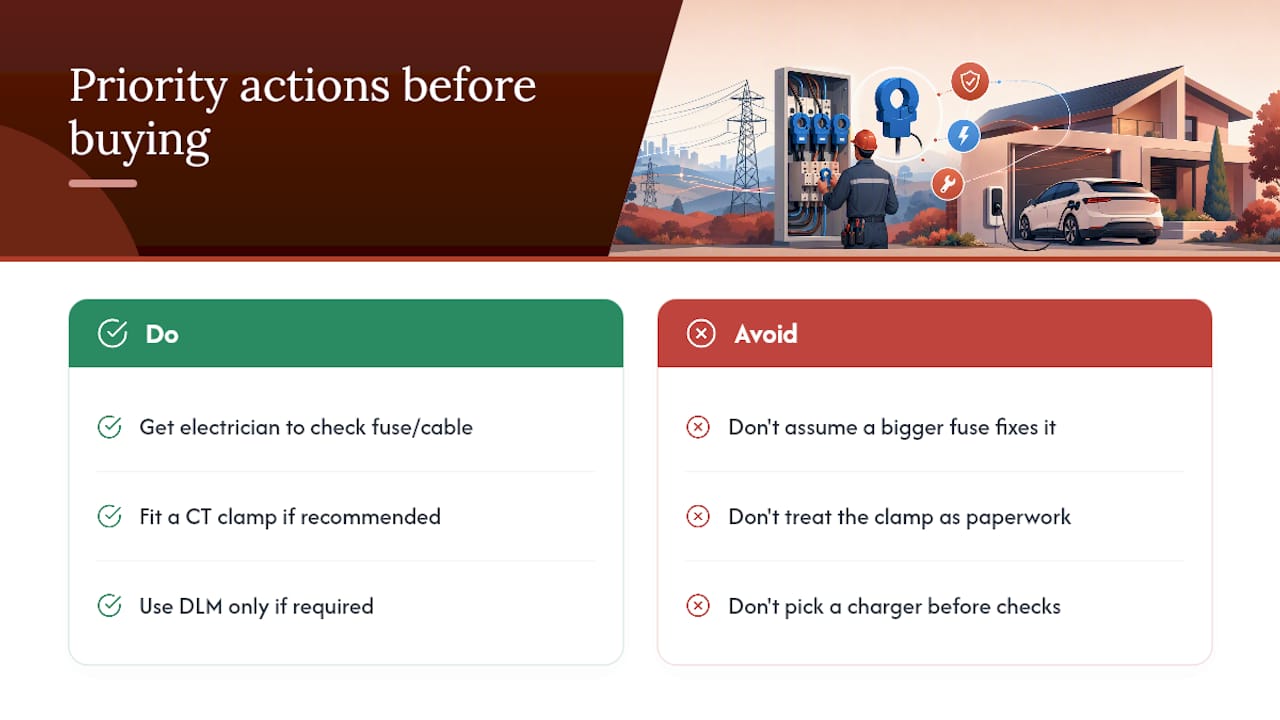
Conventional advice underplays how often a clamp is the cheaper, faster fix compared with a distribution network operator upgrade, which can take weeks to arrange and cost considerably more than the sensor itself. Homeowners fixate on charger brand and speed, and treat the clamp as paperwork.
What actually deserves priority is getting an electrician to check your main fuse rating and cable capacity before you even pick a charger model. That single step determines whether you need dynamic load management at all, and whether the charger you’re eyeing up will even support the clamp your installer recommends.
Get your CT clamp fitted properly
Smarthometechnical is the practical route for readers who’ve read this far and just want the job done correctly rather than piecing it together themselves. We install and test CT clamps as standard on EV charger installations, checking cable diameter, supply rating, and solar export before anything gets fitted, so you’re not left with a charger that ignores your solar panels or trips your main fuse on a busy evening.

If you’re pairing a charger with an existing or planned solar installation, we’ll assess whether solar-priority charging is realistic for your setup and fit the right clamp for your supply type, not a generic one that happens to be in stock. Get in touch for a site assessment and a fixed quote before you commit to any hardware.
Sources
- Load management and CT clamp (Squote)
- CT clamp placement with EV chargers — solar guide — STS
- EV Charger CT Clamps | Solar & Load Management | Electric Point
- What is a CT Clamp and Does My Charger Need One? (Joosup)
