
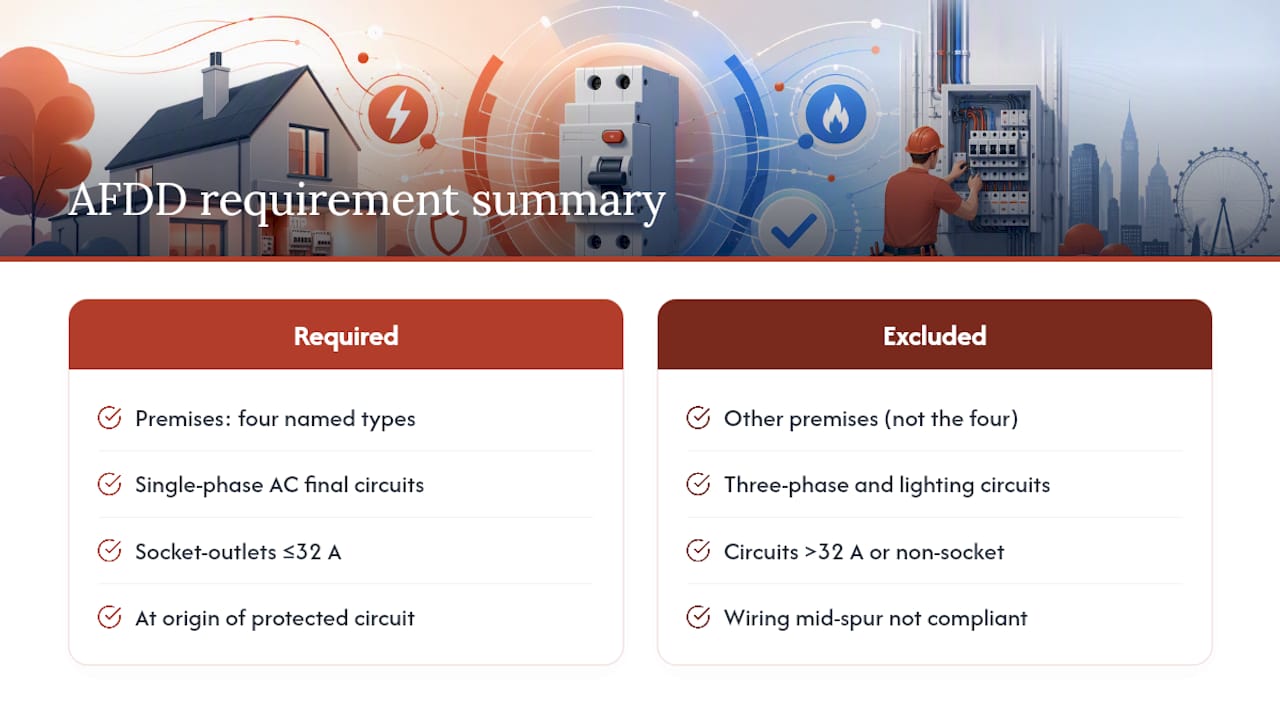
Yes, AFDDs are now mandatory in the UK, but only in specific circumstances. Under BS 7671 Regulation 421.1.7, updated by Amendment 4 (A4:2026), arc fault detection devices conforming to BS EN 62606 must be fitted on single-phase socket circuits rated up to 32 A source source in higher-risk residential buildings, HMOs, purpose-built student accommodation, and care homes. Everywhere else, they’re recommended rather than required. If you’re quoting a job in one of those four premises types, factor an AFDD into the consumer unit design now, not after the EICR flags it.
TL;DR:
- AFDDs are mandatory in the UK for single-phase socket circuits up to 32 A only in higher-risk residential buildings, HMOs, purpose-built student accommodations, and care homes.
- They must be installed at the protected circuit’s origin, with device types and placement strictly following manufacturer declarations and regulations.
- Outside the specified premises, AFDDs are recommended but not required, with exemptions for medical locations and EV charging circuits.
- Retrofit AFDDs are bulky and may require consumer unit replacements or partial rewiring, with costs mainly driven by installation labor rather than the devices themselves.
- On-site testing involves manual function checks, self-test indicators, and recording compliance in the EICR, with annual testing recommended for ongoing safety.
Table of Contents
- What the AFDD requirements actually say under BS 7671
- Where AFDDs are mandatory, recommended, or banned
- Fitting the device: placement, types and coordination
- EICR item 4.23 and how to test AFDDs on site
- What retrofit AFDD installs actually cost to plan for
- The on-site checklist for a compliant AFDD install
- A contractor’s view on quoting AFDD work
- Get an AFDD survey and compliant consumer unit upgrade
- Sources
What the AFDD requirements actually say under BS 7671
Regulation 421.1.7 didn’t invent AFDDs, but A4:2026 changed their status from a soft recommendation to a hard requirement in defined settings. The wording shifted to “shall be provided” for the four named premises types, closing a loophole that let designers treat AFDDs as optional everywhere. Scope is tightly drawn: single-phase AC final circuits supplying socket-outlets with a rated current not exceeding 32 A source. Three-phase circuits, lighting circuits, and higher-rated distribution circuits fall outside it entirely.
Placement matters as much as scope. Regulation 532.6 requires AFDDs to sit at the origin of the protected circuit, so you can’t bury one halfway down a spur and call it compliant. The device itself must carry BS EN 62606 conformity marking. Where the regs say “recommended” rather than “shall”, that’s not a free pass. Hager’s guidance notes that professional suitability still applies, and a designer who ignores a clear fire risk indicator without recording the decision leaves themselves exposed if something goes wrong later.
Where AFDDs are mandatory, recommended, or banned
Four premises types trigger the mandatory requirement outright:
- Higher-risk residential buildings (HRRBs), generally buildings 18 metres or seven storeys and above with two or more residential units.
- Houses in multiple occupation (HMOs).
- Purpose-built student accommodation.
- Care homes.
Outside those categories, AFDDs are recommended wherever there’s sleeping accommodation or combustible construction, such as timber-frame houses, thatched roofs, or converted barns. BEAMA’s guidance treats this as good practice rather than a paperwork exercise.
Two exemptions matter on site. Medical locations in groups 0 to 2 are excluded, since AFDD nuisance tripping risk outweighs the benefit where continuity of supply is critical. EV charging circuits conforming to BS EN 61851 are also exempt, so fitting a dedicated charger circuit doesn’t automatically pull an AFDD requirement into the job. Missing a mandatory AFDD typically gets coded C2 on an EICR; skipping a recommended one in a lower-risk property is more likely a C3, but insurers may still ask questions.
Fitting the device: placement, types and coordination
The origin rule is straightforward for a standard consumer unit: the AFDD sits as the first device on the protected circuit, immediately after the main switch or RCD. Busbar and powertrack systems complicate this slightly, since some designs allow AFDD modules further along the run where the manufacturer has tested and declared that configuration safe.
You’ll encounter three device architectures on the market. Integrated AFDD+MCB or AFDD+RCBO combination units are the tidiest option, giving arc fault, overcurrent, and (with the RCBO variant) earth fault protection in one module. Standalone AFDDs paired with a separately declared protective device are more common in retrofits where space allows a second module. Add-on AFDD blocks that clip onto an existing MCB exist too, but only work with the specific device the manufacturer has tested them against.
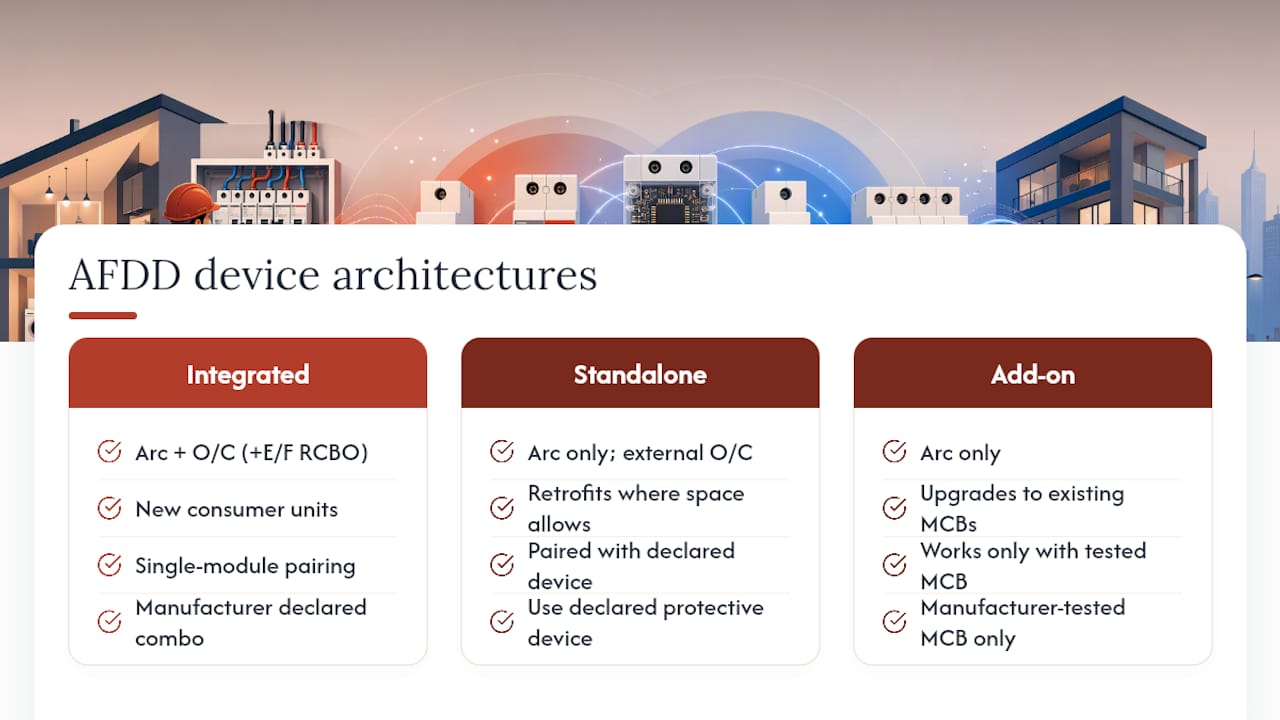
That last point is the one installers get wrong most often: coordination isn’t optional. Every AFDD has a declared protective device it’s tested to work alongside for short-circuit protection, and mixing brands or models without checking that declaration voids the safety case. Multi-pole installations need the same scrutiny. Always follow the manufacturer’s commissioning sequence, and label the consumer unit clearly so the next electrician on site knows exactly what’s fitted and why.
EICR item 4.23 and how to test AFDDs on site
The EICR inspection schedule now includes item 4.23, which specifically records whether AFDDs are fitted and operational where required. An installation missing a mandatory AFDD gets flagged here, typically as a C2, which is a “potentially dangerous” code that most landlords and letting agents will want resolved quickly.
Confirming operation on site involves two checks. Most AFDDs have a manual test button that simulates an arc signature and should trip the device; use it during commissioning and note the result. Many modern devices also run an automatic self-test at set intervals, with an LED indicator showing status. Read the manufacturer’s manual for what each indicator state actually means before signing off item 4.23 as satisfactory.
- Manual test: press the button, confirm the device trips, then reset.
- Self-test: check the indicator matches the manufacturer’s “normal operation” state.
- Insulation resistance testing: some AFDDs are sensitive to test voltages, so disconnect the device first if the manufacturer recommends it.
Annual manual testing at each periodic inspection is sensible practice, with results logged against the circuit reference so there’s a clear maintenance trail if a claim or dispute arises later.
What retrofit AFDD installs actually cost to plan for
AFDDs are physically bulkier than a standard single-module MCB, often needing two or three module widths, and that catches a lot of retrofit jobs out. A consumer unit installed even five years ago may simply have no spare busbar space to accommodate one, let alone several across multiple circuits.
On site, you’ll usually end up presenting one of these options to the client:
- A secondary enclosure fitted alongside the existing consumer unit to house the AFDDs.
- Partial rewiring to consolidate circuits and free up module space.
- Full consumer unit replacement, which is often the tidiest long-term fix in HMOs and care homes.
Pro Tip: Quote a phased approach where budget is tight: protect the highest-risk circuits (bedrooms, communal areas) with AFDDs first, and schedule the rest for the next planned electrical upgrade rather than trying to force everything into one visit.
Cost is driven mainly by consumer unit replacement labour and module count, not the AFDD units themselves. Always raise insurance implications with clients in thatched, timber-frame, or older solid-wall properties, since some insurers now ask directly whether AFDD protection is fitted.
The on-site checklist for a compliant AFDD install
- Survey: confirm premises type, circuit ratings, origin location, consumer unit spare capacity, busbar type, and check for medical location or EV charging exemptions.
- Select the device: choose integrated, standalone, or add-on AFDD based on space and the declared protective device pairing.
- Install at origin: fit per Regulation 532.6, label the circuit, and record the model and serial number.
- Test and commission: run the manual test button check, verify the self-test indicator, and complete EICR item 4.23.
- Handover: explain the test button to the client and leave a written summary with the consumer unit.
A contractor’s view on quoting AFDD work
We build AFDD checks into every consumer unit upgrade quote now, and increasingly into solar and battery installs too, since those jobs often mean opening the consumer unit anyway. The usual surprise on site is space: a client expects a simple swap, then discovers the existing board can’t take the module width needed. That changes the scope and the price, so we say so before starting, not halfway through. Writing down whether an AFDD was mandatory or simply recommended, and what the client decided, protects everyone if the EICR gets challenged later.
— Simon
Get an AFDD survey and compliant consumer unit upgrade
Smarthometechnical is the practical alternative to guessing at consumer unit compatibility yourself. We survey the board, tell you honestly whether your property falls into a mandatory AFDD category or just a recommended one, and quote a fixed price before any work starts.

That’s particularly relevant if you’re already planning solar or battery storage work, since opening the consumer unit for one job is the sensible moment to sort AFDD compliance at the same time rather than paying for two separate visits. We serve homeowners, landlords, and property managers across Dorset, Hampshire, and Devon, and we’ve handled everything from straightforward EICR follow-ups to full board replacements in HMOs and care homes. If you’re weighing up an EV charger install alongside AFDD work, we’ll confirm the exemption applies to your circuit and won’t charge you for protection you don’t need. Book a survey and we’ll give you a written recommendation and quote before anything is fitted.
Sources
For the regulation text itself, go to The IET’s AFDD guidance. For A4:2026 detail and EICR item 4.23, see Elec-Mate’s explainer. For fire-safety context in higher-risk buildings, see Approved Document B.
