
Test emergency lighting monthly with a brief functional check run by trained site staff, then commission an annual full-duration discharge test through a competent contractor. Monthly checks use the luminaire’s test facility or a fish key; the annual test typically runs for the fitting’s rated duration, often three hours. Keep every result in a permanent logbook. That record is what an inspector will ask for first.
TL;DR:
- Monthly functional checks must be logged with specific details to provide verifiable evidence during inspections; verbal assurances are insufficient.
- Annual full-duration discharge tests should be scheduled across different zones throughout the year to avoid leaving the building without backup lighting.
- Photometric verification, measuring actual lux levels, is recommended at least every five years, especially after refurbishment or lamp replacements.
- Competent testing should be performed by certified contractors, who must provide commissioning records, detailed logs, and clear maintenance schedules upon handover.
- Common site issues include battery degradation, moisture ingress, loose connections, and luminaires left switched off, which can compromise emergency lighting reliability.
Table of Contents
- What UK standards and laws govern emergency lighting testing?
- How do you run the monthly functional test correctly?
- How do you carry out the annual full-duration test?
- When do you need photometric verification?
- Who counts as a competent person for emergency lighting testing?
- What should your emergency lighting logbook contain?
- What does a practical testing checklist look like?
- What actually goes wrong on real sites?
- How should facility teams actually approach this?
- How Smart Home Technical can help with your testing programme
- Sources
What UK standards and laws govern emergency lighting testing?
The legal duty sits with the Regulatory Reform (Fire Safety) Order 2005. Article 14 requires adequate emergency illumination of escape routes; article 17 requires safety systems to stay in efficient working order. Neither article tells you how often to test or what “efficient” looks like on paper.
That’s where BS 5266-1 and BS EN 50172 come in. They aren’t law themselves, but following their testing routines, monthly functional checks plus an annual full-duration test, is the recognised way to demonstrate compliance to fire authorities. The 2025 edition of BS 5266-1 aligns more closely with BS EN 50172 and BS EN 1838, tightening expectations around commissioning records and photometric checks. When an inspector reviews your site, they’re not quoting the Fire Safety Order at you. They’re comparing your logbook against what BS 5266-1 says a properly maintained system should show.
How do you run the monthly functional test correctly?
Monthly testing checks that each luminaire illuminates on demand, without ever switching off a building’s main lighting circuit in a way that could create a hazard. Use the luminaire’s own test facility or a fish key to simulate a mains failure safely.
- Trigger the test function on each luminaire or the relevant zone.
- Walk the escape route while lights are on test, checking illumination, cleanliness, and any obstruction blocking the light path.
- Check the charge indicator returns to normal once the test ends.
- Note any fitting that fails to illuminate, flickers, or shows a fault light.
- Log the date, tester’s name, luminaire or zone ID, result, and any remedial action needed.
That last step matters more than people assume. A verbal “yes, it’s fine” from a caretaker means nothing to an inspector six months later. Written entries, tied to specific fittings, are what turn a routine chore into usable evidence.
How do you carry out the annual full-duration test?
The annual test verifies something the monthly check can’t: whether the battery actually holds its rated duration under real discharge conditions. A luminaire can pass every monthly flash test and still fail after ninety minutes on load if the battery has degraded.
Duration depends on what the fire risk assessment specifies for that building, so check the commissioning certificate rather than assuming a specific duration. The process itself is straightforward but needs planning:
- Isolate the relevant circuit safely, following the building’s electrical isolation procedure.
- Let the luminaires run on battery for the full rated duration while monitoring for early failures.
- Record the actual duration achieved against the rated duration for every fitting tested.
- Restore mains power and allow a full recharge cycle, usually 24 hours, before testing that zone again.
- Rotate which zones you test through the year rather than draining the entire system on one date.
That last point is what most managers get wrong on their first annual cycle. Phasing zones across the year still satisfies the 12-month requirement, provided every luminaire gets tested within that window, and it means you’re never running a building without backup lighting anywhere.
Pro Tip: Book annual tests for periods of low occupancy, weekends or planned closures, rather than squeezing them into a normal trading day. Recharge time afterwards matters as much as the test itself, so build a day’s buffer into your schedule before that zone goes back into full service.
When do you need photometric verification?
Photometric verification measures actual lux levels reaching the floor along escape routes, using a calibrated lux meter rather than a visual check. Current guidance describes a four-interval schedule: daily indicator checks where central battery systems exist, monthly functional tests, annual duration tests, and photometric checks at intervals not exceeding five years.
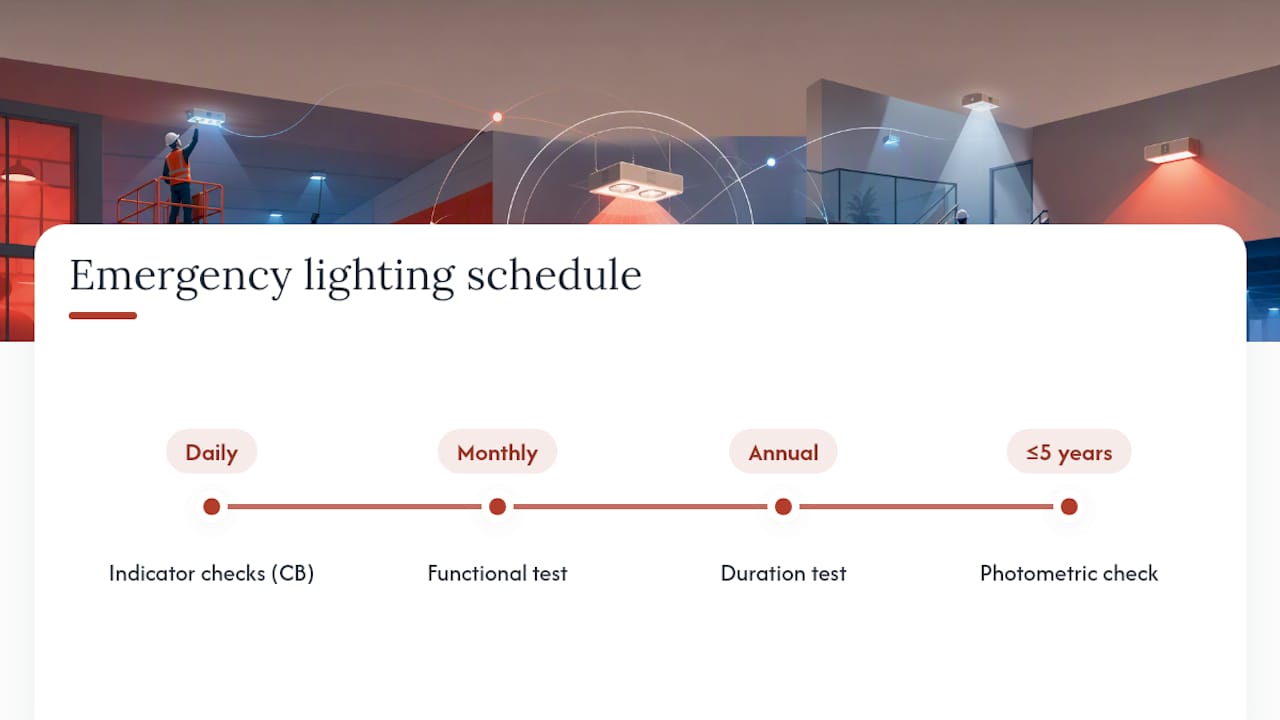
Commission photometry sooner if the system is ageing, has been through a refurbishment, or you’ve replaced several lamps individually rather than as a scheme. Results get compared against the original design targets recorded at commissioning; where levels have dropped, that’s your justification for targeted luminaire replacement rather than a guess.
Who counts as a competent person for emergency lighting testing?
Site staff can run monthly functional checks once they’ve had basic training. Annual full-duration testing is a different matter. Guidance from BAFE states this work should go to a competent person or certificated contractor, ideally one holding third-party certification such as BAFE SP203-4 or NICEIC registration.
Before booking a contractor, ask what you’ll receive at handover. A proper job includes commissioning records showing rated duration per circuit, a completed logbook ready for your team to continue, and a written maintenance schedule covering the next testing cycle. If a contractor can’t produce those documents, that’s a warning sign worth acting on before you sign anything.
What should your emergency lighting logbook contain?
A logbook is your primary evidence in an inspection, arguably more important than the systems themselves, since enforcement action often turns on whether records exist rather than whether a single fitting once failed. Minimum entries: test date, tester’s name, luminaire or zone identifier, duration achieved on annual tests, faults found, and the remedial action taken.
Keep at least five years of testing history readily accessible, and hold commissioning documents permanently, since they establish the original design baseline you’ll compare future photometric results against. A spreadsheet works fine if it’s backed up and exportable. Systems with automatic testing and cloud reporting produce a stronger paper trail, since every test is timestamped by the hardware rather than typed in after the fact.
What does a practical testing checklist look like?
Monthly functional tests typically take a short time per zone:
- Trigger the luminaire test function or fish key.
- Walk the route checking illumination and obstruction.
- Confirm charge indicators reset correctly.
- Log results immediately, including any defects.
Annually, planned around occupancy:
- Confirm rated duration from the commissioning certificate.
- Schedule zones in rotation across the year.
- Isolate safely and monitor the full discharge period.
- Record achieved duration per fitting.
- Allow full recharge before returning the zone to service.
- Book remedial repairs before the next cycle starts.
| Test type | Who performs it | Frequency | Key record |
|---|---|---|---|
| Functional check | Trained site staff | Monthly | Result, fittings checked, defects |
| Full-duration discharge | Competent contractor | Annually | Duration achieved per fitting |
| Photometric verification | Certificated engineer | At least every 5 years | Lux readings vs design target |
Booking your annual contractor visit early in the year, rather than scrambling near your renewal date, tends to get better rates and avoids the disruption of last-minute zone shutdowns.
What actually goes wrong on real sites?
Battery degradation is the most common failure Simon sees on site visits for Smart Home Technical Ltd, an electrical contractor specialising in renewable energy and building electrical systems. Batteries that pass a two-minute flash test can fail badly at the ninety-minute mark of a proper discharge test, which is exactly why the annual check exists.
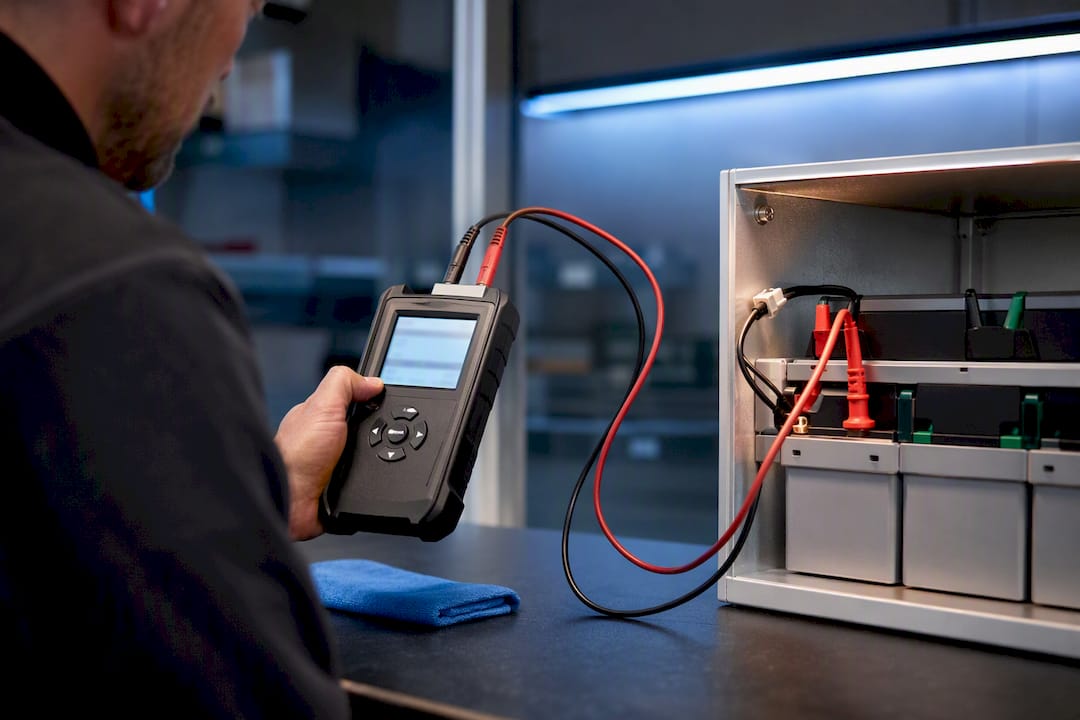
Beyond batteries, moisture ingress in older stairwell fittings, loose terminal connections from vibration, and luminaires that have been rotated or covered during redecoration all show up repeatedly. Maintained luminaires that have been left switched off at the wall are surprisingly common in refurbished buildings. For sites tired of chasing paperwork, retrofit addressable testing systems with cloud reporting cut engineer hours substantially and generate exportable logs an inspector can review in minutes rather than a filing cabinet search.
How should facility teams actually approach this?
Testing emergency lighting well is a scheduling problem before it’s a technical one. Phase your annual tests, hand training to whoever owns the monthly check, and make sure commissioning paperwork survives the handover from contractor to site team.
Clients consistently tell us the same thing matters most: less disruption during testing, and a logbook they can hand an inspector without panic.
— Simon
How Smart Home Technical can help with your testing programme
Sorting emergency lighting compliance yourself is doable, but it eats hours you probably don’t have, and a missed annual cycle is the kind of gap that only surfaces during an inspection. Smart Home Technical handles the whole cycle: a site survey to map every luminaire and zone, phased annual testing that keeps disruption to a minimum, photometric verification where systems are ageing, and automatic monitoring for sites that want to stop tracking paperwork manually.
Every job ends with a written maintenance schedule, commissioning certificates, and a clear price estimate before any work starts, no surprises on invoicing. If your emergency lighting sits alongside other electrical work, our solar installation and electrical services team can scope both in one visit. Get in touch to arrange a site survey and a service contract that keeps your testing calendar sorted for the year ahead.
