
Solar optimisers are module-level power electronics devices that independently maximise the energy output of each solar panel in a system. Where a standard string inverter treats all panels as one unit, an optimiser tracks and adjusts the maximum power point of each panel separately. This distinction matters enormously for UK homes, where roof angles, chimney shadows, and dormer windows routinely create uneven shading across a solar array. Understanding the role of solar optimisers helps homeowners and property developers make better decisions about system design, cost, and long-term performance.
How do solar optimisers work to improve solar panel performance?
Solar optimisers use a process called Maximum Power Point Tracking, or MPPT, at the individual panel level. Every panel has a point at which it produces the most power given its current temperature and light conditions. That point shifts constantly throughout the day as clouds pass, shadows move, and temperatures change. An optimiser monitors voltage and current at each panel continuously and adjusts its output to keep the panel operating at peak efficiency.
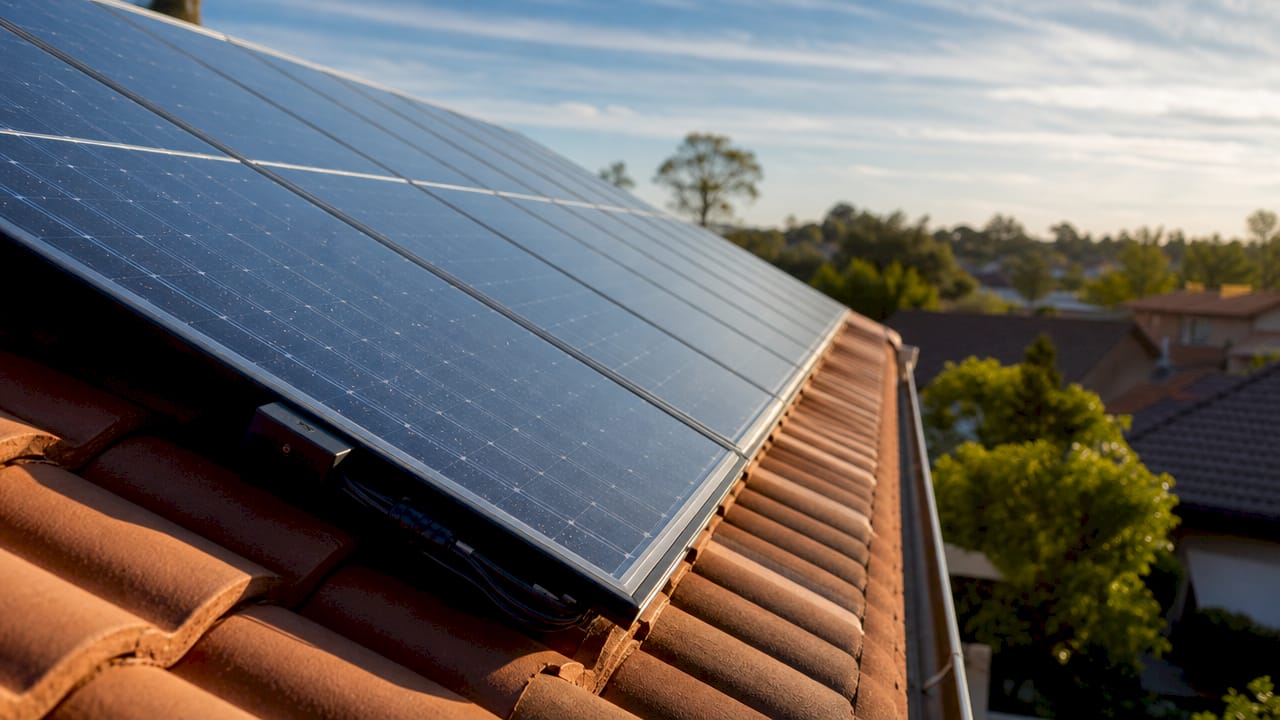
Without optimisers, a string inverter averages the performance of all panels in a series circuit. One shaded panel pulls down the output of every other panel connected to it, much like a blocked lane slowing an entire motorway. Optimisers break this dependency. Each panel sends a conditioned DC output to the string inverter independently, so a shaded panel on the north-facing section of a roof no longer penalises the south-facing panels performing well.
Real-time adaptation is a key part of how this technology works. As environmental conditions shift, the optimiser recalculates the ideal operating point within milliseconds. This continuous adjustment is what produces measurable energy gains over a full year, particularly on roofs with complex layouts or partial shading from trees and neighbouring buildings.
Pro Tip: If your roof has panels on more than one pitch or faces more than one direction, MPPT at the panel level is not a luxury. It is the difference between a system that performs as designed and one that consistently underdelivers.
What are the key benefits and limitations of solar optimisers?
Energy production gains
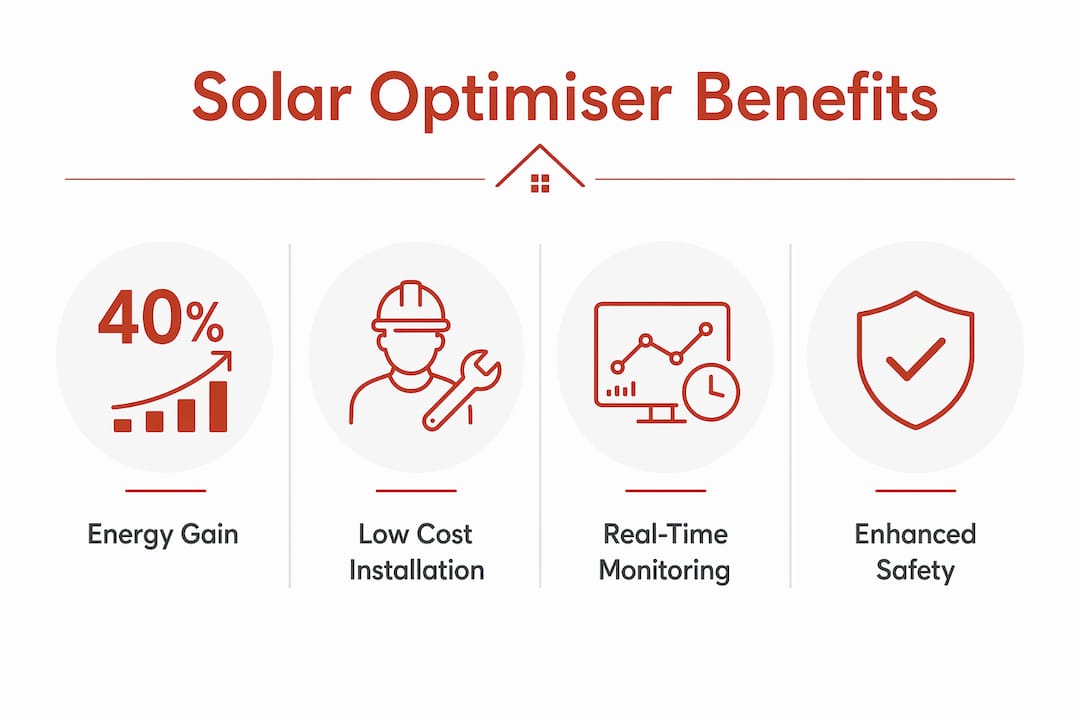
Solar optimisers can increase energy production by 10% to 40% compared to traditional string inverters in installations affected by shading, mismatch, or complex roof layouts. Recovery rates typically reach 10–15% for mixed orientations, up to 18% for moderate shading, and 25–40% in severe mismatch cases. Those figures represent real money over a 25-year system lifespan, particularly for homeowners with roofs that are not perfectly oriented south at a 35-degree pitch.
Panel-level monitoring
Panel-level monitoring allows early detection of faults, reducing maintenance costs and downtime compared to standard string inverter systems. When a panel underperforms due to a faulty cell, soiling, or a developing junction box issue, the monitoring platform flags it immediately. A string inverter system, by contrast, shows only total system output, making it difficult to identify which panel is causing a drop.
Safety compliance
Optimisers satisfy rapid shutdown safety standards including NEC 690.12 automatically, removing the need for separate rapid shutdown devices. They reduce DC voltage to safe levels within 30 seconds of shutdown initiation. This matters for fire safety: emergency responders can de-energise a rooftop array quickly without risk of electrocution from live DC conductors.
Limitations to consider
- Optimisers do not help with uniform shading such as persistent cloud cover, because their benefit comes from independently managing panels with different irradiance levels.
- The central string inverter remains a single point of failure. If it fails, the entire system stops generating power regardless of panel health.
- Adding optimisers costs approximately £30–£50 per panel, or £300–£500 for a standard 10-panel system, representing a 30–50% premium over basic string inverter setups.
Pro Tip: Ask your installer to show you the monitoring dashboard before committing. A system that gives you panel-by-panel data is far easier to maintain and far quicker to diagnose when something goes wrong.
When do solar optimisers provide the most value?
Optimisers deliver the greatest return in specific site conditions. The table below shows where they earn their cost premium and where they add little value.
| Roof condition | Optimiser benefit |
|---|---|
| Partial shading from trees or chimneys | High. Prevents shaded panels dragging down the string. |
| Multiple roof pitches or orientations | High. Each panel operates at its own peak independently. |
| Complex layout with dormers or skylights | High. Avoids mismatch losses from irregular panel placement. |
| Single south-facing pitch, no shading | Low. String inverter performs comparably at lower cost. |
| Uniform cloud cover across all panels | None. All panels are affected equally; MPPT gain is negligible. |
UK residential roofs frequently fall into the high-benefit categories. Victorian and Edwardian terraces often have chimney stacks that cast moving shadows across panels throughout the day. New-build developments with L-shaped or hipped roofs commonly require panels on two or three faces. In both cases, solar optimisation technology pays for itself through recovered energy that a string-only system would lose.
Power optimisers serve as a middle-ground technology balancing the cost efficiency of string inverters with the performance gains of microinverters. They are not the right choice for every installation, but for moderate shading and mixed roof orientations, they consistently outperform the alternatives on a cost-per-unit-of-energy basis.
How do solar optimisers enhance system safety?
Safety is one of the most underappreciated aspects of solar optimiser technology. Most homeowners focus on energy yield, but the safety architecture optimisers provide is equally significant.
“Solar optimisers reduce DC conductor voltage to safe levels within 30 seconds of shutdown initiation, meeting NEC 690.12 rapid shutdown requirements and protecting emergency responders from live rooftop conductors.”
The key safety functions optimisers provide include:
- Rapid shutdown compliance. Optimisers act as compliant rapid shutdown devices, removing the need for additional RSD hardware and reducing installation complexity.
- Hotspot prevention. Optimisers improve system safety by preventing hotspots and arc faults, reducing fire risk from overheated cells.
- Reduced standby voltage. DC conductors carry significantly lower voltage when the system is not actively generating, reducing the risk to maintenance personnel working on the roof.
- Isolation of underperforming panels. A panel developing a fault does not force excessive current through adjacent panels, limiting the risk of cascading damage.
For property developers, these safety features also carry planning and insurance implications. A system that meets recognised safety standards from day one is easier to certify, insure, and hand over to occupants. You can read more about solar safety compliance in modern PV installations to understand how these standards apply across different system types.
What should homeowners consider before installing solar optimisers?
Compatibility with your inverter
Compatibility between solar optimisers and string inverters is critical. Many optimisers are brand-locked to proprietary communication protocols that handle monitoring and safety functions. Pairing an optimiser from one manufacturer with an incompatible inverter from another can degrade or entirely disable the monitoring and rapid shutdown features. Always confirm compatibility before purchasing components separately.
Installation and cost considerations
- Optimiser installation adds a small amount of labour time per panel compared to a standard string system, as each device must be mounted and wired at the panel.
- The cost premium of £300–£500 for a 10-panel system is typically recovered through energy gains within a few years on a shaded or multi-orientation roof.
- Warranty periods vary by manufacturer. Check that both the optimiser and the inverter carry warranties that align with your expected system lifespan.
Monitoring and ongoing management
The monitoring platforms that accompany optimiser systems give homeowners a clear view of individual panel performance. This data is genuinely useful. A panel producing 60% of its expected output on a clear day signals a problem worth investigating before it worsens. Smarthometechnical recommends reviewing panel-level data at least once per quarter to catch developing faults early. For guidance on identifying system issues, the solar fault finding guide covers the most common causes of underperformance in residential installations.
Common pitfalls
- Expecting optimisers to compensate for a poorly designed system. They improve what is there; they cannot fix fundamental layout errors.
- Overlooking the central inverter as a risk. Unlike microinverter systems, a failed string inverter shuts down the entire array regardless of optimiser health.
- Choosing optimisers based on price alone without verifying inverter compatibility.
Pro Tip: Get your installer to run a shading analysis using satellite data before specifying your system. The results often reveal shading losses that make the case for optimisers far more clearly than any general rule of thumb.
Key takeaways
Solar optimisers deliver the greatest value on roofs with partial shading, multiple orientations, or complex layouts, where panel-level MPPT prevents one underperforming panel from reducing the output of the entire string.
| Point | Details |
|---|---|
| Panel-level MPPT | Each panel operates at its own peak, preventing shaded panels from dragging down the string. |
| Energy gains of 10–40% | Gains depend on shading severity; severe mismatch cases benefit most from optimisers. |
| Rapid shutdown compliance | Optimisers meet NEC 690.12 standards, reducing DC voltage to safe levels within 30 seconds. |
| Inverter compatibility is critical | Optimisers are often brand-locked; mismatched pairing disables monitoring and safety features. |
| Limited benefit on uniform shading | Persistent cloud cover affects all panels equally, so optimisers provide no advantage in that scenario. |
Simon’s view on solar optimisers for UK homes
The conversation around solar optimisers often gets stuck on cost. Homeowners see the £300–£500 premium and ask whether it is worth it. My honest answer is: it depends entirely on your roof, and most people underestimate how much their roof works against them.
I have seen systems on Victorian terraces in Hampshire where chimney shadows were cutting output by a third for three hours a day. Adding optimisers to those installations recovered energy that the homeowners had simply accepted as lost. The payback on the optimiser premium in those cases was faster than the payback on the panels themselves.
Where I think the industry gets it wrong is in treating optimisers as a default upgrade for every system. On a clean, south-facing roof with no shading, a well-specified string inverter does the job at lower cost. The decision should always start with a shading analysis, not a product preference.
The monitoring capability is the feature I find most undervalued. Homeowners who check their panel-level data regularly catch faults early, before a degraded panel quietly costs them months of lost generation. That proactive approach to solar self-consumption and system care is what separates a well-run solar installation from one that quietly underperforms for years.
— Simon
Professional solar installation from Smarthometechnical
Smarthometechnical designs and installs solar panel systems across southern England, with every installation tailored to the specific shading profile and roof layout of your property.
Where optimisers add genuine value, Smarthometechnical specifies them as part of the system design from the outset, not as an afterthought. The team carries out shading analysis before any equipment is selected, so you know exactly what performance to expect and why. For homeowners and developers ready to get the most from their roof, professional solar installation from Smarthometechnical covers everything from initial survey through to commissioning and ongoing monitoring support. You can also explore solar retrofit options if you are looking to upgrade an existing system with optimiser technology.
FAQ
What is a solar power optimiser?
A solar power optimiser is a module-level power electronics device fitted to each solar panel. It independently tracks and adjusts the panel’s maximum power point to maximise energy output regardless of what other panels in the system are doing.
Do solar optimisers work in cloudy conditions?
Optimisers improve performance when panels experience different light levels. Uniform cloud cover affects all panels equally, so optimisers provide no measurable advantage in that scenario.
How much do solar optimisers cost in the UK?
Adding optimisers costs approximately £30–£50 per panel, or £300–£500 for a standard 10-panel system. That represents a 30–50% premium over a basic string inverter setup.
Are solar optimisers compatible with all inverters?
No. Many optimisers rely on proprietary communication protocols and must be matched with compatible inverter brands. Mismatched pairing can disable monitoring and rapid shutdown functions.
What happens if the string inverter fails on an optimised system?
The entire system stops generating power. Unlike microinverter systems where each panel operates independently, optimiser-based systems still depend on a central string inverter, which remains a single point of failure.
Recommended
- Solar in Hampshire retrofits: a homeowner’s guide – Smart Home Technical Ltd
- The role of solar in 2026 homes: a complete guide – Smart Home Technical Ltd
- Why switch to solar energy: a 2026 homeowner’s guide – Smart Home Technical Ltd
- The role of solar panels in homes and businesses – Smart Home Technical Ltd
